Vietnam Actuators and Valves Market (2026-2032) | Industry, Challenges, Outlook, Forecast, Restraints, Segments, Share, Analysis, Opportunities, Companies, Strategic Insights, Competition, Competitive, Value, Size, Demand, Growth, Revenue, Strategy, Investment Trends, Pricing Analysis, Consumer Insights, Segmentation, Trends, Supply, Drivers
Market Forecast By Valve Type (Ball, Gate, Globe, Butterfly, Check Valves), By Actuation Mechanism (Pneumatic, Electric, Hydraulic Actuation), By End-Use (Oil & Gas, Water Treatment, Chemical Processing, Power Generation), By Material (Stainless Steel, Brass, Carbon Steel, PVC) And Competitive Landscape
| Product Code: ETC10731956 | Publication Date: Apr 2025 | Updated Date: Jul 2026 | Product Type: Market Research Report | |
| Publisher: 6Wresearch | Author: Bhawna Singh | No. of Pages: 70 | No. of Figures: 35 | No. of Tables: 5 |
Vietnam Actuators and Valves Market Growth Rate
According to 6Wresearch internal databases and industry analysis, the Vietnam Actuators and Valves Market is expected to expand at a steady compound annual growth rate (CAGR) of 5.8% during the forecast period (2026-2032).
Vietnam Actuators and Valves Market Year-wise Growth Rate and Key Drivers (2022–2032)
The graph illustrates the annual growth rates of the Vietnam Actuators and Valves Market from 2022 to 2032, highlighting a steady upward trajectory and projected market expansion over the forecast period.
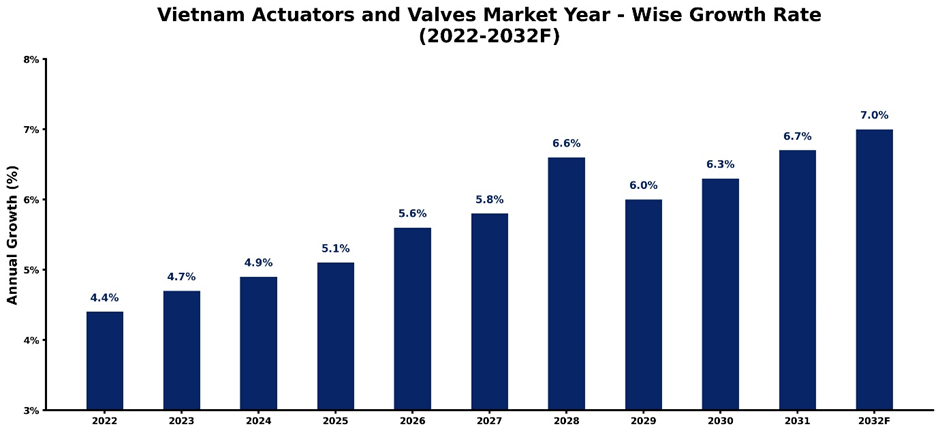 The following table summarizes historical and forecasted growth rates of the Vietnam Actuators and Valves Market, along with the rationale behind each year’s performance.
| Year | Estimated Growth (%) | Market Rationale |
| 2022 | 4.4% | Industrial activities recovered gradually, with moderate demand from manufacturing and water infrastructure projects. |
| 2023 | 4.7% | Growth improved due to rising automation adoption in processing industries and expansion of industrial zones. |
| 2024 | 4.9% | Increased investments in energy projects and wastewater treatment facilities supported valve and actuator demand. |
| 2025 | 5.1% | Market expansion continued due to smart manufacturing initiatives and replacement of aging industrial equipment. |
| 2026 | 5.6% | Growing adoption of automated control valves across chemical, power, and water treatment industries drives demand. |
| 2027 | 5.8% | Stable industrial investment and infrastructure modernization maintain market growth. |
| 2028 | 6.6% | Rising deployment of IoT-enabled industrial automation systems supports actuator upgrades. |
| 2029 | 6% | Expansion of energy infrastructure and manufacturing capacity increases requirement for advanced valve systems. |
| 2030 | 6.3% | Demand increases from process industries adopting predictive maintenance and digital control systems. |
| 2031 | 6.7% | Replacement of conventional valves with automated solutions strengthens market expansion. |
| 2032 | 7% | Long-term industrial modernization and infrastructure investments sustain market growth. |
Topics Covered in the Vietnam Actuators and Valves Market Report
The Vietnam Actuators and Valves Market Report provides a comprehensive analysis based on Valve Type, Actuation Mechanism, End-Use, and Material. It offers detailed insights into key industry trends, growth drivers, emerging opportunities, competitive developments, and high-growth segments. The report presents an objective assessment of current dynamics and future prospects, enabling stakeholders to make informed business decisions and develop effective strategies aligned with the evolving industry landscape.
Vietnam Actuators and Valves Market Highlights
| Report Name | Vietnam Actuators and Valves Market |
| Forecast period | 2026-2032 |
| CAGR | 5.8% |
| Growing Sector | Electric Actuation Systems |
Vietnam Actuators and Valves Market Synopsis
The Vietnam Actuators and Valves Market is witnessing steady growth, driven by country’s expanding industrial base, increasing investments in manufacturing facilities, and the development of energy, water, and infrastructure projects. Pneumatic actuators currently have a strong position in the processing industries, owing to their reliability, while electric actuators are gaining traction, due to the rapid adoption of digitalization and smart factories.
Evaluation of Growth Drivers in Vietnam Actuators and Valves Market (2026–2032)
Below are some major growth drivers influencing the Vietnam Actuators and Valves market:
| Drivers | Primary Segment Affected | Why It Matters (Evidence) |
| Expansion of Industrial Automation | Manufacturing Industries | Rapid adoption of automated process control systems is boosting demand for smart actuators and automated valves. |
| Development of Water and Wastewater Infrastructure | Water Treatment Sector | Government incentives in urban water management projects are surging demand for corrosion-resistant valves. |
| Growth of Energy and Power Projects | Power Generation | New thermal, renewable, and gas-based power facilities need advanced flow-control equipment. |
| Increased Chemical Processing Capacity | Chemical Industry | Chemical plants demand durable valves, that are capable of handling high-pressure and corrosive materials. |
| Foreign Direct Investment in Manufacturing | Industrial Users | Expansion of foreign manufacturing centres is growing installation of automated valve systems. |
The Vietnam Actuators and Valves Market is projected to expand at a CAGR of 5.8% during the forecast period (2026-2032), propelled by industrial automation, infrastructure development, and surging demand from manufacturing sectors. Vietnam's manufacturing sector, that accounts for almost 25% of GDP, is an increasing agreement of automated flow control solutions in sectors, such as electronics, automotive, chemical, and food processing. Industrial production is growing at about 7-9% per year, thus, creating a strong demand for advanced valves and actuators. Urbanization is also expected to surpass 45% by 2030, which will result in a growing need to support water infrastructure investments. Moreover, growth in automation spend is 8-10% annually, which is further strengthening market opportunities for smart valve technologies.
Evaluation of Restraints in Vietnam Actuators and Valves Market
Below are some major restraints and their influence on the market dynamics:
| Restraints | Primary Segment Affected | What This Means (Evidence) |
| High Installation Cost | Small and Medium Industrial Users | Advanced automated valves demand higher investment, as compared to conventional manual valves. |
| Dependency on Imported Components | Valve Manufacturers | Specialized actuators and smart control components are mostly imported, which increases supply chain reliance. |
| Maintenance and Technical Expertise Requirements | Industrial Facilities | Lack of skilled technicians’ delays servicing and reduces equipment efficiency. |
| Price Competition from Low-Cost Suppliers | Distributors | Low-priced alternatives impact adoption of premium automated solutions. |
| Slow Replacement Cycles | Existing Industrial Plants | Most facilities continue to operate old valve systems, due to long equipment lifespan. |
Vietnam Actuators and Valves Market Challenges
The Vietnam actuators and valves market growth is expected to face some major challenges due to increasing competition, dependency on imported automation components, and shortage of skilled technical professionals. Vietnam’s advanced industrial automation equipment are predominantly sourced from international suppliers at a ratio of about 60–70%, which results in higher dependency on supply chain. In many industrial facilities, traditional valve systems are replaced in cycles of more than 10–15 years, slowing the adoption of smart valve technologies. Manufacturing costs are also affected by changes in the price of stainless steel and alloys, which can fluctuate by 5–15% per year. As Vietnam’s industrial workforce continues to grow, there is still a lack of automation engineers with specialized skills.
Vietnam Actuators and Valves Market Trends
Key market trends influencing Vietnam Actuators and Valves sector are presented below:
- Increasing Adoption of Smart Valves: Industrial users are combining sensors and digital monitoring systems with valves, to improve operational visibility and predictive maintenance.
- Shift Towards Electric Actuation: Electric actuators are gaining recognition, owing to their compatibility with automated systems, lower maintenance requirements, and suitability for clean environment.
- Surge in Water Treatment Applications: Increased urbanization and environmental regulations are resulting in higher usage of butterfly and gate valves for municipal water projects.
- IoT-Connected Control Systems: Industries are now using valve systems, that can be controlled remotely, to help monitor performance in real time.
- Corrosion Resistant Materials: Chemical and marine industries are adopting stainless steel and alloys valves, due to their longevity.
Investment Opportunities in the Vietnam Actuators and Valves Market
Potential high-return investment prospects in the Vietnam Actuators and Valves Market are listed below:
- Local Manufacturing of Industrial Valves: Establishing local production facilities can decrease import dependency and improve supply chain efficiency.
- Smart Valve Technology Growth: There is huge growth opportunity from large investments in IoT actuators and automated controls systems.
- Projects in Water Infrastructure: Development in terms of wastewater treatment and clean water infrastructure, has led to massive growth opportunities for valves manufacturers.
- After-sales Services: Companies that offer after sales services, such as calibration and maintenance, get regular income opportunities.
Top 5 Leading Players in Vietnam Actuators and Valves Market
The following includes major players operating in the Vietnam Actuators and Valves market:
1. Emerson Electric Co.
| Company Name | Emerson Electric Co. |
|---|---|
| Established Year | 1890 |
| Headquarters | St. Louis, Missouri, USA |
| Official Website | Click Here |
Emerson provides advanced valve automation technologies through its industrial automation portfolio.
2. Flowserve Corporation
| Company Name | Flowserve Corporation |
|---|---|
| Established Year | 1790 |
| Headquarters | Irving, Texas, USA |
| Official Website | Click Here |
Flowserve serves Vietnam’s energy, chemical, and industrial sectors with engineered valve systems designed for high-pressure and critical applications.
3. Schneider Electric
| Company Name | Schneider Electric |
|---|---|
| Established Year | 1836 |
| Headquarters | Rueil-Malmaison, France |
| Official Website | Click Here |
Schneider Electric supplies automation and control solutions supporting industrial digitalization. Its actuator and control technologies are integrated into smart manufacturing facilities requiring efficient process management.
4. Metso Corporation
| Company Name | Metso Corporation |
|---|---|
| Established Year | 1999 |
| Headquarters | Helsinki, Finland |
| Official Website | Click Here |
Metso provides intelligent valve technologies for mining, chemical processing, energy, and industrial applications.
5. KITZ Corporation
| Company Name | KITZ Corporation |
|---|---|
| Established Year | 1951 |
| Headquarters | Chiba, Japan |
| Official Website | Click Here |
KITZ manufactures industrial valves including ball, butterfly, and control valves used across water treatment, manufacturing, and energy sectors.
Government Initiatives Being Implemented in the Vietnam Actuators and Valves Market
The Vietnamese government is promoting the modernization of industries, development of infrastructure and energy transition programs, which indirectly increases the demand for actuators and valves in many sectors. National water management programs, industrial zone expansion plans, and energy development strategies are motivating industries to introduce efficient flow-control systems.
Vietnam’s National Strategy on Environmental Protection promotes the progression of wastewater treatment and pollution control, thus generating demand for advanced valves in municipal and industrial water treatment plants. Similarly, the nation’s Power Development Plan VIII emphasizes the development of renewable energy, reinforcement of power infrastructure, and improvement of grid reliability, all of which contribute to the adoption of automated valve systems in power generation projects.
Future Insights of the Vietnam Actuators and Valves Market
The Vietnam Actuators and Valves Market is projected to experience a steady growth trajectory during the forecast period (2026-2032), due to increased adoption of industrial automation, substantial infrastructure development and rising demand for efficient resource management systems. Vietnam’s manufacturing industry accounts for almost 25% of GDP, enabling continued adoption of automated flow-control technologies. Additionally, industries are aiming for 10-20% profits in operational efficiency, through automation and intelligent valve solutions with sensors and predictive maintenance systems are making inroads.
Market Segmentation Analysis
This report presents a detailed analysis of the market segments along with their leading categories:
By Valve Type – Ball Valves Dominate
Ball valves accounted for approximately 32.5% of the Vietnam Actuators and Valves Market Share in 2025, making them the leading valve type segment. The dominance of the segment is attributed to their high durability, low leakage rate, quick shut-off capability, and suitability across oil & gas, chemical processing, water treatment, and manufacturing applications. Ball valves are being favoured in automated systems, as they can be easily integrated with pneumatic and electric actuators for a precise flow regulation. The segment is projected to grow at a CAGR of 6.1% during the forecast period (2026–2032).
By Actuation Mechanism – Pneumatic Actuation Leads Market
Pneumatic actuators dominated the industry with an estimated 46.8% of share in 2025 as they are being widely used for their quick response time, operational reliability, and suitability for hazardous industrial environments, where electrical systems might face limitations. Industries such as chemical processing, food & beverage, pharmaceuticals, and manufacturing plants extensively utilize pneumatic actuators for automated valve operations. The pneumatic actuation segment is expected to expand at a CAGR of 5.5% during the forecast period (2026-2032).
By End-Use – Water Treatment Sector Holds Leading Market Position
According to Bhawna Singh, Senior Research Analyst, 6Wresearch, Water Treatment accounted for approximately 29.4% of Vietnam actuators and valves market share in 2025, representing the largest application segment. Rapid urbanization, increased industrial wastewater generation, and government emphasis on improving water infrastructure results in heavy investments in municipal and industrial wastewater treatment plants. The Water Treatment segment is estimated to rise at a CAGR of 6.4% during the forecast period (2026–2032), owing to infrastructure modernization projects, environmental regulations, and surging private-sector involvement in water management projects.
By Material – Stainless Steel Dominates Due to Corrosion Resistance and Durability
Stainless steel valves led the market with a share of 38.7% in 2025. Stainless steel is being preferred across chemical processing, food processing, pharmaceuticals, and water treatment applications, due to its corrosion resistance, strength, and ability to resist challenging operating conditions. The segment is expected to grow at a CAGR of 6% during the forecast period (2026–2032), on account of rising industrial quality standards and growing investments in advanced manufacturing facilities.
Note: Market size estimations and growth projections presented in this report are based on 6Wresearch's proprietary forecasting methodology, utilizing the latest available industry data, government publications, and primary research inputs.
Key Attractiveness of the Report:
- 10 Years of Market Numbers
- Historical Data Starting from 2022 to 2025
- Base Year: 2025
- Forecast Data until 2032
- Key Performance Indicators Impacting the Market
- Major Upcoming Developments and Projects
Key Highlights of the Report:
- Vietnam Actuators and Valves Market Outlook
- Market Size of Vietnam Actuators and Valves Market, 2025
- Forecast of Vietnam Actuators and Valves Market, 2032
- Historical Data and Forecast of Vietnam Actuators and Valves Revenues & Volume for the Period 2022-2032
- Vietnam Actuators and Valves Market Trend Evolution
- Vietnam Actuators and Valves Market Drivers and Challenges
- Vietnam Actuators and Valves Price Trends
- Vietnam Actuators and Valves Porter's Five Forces
- Vietnam Actuators and Valves Industry Life Cycle
- Historical Data and Forecast of Vietnam Actuators and Valves Market Revenues & Volume By Valve Type for the Period 2022-2032
- Historical Data and Forecast of Vietnam Actuators and Valves Market Revenues & Volume By Ball for the Period 2022-2032
- Historical Data and Forecast of Vietnam Actuators and Valves Market Revenues & Volume By Gate for the Period 2022-2032
- Historical Data and Forecast of Vietnam Actuators and Valves Market Revenues & Volume By Globe for the Period 2022-2032
- Historical Data and Forecast of Vietnam Actuators and Valves Market Revenues & Volume By Butterfly for the Period 2022-2032
- Historical Data and Forecast of Vietnam Actuators and Valves Market Revenues & Volume By Check Valves for the Period 2021 - 2031
- Historical Data and Forecast of Vietnam Actuators and Valves Market Revenues & Volume By Actuation Mechanism for the Period 2022-2032
- Historical Data and Forecast of Vietnam Actuators and Valves Market Revenues & Volume By Pneumatic for the Period 2022-2032
- Historical Data and Forecast of Vietnam Actuators and Valves Market Revenues & Volume By Electric for the Period 2022-2032
- Historical Data and Forecast of Vietnam Actuators and Valves Market Revenues & Volume By Hydraulic Actuation for the Period 2022-2032
- Historical Data and Forecast of Vietnam Actuators and Valves Market Revenues & Volume By End-Use for the Period 2022-2032
- Historical Data and Forecast of Vietnam Actuators and Valves Market Revenues & Volume By Oil & Gas for the Period 2022-2032
- Historical Data and Forecast of Vietnam Actuators and Valves Market Revenues & Volume By Water Treatment for the Period 2022-2032
- Historical Data and Forecast of Vietnam Actuators and Valves Market Revenues & Volume By Chemical Processing for the Period 2022-2032
- Historical Data and Forecast of Vietnam Actuators and Valves Market Revenues & Volume By Power Generation for the Period 2022-2032
- Historical Data and Forecast of Vietnam Actuators and Valves Market Revenues & Volume By Material for the Period 2022-2032
- Historical Data and Forecast of Vietnam Actuators and Valves Market Revenues & Volume By Stainless Steel for the Period 2022-2032
- Historical Data and Forecast of Vietnam Actuators and Valves Market Revenues & Volume By Brass for the Period 2022-2032
- Historical Data and Forecast of Vietnam Actuators and Valves Market Revenues & Volume By Carbon Steel for the Period 2022-2032
- Historical Data and Forecast of Vietnam Actuators and Valves Market Revenues & Volume By PVC for the Period 2022-2032
- Vietnam Actuators and Valves Import Export Trade Statistics
- Market Opportunity Assessment By Valve Type
- Market Opportunity Assessment By Actuation Mechanism
- Market Opportunity Assessment By End-Use
- Market Opportunity Assessment By Material
- Vietnam Actuators and Valves Top Companies Market Share
- Vietnam Actuators and Valves Competitive Benchmarking By Technical and Operational Parameters
- Vietnam Actuators and Valves Company Profiles
- Vietnam Actuators and Valves Key Strategic Recommendations
Market Covered
The report offers an extensive study of the following market segments:
By Valve Type
- Ball Valves
- Gate Valves
- Globe Valves
- Butterfly Valves
- Check Valves
By Actuation Mechanism
- Pneumatic Actuation
- Electric Actuation
- Hydraulic Actuation
By End-Use
- Oil & Gas
- Water Treatment
- Chemical Processing
- Power Generation
By Material
- Stainless Steel
- Brass
- Carbon Steel
- PVC
Vietnam Actuators and Valves Market (2026-2032): FAQs
The Vietnam Actuators and Valves Market is expected to grow at a CAGR of 5.8% during 2026–2032, due to industrial automation.
Investment opportunities exist in smart valve technologies, water infrastructure projects, local manufacturing facilities, and aftermarket maintenance solutions.
The market is driven by increasing industrial automation and rising investments in water treatment and energy infrastructure.
Key challenges include dependence on imported components, high installation costs for advanced automation systems, and a shortage of skilled technical professionals.
6Wresearch actively monitors the Vietnam Actuators and Valves Market and publishes its comprehensive annual report, highlighting emerging trends, growth drivers, revenue analysis, and forecast outlook. Our insights help businesses to make data-backed strategic decisions with ongoing market dynamics. Our analysts track relevent industries related to the Vietnam Actuators and Valves Market, allowing our clients with actionable intelligence and reliable forecasts tailored to emerging regional needs.
Yes, we provide customisation as per your requirements. To learn more, feel free to contact us on sales@6wresearch.com
| 1 Executive Summary |
| 2 Introduction |
| 2.1 Key Highlights of the Report |
| 2.2 Report Description |
| 2.3 Market Scope & Segmentation |
| 2.4 Research Methodology |
| 2.5 Assumptions |
| 3 Vietnam Actuators and Valves Market Overview |
| 3.1 Vietnam Country Macro Economic Indicators |
| 3.2 Vietnam Actuators and Valves Market Revenues & Volume, 2022 & 2032F |
| 3.3 Vietnam Actuators and Valves Market - Industry Life Cycle |
| 3.4 Vietnam Actuators and Valves Market - Porter's Five Forces |
| 3.5 Vietnam Actuators and Valves Market Revenues & Volume Share, By Valve Type, 2022 & 2032F |
| 3.6 Vietnam Actuators and Valves Market Revenues & Volume Share, By Actuation Mechanism, 2022 & 2032F |
| 3.7 Vietnam Actuators and Valves Market Revenues & Volume Share, By End-Use, 2022 & 2032F |
| 3.8 Vietnam Actuators and Valves Market Revenues & Volume Share, By Material, 2022 & 2032F |
| 4 Vietnam Actuators and Valves Market Dynamics |
| 4.1 Impact Analysis |
| 4.2 Market Drivers |
| 4.2.1 Increasing industrialization and infrastructure development in Vietnam |
| 4.2.2 Rising investments in the oil and gas sector |
| 4.2.3 Growing adoption of automation technologies in manufacturing processes |
| 4.3 Market Restraints |
| 4.3.1 Fluctuations in raw material prices |
| 4.3.2 Intense competition from international market players |
| 4.3.3 Regulatory challenges related to environmental standards and certifications |
| 5 Vietnam Actuators and Valves Market Trends |
| 6 Vietnam Actuators and Valves Market, By Types |
| 6.1 Vietnam Actuators and Valves Market, By Valve Type |
| 6.1.1 Overview and Analysis |
| 6.1.2 Vietnam Actuators and Valves Market Revenues & Volume, By Valve Type, 2022-2032F |
| 6.1.3 Vietnam Actuators and Valves Market Revenues & Volume, By Ball, 2022-2032F |
| 6.1.4 Vietnam Actuators and Valves Market Revenues & Volume, By Gate, 2022-2032F |
| 6.1.5 Vietnam Actuators and Valves Market Revenues & Volume, By Globe, 2022-2032F |
| 6.1.6 Vietnam Actuators and Valves Market Revenues & Volume, By Butterfly, 2022-2032F |
| 6.1.7 Vietnam Actuators and Valves Market Revenues & Volume, By Check Valves, 2022-2032F |
| 6.2 Vietnam Actuators and Valves Market, By Actuation Mechanism |
| 6.2.1 Overview and Analysis |
| 6.2.2 Vietnam Actuators and Valves Market Revenues & Volume, By Pneumatic, 2022-2032F |
| 6.2.3 Vietnam Actuators and Valves Market Revenues & Volume, By Electric, 2022-2032F |
| 6.2.4 Vietnam Actuators and Valves Market Revenues & Volume, By Hydraulic Actuation, 2022-2032F |
| 6.3 Vietnam Actuators and Valves Market, By End-Use |
| 6.3.1 Overview and Analysis |
| 6.3.2 Vietnam Actuators and Valves Market Revenues & Volume, By Oil & Gas, 2022-2032F |
| 6.3.3 Vietnam Actuators and Valves Market Revenues & Volume, By Water Treatment, 2022-2032F |
| 6.3.4 Vietnam Actuators and Valves Market Revenues & Volume, By Chemical Processing, 2022-2032F |
| 6.3.5 Vietnam Actuators and Valves Market Revenues & Volume, By Power Generation, 2022-2032F |
| 6.4 Vietnam Actuators and Valves Market, By Material |
| 6.4.1 Overview and Analysis |
| 6.4.2 Vietnam Actuators and Valves Market Revenues & Volume, By Stainless Steel, 2022-2032F |
| 6.4.3 Vietnam Actuators and Valves Market Revenues & Volume, By Brass, 2022-2032F |
| 6.4.4 Vietnam Actuators and Valves Market Revenues & Volume, By Carbon Steel, 2022-2032F |
| 6.4.5 Vietnam Actuators and Valves Market Revenues & Volume, By PVC, 2022-2032F |
| 7 Vietnam Actuators and Valves Market Import-Export Trade Statistics |
| 7.1 Vietnam Actuators and Valves Market Export to Major Countries |
| 7.2 Vietnam Actuators and Valves Market Imports from Major Countries |
| 8 Vietnam Actuators and Valves Market Key Performance Indicators |
| 8.1 Number of new infrastructure projects in Vietnam |
| 8.2 Total value of investments in the oil and gas industry |
| 8.3 Percentage of manufacturing facilities implementing automation technologies |
| 8.4 Energy efficiency improvements in industrial processes |
| 8.5 Number of new environmental regulations impacting the industry |
| 9 Vietnam Actuators and Valves Market - Opportunity Assessment |
| 9.1 Vietnam Actuators and Valves Market Opportunity Assessment, By Valve Type, 2022 & 2032F |
| 9.2 Vietnam Actuators and Valves Market Opportunity Assessment, By Actuation Mechanism, 2022 & 2032F |
| 9.3 Vietnam Actuators and Valves Market Opportunity Assessment, By End-Use, 2022 & 2032F |
| 9.4 Vietnam Actuators and Valves Market Opportunity Assessment, By Material, 2022 & 2032F |
| 10 Vietnam Actuators and Valves Market - Competitive Landscape |
| 10.1 Vietnam Actuators and Valves Market Revenue Share, By Companies, 2025 |
| 10.2 Vietnam Actuators and Valves Market Competitive Benchmarking, By Operating and Technical Parameters |
| 11 Company Profiles |
| 12 Recommendations |
| 13 Disclaimer |
Global Go To Market Strategy - 2030
Export potential enables firms to identify high-growth global markets with greater confidence by combining advanced trade intelligence with a structured quantitative methodology. The framework analyzes emerging demand trends and country-level import patterns while integrating macroeconomic and trade datasets such as GDP and population forecasts, bilateral import–export flows, tariff structures, elasticity differentials between developed and developing economies, geographic distance, and import demand projections. Using weighted trade values from 2020–2024 as the base period to project country-to-country export potential for 2030, these inputs are operationalized through calculated drivers such as gravity model parameters, tariff impact factors, and projected GDP per-capita growth. Through an analysis of hidden potentials, demand hotspots, and market conditions that are most favorable to success, this method enables firms to focus on target countries, maximize returns, and global expansion with data, backed by accuracy.
By factoring in the projected importer demand gap that is currently unmet and could be potential opportunity, it identifies the potential for the Exporter (Country) among 190 countries, against the general trade analysis, which identifies the biggest importer or exporter.
To discover high-growth global markets and optimize your business strategy:
Click Here
Request Primary Research & Report
- Single User License$ 1,995
- Department License$ 2,400
- Site License$ 3,120
- Global License$ 3,795

Leadership Perspectives from Industry Events
Search
6Wresearch in the News
 Forbes
Citing 6Wresearch analytics to map global infrastructure and pharmaceutical industry trajectories.
 Bloomberg Law
Direct syndication of 6Wresearch's macro data points, capturing complex supply chain shifts.
 Reuters
Tracking industrial manufacturing adjustments and electronic security ecosystem scaling.
 Mint
Mint
Utilizing deep-tech sector market sizing to analyze global automation and robotics.
 The Economic Times
Anchoring features on industrial IoT growth metrics and connected smart-grid devices.
 Business Standard
Featuring strategic evaluations of Advanced Driver Assistance Systems (ADAS) and AI road safety.
 The Hindu
Spotlighting core commercial metrics ranging from unmanned aerial vehicles (UAVs) to consumer durables.
 Financial Express
Anchoring quarterly reviews on cross-border real estate tech and structural hardware manufacturing.
 Yahoo Finance
Syndicating the tracker's $30.1 billion untapped-market findings, spotlighting Japan, the US and China as India's top new-potential importers.
 India Today
Carrying the release on smartphones leading India's export potential to $94 billion by 2031, per 6WExportGTM data.
 Dailyhunt
Distributing the tracker findings to its regional readership, framing India's export diversification into Japan and Mexico.
 PR Newswire Original release
Publishing the full India Export Attractiveness Tracker 2026, detailing new trade corridors across iron ore, LCVs and pharmaceuticals.
 The Industrial
Highlighting the tracker's read on India's semiconductor ambitions and long-term chip-assembly export potential.
 PTI News
Reporting on the $66.81 billion pharmaceuticals export opportunity flagged in the tracker, amid looming US generic-drug tariffs.
 Tribune India
Covering the tracker's tariff-versus-regulation analysis across India's mature export markets in the US, China and UAE.
 ANI News
Amplifying the report's findings on polished diamonds, refined petroleum and medicines as India's core export engines.
 International Business Magazine
Covering the report's insight into how AEB, blind spot detection, and driver monitoring are reshaping India's ADAS market.
 Focus Gaming News
Highlighting the research forecast for Egypt's gambling market, projecting steady growth through 2032.
Thought Leadership and Analyst Meet





Our Clients








Latest Reports
- Namibia Financial Asset Management Market (2026-2032)
- Mozambique Financial Asset Management Market (2026-2032)
- Montenegro Financial Asset Management Market (2026-2032)
- Mongolia Financial Asset Management Market (2026-2032)
- Monaco Financial Asset Management Market (2026-2032)
- Micronesia Financial Asset Management Market (2026-2032)
- Mauritius Financial Asset Management Market (2026-2032)
- Mauritania Financial Asset Management Market (2026-2032)
- Marshall Islands Financial Asset Management Market (2026-2032)
- Malta Financial Asset Management Market (2026-2032)
Industry Events and Analyst Meet

EV India Expo 2026

HIMTEX 2026

India Refining Summit 2026

India EV Show 2026

EV tech India Expo 2026
Whitepaper
- Middle East & Africa Commercial Security Market Click here to view more.
- Middle East & Africa Fire Safety Systems & Equipment Market Click here to view more.
- GCC Drone Market Click here to view more.
- Middle East Lighting Fixture Market Click here to view more.
- GCC Physical & Perimeter Security Market Click here to view more.


