Vietnam AI in Telecommunication Market Size & Growth Rate (2026-2032)
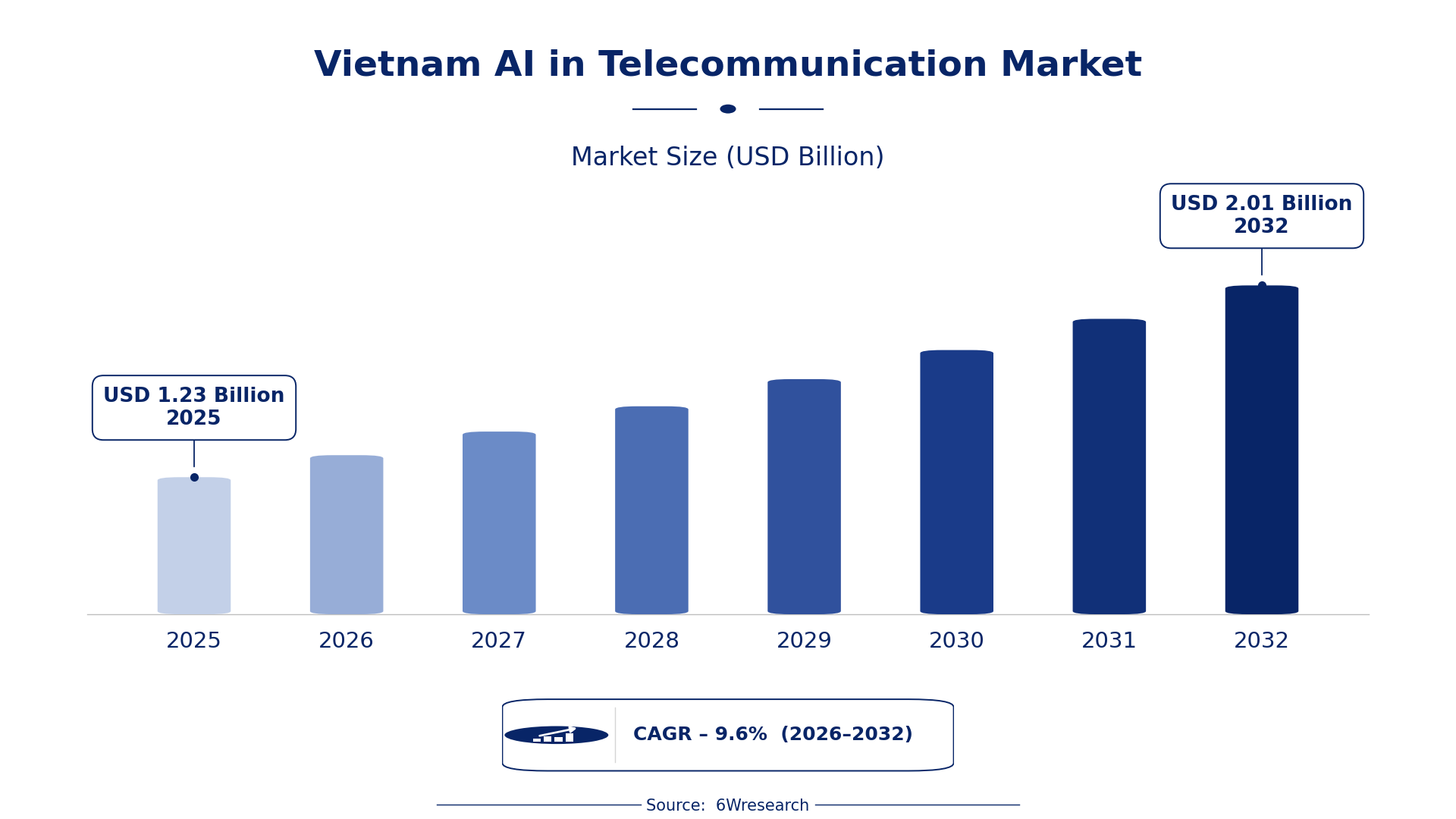
The Vietnam AI in Telecommunication Market was estimated at USD 1234 Million in 2025 and is projected to reach USD 2011 Million by 2032, growing at a CAGR of 9.6% from 2026 to 2032.
Vietnam AI in Telecommunication Market Synopsis
The Vietnam AI in Telecommunication Market is currently witnessing a surge in interest as telecom operators embrace innovative AI solutions. This momentum is not just about keeping pace; it’s a strategic response to the growing complexities within the telecom sector. Operators are increasingly integrating AI to streamline processes, enhance efficiency, and meet customer expectations.
Looking forward, the trajectory appears promising. The combination of 5G rollout and an increasing number of IoT devices creates an environment ripe for AI-driven optimization. These factors signal a substantial shift in operational paradigms, reinforcing the necessity for telecom operators to adopt sophisticated technological solutions to ensure service reliability and customer satisfaction.
Vietnam AI in Telecommunication Market Year-wise Growth Rate and Key Drivers
This graph illustrates the annual growth rates of the Vietnam AI in Telecommunication Market from 2021 to 2032, highlighting a steady upward trajectory and projected expansion over the forecast period.
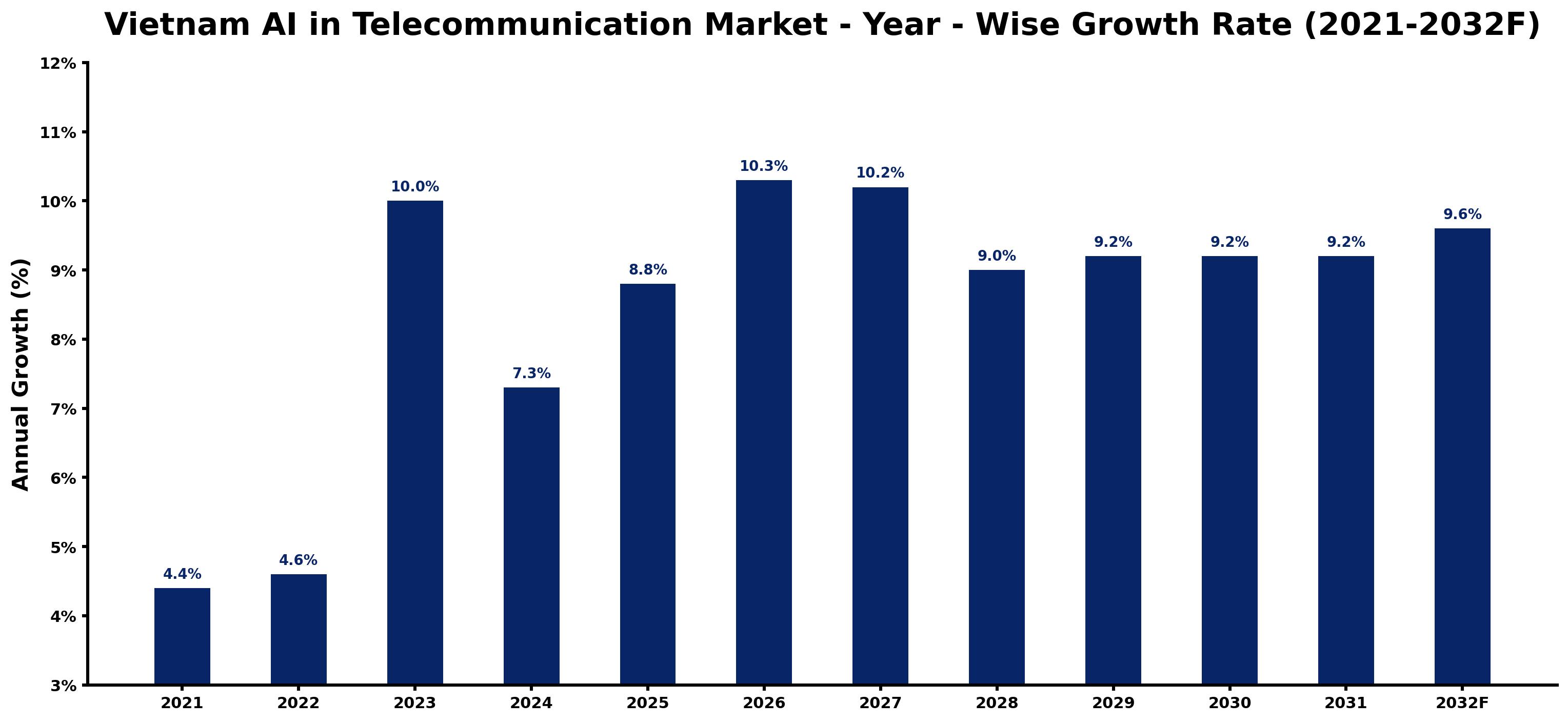
The table below presents the year‑wise growth rates along with the key drivers influencing the market
| Year | Growth Rate | Major Drivers |
| 2021 | 4.4% | Vietnam's 5G rollout accelerates AI integration in telecom. |
| 2022 | 4.6% | Government push for digital transformation supports AI adoption. |
| 2023 | 10.0% | Increased demand for AI-powered customer service solutions. |
| 2024 | 7.3% | Partnerships with local AI startups enhance telecom innovation. |
| 2025 | 8.8% | Growing smartphone penetration drives AI telecommunications applications. |
| 2026 | 10.3% | Telecom infrastructure investments boost AI technology deployment. |
| 2027 | 10.2% | Regulatory support for AI research enhances telecom capabilities. |
| 2028 | 9.0% | Rising consumer demand for personalized telecommunications experiences. |
| 2029 | 9.2% | Digital infrastructure upgrades facilitate AI advancements in telecom. |
| 2030 | 9.2% | Telecom firms leveraging AI for optimizing network management. |
| 2031 | 9.2% | Investment in AI talent fosters local telecom innovation. |
| 2032 | 9.6% | Enhanced data analytics enriches telecom service offerings. |
Note: Market size estimations and growth projections presented in this report are based on 6Wresearch's proprietary forecasting methodology, utilizing the latest available industry data, government publications, and primary research inputs.
Vietnam AI in Telecommunication Market Key Takeaways
Below are some of the specific key takeaways from the market, including:
- The market is expected to grow significantly due to the rapid adoption of AI-driven technologies.
- Network optimization and customer experience enhancement are at the forefront of AI applications.
- Government initiatives supporting digital transformation are fostering market growth.
- AI solutions are essential for managing the complexities introduced by 5G technology.
- Challenges related to data quality and regulatory compliance continue to affect market dynamics.
Evaluation of Restraints in Vietnam AI in Telecommunication Market
Despite the positive outlook, several factors hinder the growth of the Vietnam AI in Telecommunication Market. One primary concern is the quality of data necessary for effective AI applications. Without access to clean and relevant data, telecom operators face challenges in deploying AI solutions effectively. Furthermore, compliance with data protection regulations poses another challenge, as firms must navigate a complex legal landscape while maintaining customer trust. The gap in AI talent also complicates matters, as the demand for skilled professionals exceeds supply, limiting the pace of innovation.
Vietnam AI in Telecommunication Market Trends
Currently, several trends are shaping the Vietnam AI in Telecommunication Market. One of the most notable is the increasing reliance on AI for predictive maintenance, which allows telecom companies to preemptively address network issues. Another trend is the growing use of AI chatbots for customer service, significantly improving response times and overall customer satisfaction. The adoption of machine learning algorithms for data analysis is also rising, enabling telecom operators to gain valuable insights into user behavior and preferences.
Vietnam AI in Telecommunication Market Opportunities
A wealth of opportunities exists for growth within the Vietnam AI in Telecommunication Market. The ongoing rollout of 5G technology presents a significant chance for operators to enhance their service offerings through AI-driven innovations. Investment in AI infrastructure and technology development can further improve operational efficiency and customer engagement. Additionally, there’s an untapped potential in integrating AI with emerging technologies like blockchain and edge computing, paving the way for new services and revenue streams.
Government Initiatives in the Vietnam AI in Telecommunication Market
The Vietnamese government is actively shaping the AI in Telecommunication Market through a variety of initiatives aimed at boosting digital transformation. The regulatory landscape encourages technological advancement, making it crucial for telecom operators to align their strategies with governmental priorities. These initiatives create a supportive environment for market growth, focusing on enhancing connectivity and service delivery.
- A national digital infrastructure upgrade programme initiated in 2023 aims to improve network reliability and performance.
- Currently ongoing is a regulatory framework that promotes the ethical use of AI in telecommunications, ensuring customer data protection.
- A recently completed initiative provides funding and resources for telecom startups focused on AI technology development.
- Plans for a comprehensive public-private partnership are underway to expand rural telecommunications access by 2026.
- The government is developing a policy framework to incentivize AI research and development in the telecommunications sector, set to launch in 2025.
Future Insights of the Vietnam AI in Telecommunication Market
As we look towards 2026-2032, the Vietnam AI in Telecommunication Market is set to experience transformative changes. The convergence of AI with advanced telecommunication technologies will redefine service offerings and operational frameworks. Telecom operators will increasingly depend on AI to not only improve network efficiency but also to deliver personalized customer experiences. The rising demand for seamless connectivity will further drive the adoption of innovative AI solutions, ensuring that Vietnam remains competitive in the global telecommunications arena.
Vietnam AI in Telecommunication Market Latest Developments
In the past year, the Vietnam AI in Telecommunication Market has been characterized by dynamic advancements. Companies are rapidly integrating AI technologies to enhance operational efficiency and customer service capabilities. The emphasis has been on adopting AI solutions to manage increased demands for data and connectivity.
- A major technology vendor launched an AI-powered analytics platform in late 2023, aimed at improving network optimization for telecom operators.
- A partnership between a leading telecom operator and a data analytics firm was established in Q1 2024, focusing on AI-driven customer insights.
- New AI-based chat solutions are currently being rolled out to enhance customer interaction and service delivery, beginning in early 2024.
- An initiative to develop an AI training programme for telecom professionals is currently underway, intended to bridge the skills gap in the industry.
- Plans for an upcoming AI-driven customer service system are expected to be implemented by mid-2025, aiming to streamline support processes.
Vietnam AI in Telecommunication Market - Key Attractiveness of the Report
- 10 Years of Market Numbers
- Historical Data Starting from 2022 to 2025
- Base Year: 2025
- Forecast Data until 2032
- Key Performance Indicators Impacting the Market
- Major Upcoming Developments and Projects
Key Highlights of the Report:
- Vietnam AI in Telecommunication Market Outlook
- Market Size of Vietnam AI in Telecommunication Market, 2025
- Forecast of Vietnam AI in Telecommunication Market, 2032
- Historical Data and Forecast of Vietnam AI in Telecommunication Revenues & Volume for the Period 2022-2032F
- Vietnam AI in Telecommunication Market Trend Evolution
- Vietnam AI in Telecommunication Market Drivers and Challenges
- Vietnam AI in Telecommunication Price Trends
- Vietnam AI in Telecommunication Porter's Five Forces
- Vietnam AI in Telecommunication Industry Life Cycle
- Historical Data and Forecast of Vietnam AI in Telecommunication Market Revenues & Volume By Application for the Period 2022-2032F
- Historical Data and Forecast of Vietnam AI in Telecommunication Market Revenues & Volume By Customer analytics for the Period 2022-2032F
- Historical Data and Forecast of Vietnam AI in Telecommunication Market Revenues & Volume By Network security for the Period 2022-2032F
- Historical Data and Forecast of Vietnam AI in Telecommunication Market Revenues & Volume By Network optimization for the Period 2022-2032F
- Historical Data and Forecast of Vietnam AI in Telecommunication Market Revenues & Volume By Self-diagnostics for the Period 2022-2032F
- Historical Data and Forecast of Vietnam AI in Telecommunication Market Revenues & Volume By Virtual assistance for the Period 2022-2032F
- Historical Data and Forecast of Vietnam AI in Telecommunication Market Revenues & Volume By Others (contact center analytics and marketing campaign analytics) for the Period 2022-2032F
- Historical Data and Forecast of Vietnam AI in Telecommunication Market Revenues & Volume By Component for the Period 2022-2032F
- Historical Data and Forecast of Vietnam AI in Telecommunication Market Revenues & Volume By Solutions for the Period 2022-2032F
- Historical Data and Forecast of Vietnam AI in Telecommunication Market Revenues & Volume By Services for the Period 2022-2032F
- Historical Data and Forecast of Vietnam AI in Telecommunication Market Revenues & Volume By Deployment Mode for the Period 2022-2032F
- Historical Data and Forecast of Vietnam AI in Telecommunication Market Revenues & Volume By Cloud for the Period 2022-2032F
- Historical Data and Forecast of Vietnam AI in Telecommunication Market Revenues & Volume By On-premises for the Period 2022-2032F
- Historical Data and Forecast of Vietnam AI in Telecommunication Market Revenues & Volume By Technology for the Period 2022-2032F
- Historical Data and Forecast of Vietnam AI in Telecommunication Market Revenues & Volume By Machine learning and deep learning for the Period 2022-2032F
- Historical Data and Forecast of Vietnam AI in Telecommunication Market Revenues & Volume By Natural Language Processing (NLP) for the Period 2022-2032F
- Vietnam AI in Telecommunication Import Export Trade Statistics
- Market Opportunity Assessment By Application
- Market Opportunity Assessment By Component
- Market Opportunity Assessment By Deployment Mode
- Market Opportunity Assessment By Technology
- Vietnam AI in Telecommunication Top Companies Market Share
- Vietnam AI in Telecommunication Competitive Benchmarking By Technical and Operational Parameters
- Vietnam AI in Telecommunication Company Profiles
- Vietnam AI in Telecommunication Key Strategic Recommendations






































