Vietnam Animal Feed Enzymes Market Size, Share & Growth Rate
The Vietnam Animal Feed Enzymes Market was estimated at USD 291 Million in 2025 and is projected to reach USD 411 Million by 2032, growing at a CAGR of 5.1% from 2026 to 2032. This growth trajectory is primarily driven by the increasing focus on livestock and poultry productivity, as producers seek to optimize animal nutrition. The integration of advanced nutritional research and government backing for sustainable farming practices further supports the market's upward momentum.
Vietnam Animal Feed Enzymes Market Year-wise Growth Rate and Key Drivers
This graph highlights how the Vietnam Animal Feed Enzymes Market has steadily grown over the years, supported by major growth factors.
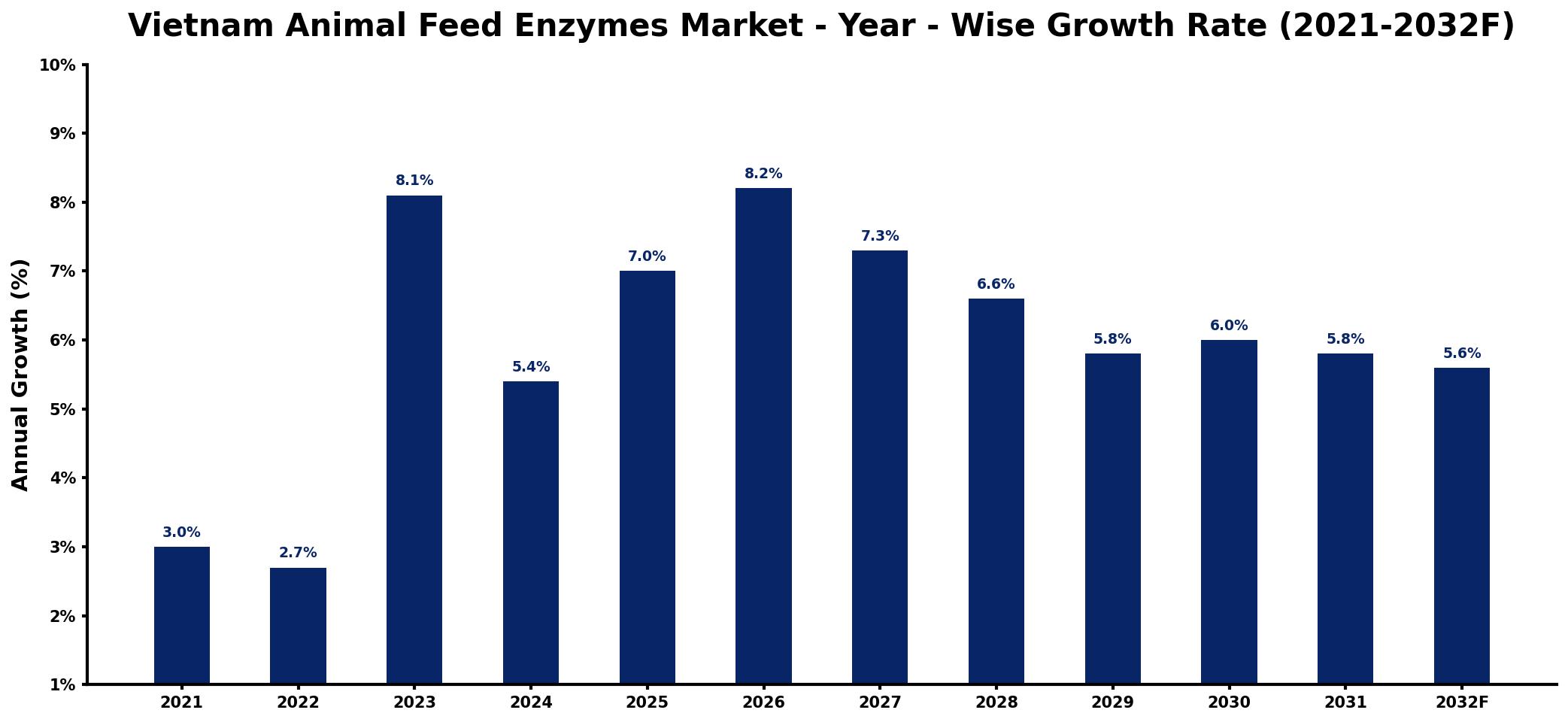
The table below presents the year‑wise growth rates along with the key drivers influencing the market
| Year | Growth Rate | Major Drivers |
| 2021 | 3.0% | Rising livestock production rates |
| 2022 | 2.7% | Increased health awareness trends |
| 2023 | 8.1% | Growth in aquaculture sector |
| 2024 | 5.4% | Expansion of poultry farming |
| 2025 | 7.0% | Higher demand for sustainable practices |
| 2026 | 8.2% | Technological advancements in agriculture |
| 2027 | 7.3% | Increased export opportunities emerging |
| 2028 | 6.6% | Investment in research initiatives |
| 2029 | 5.8% | Growing consumer preference shift |
| 2030 | 6.0% | Strengthening supply chain efficiency |
| 2031 | 5.8% | Enhanced regulatory framework benefits |
| 2032 | 5.6% | Development of organic farming techniques |
Note: Market size estimations and growth projections presented in this report are based on 6Wresearch's proprietary forecasting methodology, utilizing the latest available industry data, government publications, and primary research inputs.
Vietnam Animal Feed Enzymes Market Synopsis
The Vietnam animal feed enzymes market plays a pivotal role in enhancing the efficiency and efficacy of livestock feed, crucially impacting the countrys agricultural output. With an increasing number of farmers adopting innovative solutions to boost animal health and growth rates, feed enzymes are becoming indispensable in modern livestock farming.
This sector is characterized by its alignment with evolving agricultural practices, where precision nutrition is prioritized. As a response to both domestic demand and international market dynamics, the adoption of feed enzymes is expanding, reflecting broader trends in the agriculture industry towards sustainability and enhanced productivity.
Vietnam Animal Feed Enzymes Market Key Takeaways
- The market is experiencing significant growth due to rising awareness of feed efficiency.
- Government initiatives are bolstering support for the animal husbandry sector.
- COVID-19-related disruptions have led to a rebound in the demand for protein sources.
- Manufacturers face regulatory challenges that require robust compliance and efficacy proof.
- Investment in research and development is vital for product innovation and market adoption.
Evaluation of Restraints in Vietnam Animal Feed Enzymes Market
Despite the positive outlook, the Vietnam animal feed enzymes market faces several restraints that can impact its growth. Regulatory compliance is a significant hurdle, as manufacturers must navigate a complex landscape of feed regulations to ensure their products meet safety and efficacy standards. This challenge is compounded by the need for rigorous efficacy trials to demonstrate the benefits of feed enzymes in livestock nutrition, which can be time-consuming and resource-intensive. Additionally, achieving consistent enzyme activity in production and managing market adoption remain critical factors that stakeholders must address to fully capitalize on the growth potential of this market.
Vietnam Animal Feed Enzymes Market Trends
The market is currently shaped by several key trends, including a growing emphasis on sustainable agriculture practices and the adoption of precision livestock farming. Innovations in enzyme technology are enhancing feed formulations, making them more effective in nutrient absorption. Furthermore, there is a marked increase in consumer awareness regarding food safety and quality, propelling producers to seek better nutritional solutions for their animals. These trends are driving the demand for high-quality feed enzymes that improve overall livestock health and productivity.
Vietnam Animal Feed Enzymes Market Opportunities
There are substantial opportunities within the Vietnam animal feed enzymes market, particularly as the livestock sector continues to grow in response to increased protein demand. Investments in research and product development can lead to innovative enzyme solutions tailored to local agricultural needs. Additionally, expanding distribution networks and improving accessibility of feed enzyme products to smallholder farmers can further enhance market penetration. As the industry shifts towards sustainability, opportunities in bio-based enzymes are also emerging, which align with global trends towards eco-friendly agricultural practices.
Government Initiatives in the Vietnam Animal Feed Enzymes Market
The Vietnamese government is actively promoting initiatives that support the agricultural sector, including the animal feed industry. Policies aimed at enhancing livestock productivity and sustainability are encouraging the adoption of advanced feed technologies, including enzymes. Through funding, research grants, and strategic programs, the government is fostering an environment conducive to innovation and growth, ensuring the sector remains competitive and responsive to both domestic and international market demands.
Future Insights of the Vietnam Animal Feed Enzymes Market
Looking ahead to 2026-2032, the Vietnam animal feed enzymes market is poised for significant advancements, driven by technological innovations and evolving farming practices. As producers increasingly adopt precision nutrition techniques, the demand for specialized feed enzymes is expected to rise. Additionally, government support for sustainable practices and ongoing research into enzyme efficacy will likely enhance product development. Overall, the market is set to evolve into a more sophisticated landscape, with opportunities for growth aligning closely with the global shift towards sustainable and efficient animal farming.
Vietnam Animal Feed Enzymes Market Latest Developments (2025 - 2026)
In recent months, the Vietnam animal feed enzymes market has seen a flurry of activity with numerous initiatives aimed at enhancing product offerings and distribution channels. Manufacturers are focusing on strengthening their supply chains post-COVID-19 to ensure product availability. Additionally, collaborations between agricultural organizations and research institutions are fostering innovation in enzyme technology, aimed at meeting the evolving needs of the livestock industry. These developments reflect the market's adaptive response to emerging challenges and opportunities in the agricultural sector.
Vietnam Animal Feed Enzymes Market - Key Attractiveness of the Report
- 10 Years of Market Numbers
- Historical Data Starting from 2022 to 2025
- Base Year: 2025
- Forecast Data until 2032
- Key Performance Indicators Impacting the Market
- Major Upcoming Developments and Projects
Key Highlights of the Report:
- Vietnam Animal Feed Enzymes Market Outlook
- Market Size of Vietnam Animal Feed Enzymes Market, 2025
- Forecast of Vietnam Animal Feed Enzymes Market, 2032
- Historical Data and Forecast of Vietnam Animal Feed Enzymes Revenues & Volume for the Period 2022-2032F
- Vietnam Animal Feed Enzymes Market Trend Evolution
- Vietnam Animal Feed Enzymes Market Drivers and Challenges
- Vietnam Animal Feed Enzymes Price Trends
- Vietnam Animal Feed Enzymes Porter's Five Forces
- Vietnam Animal Feed Enzymes Industry Life Cycle
- Historical Data and Forecast of Vietnam Animal Feed Enzymes Market Revenues & Volume By Formulation for the Period 2022-2032F
- Historical Data and Forecast of Vietnam Animal Feed Enzymes Market Revenues & Volume By Dry for the Period 2022-2032F
- Historical Data and Forecast of Vietnam Animal Feed Enzymes Market Revenues & Volume By Liquid for the Period 2022-2032F
- Historical Data and Forecast of Vietnam Animal Feed Enzymes Market Revenues & Volume By Product for the Period 2022-2032F
- Historical Data and Forecast of Vietnam Animal Feed Enzymes Market Revenues & Volume By Phytase for the Period 2022-2032F
- Historical Data and Forecast of Vietnam Animal Feed Enzymes Market Revenues & Volume By Carbohydrase for the Period 2022-2032F
- Historical Data and Forecast of Vietnam Animal Feed Enzymes Market Revenues & Volume By Protease for the Period 2022-2032F
- Historical Data and Forecast of Vietnam Animal Feed Enzymes Market Revenues & Volume By Non starch polysaccharides for the Period 2022-2032F
- Historical Data and Forecast of Vietnam Animal Feed Enzymes Market Revenues & Volume By Livestock for the Period 2022-2032F
- Historical Data and Forecast of Vietnam Animal Feed Enzymes Market Revenues & Volume By Poultry for the Period 2022-2032F
- Historical Data and Forecast of Vietnam Animal Feed Enzymes Market Revenues & Volume By Swine for the Period 2022-2032F
- Historical Data and Forecast of Vietnam Animal Feed Enzymes Market Revenues & Volume By Ruminant for the Period 2022-2032F
- Historical Data and Forecast of Vietnam Animal Feed Enzymes Market Revenues & Volume By Aquaculture for the Period 2022-2032F
- Historical Data and Forecast of Vietnam Animal Feed Enzymes Market Revenues & Volume By Others for the Period 2022-2032F
- Vietnam Animal Feed Enzymes Import Export Trade Statistics
- Market Opportunity Assessment By Formulation
- Market Opportunity Assessment By Product
- Market Opportunity Assessment By Livestock
- Vietnam Animal Feed Enzymes Top Companies Market Share
- Vietnam Animal Feed Enzymes Competitive Benchmarking By Technical and Operational Parameters
- Vietnam Animal Feed Enzymes Company Profiles
- Vietnam Animal Feed Enzymes Key Strategic Recommendations






































