Vietnam Architectural Hardware Market Summary
The vietnam architectural hardware market was estimated at USD 454 Million in 2025 and is projected to reach USD 642 Million by 2032, growing at a CAGR of 7.9% from 2026 to 2032.
Vietnam Architectural Hardware Market Year-wise Growth Rate and Key Drivers
This graph highlights how the Vietnam Architectural Hardware Market has steadily grown over the past five years, supported by major growth factors.
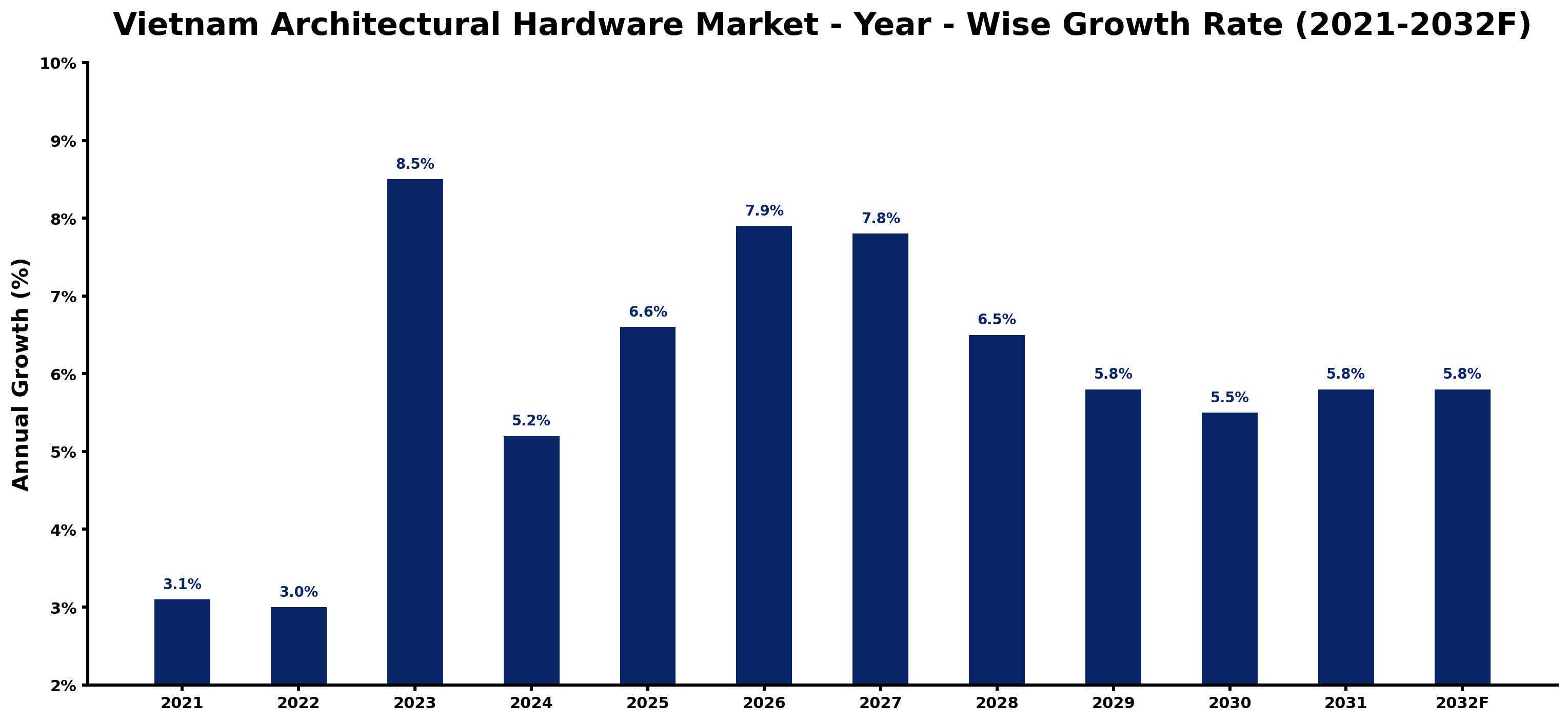
The table below presents the year wise growth rates along with the key drivers influencing the market
| Year | Growth Rate | Major Drivers |
| 2021 | 3.1% | Post-lockdown retail projects sparked renewed interest in efficient architectural hardware solutions. |
| 2022 | 3.0% | Manufacturing relocations attracted investments in advanced architectural hardware production technologies. |
| 2023 | 8.5% | Increased urbanization resulted in higher demand for innovative building solutions and hardware. |
| 2024 | 5.2% | Rural infrastructure development focused attention on sustainable architectural hardware options. |
| 2025 | 6.6% | Corporate sustainability initiatives encouraged eco-friendly materials in architectural hardware designs. |
| 2026 | 7.9% | Emerging smart home technologies influenced preferences for high-tech architectural hardware features. |
| 2027 | 7.8% | Partnerships with global manufacturers improved local access to cutting-edge hardware innovations. |
| 2028 | 6.5% | A shift towards modular construction techniques drove interest in versatile architectural hardware products. |
| 2029 | 5.8% | Green building certifications spurred architects to choose sustainable hardware materials and designs. |
| 2030 | 5.5% | Investment in smart city projects emphasized the need for resilient architectural hardware solutions. |
| 2031 | 5.8% | Technological disruptions in manufacturing enhanced local capabilities for customized architectural hardware. |
| 2032 | 5.8% | Customer awareness of design trends pushed architects toward unique and functional hardware solutions. |
Note - Market size estimations and growth projections presented in this report are based on 6Wresearch's advanced forecasting approach, validated with industry datasets as of June 2026.
Vietnam Architectural Hardware Market Synopsis
The Vietnam Architectural Hardware Market is projected to reach 7.9% and witness significant growth during the forecast period (2026-2032). This market encompasses a variety of components essential for the construction and interior design industries, including door handles, locks, hinges, and window fittings. The growth trajectory of this market is closely aligned with the burgeoning construction activities within Vietnam, which are largely spurred by rapid urbanization, extensive real estate investments, and substantial infrastructure developments. As the demand for modern and aesthetically pleasing buildings escalates, the need for high-quality architectural hardware products becomes increasingly pronounced. Furthermore, the rising emphasis on security and safety in buildings enhances the uptake of advanced locking systems and access control solutions.
Vietnam Architectural Hardware Market Growth Drivers
The growth of the Vietnam Architectural Hardware Market is underpinned by several critical drivers:
- The construction industry in Vietnam is experiencing unprecedented growth, with a surge in urbanization leading to a multitude of construction projects. This includes residential, commercial, and industrial constructions that necessitate a wide array of architectural hardware components.
- A notable trend toward modernization among the Vietnamese population promotes the need for stylish and functional living and working environments. This trend drives demand for contemporary architectural hardware solutions that align with urban lifestyle preferences.
- The tourism and hospitality sectors are increasingly contributing to the demand for architectural hardware. As Vietnam solidifies its status as a prime tourist destination, there is a growing requirement for hardware in hotels and resorts, including secure locking mechanisms and decorative fittings.
- Government initiatives aimed at promoting sustainable construction practices are fostering demand for green architectural hardware. Builders are adopting eco-friendly materials and energy-efficient solutions to comply with environmental standards and regulations.
- Heightened awareness surrounding security and safety has escalated demand for robust architectural hardware. This includes high-quality locking systems and advanced access control technologies to ensure the safety of residential and commercial properties.
Vietnam Architectural Hardware Market Challenges and Restraints
Despite the promising growth indicators, the Vietnam Architectural Hardware Market faces several challenges:
- Price sensitivity remains a significant barrier, as consumers and builders often regard architectural hardware as secondary to the primary construction budget. This can lead to intense price competition, adversely affecting profit margins for manufacturers.
- The prevalence of counterfeit and inferior-quality hardware products poses a challenge. Such products can damage the reputation of reputable brands, making consumer education on the importance of high-quality hardware essential.
- Architects and designers frequently seek unique, customized hardware solutions, leading to design and customization challenges that manufacturers must navigate effectively to meet specific aesthetic demands.
- The cyclical nature of the construction industry can lead to fluctuations in demand for architectural hardware. Economic uncertainties and shifts in government policies may impact construction activities and, by extension, the architectural hardware market.
- The COVID-19 pandemic introduced additional complexities, causing disruptions in supply chains and altering consumer priorities, such as a shift toward home improvement projects during lockdowns.
Vietnam Architectural Hardware Market Government Investment and Initiatives
The government of Vietnam is actively supporting the architectural hardware market through various initiatives aimed at boosting the construction sector and enhancing infrastructure. Policies aimed at urban development encourage increased public and private investments in construction projects, which, in turn, drive demand for architectural hardware. There is also a concerted effort to promote sustainable building practices, with government incentives for using green materials and energy-efficient products. Additionally, the government's infrastructure development plans prioritize the modernization of urban areas, further stimulating construction activities and the corresponding demand for architectural hardware. Public spending on infrastructure continues to rise, creating a favorable environment for architectural hardware manufacturers and suppliers.
Vietnam Architectural Hardware Market Latest Developments (May 2025 - June 2026)
Between May 2025 and June 2026, the Vietnam Architectural Hardware Market has seen significant developments. Construction projects resumed robustly following initial pandemic-related delays, reflecting a resurgence in both residential and commercial investments. The trend towards home renovations and improvements remained prevalent, as many consumers sought to enhance their living spaces amid shifting lifestyles. Digital marketing strategies gained traction among architectural hardware suppliers, enabling them to engage with consumers more effectively in an increasingly online marketplace. Furthermore, the introduction of innovative products, such as smart locking systems and eco-friendly hardware, received positive responses, indicating a growing consumer preference for advanced functional designs. Overall, the market demonstrated resilience and adaptability in the face of evolving consumer demands and market conditions.
Vietnam Architectural Hardware Market - Key Attractiveness of the Report
- 10 Years of Market Numbers
- Historical Data Starting from 2022 to 2025
- Base Year: 2025
- Forecast Data until 2032
- Key Performance Indicators Impacting the Market
- Major Upcoming Developments and Projects
Key Highlights of the Report:
- Vietnam Architectural Hardware Market Outlook
- Market Size of Vietnam Architectural Hardware Market, 2025
- Forecast of Vietnam Architectural Hardware Market, 2032
- Historical Data and Forecast of Vietnam Architectural Hardware Revenues & Volume for the Period 2022-2032F
- Vietnam Architectural Hardware Market Trend Evolution
- Vietnam Architectural Hardware Market Drivers and Challenges
- Vietnam Architectural Hardware Price Trends
- Vietnam Architectural Hardware Porter's Five Forces
- Vietnam Architectural Hardware Industry Life Cycle
- Historical Data and Forecast of Vietnam Architectural Hardware Market Revenues & Volume By Application for the Period 2022-2032F
- Historical Data and Forecast of Vietnam Architectural Hardware Market Revenues & Volume By Doors for the Period 2022-2032F
- Historical Data and Forecast of Vietnam Architectural Hardware Market Revenues & Volume By Windows for the Period 2022-2032F
- Historical Data and Forecast of Vietnam Architectural Hardware Market Revenues & Volume By Furniture for the Period 2022-2032F
- Historical Data and Forecast of Vietnam Architectural Hardware Market Revenues & Volume By Shower for the Period 2022-2032F
- Historical Data and Forecast of Vietnam Architectural Hardware Market Revenues & Volume By End-user for the Period 2022-2032F
- Historical Data and Forecast of Vietnam Architectural Hardware Market Revenues & Volume By Commercial for the Period 2022-2032F
- Historical Data and Forecast of Vietnam Architectural Hardware Market Revenues & Volume By Industrial for the Period 2022-2032F
- Historical Data and Forecast of Vietnam Architectural Hardware Market Revenues & Volume By Residential for the Period 2022-2032F
- Vietnam Architectural Hardware Import Export Trade Statistics
- Market Opportunity Assessment By Application
- Market Opportunity Assessment By End-user
- Vietnam Architectural Hardware Top Companies Market Share
- Vietnam Architectural Hardware Competitive Benchmarking By Technical and Operational Parameters
- Vietnam Architectural Hardware Company Profiles
- Vietnam Architectural Hardware Key Strategic Recommendations






































