Vietnam Aromatic Compounds Market Size, Share & Growth Rate
The Vietnam Aromatic Compounds Market was estimated at USD 430 Million in 2025 and is projected to reach USD 609 Million by 2032, growing at a CAGR of 5.1% from 2026 to 2032. This robust growth trajectory is fueled by the booming manufacturing sector, alongside a surge in consumer goods demand that increasingly incorporate aromatic compounds. As urbanization and industrialization continue to rise, the market stands poised for expansion.
Vietnam Aromatic Compounds Market Year-wise Growth Rate and Key Drivers
This graph highlights how the Vietnam Aromatic Compounds Market has steadily grown over the years, supported by major growth factors.
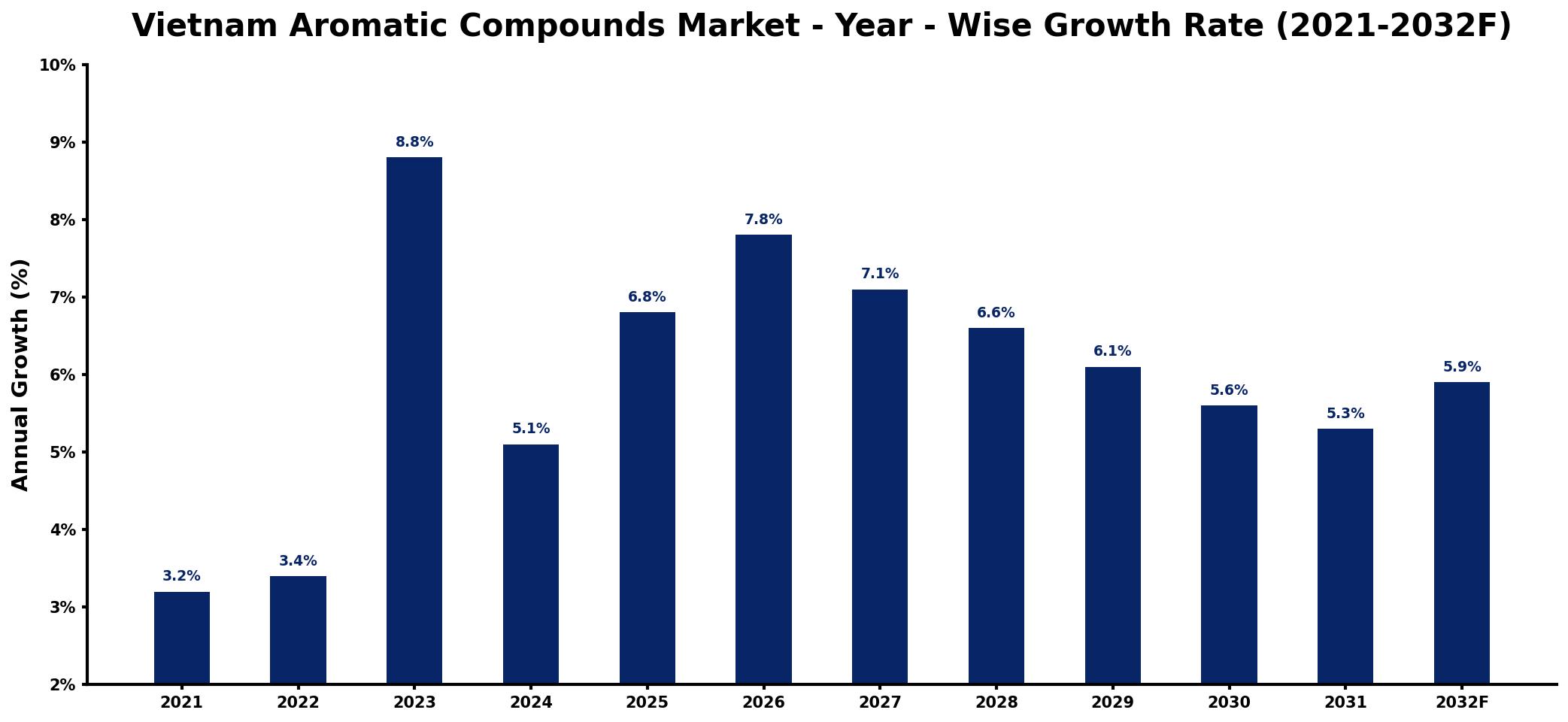
The table below presents the year‑wise growth rates along with the key drivers influencing the market
| Year | Growth Rate | Major Drivers |
| 2021 | 3.2% | Rising consumer fragrance preferences |
| 2022 | 3.4% | Growth in personal care sector |
| 2023 | 8.8% | Expansion of food flavoring industry |
| 2024 | 5.1% | Increased investment in manufacturing |
| 2025 | 6.8% | Surge in home fragrance market |
| 2026 | 7.8% | Demand from cosmetics industry rises |
| 2027 | 7.1% | improved raw material availability |
| 2028 | 6.6% | Rising popularity of natural scents |
| 2029 | 6.1% | increased production capacity utilization |
| 2030 | 5.6% | Increased use in therapeutic products |
| 2031 | 5.3% | Growing trend in eco-friendly products |
| 2032 | 5.9% | Rising demand for innovative fragrances |
Note: Market size estimations and growth projections presented in this report are based on 6Wresearch's proprietary forecasting methodology, utilizing the latest available industry data, government publications, and primary research inputs.
Vietnam Aromatic Compounds Market Synopsis
The Vietnamese aromatic compounds market is witnessing significant momentum, driven by its essential role in the petrochemical, plastics, and pharmaceutical industries. A marked increase in production capabilities, supported by heightened consumer demand, underscores the importance of these compounds in manufacturing processes.
Moreover, the evolving landscape of industrial practices highlights a pivot towards sustainable and environmentally friendly alternatives. As regulatory frameworks tighten, companies are adapting their practices to align with sustainability goals, which will invariably shape the future of aromatic compound utilization in Vietnam.
Vietnam Aromatic Compounds Market Key Takeaways
- Strong growth projected due to increasing urbanization and industrial development.
- Aromatic compounds are integral in various applications, enhancing demand across multiple industries.
- Environmental concerns are prompting shifts towards more sustainable manufacturing practices.
- Challenges such as feedstock availability and pricing volatility may affect market stability.
- Government initiatives may foster advancements in technology and infrastructure to support market growth.
Evaluation of Restraints in Vietnam Aromatic Compounds Market
Despite the optimistic growth outlook, the Vietnam Aromatic Compounds Market grapples with several restraints. A primary concern is the volatility in feedstock availability, which can hinder production and lead to price fluctuations. Additionally, stringent environmental regulations pose challenges, requiring manufacturers to innovate and adopt alternative processes. As sustainability becomes increasingly prioritized, companies must navigate compliance while remaining competitive, complicating operational dynamics in this evolving landscape.
Vietnam Aromatic Compounds Market Trends
The current trends in the Vietnam Aromatic Compounds Market reflect a dual focus on innovation and sustainability. Emerging technologies in chemical processes are enhancing efficiency and reducing the environmental footprint of aromatic compound production. Additionally, there is a notable shift toward biodegradable alternatives, as manufacturers respond to consumer demand for environmentally friendly products. This trend is expected to reshape product offerings and influence investment in research and development.
Vietnam Aromatic Compounds Market Opportunities
Opportunities within the Vietnam Aromatic Compounds Market are expanding, particularly in the realm of specialty chemicals and bio-based products. The ongoing push for sustainability is likely to open avenues for innovative applications, such as in high-performance materials and eco-friendly solvents. Furthermore, as regional integration strengthens trade ties, Vietnamese manufacturers could leverage their position to tap into international markets seeking reliable suppliers of aromatic compounds.
Government Initiatives in the Vietnam Aromatic Compounds Market
The Vietnamese government is actively supporting the aromatic compounds market through various initiatives aimed at enhancing industrial capacity and sustainability. Investments in petrochemical infrastructure are being prioritized, along with policies encouraging research and development in environmentally friendly practices. Additionally, government programs are increasingly focused on fostering collaborations between the public and private sectors to drive innovation and ensure compliance with global environmental standards.
Future Insights of the Vietnam Aromatic Compounds Market
Looking ahead to 2026-2032, the Vietnam Aromatic Compounds Market is set to evolve significantly. Continued urbanization and industrialization will likely fuel demand, but the market must also adapt to increasing sustainability requirements. Innovations in production processes, alongside shifts in consumer preferences towards greener alternatives, will dictate the competitive landscape. As players in the market align with these trends, strategic investments and agile operational frameworks will be essential for capturing growth opportunities.
Vietnam Aromatic Compounds Market Latest Developments (2025 - 2026)
Recent developments in the Vietnam Aromatic Compounds Market indicate a growing focus on sustainability and technological advancements. Many companies are exploring partnerships to enhance research capabilities and develop eco-friendly production methods. Additionally, there has been an uptick in discussions around regulatory reforms aimed at promoting sustainable practices across the industry. This aligns with global trends where environmental accountability is becoming a focal point for manufacturers.
Vietnam Aromatic Compounds Market - Key Attractiveness of the Report
- 10 Years of Market Numbers
- Historical Data Starting from 2022 to 2025
- Base Year: 2025
- Forecast Data until 2032
- Key Performance Indicators Impacting the Market
- Major Upcoming Developments and Projects
Key Highlights of the Report:
- Vietnam Aromatic Compounds Market Outlook
- Market Size of Vietnam Aromatic Compounds Market, 2025
- Forecast of Vietnam Aromatic Compounds Market, 2032
- Historical Data and Forecast of Vietnam Aromatic Compounds Revenues & Volume for the Period 2022-2032F
- Vietnam Aromatic Compounds Market Trend Evolution
- Vietnam Aromatic Compounds Market Drivers and Challenges
- Vietnam Aromatic Compounds Price Trends
- Vietnam Aromatic Compounds Porter's Five Forces
- Vietnam Aromatic Compounds Industry Life Cycle
- Historical Data and Forecast of Vietnam Aromatic Compounds Market Revenues & Volume By Type for the Period 2022-2032F
- Historical Data and Forecast of Vietnam Aromatic Compounds Market Revenues & Volume By Benzene for the Period 2022-2032F
- Historical Data and Forecast of Vietnam Aromatic Compounds Market Revenues & Volume By Xylene for the Period 2022-2032F
- Historical Data and Forecast of Vietnam Aromatic Compounds Market Revenues & Volume By Toluene for the Period 2022-2032F
- Historical Data and Forecast of Vietnam Aromatic Compounds Market Revenues & Volume By Application for the Period 2022-2032F
- Historical Data and Forecast of Vietnam Aromatic Compounds Market Revenues & Volume By Solvent for the Period 2022-2032F
- Historical Data and Forecast of Vietnam Aromatic Compounds Market Revenues & Volume By Additive for the Period 2022-2032F
- Historical Data and Forecast of Vietnam Aromatic Compounds Market Revenues & Volume By End-use for the Period 2022-2032F
- Historical Data and Forecast of Vietnam Aromatic Compounds Market Revenues & Volume By Packaging for the Period 2022-2032F
- Historical Data and Forecast of Vietnam Aromatic Compounds Market Revenues & Volume By Detergent And Dyes for the Period 2022-2032F
- Historical Data and Forecast of Vietnam Aromatic Compounds Market Revenues & Volume By Automobile for the Period 2022-2032F
- Historical Data and Forecast of Vietnam Aromatic Compounds Market Revenues & Volume By Electronic Devices for the Period 2022-2032F
- Historical Data and Forecast of Vietnam Aromatic Compounds Market Revenues & Volume By Medical Devices for the Period 2022-2032F
- Historical Data and Forecast of Vietnam Aromatic Compounds Market Revenues & Volume By Pharmaceuticals for the Period 2022-2032F
- Historical Data and Forecast of Vietnam Aromatic Compounds Market Revenues & Volume By Gasoline for the Period 2022-2032F
- Historical Data and Forecast of Vietnam Aromatic Compounds Market Revenues & Volume By Tire for the Period 2022-2032F
- Vietnam Aromatic Compounds Import Export Trade Statistics
- Market Opportunity Assessment By Type
- Market Opportunity Assessment By Application
- Market Opportunity Assessment By End-use
- Vietnam Aromatic Compounds Top Companies Market Share
- Vietnam Aromatic Compounds Competitive Benchmarking By Technical and Operational Parameters
- Vietnam Aromatic Compounds Company Profiles
- Vietnam Aromatic Compounds Key Strategic Recommendations






































