Vietnam Beef And Veal Market Size, Share & Growth Rate
The Vietnam Beef And Veal Market was estimated at USD 187 Million in 2025 and is projected to reach USD 264 Million by 2032, growing at a CAGR of 5.0% from 2026 to 2032. This robust growth trajectory is primarily fueled by shifting consumer preferences towards high-quality meat and the increasing disposable incomes of the Vietnamese population. Furthermore, the expansion of the foodservice sector, driven by both local restaurants and international fast-food chains, is intensifying the demand for diverse beef and veal products.
Vietnam Beef And Veal Market Year-wise Growth Rate and Key Drivers
This graph highlights how the Vietnam Beef And Veal Market has steadily grown over the years, supported by major growth factors.
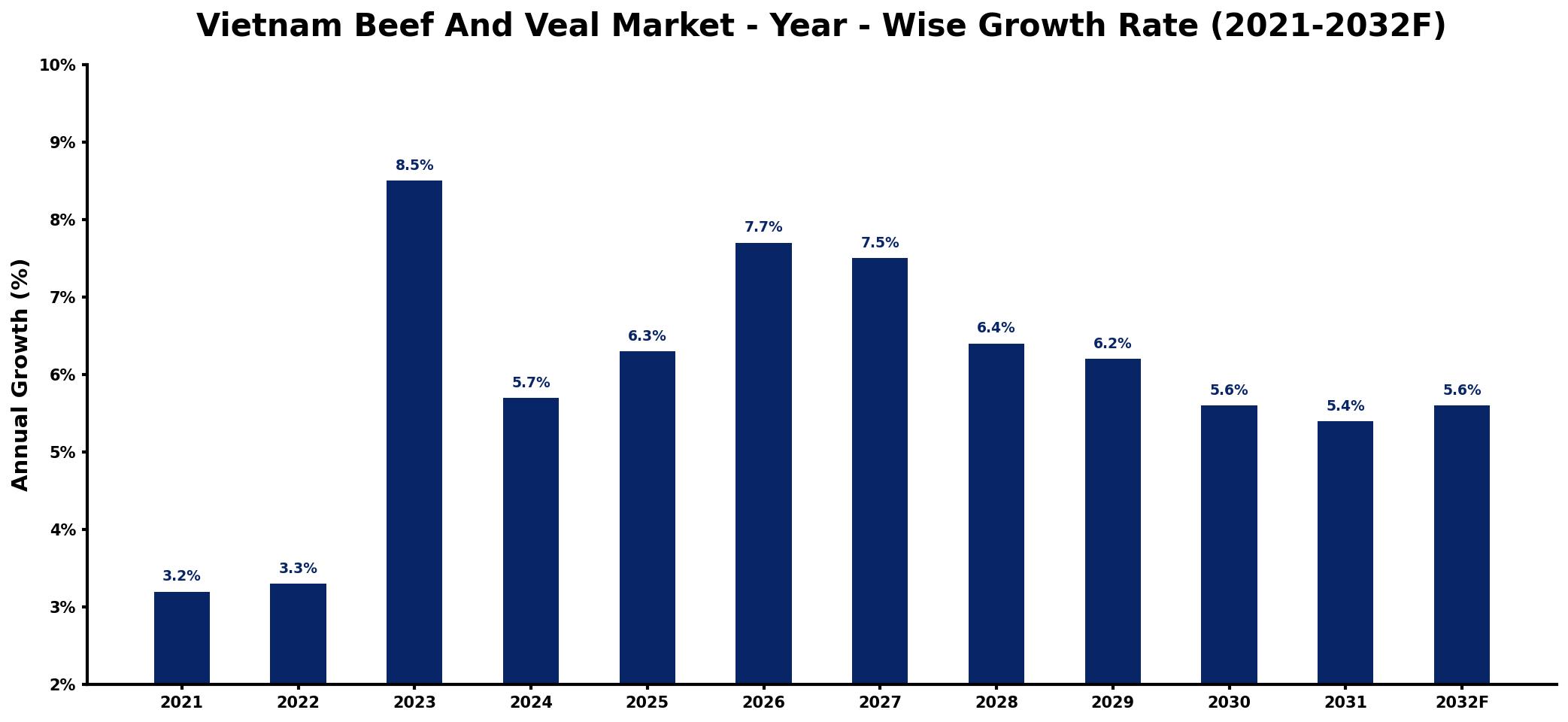
The table below presents the year‑wise growth rates along with the key drivers influencing the market
| Year | Growth Rate | Major Drivers |
| 2021 | 3.2% | Rising consumer health awareness |
| 2022 | 3.3% | Increased urban population growth |
| 2023 | 8.5% | Expansion of food service sector |
| 2024 | 5.7% | Growing export market opportunities |
| 2025 | 6.3% | Higher disposable income levels |
| 2026 | 7.7% | Advancements in farming technology |
| 2027 | 7.5% | Increased domestic production capacity |
| 2028 | 6.4% | Shift towards premium products |
| 2029 | 6.2% | Growing online retail channels |
| 2030 | 5.6% | Strengthened supply chain efficiency |
| 2031 | 5.4% | Rising popularity of food trends |
| 2032 | 5.6% | Development of sustainable practices |
Note: Market size estimations and growth projections presented in this report are based on 6Wresearch's proprietary forecasting methodology, utilizing the latest available industry data, government publications, and primary research inputs.
Vietnam Beef And Veal Market Synopsis
Consumer demand for quality beef and veal products is the strongest force shaping the Vietnam Beef and Veal Market today. As the country evolves economically, these proteins are becoming increasingly integrated into the traditional Vietnamese diet, underscoring a shift in culinary preferences.
The market is characterized by a variety of cuts and processed products that cater to both local tastes and the demands of the foodservice industry. As Vietnam's economy continues to grow, so too does the potential for enhanced production methods and product innovation within the sector.
Vietnam Beef And Veal Market Key Takeaways
- The market is on a steady growth path, projected to reach USD 264 Million by 2032.
- Rising disposable incomes are driving demand for high-quality meat products.
- The expansion of foodservice options plays a crucial role in increasing beef and veal consumption.
- Government initiatives are focusing on improving domestic cattle farming practices.
- COVID-19 has shifted consumer preferences towards locally sourced products, creating new opportunities.
Evaluation of Restraints in Vietnam Beef And Veal Market
Despite its promising growth, the Vietnam Beef and Veal Market faces significant constraints. One primary issue is the supply chain logistics involved in cattle farming and meat processing. Many domestic producers struggle with outdated farming practices that limit quality and output. Additionally, the deep-rooted preference for pork and poultry in Vietnamese cuisine poses a challenge for beef and veal to capture a larger market share. This necessitates innovative marketing strategies to change consumer perceptions and increase beef consumption.
Vietnam Beef And Veal Market Trends
Current trends in the Vietnam Beef and Veal Market reveal a growing consumer inclination towards premium products. There is an increasing interest in organic and grass-fed beef, reflecting global dietary trends. Moreover, technological advancements in farming practices, as well as processing innovations, are enhancing the efficiency and quality of meat production. Consumers are also gravitating towards more sustainable and locally sourced meat options, showcasing a significant shift in purchasing habits.
Vietnam Beef And Veal Market Opportunities
The market offers significant growth and investment opportunities, particularly in enhancing beef production capabilities. Investing in modern farming technologies can yield higher-quality meat and improve supply chain efficiency. Additionally, opportunities exist in expanding export markets for Vietnamese beef, where international demand for quality meat continues to rise. Establishing partnerships with local restaurants and international food chains can further amplify market penetration.
Government Initiatives in the Vietnam Beef And Veal Market
The Vietnamese government has recognized the importance of the beef and veal industry and has introduced initiatives to support its growth. Efforts include funding for agricultural research and development aimed at improving cattle farming techniques. Moreover, there are programs focused on ensuring meat quality and safety, which are crucial for both domestic consumption and export. The government's engagement in enhancing infrastructure for meat processing is also a significant aspect of fostering market growth.
Future Insights of the Vietnam Beef And Veal Market
Looking ahead to 2026-2032, the Vietnam Beef and Veal Market is expected to evolve with a stronger emphasis on quality and sustainability. With increasing consumer awareness regarding health and nutrition, demand for high-quality beef products will continue to rise. The sector is likely to benefit from technological advancements, leading to improved production methods and efficiency. As the export potential strengthens, Vietnam may position itself as a significant player in the global beef market, enhancing economic prospects for domestic producers.
Vietnam Beef And Veal Market Latest Developments (2025 - 2026)
Recent developments in the Vietnam Beef and Veal Market indicate a growing emphasis on quality assurance and traceability in meat products. Initiatives to enhance the standards of local beef production are becoming increasingly prominent. Concurrently, consumer preferences are shifting towards premium beef options, driven by health-conscious choices. These shifts are encouraging local producers to adapt their offerings, providing innovative products that meet evolving consumer demands.
Vietnam Beef And Veal Market - Key Attractiveness of the Report
- 10 Years of Market Numbers
- Historical Data Starting from 2022 to 2025
- Base Year: 2025
- Forecast Data until 2032
- Key Performance Indicators Impacting the Market
- Major Upcoming Developments and Projects
Key Highlights of the Report:
- Vietnam Beef And Veal Market Outlook
- Market Size of Vietnam Beef And Veal Market, 2025
- Forecast of Vietnam Beef And Veal Market, 2032
- Historical Data and Forecast of Vietnam Beef And Veal Revenues & Volume for the Period 2022-2032F
- Vietnam Beef And Veal Market Trend Evolution
- Vietnam Beef And Veal Market Drivers and Challenges
- Vietnam Beef And Veal Price Trends
- Vietnam Beef And Veal Porter's Five Forces
- Vietnam Beef And Veal Industry Life Cycle
- Historical Data and Forecast of Vietnam Beef And Veal Market Revenues & Volume By Type for the Period 2022-2032F
- Historical Data and Forecast of Vietnam Beef And Veal Market Revenues & Volume By Beef for the Period 2022-2032F
- Historical Data and Forecast of Vietnam Beef And Veal Market Revenues & Volume By Veal for the Period 2022-2032F
- Historical Data and Forecast of Vietnam Beef And Veal Market Revenues & Volume By Distribution Channel for the Period 2022-2032F
- Historical Data and Forecast of Vietnam Beef And Veal Market Revenues & Volume By Supermarkets for the Period 2022-2032F
- Historical Data and Forecast of Vietnam Beef And Veal Market Revenues & Volume By Convenient Store for the Period 2022-2032F
- Historical Data and Forecast of Vietnam Beef And Veal Market Revenues & Volume By Speciality Stores for the Period 2022-2032F
- Historical Data and Forecast of Vietnam Beef And Veal Market Revenues & Volume By Online Retail for the Period 2022-2032F
- Vietnam Beef And Veal Import Export Trade Statistics
- Market Opportunity Assessment By Type
- Market Opportunity Assessment By Distribution Channel
- Vietnam Beef And Veal Top Companies Market Share
- Vietnam Beef And Veal Competitive Benchmarking By Technical and Operational Parameters
- Vietnam Beef And Veal Company Profiles
- Vietnam Beef And Veal Key Strategic Recommendations






































