Vietnam Conversational Systems Market Size & Growth Rate (2026-2032)
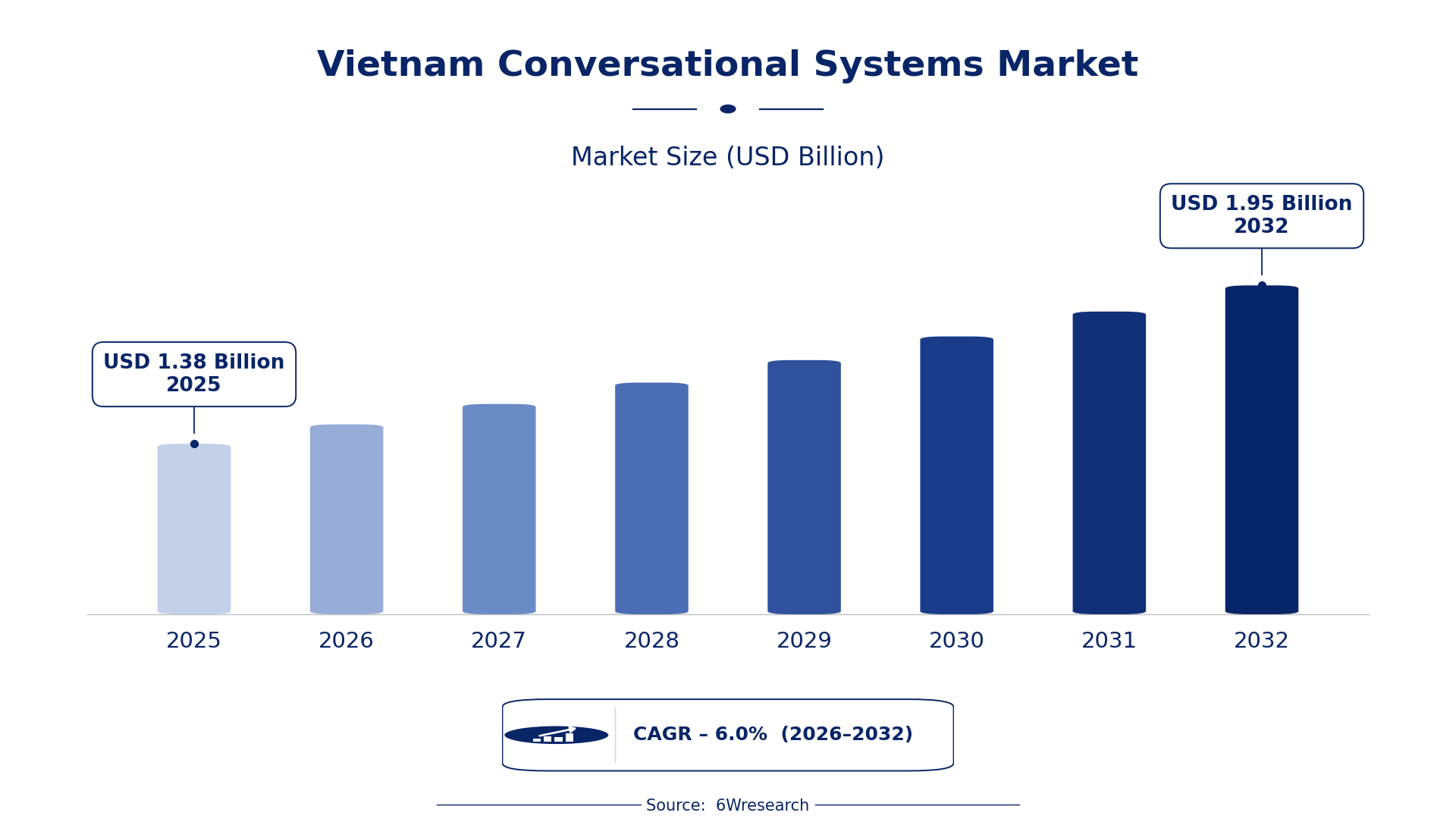
The Vietnam Conversational Systems Market was estimated at USD 1378 Million in 2025 and is projected to reach USD 1954 Million by 2032, growing at a CAGR of 6.0% from 2026 to 2032.
Vietnam Conversational Systems Market Synopsis
The rapid adoption of conversational systems is the strongest force shaping the Vietnam market today. Businesses are increasingly recognizing the importance of customer engagement and support efficiency, leading to the integration of chatbots and virtual assistants in various sectors.
As Vietnamese consumers become more accustomed to digital interactions, the demand for intelligent, responsive communication tools is on the rise. This trend is not just about automating processes; it’s about enhancing the overall customer experience, making conversational systems a critical asset for businesses aiming to thrive in a competitive environment.
Vietnam Conversational Systems Market Year-wise Growth Rate and Key Drivers
This graph illustrates the annual growth rates of the Vietnam Conversational Systems Market from 2021 to 2032, highlighting a steady upward trajectory and projected expansion over the forecast period.
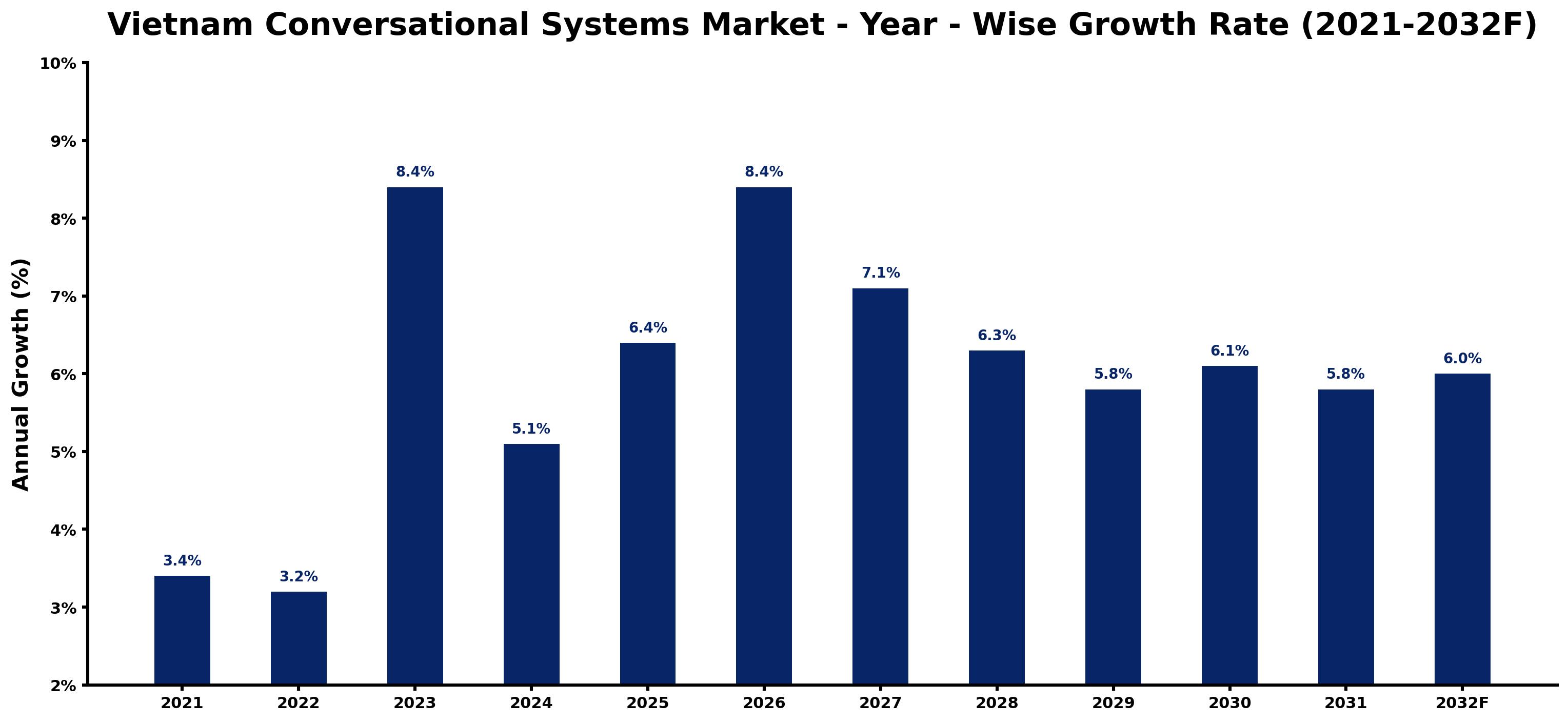
The table below presents the year‑wise growth rates along with the key drivers influencing the market
| Year | Growth Rate | Major Drivers |
| 2021 | 3.4% | Government investment in AI-driven tech innovation programs. |
| 2022 | 3.2% | Rising smartphone penetration enhancing voice interaction features. |
| 2023 | 8.4% | Increasing e-commerce growth boosting customer service automation. |
| 2024 | 5.1% | Local startups developing tailored chatbot solutions for SMEs. |
| 2025 | 6.4% | Growing tech-savvy youth demographic embracing digital assistants. |
| 2026 | 8.4% | Educational initiatives promoting AI literacy among professionals. |
| 2027 | 7.1% | Increased smartphone usage in rural areas driving adoption. |
| 2028 | 6.3% | Demand for personalized marketing with conversational AI solutions. |
| 2029 | 5.8% | Growing fintech sector relying on automation for customer interactions. |
| 2030 | 6.1% | Local government initiatives fostering smart city voice applications. |
| 2031 | 5.8% | Surge in telehealth services utilizing conversational platforms. |
| 2032 | 6.0% | Cultural shift toward online services enhancing communication tools. |
Note: Market size estimations and growth projections presented in this report are based on 6Wresearch's proprietary forecasting methodology, utilizing the latest available industry data, government publications, and primary research inputs.
Vietnam Conversational Systems Market Key Takeaways
Below are some of the specific key takeaways from the market, including:
- Growing interest in AI-driven customer service solutions is shaping investment strategies.
- Businesses are focusing on personalization and efficiency in customer interactions.
- Integration challenges due to language diversity present ongoing hurdles.
- The pandemic has accelerated the shift toward digital customer engagement channels.
- Emerging technologies are expected to further enhance the capabilities of conversational systems.
Evaluation of Restraints in Vietnam Conversational Systems Market
Despite the promising growth, the Vietnam Conversational Systems Market faces critical challenges. Language diversity is a significant barrier, as the Vietnamese language has various regional dialects that conversational systems must accurately interpret. This requires ongoing refinement and adaptation to ensure effective communication.
on top of that, the fragmented nature of the market, dominated by small and medium-sized enterprises, complicates integration efforts. Many of these businesses lack the resources or technical expertise to implement sophisticated conversational systems, limiting their potential impact on customer engagement.
Vietnam Conversational Systems Market Trends
The market is currently witnessing a trend toward hyper-personalization, where businesses aim to tailor interactions based on individual customer preferences and behaviors. Advanced analytics and machine learning are driving this trend, enabling more nuanced understanding of customer needs.
on top of that, the integration of voice recognition technology into conversational systems is gaining traction. As users increasingly favor voice commands over text, this shift is set to reshape user interfaces and enhance accessibility for diverse customer bases.
Vietnam Conversational Systems Market Opportunities
Investment opportunities are abundant in the Vietnam Conversational Systems Market, particularly in sectors like e-commerce and finance, where customer interaction is paramount. Businesses that harness the power of conversational AI can streamline operations while enhancing user satisfaction.
The increasing smartphone penetration and internet connectivity in Vietnam also present a fertile ground for growth. Companies willing to adapt to the local market's unique challenges will find ample opportunities to innovate and capture market share.
Government Initiatives in the Vietnam Conversational Systems Market
The Vietnamese government is actively fostering a digital economy, which is crucial for the growth of the Conversational Systems Market. Policies aimed at enhancing technological infrastructure and promoting digital literacy are in place, providing a supportive environment for businesses to innovate.
- A national digital infrastructure upgrade programme now in its rollout phase aims to improve connectivity across urban and rural areas.
- Current initiatives include partnerships with tech companies to enhance AI capabilities within the public sector.
- A regulatory framework introduced in 2025 focuses on data privacy and security, which is essential for building consumer trust in AI-driven solutions.
- Upcoming plans involve a public-private initiative expected to expand training programs for AI developers by 2027.
Future Insights of the Vietnam Conversational Systems Market
Looking ahead, the Vietnam Conversational Systems Market is set for sustained growth. The continued evolution of AI technologies and the increasing demand for personalized customer experiences will drive innovation.
As more businesses recognize the competitive edge that advanced conversational systems can offer, we expect to see an increase in investment aimed at refining these technologies and expanding their applications across various sectors.
Vietnam Conversational Systems Market Latest Developments
Over the past year, the Vietnam Conversational Systems Market has experienced notable activity, particularly as businesses adapt to a post-pandemic environment. The emphasis on digital transformation has led to several key developments aimed at enhancing customer engagement through conversational technologies.
- A major technology vendor launched a new AI-driven chatbot platform in early 2025, designed to improve customer interactions in retail.
- Ongoing partnerships between local businesses and AI startups are focused on developing region-specific conversational solutions.
- A financial services company is currently upgrading its virtual assistant capabilities, expected to be completed by mid-2026, to better serve customer inquiries.
- Upcoming initiatives include a rollout of an enhanced natural language processing tool anticipated to begin in late 2025.
Vietnam Conversational Systems Market - Key Attractiveness of the Report
- 10 Years of Market Numbers
- Historical Data Starting from 2022 to 2025
- Base Year: 2025
- Forecast Data until 2032
- Key Performance Indicators Impacting the Market
- Major Upcoming Developments and Projects
Key Highlights of the Report:
- Vietnam Conversational Systems Market Outlook
- Market Size of Vietnam Conversational Systems Market, 2025
- Forecast of Vietnam Conversational Systems Market, 2032
- Historical Data and Forecast of Vietnam Conversational Systems Revenues & Volume for the Period 2022-2032F
- Vietnam Conversational Systems Market Trend Evolution
- Vietnam Conversational Systems Market Drivers and Challenges
- Vietnam Conversational Systems Price Trends
- Vietnam Conversational Systems Porter's Five Forces
- Vietnam Conversational Systems Industry Life Cycle
- Historical Data and Forecast of Vietnam Conversational Systems Market Revenues & Volume By Component for the Period 2022-2032F
- Historical Data and Forecast of Vietnam Conversational Systems Market Revenues & Volume By Compute Platforms for the Period 2022-2032F
- Historical Data and Forecast of Vietnam Conversational Systems Market Revenues & Volume By Solutions for the Period 2022-2032F
- Historical Data and Forecast of Vietnam Conversational Systems Market Revenues & Volume By Services for the Period 2022-2032F
- Historical Data and Forecast of Vietnam Conversational Systems Market Revenues & Volume By Application for the Period 2022-2032F
- Historical Data and Forecast of Vietnam Conversational Systems Market Revenues & Volume By Customer Support and Personal Assistant for the Period 2022-2032F
- Historical Data and Forecast of Vietnam Conversational Systems Market Revenues & Volume By Branding and Advertisement for the Period 2022-2032F
- Historical Data and Forecast of Vietnam Conversational Systems Market Revenues & Volume By Data Privacy and Compliance for the Period 2022-2032F
- Historical Data and Forecast of Vietnam Conversational Systems Market Revenues & Volume By Others for the Period 2022-2032F
- Historical Data and Forecast of Vietnam Conversational Systems Market Revenues & Volume By Type for the Period 2022-2032F
- Historical Data and Forecast of Vietnam Conversational Systems Market Revenues & Volume By Voice Assisted for the Period 2022-2032F
- Historical Data and Forecast of Vietnam Conversational Systems Market Revenues & Volume By Text Assistant for the Period 2022-2032F
- Historical Data and Forecast of Vietnam Conversational Systems Market Revenues & Volume By Others for the Period 2022-2032F
- Historical Data and Forecast of Vietnam Conversational Systems Market Revenues & Volume By Vertical for the Period 2022-2032F
- Historical Data and Forecast of Vietnam Conversational Systems Market Revenues & Volume By BFSI for the Period 2022-2032F
- Historical Data and Forecast of Vietnam Conversational Systems Market Revenues & Volume By Media and Entertainment for the Period 2022-2032F
- Historical Data and Forecast of Vietnam Conversational Systems Market Revenues & Volume By Retail and eCommerce for the Period 2022-2032F
- Historical Data and Forecast of Vietnam Conversational Systems Market Revenues & Volume By Travel and Hospitality for the Period 2022-2032F
- Historical Data and Forecast of Vietnam Conversational Systems Market Revenues & Volume By Telecom for the Period 2022-2032F
- Historical Data and Forecast of Vietnam Conversational Systems Market Revenues & Volume By Healthcare and Life Sciences for the Period 2022-2032F
- Historical Data and Forecast of Vietnam Conversational Systems Market Revenues & Volume By Others for the Period 2022-2032F
- Vietnam Conversational Systems Import Export Trade Statistics
- Market Opportunity Assessment By Component
- Market Opportunity Assessment By Application
- Market Opportunity Assessment By Type
- Market Opportunity Assessment By Vertical
- Vietnam Conversational Systems Top Companies Market Share
- Vietnam Conversational Systems Competitive Benchmarking By Technical and Operational Parameters
- Vietnam Conversational Systems Company Profiles
- Vietnam Conversational Systems Key Strategic Recommendations






































