Vietnam Cybersecurity Market Growth Rate
According to 6Wresearch internal databases and industry insights, the Vietnam Cybersecurity Market is projected to grow at a compound annual growth rate (CAGR) of 12.96% during the forecast period 2026–2032.
Vietnam Cybersecurity Market Year-wise Growth Rate and Key Drivers (2022–2032)
This graph illustrates the annual growth rates of the Vietnam Cybersecurity Market from 2022 to 2032, highlighting a steady upward trajectory and projected market expansion over the forecast period.
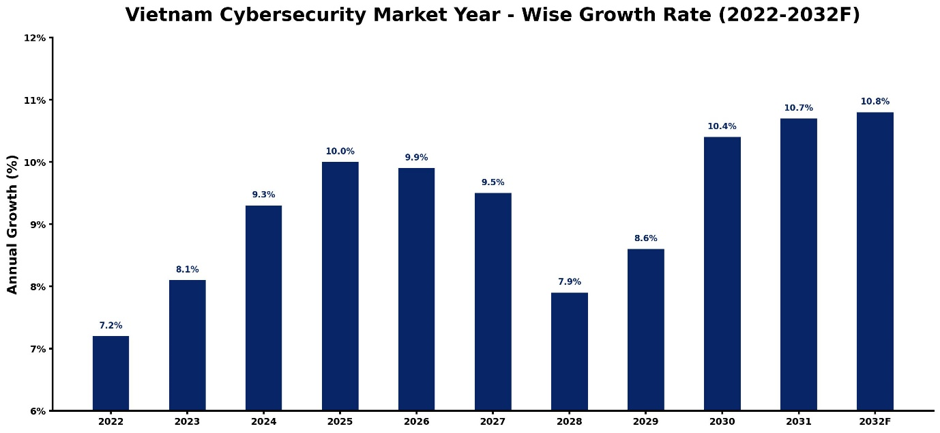
The following table summarizes the historical and forecasted growth rates of the Vietnam Cybersecurity Market, along with the rationale behind each year’s performance.
| Year | Estimated Growth (%) | Market Rationale |
| 2022 | 7.2% | Early-stage cybersecurity adoption driven by basic antivirus and digital banking expansion |
| 2023 | 8.1% | Rising phishing and ransomware attacks targeting fintech platforms |
| 2024 | 9.3% | Accelerated cloud migration across enterprises |
| 2025 | 10% | Strengthening enforcement of cybersecurity regulations |
| 2026 | 9.9% | Increased adoption of Zero Trust security models across government sectors |
| 2027 | 9.5% | Rapid expansion of cloud-native applications |
| 2028 | 7.9% | Widespread use of AI-based threat detection and automated security monitoring systems |
| 2029 | 8.6% | Market stabilization with improved compliance maturity across enterprises and SMEs |
| 2030 | 10.4% | Growth in protection of critical infrastructure including energy, telecom, and transport systems |
| 2031 | 10.7% | Expansion of Managed Security Services (MSSP) and advanced threat intelligence platforms |
| 2032 | 10.8% | Mature cybersecurity ecosystem with AI-driven autonomous security operations |
Topics Covered in the Vietnam Cybersecurity Market Report
The Vietnam Cybersecurity Industry report covers the market by solution type, deployment model, and end-user industry. The report provides a detailed analysis of ongoing cybersecurity threats, regulatory developments, and enterprise security transformation strategies shaping market growth.
Vietnam Cybersecurity Market Highlights
| Report Name | Vietnam Cybersecurity Market |
| Forecast period | 2026-2032 |
| CAGR | 12.96% |
| Growing Sector | BFSI, Government & IT Services |
Vietnam Cybersecurity Market Synopsis
The Vietnam Cybersecurity Market is witnessing substantial growth owing to the rapid expansion of digital infrastructure, increasing adoption of cloud computing, and rising cyber threats across banking, government, telecom, and enterprise sectors. The widespread deployment of cybersecurity solutions is aimed at securing sensitive data, critical information systems, and digital financial services against increasing threats from ransomware, phishing, and advanced persistent threats. As organizations adopt technologies such as artificial intelligence, Zero Trust security models, and cloud-based security platforms, they are increasing their ability to detect, prevent, and respond to cyberattacks in real time.
Evaluation of Growth Drivers in Vietnam Cybersecurity Market (2026–2032)
Below are some major drivers and their influence on the market dynamics:
| Drivers | Primary Segment Affected | Why It Matters (Evidence) |
| Rising cyberattacks and ransomware incidents | BFSI & Government | Increasing need for advanced threat detection and incident response systems |
| Rapid cloud adoption across enterprises | IT & Telecom | Expands demand for cloud security and identity management solutions |
| Enforcement of cybersecurity regulations | All industries | Drives compliance-based security investments across organizations |
| Growth of digital banking and fintech | Financial Services | Requires fraud prevention and real-time security monitoring systems |
| Expansion of critical infrastructure digitization | Energy & Transport | Necessitates industrial-grade cybersecurity protection systems |
The Vietnam cybersecurity market is estimated to grow at a CAGR of around 12.96% during the forecast period (2026-2032). The growth is driven by rapid digital transformation, growing cloud adoption, and increasing frequency of sophisticated cyberattacks across critical sectors such as banking, government, telecom, and enterprises. This ongoing shift is leading to higher demand for sophisticated cybersecurity solutions, including cloud security, endpoint protection, identity and access management, and AI-driven threat detection systems.
Evaluation of Restraints in Vietnam Cybersecurity Market
Below are some major restraints and their influence on the market dynamics:
| Restraints | Primary Segment Affected | What This Means (Evidence) |
| Shortage of skilled cybersecurity professionals | Enterprises | Limits deployment and management of advanced security systems |
| High cost of enterprise-grade solutions | SMEs | Slows adoption of advanced cybersecurity infrastructure |
| Limited cybersecurity awareness | SMEs | Increases vulnerability to cyber threats |
| Dependence on foreign technologies | Government & Enterprises | Creates strategic and operational dependency risks |
| Complex compliance requirements | All sectors | Increases operational and regulatory burden |
Vietnam Cybersecurity Market Challenges
The Vietnam Cybersecurity Industry faces the challenge of uneven cybersecurity maturity and infrastructure readiness across different sectors and organization sizes. Large enterprises, banks, and government agencies in major cities have adopted advanced security frameworks such as Security Operations Centers (SOCs), cloud security systems, and Zero Trust architectures, while many SMEs lack sufficient budgets, skilled cybersecurity professionals, and technical capabilities to implement robust protection systems. This gap increases vulnerability across interconnected digital ecosystems and creates inconsistent levels of cyber resilience nationwide.
Vietnam Cybersecurity Market Trends
Key trends influencing the Vietnam cybersecurity market growth include:
- Shift Toward Zero Trust Security Architecture: Organizations are adopting Zero Trust models that continuously verify users, devices and network access, thus reducing risks from internal and external threats.
- Rapid Integration of AI-Driven Threat Detection Systems: Cybersecurity platforms are using artificial intelligence and machine learning to identify anomalies, detect advanced threats, and enable faster incident response in real time.
- Expansion of Cloud Security and DevSecOps Practices: With accelerated cloud adoption, enterprises are embedding security into development pipelines (DevSecOps) and employing advanced cloud-native security solutions to protect distributed environments.
Investment Opportunities in the Vietnam Cybersecurity Market
Some of the profitable investments in the Vietnam cybersecurity industry include the following:
- Invest in AI-Driven Security Analytics and Threat Intelligence Solutions: High potential investment in artificial intelligence (AI) driven cybersecurity platforms that can identify threats in real time, predict risks, and automate responses.
- Creation of AI-Based Threat Intelligence and Security Analytics Solutions: High potential investment in artificial intelligence-driven cybersecurity platforms that can detect threats in real time, predict risks, and automate responses.
- Expansion of Cloud Security and Identity Access Management (IAM) Solutions: With a rapid transition to hybrid and multi-cloud environments by organizations, the demand for cloud-native security frameworks and IAM systems is increasing.
Top 5 Leading Players in Vietnam Cybersecurity Market
Below is a list of prominent companies operating in the Vietnam Cybersecurity Market:
Viettel Cyber Security
| Company Name | Viettel Cyber Security |
| Established Year | Hanoi, Vietnam |
| Headquarters | 2014 |
| Official Website | Click Here |
Viettel Cyber Security is a leading cybersecurity provider in Vietnam, offering advanced threat intelligence, Security Operations Center (SOC) services, penetration testing, and national-level cyber defense solutions for government and enterprises.
BKAV
| Company Name | BKAV |
| Established Year | 1995 |
| Headquarters | Hanoi, Vietnam |
| Official Website | Click Here |
BKAV is one of Vietnam’s earliest cybersecurity companies, known for its antivirus software, endpoint protection solutions, and enterprise security systems, serving both domestic and international markets.
FPT Information System (FPT IS)
| Company Name | FPT Information System (FPT IS) |
| Established Year | 1994 |
| Headquarters | Hanoi, Vietnam |
| Official Website | Click Here |
FPT IS provides comprehensive cybersecurity services including cloud security, managed security services, system integration, and enterprise-grade digital protection solutions.
CyRadar
| Company Name | CyRadar |
| Established Year | Hanoi, Vietnam |
| Headquarters | 2017 |
| Official Website | Click Here |
CyRadar is a Vietnamese cybersecurity company focused on AI-powered threat detection, network security monitoring, email security, and cyber threat intelligence solutions.
CMC Cyber Security
| Company Name | CMC Cyber Security |
| Established Year | 1993 |
| Headquarters | Hanoi, Vietnam |
| Official Website | Click Here |
CMC Cyber Security is one of Vietnam’s leading cybersecurity providers, offering managed security services, SOC operations, penetration testing, vulnerability assessment, and enterprise cyber defense solutions.
Government Initiatives Being Implemented in the Vietnam Cybersecurity Market
The Government of Vietnam has placed a strong emphasis on strengthening national cybersecurity infrastructure through comprehensive laws, regulations and strategic digital security programmes to secure critical information systems and digital assets. Furthermore, the government has launched the National Cybersecurity Strategy and Digital Transformation Programme to improve the country’s cyber resilience, increase the number of Security Operations Centres (SOCs), and encourage the acceptance of cutting-edge cybersecurity services like AI-based threat detection, Zero Trust architecture, and cloud security models.
Future Insights of the Vietnam Cybersecurity Market
The Vietnam Cybersecurity Market is expected to experience sustained growth, driven by ongoing digital transformation, cloud adoption, and rising cyber threats that are transforming the country’s technology landscape. From banking to government, telecom to enterprise, organizations are anticipated to invest heavily in advanced cybersecurity frameworks, such as AI-driven threat detection systems, Zero Trust security architectures, and cloud-native protection platforms, to enhance digital resilience and protect critical data infrastructure. The rising adoption of digital services, expansion of IoT ecosystems, and growing sophistication of cyberattacks will further accelerate demand for proactive security solutions, real-time threat intelligence, and managed security services across Vietnam’s rapidly evolving digital economy.
Market Segmentation Analysis
This report offers a comprehensive study of the following market segments and their leading categories:
By Security Type – Cloud Security and Identity Access Management Lead the Market
According to Vasudha, Senior Research Analyst, 6Wresearch, Cloud Security and Identity Access Management (IAM) secured a dominant 42.6% share of the Vietnam cybersecurity market value in 2025. This is driven by rapid cloud migration across enterprises, BFSI institutions, and government agencies, requiring strong identity verification, access control, and data protection across distributed digital environments. Conversely, Infrastructure Protection and Data Security solutions are projected to advance at a strong CAGR of 13.2% during 2026–2032, fueled by increasing cyberattacks on critical infrastructure such as energy systems, telecommunications networks, and financial institutions.
By Deployment – Cloud Security Expands Fast
The On-Premise deployment model retained a significant 51.3% share of the Vietnam cybersecurity market in 2025, particularly among government organizations and regulated industries that prioritize strict data control, compliance, and internal infrastructure security. Simultaneously, cloud-based cybersecurity solutions are anticipated to witness a strong CAGR of 13.8% during 2026–2032, owing to the fast adoption of the enterprise cloud and hybrid work environments.
By End User – BFSI and Government Lead, IT & Telecom Expands Rapidly
The BFSI and Government & Defense sectors accounted for a dominant 49.6% share of the Vietnam cybersecurity market in 2025, driven by increasing cyber threats targeting financial systems, sensitive government data, and critical national infrastructure. Meanwhile, the IT & Telecommunication segment is anticipated to register the highest CAGR during forecast period 2026–2032 at 14.1% CAGR, owing to the rapid digital transformation, expansion of 5G, adoption of cloud services, and increased reliance on connected digital ecosystems.
Note: Market size estimations and growth projections presented in this report are based on 6Wresearch’s advanced forecasting approach, validated with industry datasets as of June 2026.
Key Attractiveness of the Report:
- 10 Years of Market Numbers
- Historical Data Starting from 2022 to 2025
- Base Year: 2025
- Forecast Data until 2032
- Key Performance Indicators Impacting the Market
- Major Upcoming Developments and Projects
Key Highlights of the Report:
- Vietnam Cybersecurity Market Outlook
- Market Size of Vietnam Cybersecurity Market, 2025
- Forecast of Vietnam Cybersecurity Market, 2032
- Historical Data and Forecast of Vietnam Cybersecurity Revenues & Volume for the Period 2022- 2032
- Vietnam Cybersecurity Market Trend Evolution
- Vietnam Cybersecurity Market Drivers and Challenges
- Vietnam Cybersecurity Price Trends
- Vietnam Cybersecurity Porter's Five Forces
- Vietnam Cybersecurity Industry Life Cycle
- Historical Data and Forecast of Vietnam Cybersecurity Market Revenues & Volume By Security Type for the Period 2022- 2032
- Historical Data and Forecast of Vietnam Cybersecurity Market Revenues & Volume By Cloud Security for the Period 2022- 2032
- Historical Data and Forecast of Vietnam Cybersecurity Market Revenues & Volume By Data Security for the Period 2022- 2032
- Historical Data and Forecast of Vietnam Cybersecurity Market Revenues & Volume By Identity Access Management for the Period 2022- 2032
- Historical Data and Forecast of Vietnam Cybersecurity Market Revenues & Volume By Network Security for the Period 2022- 2032
- Historical Data and Forecast of Vietnam Cybersecurity Market Revenues & Volume By Consumer Security for the Period 2022- 2032
- Historical Data and Forecast of Vietnam Cybersecurity Market Revenues & Volume By Infrastructure Protection for the Period 2022- 2032
- Historical Data and Forecast of Vietnam Cybersecurity Market Revenues & Volume By Others for the Period 2022- 2032
- Historical Data and Forecast of Vietnam Cybersecurity Market Revenues & Volume By Deployment for the Period 2022- 2032
- Historical Data and Forecast of Vietnam Cybersecurity Market Revenues & Volume By Cloud for the Period 2022- 2032
- Historical Data and Forecast of Vietnam Cybersecurity Market Revenues & Volume By On-Premise for the Period 2022- 2032
- Historical Data and Forecast of Vietnam Cybersecurity Market Revenues & Volume By End-User for the Period 2022- 2032
- Historical Data and Forecast of Vietnam Cybersecurity Market Revenues & Volume By BFSI for the Period 2022- 2032
- Historical Data and Forecast of Vietnam Cybersecurity Market Revenues & Volume By Healthcare for the Period 2022- 2032
- Historical Data and Forecast of Vietnam Cybersecurity Market Revenues & Volume By Manufacturing for the Period 2022- 2032
- Historical Data and Forecast of Vietnam Cybersecurity Market Revenues & Volume By Government and Defense for the Period 2022- 2032
- Historical Data and Forecast of Vietnam Cybersecurity Market Revenues & Volume By IT and Telecommunication for the Period 2022- 2032
- Historical Data and Forecast of Vietnam Cybersecurity Market Revenues & Volume By Others for the Period 2022- 2032
- Vietnam Cybersecurity Import Export Trade Statistics
- Market Opportunity Assessment By Security Type
- Market Opportunity Assessment By Deployment
- Market Opportunity Assessment By End-User
- Vietnam Cybersecurity Top Companies Market Share
- Vietnam Cybersecurity Competitive Benchmarking By Technical and Operational Parameters
- Vietnam Cybersecurity Company Profiles
- Vietnam Cybersecurity Key Strategic Recommendations
Market Covered
The report offers an extensive study of the following market segments:
By Security Type
- Cloud Security
- Data Security
- Identity & Access Management
- Network Security
- Consumer Security
- Infrastructure Protection
- Others
By Deployment
- Cloud
- On-Premise
By End User
- BFSI
- Healthcare
- Manufacturing
- Government & Defense
- IT & Telecommunication
- Others






































