Vietnam Diatomite Market Size Growth Rate
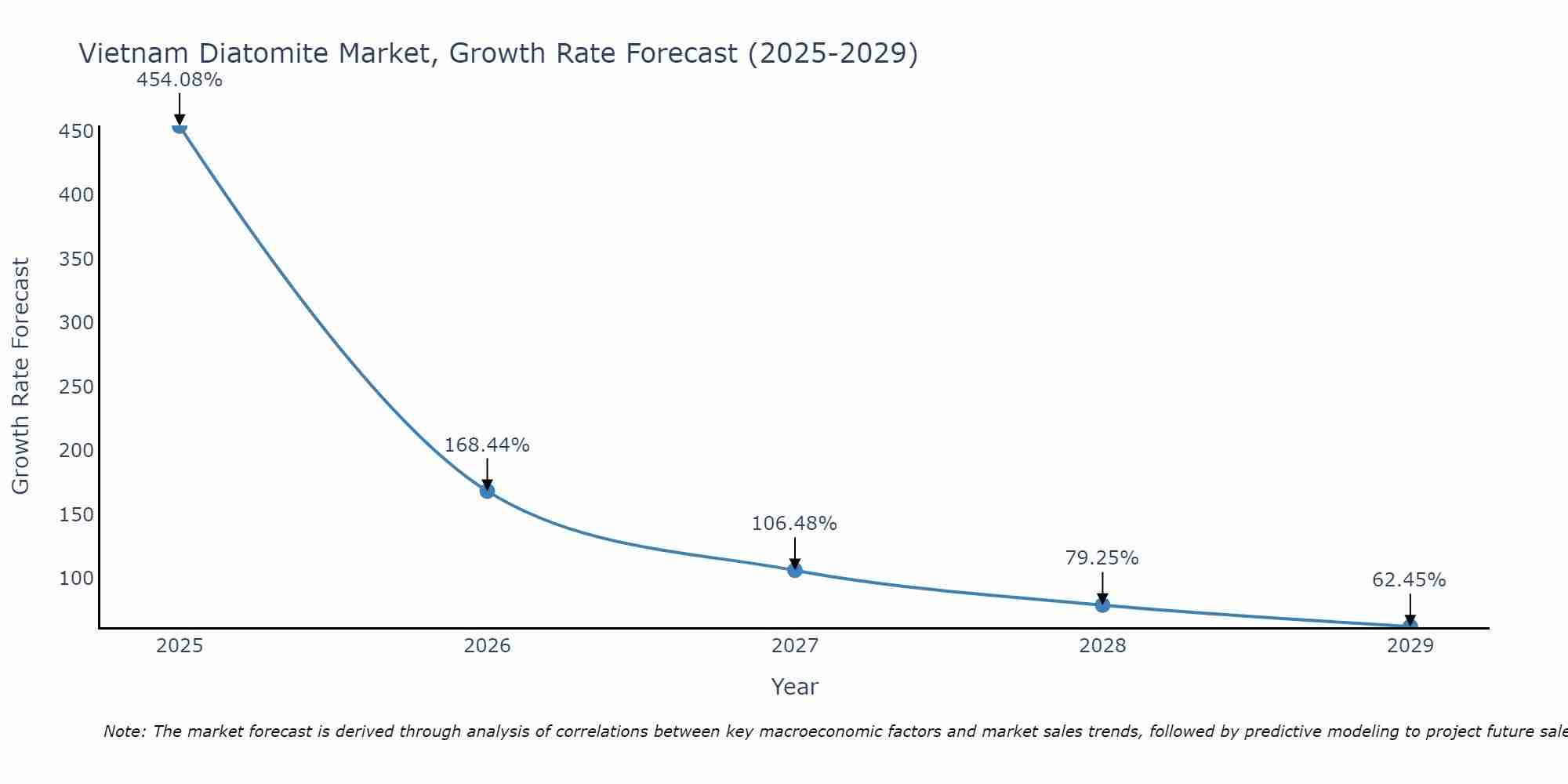
The Vietnam Diatomite Market could see a tapering of growth rates over 2025 to 2029. Beginning strongly at 454.08% in 2025, growth softens to 62.45% in 2029.
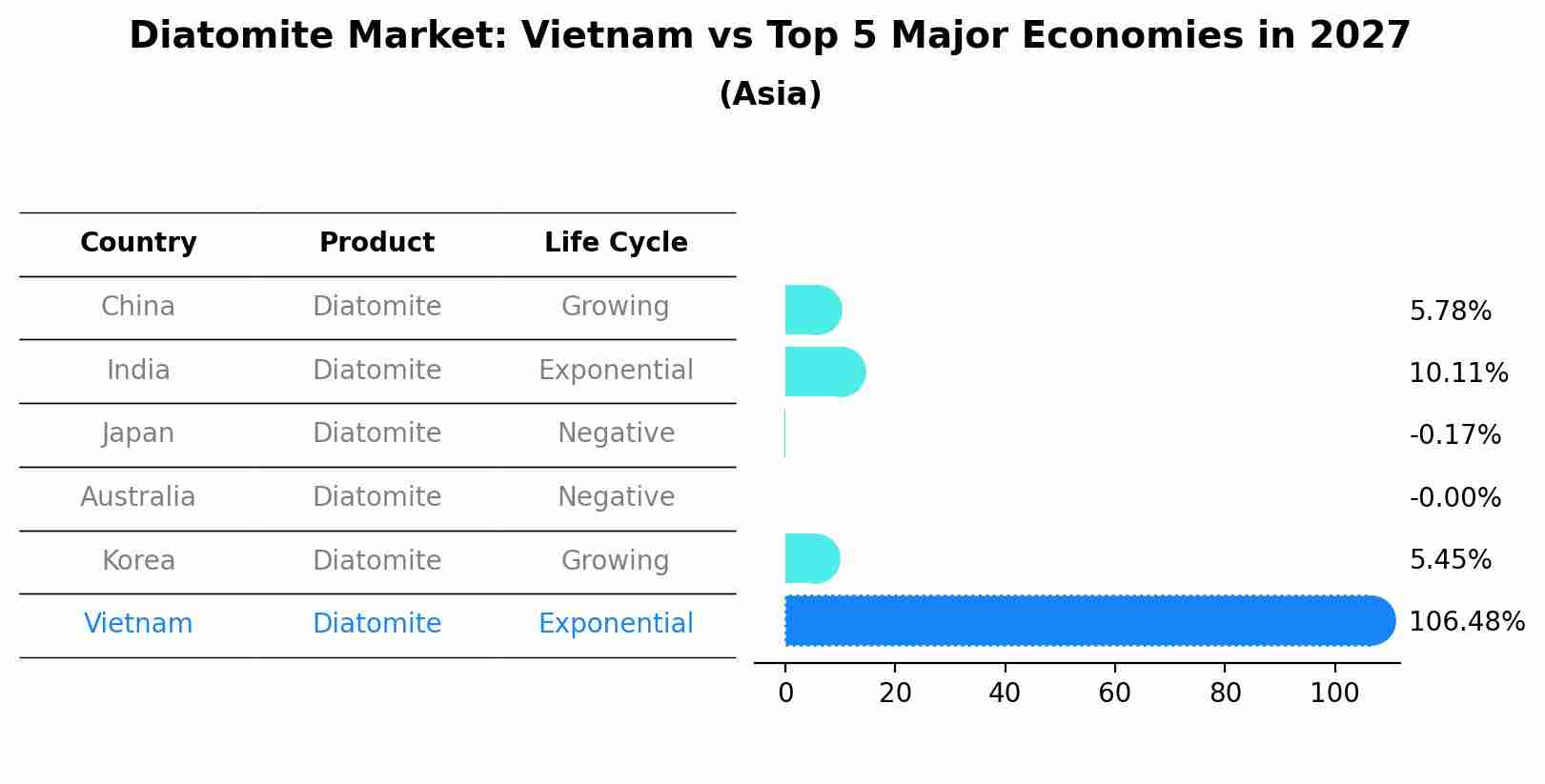
Diatomite Market: Vietnam vs Top 5 Major Economies in 2027 (Asia)
In the Asia region, the Diatomite market in Vietnam is projected to expand at a exponential growth rate of 106.48% by 2027. The largest economy is China, followed by India, Japan, Australia and South Korea.
Vietnam Diatomite Market Synopsis
The Vietnam diatomite market specializes in diatomaceous earth, a naturally occurring siliceous sedimentary rock with various industrial and agricultural applications. Diatomite is known for its absorbent and filtration properties, making it valuable in industries such as agriculture, filtration, and cosmetics. The market serves diverse industries requiring diatomite for specific functions.
Drivers of the Market
The Vietnam diatomite market has seen growth due to the versatile applications of diatomaceous earth in industries such as agriculture, filtration, and cosmetics. A significant driver is the demand for diatomite known for its absorbent, abrasive, and natural properties. In agriculture, diatomaceous earth is used as a natural insecticide and soil conditioner. Moreover, the filtration industry relies on diatomite for water and beverage filtration. Additionally, the cosmetics sector incorporates diatomite into skincare and personal care products for its exfoliating and oil-absorbing qualities. The market for diatomite has expanded to meet the diverse needs of these industries, contributing to its growth.
Challenges of the Market
Challenges in the Vietnam diatomite market include the need for sustainable and eco-friendly diatomaceous earth products. Ensuring diatomite quality, purity, and compliance with environmental regulations while managing production costs and addressing industrial and agricultural demands pose ongoing challenges. Market players must also adapt to evolving applications of diatomite.
COVID-19 Impact on the Market
The COVID-19 pandemic had an impact on the Vietnam diatomite market. Disruptions in industrial processes and filtration applications initially affected diatomite demand. Nevertheless, as industrial operations and environmental concerns persisted post-pandemic, the market began to recover, focusing on filtration efficiency and sustainability.
Key Players in the Market
Prominent players in the Vietnam Diatomite Market include DiatomiteMiners Vietnam and IndustrialMaterials Co., Ltd. They are involved in the mining and supply of diatomaceous earth, commonly used in filtration and industrial applications.
Key Highlights of the Report:
- Vietnam Diatomite Market Outlook
- Market Size of Vietnam Diatomite Market, 2024
- Forecast of Vietnam Diatomite Market, 2031
- Historical Data and Forecast of Vietnam Diatomite Revenues & Volume for the Period 2021-2031
- Vietnam Diatomite Market Trend Evolution
- Vietnam Diatomite Market Drivers and Challenges
- Vietnam Diatomite Price Trends
- Vietnam Diatomite Porter's Five Forces
- Vietnam Diatomite Industry Life Cycle
- Historical Data and Forecast of Vietnam Diatomite Market Revenues & Volume By Type for the Period 2021-2031
- Historical Data and Forecast of Vietnam Diatomite Market Revenues & Volume By Natural for the Period 2021-2031
- Historical Data and Forecast of Vietnam Diatomite Market Revenues & Volume By Calcined for the Period 2021-2031
- Historical Data and Forecast of Vietnam Diatomite Market Revenues & Volume By Flux Calcined for the Period 2021-2031
- Historical Data and Forecast of Vietnam Diatomite Market Revenues & Volume By Application for the Period 2021-2031
- Historical Data and Forecast of Vietnam Diatomite Market Revenues & Volume By Filter Aids for the Period 2021-2031
- Historical Data and Forecast of Vietnam Diatomite Market Revenues & Volume By Filler for the Period 2021-2031
- Historical Data and Forecast of Vietnam Diatomite Market Revenues & Volume By Absorbents for the Period 2021-2031
- Historical Data and Forecast of Vietnam Diatomite Market Revenues & Volume By Construction Materials for the Period 2021-2031
- Historical Data and Forecast of Vietnam Diatomite Market Revenues & Volume By Others for the Period 2021-2031
- Vietnam Diatomite Import Export Trade Statistics
- Market Opportunity Assessment By Type
- Market Opportunity Assessment By Application
- Vietnam Diatomite Top Companies Market Share
- Vietnam Diatomite Competitive Benchmarking By Technical and Operational Parameters
- Vietnam Diatomite Company Profiles
- Vietnam Diatomite Key Strategic Recommendations






































