Vietnam Energy Efficient Lighting Market Size, Share & Growth Rate
The Vietnam Energy Efficient Lighting Market was estimated at USD 270 Million in 2025 and is projected to reach USD 381 Million by 2032, growing at a CAGR of 5.0% from 2026 to 2032. This growth trajectory is primarily fueled by increasing environmental awareness among consumers and businesses, coupled with governmental initiatives promoting green technologies. As the demand for sustainable solutions rises, the market is shifting towards innovative lighting technologies that lower both energy consumption and operational costs.
Vietnam Energy Efficient Lighting Market Year-wise Growth Rate and Key Drivers
This graph highlights how the Vietnam Energy Efficient Lighting Market has steadily grown over the years, supported by major growth factors.
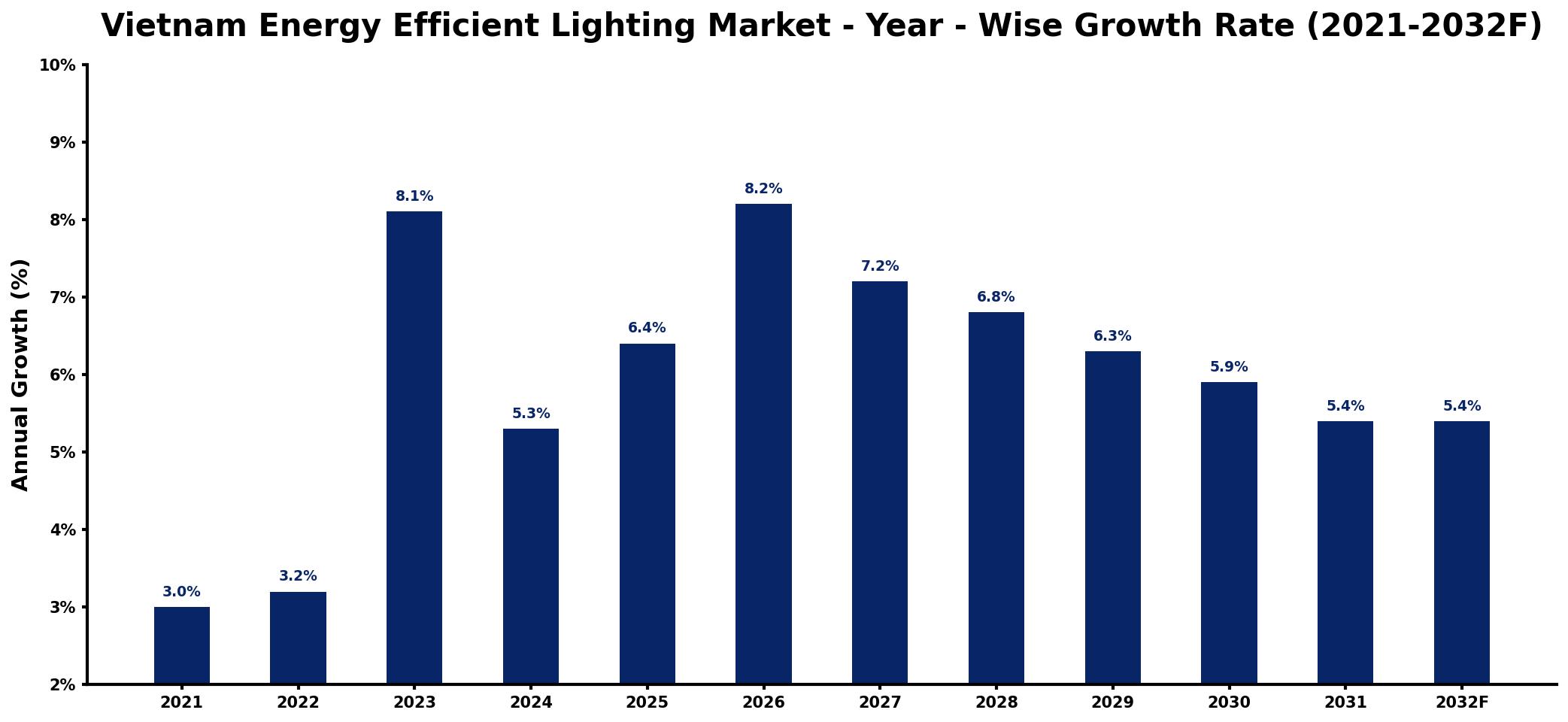
The table below presents the year‑wise growth rates along with the key drivers influencing the market
| Year | Growth Rate | Major Drivers |
| 2021 | 3.0% | Increased consumer awareness initiatives |
| 2022 | 3.2% | Government incentives for adoption |
| 2023 | 8.1% | Rising demand for sustainable solutions |
| 2024 | 5.3% | rising procurement volume requirements |
| 2025 | 6.4% | Growing investments in infrastructure |
| 2026 | 8.2% | Technological advancements in alternatives |
| 2027 | 7.2% | Enhanced regulations promoting sustainability |
| 2028 | 6.8% | Corporate responsibility initiatives gaining traction |
| 2029 | 6.3% | Emergence of new market players |
| 2030 | 5.9% | Focus on reducing operational costs |
| 2031 | 5.4% | Increased collaboration among industries |
| 2032 | 5.4% | Growing interest in smart applications |
Note: Market size estimations and growth projections presented in this report are based on 6Wresearch's proprietary forecasting methodology, utilizing the latest available industry data, government publications, and primary research inputs.
Vietnam Energy Efficient Lighting Market Synopsis
The strongest force shaping the Vietnam Energy Efficient Lighting Market right now is the growing emphasis on environmental sustainability. Stakeholders are increasingly recognizing the importance of energy-efficient lighting solutions as integral to reducing carbon footprints and enhancing energy conservation. This heightened awareness is supported by government policies that incentivize the adoption of energy-saving technologies.
Alongside environmental concerns, economic factors also play a significant role in this market's dynamics. As residential and commercial consumers seek to minimize electricity costs, energy-efficient lighting options, such as LED and CFL bulbs, have gained traction. This convergence of environmental and financial motivations is set to drive further growth in the sector.
Vietnam Energy Efficient Lighting Market Key Takeaways
- The market is anticipated to grow steadily, driven by increasing energy-saving initiatives.
- Government regulations are promoting the adoption of eco-friendly lighting technologies.
- Consumer demand for lower electricity bills is propelling the market forward.
- Affordability remains a key challenge for wider adoption of energy-efficient solutions.
- COVID-19 has shifted consumer behavior, favoring online sales channels for lighting products.
Evaluation of Restraints in Vietnam Energy Efficient Lighting Market
While the Vietnam Energy Efficient Lighting Market shows promise, certain restraints hinder its full potential. Primarily, affordability presents a significant barrier; despite the long-term savings offered by energy-efficient solutions, initial costs can deter consumers. Additionally, a lack of awareness regarding the benefits of these technologies persists among certain demographics. Manufacturers must focus on reducing costs and enhancing consumer education to ensure widespread acceptance and integration of energy-efficient lighting solutions.
Vietnam Energy Efficient Lighting Market Trends
Several current and emerging trends are shaping the Vietnam Energy Efficient Lighting Market. The increasing integration of smart lighting technologies, including IoT-enabled systems, is becoming prevalent as consumers seek greater control and efficiency. Furthermore, the trend towards eco-friendly products is gaining momentum, with manufacturers exploring sustainable materials for light fittings and packaging. This shift is reflected in the growing popularity of LED and CFL products, which promise both energy savings and extended lifespans.
Vietnam Energy Efficient Lighting Market Opportunities
The potential for growth and investment within the Vietnam Energy Efficient Lighting Market is substantial. As the government continues to prioritize sustainable development, opportunities exist for companies to innovate and introduce new lighting technologies. Additionally, untapped segments such as rural electrification and public infrastructure projects present lucrative avenues for expansion. Companies that can offer cost-effective, energy-efficient solutions tailored to these segments will likely see significant returns on investment.
Government Initiatives in the Vietnam Energy Efficient Lighting Market
The Vietnamese government is actively promoting energy efficiency through various initiatives and policies aimed at reducing electricity consumption. These include subsidies for energy-efficient lighting products and awareness campaigns designed to educate consumers about the benefits of energy conservation. Public spending on sustainable infrastructure also supports the adoption of energy-efficient lighting solutions in both urban and rural areas, creating a conducive environment for market growth.
Future Insights of the Vietnam Energy Efficient Lighting Market
Looking ahead to the years 2026-2032, the Vietnam Energy Efficient Lighting Market is poised for robust growth. As consumers become more environmentally conscious and governments bolster their sustainability efforts, demand for energy-efficient lighting solutions will only intensify. Innovations in technology, especially in smart lighting and IoT integration, will further enhance the appeal of these products, potentially leading to increased adoption rates across both residential and commercial sectors.
Vietnam Energy Efficient Lighting Market Latest Developments (2025 - 2026)
In recent months, the Vietnam Energy Efficient Lighting Market has seen notable shifts toward digitalization, with manufacturers enhancing their online presence to accommodate changing consumer behaviors post-COVID-19. The introduction of new energy-efficient product lines that cater to smart homes has gained traction, reflecting broader global trends. Additionally, collaborative efforts between the government and private sector are ramping up, aiming to create more incentives for adopting sustainable lighting solutions.
Vietnam Energy Efficient Lighting Market - Key Attractiveness of the Report
- 10 Years of Market Numbers
- Historical Data Starting from 2022 to 2025
- Base Year: 2025
- Forecast Data until 2032
- Key Performance Indicators Impacting the Market
- Major Upcoming Developments and Projects
Key Highlights of the Report:
- Vietnam Energy Efficient Lighting Market Outlook
- Market Size of Vietnam Energy Efficient Lighting Market, 2025
- Forecast of Vietnam Energy Efficient Lighting Market, 2032
- Historical Data and Forecast of Vietnam Energy Efficient Lighting Revenues & Volume for the Period 2022-2032F
- Vietnam Energy Efficient Lighting Market Trend Evolution
- Vietnam Energy Efficient Lighting Market Drivers and Challenges
- Vietnam Energy Efficient Lighting Price Trends
- Vietnam Energy Efficient Lighting Porter's Five Forces
- Vietnam Energy Efficient Lighting Industry Life Cycle
- Historical Data and Forecast of Vietnam Energy Efficient Lighting Market Revenues & Volume By Product Type for the Period 2022-2032F
- Historical Data and Forecast of Vietnam Energy Efficient Lighting Market Revenues & Volume By Incandescent Lamp for the Period 2022-2032F
- Historical Data and Forecast of Vietnam Energy Efficient Lighting Market Revenues & Volume By Light Emitting Diode for the Period 2022-2032F
- Historical Data and Forecast of Vietnam Energy Efficient Lighting Market Revenues & Volume By Arc Lamp for the Period 2022-2032F
- Historical Data and Forecast of Vietnam Energy Efficient Lighting Market Revenues & Volume By Gas Discharge Lamps for the Period 2022-2032F
- Historical Data and Forecast of Vietnam Energy Efficient Lighting Market Revenues & Volume By Application for the Period 2022-2032F
- Historical Data and Forecast of Vietnam Energy Efficient Lighting Market Revenues & Volume By Commercial for the Period 2022-2032F
- Historical Data and Forecast of Vietnam Energy Efficient Lighting Market Revenues & Volume By Residential for the Period 2022-2032F
- Historical Data and Forecast of Vietnam Energy Efficient Lighting Market Revenues & Volume By Government for the Period 2022-2032F
- Historical Data and Forecast of Vietnam Energy Efficient Lighting Market Revenues & Volume By Correlated Color Temperature for the Period 2022-2032F
- Historical Data and Forecast of Vietnam Energy Efficient Lighting Market Revenues & Volume By 2700K-3000K for the Period 2022-2032F
- Historical Data and Forecast of Vietnam Energy Efficient Lighting Market Revenues & Volume By 3500K??4000K for the Period 2022-2032F
- Historical Data and Forecast of Vietnam Energy Efficient Lighting Market Revenues & Volume By 4000K-5000K for the Period 2022-2032F
- Historical Data and Forecast of Vietnam Energy Efficient Lighting Market Revenues & Volume By 5000K-6500K for the Period 2022-2032F
- Historical Data and Forecast of Vietnam Energy Efficient Lighting Market Revenues & Volume By More Than 6500K for the Period 2022-2032F
- Vietnam Energy Efficient Lighting Import Export Trade Statistics
- Market Opportunity Assessment By Product Type
- Market Opportunity Assessment By Application
- Market Opportunity Assessment By Correlated Color Temperature
- Vietnam Energy Efficient Lighting Top Companies Market Share
- Vietnam Energy Efficient Lighting Competitive Benchmarking By Technical and Operational Parameters
- Vietnam Energy Efficient Lighting Company Profiles
- Vietnam Energy Efficient Lighting Key Strategic Recommendations






































