Vietnam Ferro Aluminum Market Size, Share & Growth Rate
The Vietnam Ferro Aluminum Market was estimated at USD 330 Million in 2025 and is projected to reach USD 467 Million by 2032, growing at a CAGR of 5.1% from 2026 to 2032. This growth trajectory is underpinned by robust demand from key sectors, especially automotive and construction, where lightweight yet durable materials are increasingly sought after. Furthermore, heightened industrialization initiatives and foreign investment in manufacturing are amplifying the markets potential.
Vietnam Ferro Aluminum Market Year-wise Growth Rate and Key Drivers
This graph highlights how the Vietnam Ferro Aluminum Market has steadily grown over the years, supported by major growth factors.
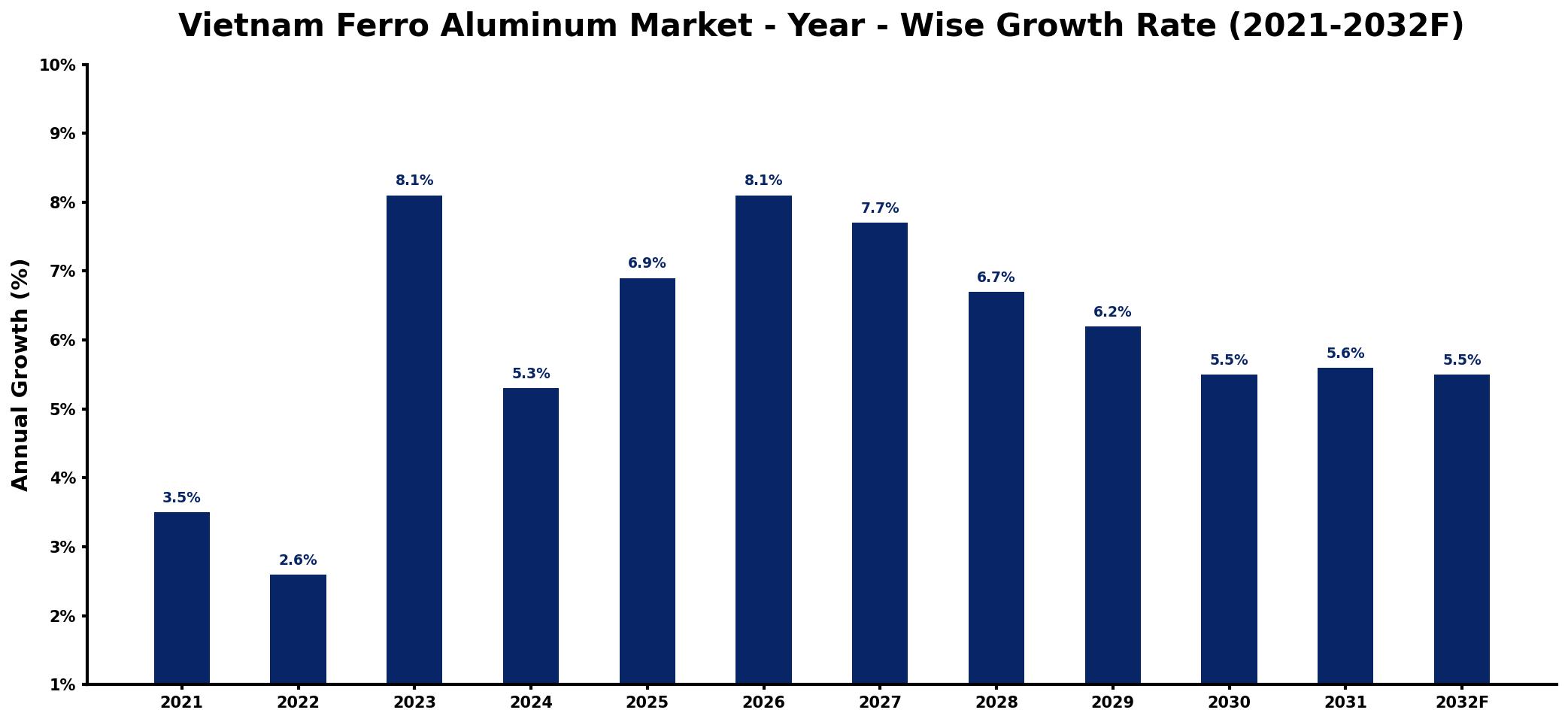
The table below presents the year‑wise growth rates along with the key drivers influencing the market
| Year | Growth Rate | Major Drivers |
| 2021 | 3.5% | Rising construction sector investments |
| 2022 | 2.6% | Increased demand from manufacturing |
| 2023 | 8.1% | Surge in automotive production levels |
| 2024 | 5.3% | Growth in renewable energy projects |
| 2025 | 6.9% | Expansion of infrastructure initiatives |
| 2026 | 8.1% | Technological advancements in industry |
| 2027 | 7.7% | Increased exports to neighboring countries |
| 2028 | 6.7% | Higher consumer spending trends |
| 2029 | 6.2% | growing automotive sector requirements |
| 2030 | 5.5% | Rising demand for transportation vehicles |
| 2031 | 5.6% | Investment in sustainable energy solutions |
| 2032 | 5.5% | Increase in industrial production capacity |
Note: Market size estimations and growth projections presented in this report are based on 6Wresearch's proprietary forecasting methodology, utilizing the latest available industry data, government publications, and primary research inputs.
Vietnam Ferro Aluminum Market Synopsis
The Vietnam Ferro Aluminum market has experienced considerable momentum, driven primarily by its crucial role in steelmaking and aluminum alloy production. As demand in the automotive, aerospace, and electronics sectors accelerates, the market is well-positioned for further growth.
Looking ahead, the market is likely to evolve as manufacturers enhance product quality and efficiency to meet the diverse requirements across industries. This evolution will ensure a strong competitive presence as the need for advanced aluminum alloys continues to rise.
Vietnam Ferro Aluminum Market Key Takeaways
- Significant demand from the automotive sector is propelling market growth.
- The aerospace and electronics industries are increasingly adopting high-quality aluminum alloys, further expanding the market.
- Government initiatives aimed at industrialization are fostering an environment conducive to market expansion.
- Energy-intensive production processes pose challenges that manufacturers must navigate.
- Continued investments in infrastructure development promise sustained demand for ferro aluminum.
Evaluation of Restraints in Vietnam Ferro Aluminum Market
Despite the markets promising outlook, several factors hinder its growth. The energy-intensive nature of ferro aluminum production makes it vulnerable to fluctuations in energy prices, impacting overall profitability. Additionally, meeting stringent quality control and alloy composition requirements can present challenges for manufacturers, requiring constant vigilance and adaptation. These issues necessitate strategic planning and efficient operational practices to mitigate potential setbacks.
Vietnam Ferro Aluminum Market Trends
Current trends highlight a shift towards sustainable manufacturing practices in the ferro aluminum industry. Companies are increasingly prioritizing energy efficiency and the use of recycled materials in production. Moreover, innovations in alloy composition are leading to improved performance characteristics, catering to the evolving needs of sectors such as automotive and aerospace. These trends signify a transformative phase in the market, aligning with global sustainability goals.
Vietnam Ferro Aluminum Market Opportunities
The Vietnamese Ferro Aluminum market offers numerous growth and investment opportunities, particularly in enhancing production technologies and processes. With the demand for lightweight materials on the rise, manufacturers can capitalize on the development of specialized alloys tailored for specific applications. Additionally, foreign investments aimed at local production capabilities could significantly bolster market expansion, making it an attractive landscape for stakeholders.
Government Initiatives in the Vietnam Ferro Aluminum Market
The Vietnamese government has implemented several initiatives to stimulate the manufacturing sector, including tax incentives and support for infrastructure development. These efforts are designed to attract foreign investment and boost domestic production capabilities. Additionally, policies focusing on industrial modernization are paving the way for technological advancements in the ferro aluminum sector, further enhancing its growth potential.
Future Insights of the Vietnam Ferro Aluminum Market
Between 2026 and 2032, the Vietnam Ferro Aluminum market is expected to evolve significantly, driven by increasing industrial demand and technological innovations. As sectors such as automotive and construction ramp up, the need for high-quality, efficient aluminum alloys will likely intensify. Furthermore, ongoing government support and strategic partnerships in manufacturing are anticipated to propel the market toward greater stability and expansion, positioning Vietnam as a key player in the global ferro aluminum landscape.
Vietnam Ferro Aluminum Market Latest Developments (2025 - 2026)
Recent developments in the Vietnam ferro aluminum market indicate a robust focus on enhancing production capacities. Manufacturers are investing in state-of-the-art technologies to optimize efficiency and reduce energy consumption. Moreover, partnerships are being formed to explore innovative applications of ferro aluminum in emerging sectors, highlighting the markets adaptability in response to shifting industry demands.
Vietnam Ferro Aluminum Market - Key Attractiveness of the Report
- 10 Years of Market Numbers
- Historical Data Starting from 2022 to 2025
- Base Year: 2025
- Forecast Data until 2032
- Key Performance Indicators Impacting the Market
- Major Upcoming Developments and Projects
Key Highlights of the Report:
- Vietnam Ferro Aluminum Market Outlook
- Market Size of Vietnam Ferro Aluminum Market, 2025
- Forecast of Vietnam Ferro Aluminum Market, 2032
- Historical Data and Forecast of Vietnam Ferro Aluminum Revenues & Volume for the Period 2022-2032F
- Vietnam Ferro Aluminum Market Trend Evolution
- Vietnam Ferro Aluminum Market Drivers and Challenges
- Vietnam Ferro Aluminum Price Trends
- Vietnam Ferro Aluminum Porter's Five Forces
- Vietnam Ferro Aluminum Industry Life Cycle
- Historical Data and Forecast of Vietnam Ferro Aluminum Market Revenues & Volume By Type for the Period 2022-2032F
- Historical Data and Forecast of Vietnam Ferro Aluminum Market Revenues & Volume By Pure Ferro Aluminium Alloy for the Period 2022-2032F
- Historical Data and Forecast of Vietnam Ferro Aluminum Market Revenues & Volume By Ferro Aluminium Alloy Mixture for the Period 2022-2032F
- Historical Data and Forecast of Vietnam Ferro Aluminum Market Revenues & Volume By Application for the Period 2022-2032F
- Historical Data and Forecast of Vietnam Ferro Aluminum Market Revenues & Volume By Automobile Industry for the Period 2022-2032F
- Historical Data and Forecast of Vietnam Ferro Aluminum Market Revenues & Volume By Machinery Manufacturing for the Period 2022-2032F
- Historical Data and Forecast of Vietnam Ferro Aluminum Market Revenues & Volume By Fireworks Industry for the Period 2022-2032F
- Historical Data and Forecast of Vietnam Ferro Aluminum Market Revenues & Volume By Other for the Period 2022-2032F
- Vietnam Ferro Aluminum Import Export Trade Statistics
- Market Opportunity Assessment By Type
- Market Opportunity Assessment By Application
- Vietnam Ferro Aluminum Top Companies Market Share
- Vietnam Ferro Aluminum Competitive Benchmarking By Technical and Operational Parameters
- Vietnam Ferro Aluminum Company Profiles
- Vietnam Ferro Aluminum Key Strategic Recommendations






































