Vietnam Functional Apparel Market Size, Share & Growth Rate
The Vietnam Functional Apparel Market was estimated at USD 321 Million in 2025 and is projected to reach USD 454 Million by 2032, growing at a CAGR of 5.1% from 2026 to 2032. This growth trajectory is underpinned by a robust increase in health consciousness among consumers, a rising inclination towards outdoor activities, and stringent workplace safety regulations. As consumers continue to prioritize functionality alongside style, the demand for versatile and performance-driven apparel is set to surge.
Vietnam Functional Apparel Market Year-wise Growth Rate and Key Drivers
This graph highlights how the Vietnam Functional Apparel Market has steadily grown over the years, supported by major growth factors.
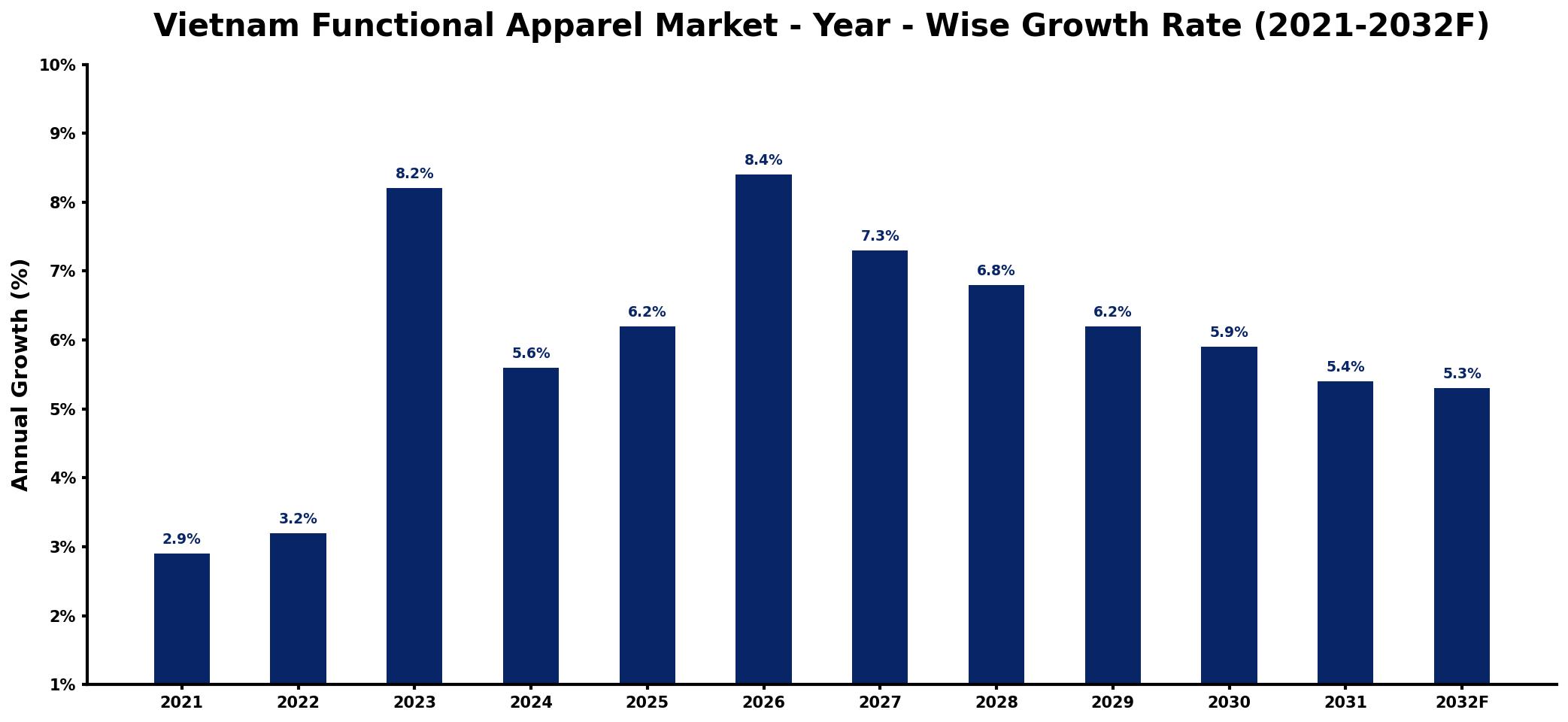
The table below presents the year‑wise growth rates along with the key drivers influencing the market
| Year | Growth Rate | Major Drivers |
| 2021 | 2.9% | Rising outdoor activity participation |
| 2022 | 3.2% | Increased health awareness initiatives |
| 2023 | 8.2% | Growing e-commerce platform sales |
| 2024 | 5.6% | Expansion of fitness facilities |
| 2025 | 6.2% | Increased disposable income levels |
| 2026 | 8.4% | Emergence of sustainable materials |
| 2027 | 7.3% | Technological advancements in textiles |
| 2028 | 6.8% | Shift towards athleisure trends |
| 2029 | 6.2% | Growing interest in wellness lifestyles |
| 2030 | 5.9% | Rise in personalized fashion trends |
| 2031 | 5.4% | Increased investment in innovation |
| 2032 | 5.3% | Strengthened retail distribution networks |
Note: Market size estimations and growth projections presented in this report are based on 6Wresearch's proprietary forecasting methodology, utilizing the latest available industry data, government publications, and primary research inputs.
Vietnam Functional Apparel Market Synopsis
The most significant force shaping the Vietnam Functional Apparel Market is the increasing interest in health and fitness among the population. This trend, combined with a growing enthusiasm for outdoor activities, drives the need for specialized apparel that enhances performance and ensures comfort.
Additionally, the rising trend of athleisure wear is fostering a culture where consumers seek apparel that can transition seamlessly from workouts to everyday life. This evolution reflects a broader lifestyle shift toward active living, further propelling market dynamics.
Vietnam Functional Apparel Market Key Takeaways
- The market is poised for steady growth due to increased participation in sports and outdoor activities.
- Health and wellness trends significantly drive consumer preferences for performance-oriented clothing.
- Technological innovations in fabric and design are key factors shaping product offerings.
- Affordability and quality assurance are critical for building consumer trust in functional apparel.
- The COVID-19 pandemic accelerated a shift towards e-commerce, reshaping retail strategies within the market.
Evaluation of Restraints in Vietnam Functional Apparel Market
Despite the promising growth potential, the Vietnam Functional Apparel Market faces several restraints that may hinder its full expansion. One of the primary challenges is the rapid pace of technological advancement, which requires manufacturers to continually innovate. Consumers are increasingly discerning, seeking apparel with features such as moisture-wicking capabilities, UV protection, and exceptional durability. Balancing these heightened expectations with the need for cost-effective solutions can prove to be a significant hurdle for many companies. Moreover, ensuring the authenticity and quality of functional properties is paramount to build and maintain consumer trust in a competitive landscape.
Vietnam Functional Apparel Market Trends
Several current trends are emerging in the Vietnam Functional Apparel Market. The rise of sustainable fashion has led brands to incorporate eco-friendly materials and ethical practices into their offerings. Additionally, the increasing popularity of wearable technology is influencing functional apparel, with consumers looking for smart clothing that can track performance metrics. Furthermore, the blending of high-performance fabrics with stylish designs is driving the growth of athleisure wear, appealing to a broader audience beyond just athletes. As the market evolves, these trends will continue to shape consumer preferences and product innovations.
Vietnam Functional Apparel Market Opportunities
There are significant growth and investment opportunities within the Vietnam Functional Apparel Market. The increasing emphasis on fitness and health presents a ripe opportunity for brands to introduce innovative performance-driven products. Additionally, tapping into the expanding e-commerce sector can enhance market reach and accessibility. Brands that invest in research and development to create multifunctional clothing—suitable for both work and leisure—will likely capture consumer interest. Lastly, targeting niche markets such as adaptive apparel for individuals with disabilities may also yield new avenues for growth.
Government Initiatives in the Vietnam Functional Apparel Market
The Vietnamese government is increasingly recognizing the potential of the functional apparel sector as part of the broader economic growth strategy. Policies aimed at promoting health and wellness, as well as safety regulations in workplaces, are encouraging investments in performance apparel. Additionally, government incentives for sustainable practices and innovations in textile production are likely to support the growth of this market. Such initiatives create an enabling environment for local manufacturers and foreign investors alike, positioning Vietnam as a competitive player in the functional apparel landscape.
Future Insights of the Vietnam Functional Apparel Market
Looking ahead to 2026-2032, the Vietnam Functional Apparel Market is expected to continue on its upward trajectory, driven by ongoing health trends and an expanding active lifestyle culture. As consumers demand greater functionality and versatility from their apparel, innovation in materials and design will be crucial. Brands that prioritize sustainability and technological integration will likely set themselves apart in a crowded market. Moreover, as retail channels evolve with a focus on digital engagement, the ability to adapt to changing consumer shopping behaviors will be vital for sustained success.
Vietnam Functional Apparel Market Latest Developments (2025 - 2026)
Recent developments within the Vietnam Functional Apparel Market indicate a strong shift toward sustainable practices and technological advancements. Many manufacturers are prioritizing eco-friendly materials and innovative designs to meet growing consumer demand for sustainable options. Additionally, the expansion of e-commerce platforms is enabling brands to reach a wider audience more effectively, with many leveraging social media for marketing. As health and fitness continue to be focal points for consumers, companies are adapting their product lines to incorporate advanced functionalities, reflecting the dynamic nature of the market.
Vietnam Functional Apparel Market - Key Attractiveness of the Report
- 10 Years of Market Numbers
- Historical Data Starting from 2022 to 2025
- Base Year: 2025
- Forecast Data until 2032
- Key Performance Indicators Impacting the Market
- Major Upcoming Developments and Projects
Key Highlights of the Report:
- Vietnam Functional Apparel Market Outlook
- Market Size of Vietnam Functional Apparel Market, 2025
- Forecast of Vietnam Functional Apparel Market, 2032
- Historical Data and Forecast of Vietnam Functional Apparel Revenues & Volume for the Period 2022-2032F
- Vietnam Functional Apparel Market Trend Evolution
- Vietnam Functional Apparel Market Drivers and Challenges
- Vietnam Functional Apparel Price Trends
- Vietnam Functional Apparel Porter's Five Forces
- Vietnam Functional Apparel Industry Life Cycle
- Historical Data and Forecast of Vietnam Functional Apparel Market Revenues & Volume By Product Type for the Period 2022-2032F
- Historical Data and Forecast of Vietnam Functional Apparel Market Revenues & Volume By Sportswear for the Period 2022-2032F
- Historical Data and Forecast of Vietnam Functional Apparel Market Revenues & Volume By Activewear for the Period 2022-2032F
- Historical Data and Forecast of Vietnam Functional Apparel Market Revenues & Volume By Protective Clothing for the Period 2022-2032F
- Historical Data and Forecast of Vietnam Functional Apparel Market Revenues & Volume By Others for the Period 2022-2032F
- Historical Data and Forecast of Vietnam Functional Apparel Market Revenues & Volume By Application for the Period 2022-2032F
- Historical Data and Forecast of Vietnam Functional Apparel Market Revenues & Volume By Sports Industry for the Period 2022-2032F
- Historical Data and Forecast of Vietnam Functional Apparel Market Revenues & Volume By Outdoor Clothing for the Period 2022-2032F
- Historical Data and Forecast of Vietnam Functional Apparel Market Revenues & Volume By Healthcare sector for the Period 2022-2032F
- Historical Data and Forecast of Vietnam Functional Apparel Market Revenues & Volume By Distribution Channel for the Period 2022-2032F
- Historical Data and Forecast of Vietnam Functional Apparel Market Revenues & Volume By Offline Store for the Period 2022-2032F
- Historical Data and Forecast of Vietnam Functional Apparel Market Revenues & Volume By Online Store for the Period 2022-2032F
- Vietnam Functional Apparel Import Export Trade Statistics
- Market Opportunity Assessment By Product Type
- Market Opportunity Assessment By Application
- Market Opportunity Assessment By Distribution Channel
- Vietnam Functional Apparel Top Companies Market Share
- Vietnam Functional Apparel Competitive Benchmarking By Technical and Operational Parameters
- Vietnam Functional Apparel Company Profiles
- Vietnam Functional Apparel Key Strategic Recommendations






































