Vietnam Glass Lens Market Size, Share & Growth Rate
The Vietnam Glass Lens Market was estimated at USD 926 Million in 2025 and is projected to reach USD 1316 Million by 2032, growing at a CAGR of 5.1% from 2026 to 2032. This trajectory is primarily driven by the booming consumer electronics sector, particularly the surge in smartphone and digital camera production. As optical precision continues to be a priority for manufacturers, the demand for high-quality glass lenses is set to intensify, reinforcing market expansion.
Vietnam Glass Lens Market Year-wise Growth Rate and Key Drivers
This graph highlights how the Vietnam Glass Lens Market has steadily grown over the years, supported by major growth factors.
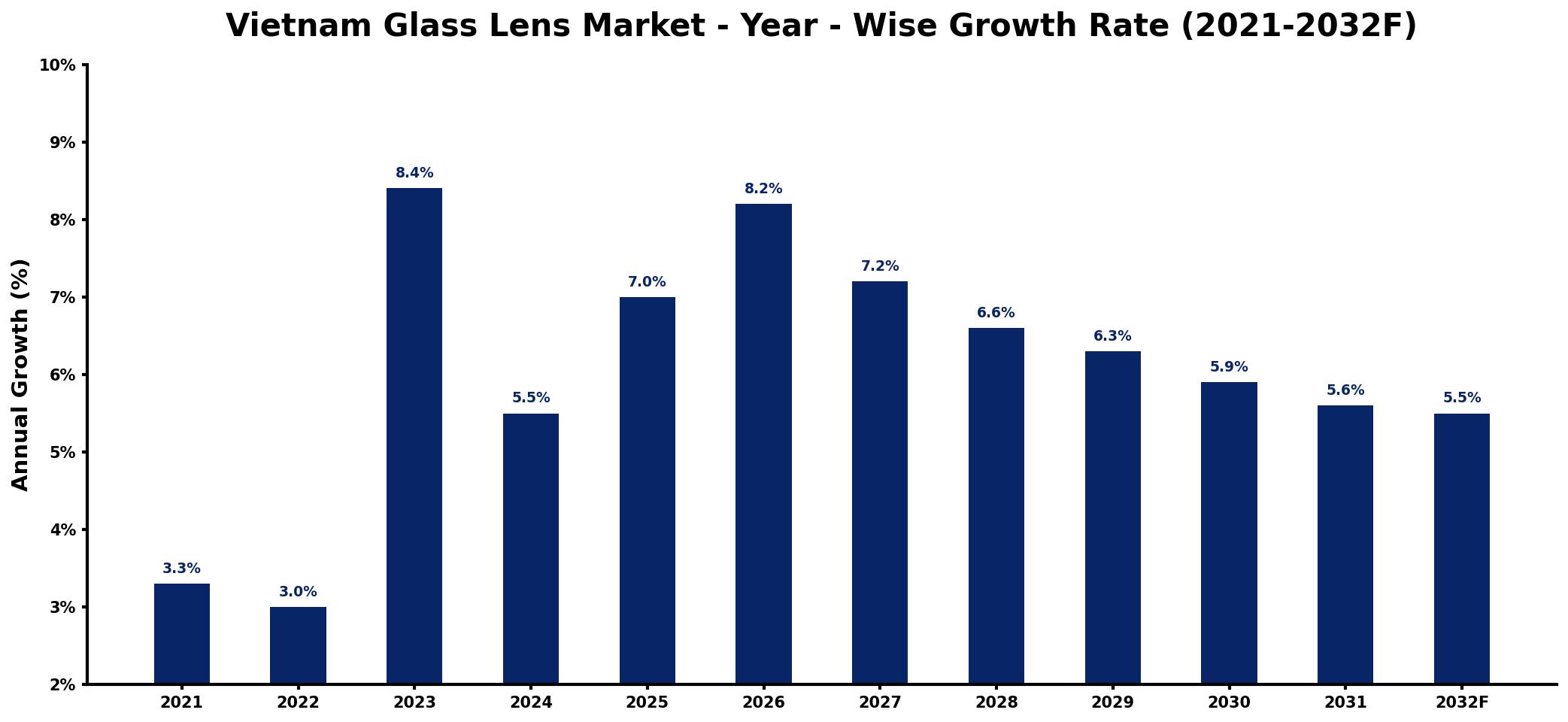
The table below presents the year‑wise growth rates along with the key drivers influencing the market
| Year | Growth Rate | Major Drivers |
| 2021 | 3.3% | Rising consumer health awareness |
| 2022 | 3.0% | Increase in optical retail stores |
| 2023 | 8.4% | Growing online eyewear sales |
| 2024 | 5.5% | Innovation in vision correction technology |
| 2025 | 7.0% | Expansion of eyewear manufacturing facilities |
| 2026 | 8.2% | Higher disposable income levels |
| 2027 | 7.2% | Increased demand for fashion eyewear |
| 2028 | 6.6% | Advancements in digital eye care |
| 2029 | 6.3% | Surge in aging population needs |
| 2030 | 5.9% | Investment in sustainable materials |
| 2031 | 5.6% | Growth in preventive eye care |
| 2032 | 5.5% | Emerging trends in personalized eyewear |
Note: Market size estimations and growth projections presented in this report are based on 6Wresearch's proprietary forecasting methodology, utilizing the latest available industry data, government publications, and primary research inputs.
Vietnam Glass Lens Market Synopsis
The strongest force shaping the Vietnam Glass Lens Market is the relentless growth of consumer electronics, which has led to increased demand for sophisticated optical solutions. As the production of smartphones and digital cameras flourishes, the need for superior glass lenses to enhance visual performance is becoming more pronounced.
Additionally, the automotive sector's expansion is spurring the use of advanced optical systems, including high-definition glass lenses for vehicle cameras and sensors. Coupled with rising consumer awareness regarding the advantages of glass lenses for eyewear, these trends are driving robust market dynamics.
Vietnam Glass Lens Market Key Takeaways
- The market is poised for sustained growth fueled by increasing demands from consumer electronics and automotive industries.
- Technological advancements are leading to improved manufacturing processes and lens quality.
- Heightened consumer awareness is contributing to the rising adoption of glass lenses for vision correction.
- Competitive pressure from non-glass materials is necessitating innovation among traditional glass lens manufacturers.
- The recovery post-COVID-19 has resulted in a renewed demand for optical products featuring glass lenses.
Evaluation of Restraints in Vietnam Glass Lens Market
Despite the promising growth outlook, the Vietnam Glass Lens Market faces notable restraints. Competition from alternative materials, particularly plastics and composites, poses a significant challenge. These materials often offer lower production costs and greater flexibility, which can attract manufacturers looking to optimize their supply chains. Furthermore, maintaining high quality and durability in glass lenses remains crucial, as consumer expectations continue to rise. Thus, manufacturers must focus on innovation and differentiation to secure their position in this competitive landscape.
Vietnam Glass Lens Market Trends
Several current and emerging trends are shaping demand in the Vietnam Glass Lens Market. The rise of smart devices is prompting a shift toward multifunctional lenses, combining features like anti-reflective coatings and blue light filtering. Moreover, advancements in manufacturing technology are enhancing the clarity and precision of glass lenses, making them more appealing to both consumers and manufacturers. Eco-friendly production practices are also gaining traction, with a growing emphasis on sustainable sourcing and reduced environmental impact in lens manufacturing.
Vietnam Glass Lens Market Opportunities
Opportunities abound in the Vietnam Glass Lens Market, particularly in niche applications such as optical equipment for drones and medical devices. As these segments expand, manufacturers have the chance to diversify their offerings and tap into new customer bases. Furthermore, partnerships with tech companies for innovative lens applications can lead to unique market propositions. Investments in research and development to explore new lens technologies and materials are also likely to yield substantial rewards in this evolving landscape.
Government Initiatives in the Vietnam Glass Lens Market
The Vietnamese government has been proactive in fostering the growth of the optical industry, which includes the glass lens sector. Initiatives to promote local manufacturing, encourage foreign investment, and enhance vocational training programs for skilled labor in optics are currently being implemented. Public spending in infrastructure and technology development further supports the market by creating a conducive environment for innovation and efficiency in production.
Future Insights of the Vietnam Glass Lens Market
Looking ahead to 2026-2032, the Vietnam Glass Lens Market is expected to witness a significant transformation driven by technological advancements and shifting consumer preferences. The integration of smart technology into glass lenses is likely to accelerate, enhancing their functionality. With a continuous push for higher quality and innovative designs, manufacturers who adapt swiftly to these changes will thrive. As the automotive sector increasingly adopts advanced optical systems, the demand for high-performance glass lenses will remain strong, securing a promising future for this market.
Vietnam Glass Lens Market Latest Developments (2025 - 2026)
Recent developments in the Vietnam Glass Lens Market indicate a strong focus on innovation and sustainability. Manufacturers are increasingly investing in environmentally friendly practices, including the use of recycled materials in lens production. Collaborations between tech firms and lens manufacturers are becoming more common, particularly in the development of lenses designed for augmented reality and smart eyewear applications. The market is also witnessing enhancements in supply chain efficiencies, responding to past disruptions and aiming for robust resilience in the face of future challenges.
Vietnam Glass Lens Market - Key Attractiveness of the Report
- 10 Years of Market Numbers
- Historical Data Starting from 2022 to 2025
- Base Year: 2025
- Forecast Data until 2032
- Key Performance Indicators Impacting the Market
- Major Upcoming Developments and Projects
Key Highlights of the Report:
- Vietnam Glass Lens Market Outlook
- Market Size of Vietnam Glass Lens Market, 2025
- Forecast of Vietnam Glass Lens Market, 2032
- Historical Data and Forecast of Vietnam Glass Lens Revenues & Volume for the Period 2022-2032F
- Vietnam Glass Lens Market Trend Evolution
- Vietnam Glass Lens Market Drivers and Challenges
- Vietnam Glass Lens Price Trends
- Vietnam Glass Lens Porter's Five Forces
- Vietnam Glass Lens Industry Life Cycle
- Historical Data and Forecast of Vietnam Glass Lens Market Revenues & Volume By Product Type for the Period 2022-2032F
- Historical Data and Forecast of Vietnam Glass Lens Market Revenues & Volume By Single Vision Lenses for the Period 2022-2032F
- Historical Data and Forecast of Vietnam Glass Lens Market Revenues & Volume By Progressive Lenses for the Period 2022-2032F
- Historical Data and Forecast of Vietnam Glass Lens Market Revenues & Volume By Bifocal and Trifocal Lenses for the Period 2022-2032F
- Historical Data and Forecast of Vietnam Glass Lens Market Revenues & Volume By Photochromic Lenses for the Period 2022-2032F
- Historical Data and Forecast of Vietnam Glass Lens Market Revenues & Volume By Polarized Lenses for the Period 2022-2032F
- Historical Data and Forecast of Vietnam Glass Lens Market Revenues & Volume By Others for the Period 2022-2032F
- Historical Data and Forecast of Vietnam Glass Lens Market Revenues & Volume By Coating for the Period 2022-2032F
- Historical Data and Forecast of Vietnam Glass Lens Market Revenues & Volume By Anti-Reflective for the Period 2022-2032F
- Historical Data and Forecast of Vietnam Glass Lens Market Revenues & Volume By Blue Light Reduction for the Period 2022-2032F
- Historical Data and Forecast of Vietnam Glass Lens Market Revenues & Volume By Scratch-Resistant for the Period 2022-2032F
- Historical Data and Forecast of Vietnam Glass Lens Market Revenues & Volume By UV Protection for the Period 2022-2032F
- Historical Data and Forecast of Vietnam Glass Lens Market Revenues & Volume By Distribution Channel for the Period 2022-2032F
- Historical Data and Forecast of Vietnam Glass Lens Market Revenues & Volume By Offline for the Period 2022-2032F
- Historical Data and Forecast of Vietnam Glass Lens Market Revenues & Volume By Online for the Period 2022-2032F
- Vietnam Glass Lens Import Export Trade Statistics
- Market Opportunity Assessment By Product Type
- Market Opportunity Assessment By Coating
- Market Opportunity Assessment By Distribution Channel
- Vietnam Glass Lens Top Companies Market Share
- Vietnam Glass Lens Competitive Benchmarking By Technical and Operational Parameters
- Vietnam Glass Lens Company Profiles
- Vietnam Glass Lens Key Strategic Recommendations






































