Vietnam Groceries Market Summary
The vietnam groceries market was estimated at USD 493 Million in 2025 and is projected to reach USD 696 Million by 2032, growing at a CAGR of 8.1% from 2026 to 2032.
Vietnam Groceries Market Year-wise Growth Rate and Key Drivers
This graph highlights how the Vietnam Groceries Market has steadily grown over the past five years, supported by major growth factors.
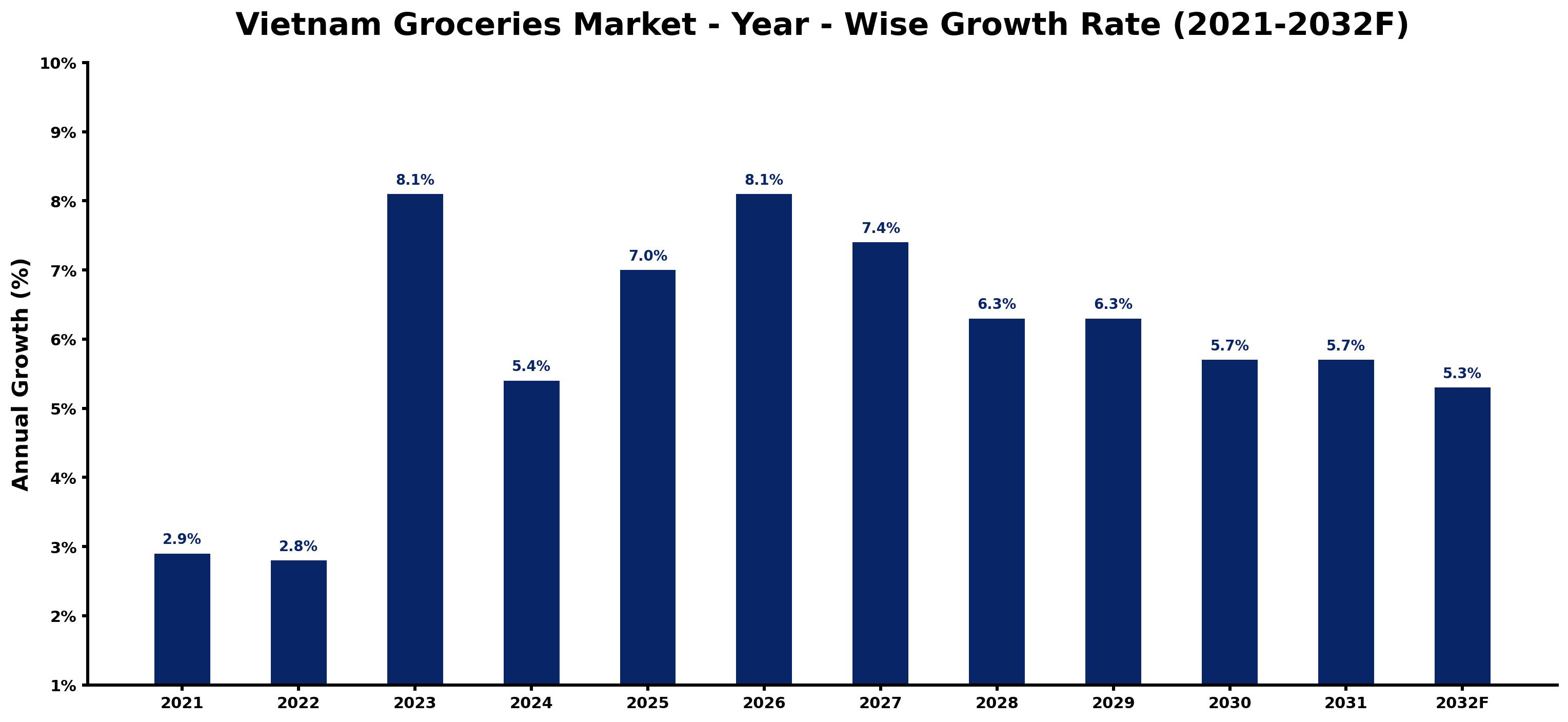
The table below presents the year wise growth rates along with the key drivers influencing the market
| Year | Growth Rate | Major Drivers |
| 2021 | 2.9% | Post-lockdown retail projects focused on resuming consumer trust and foot traffic. |
| 2022 | 2.8% | Remote work's enduring presence reshapes shopping patterns towards online grocery options. |
| 2023 | 8.1% | Rural electrification initiatives support convenience stores in hard-to-reach areas. |
| 2024 | 5.4% | Consumer preferences shift towards premium organic products and local sourcing. |
| 2025 | 7.0% | Digital payment solutions gain traction among urban consumers seeking convenience. |
| 2026 | 8.1% | Urbanization drives demand for ready-to-eat meal kits among busy professionals. |
| 2027 | 7.4% | Increased accessibility of health-conscious products reflects changing dietary priorities. |
| 2028 | 6.3% | Supply chain innovations enhance product availability and reduce delivery times. |
| 2029 | 6.3% | Partnerships between local farms and retailers promote sustainable sourcing practices. |
| 2030 | 5.7% | Technological advancements streamline inventory management, improving operational efficiency. |
| 2031 | 5.7% | Focus on eco-friendly packaging resonates with environmentally aware consumers. |
| 2032 | 5.3% | Customized shopping experiences via AI enhance consumer engagement and loyalty. |
Note - Market size estimations and growth projections presented in this report are based on 6Wresearch's advanced forecasting approach, validated with industry datasets as of June 2026.
Vietnam Groceries Market Synopsis
The Vietnam Groceries Market is projected to reach 8.1% and witness significant growth during the forecast period (2026-2032). This market encompasses a broad array of essential food items and household products ranging from fresh produce to packaged goods and personal care items. As a vital component of the retail sector, the groceries market in Vietnam is integral to meeting the daily requirements of an expanding consumer base.
Vietnam Groceries Market Growth Drivers
One of the primary drivers of growth in the Vietnam Groceries Market is the steadily increasing population, which results in a larger consumer base for essential goods. Urban migration trends contribute significantly to this development, with more individuals seeking convenient and accessible grocery options. Additionally, shifting consumer preferences towards healthier food choices influence the market demand, compelling retailers to adapt their offerings to meet these needs.
- The rise of e-commerce platforms has revolutionized how consumers access groceries, with online shopping becoming a favored option for many in urban areas.
- The increasing popularity of ready-to-eat and packaged food products reflects the demand for convenience, particularly among busy urban dwellers.
- Changing lifestyles and dietary habits drive the market towards organic and natural grocery options, diversifying the product range available in stores.
- Retailers are increasingly investing in supply chain improvements to ensure product availability and freshness, enhancing consumer confidence in grocery purchases.
- Innovations in packaging, such as eco-friendly solutions, have started to attract environmentally conscious consumers, further supporting market growth.
Vietnam Groceries Market Challenges and Restraints
Despite its growth, the Vietnam Groceries Market faces several challenges. Being a price-sensitive market, consumer demand for value-for-money products can exert pressure on profit margins for retailers. Additionally, ensuring the timely distribution of products, particularly to remote areas, poses logistical hurdles that can affect product availability. The competitive landscape, characterized by a mix of modern retail formats and traditional markets, adds to the complexity of operating in this space.
- Retailers must navigate the complexity of managing inventory effectively while minimizing waste and ensuring a consistent supply of fresh products.
- The regulatory landscape, including health and safety standards for food products, requires continuous compliance, adding to operational costs for businesses.
- Economic fluctuations can influence consumer spending patterns, making demand projections uncertain for retailers.
- Cultural preferences and regional tastes can necessitate localized marketing strategies, complicating national campaigns.
- The rapid pace of technological advancements in retail means that businesses must continually invest in upgrading their systems to remain competitive.
Vietnam Groceries Market Government Investment and Initiatives
The Vietnamese government has recognized the importance of the groceries market as part of its broader economic development strategy. Initiatives aimed at enhancing infrastructure, such as roads and logistics networks, are crucial for improving the distribution of groceries across urban and rural settings. Moreover, public spending on food safety and quality standards ensures that consumers receive safe and healthy products, which in turn boosts confidence in retail channels.
- Government initiatives to support supply chain management aim to reduce food waste and ensure efficient movement of goods through various channels.
- Investment in digital infrastructure facilitates the growth of e-commerce, making groceries more accessible to a wider audience.
- Policy frameworks are being developed to encourage sustainable practices among grocery retailers, promoting eco-friendly products and reducing environmental impact.
- Public health campaigns focus on educating consumers about nutrition and healthy eating, indirectly influencing grocery purchasing behavior.
- Collaboration with private sectors is encouraged to invest in technology and innovation to enhance product offerings and improve the customer shopping experience.
Vietnam Groceries Market Latest Developments (May 2025 - June 2026)
During the period from May 2025 to June 2026, the Vietnam Groceries Market has seen a marked shift towards digitalization, with many retailers expanding their online presence to accommodate changing consumer preferences. Increased partnerships among local producers and grocery platforms have enhanced product availability and variety in the market. Furthermore, consumer interest in sustainable and organic products has prompted many retailers to revise their supply chains to incorporate eco-friendly options.
- Enhanced logistics solutions and cold chain management have improved the freshness and quality of perishable goods provided in grocery stores.
- The competitive landscape has intensified with the entry of new players in the online grocery segment, offering innovative products and delivery services.
- Consumer education initiatives have focused on promoting local agricultural products, thereby supporting local economies and sustainability efforts.
- Retailers have invested in advanced data analytics to understand consumer behavior better and tailor their offerings accordingly.
- The emphasis on customer experience has led many grocery stores to enhance in-store services and adopt modern retail technologies.
Vietnam Groceries Market - Key Attractiveness of the Report
- 10 Years of Market Numbers
- Historical Data Starting from 2022 to 2025
- Base Year: 2025
- Forecast Data until 2032
- Key Performance Indicators Impacting the Market
- Major Upcoming Developments and Projects
Key Highlights of the Report:
- Vietnam Groceries Market Outlook
- Market Size of Vietnam Groceries Market, 2025
- Forecast of Vietnam Groceries Market, 2032
- Historical Data and Forecast of Vietnam Groceries Revenues & Volume for the Period 2022-2032F
- Vietnam Groceries Market Trend Evolution
- Vietnam Groceries Market Drivers and Challenges
- Vietnam Groceries Price Trends
- Vietnam Groceries Porter's Five Forces
- Vietnam Groceries Industry Life Cycle
- Historical Data and Forecast of Vietnam Groceries Market Revenues & Volume By Product Types for the Period 2022-2032F
- Historical Data and Forecast of Vietnam Groceries Market Revenues & Volume By Packaged Food for the Period 2022-2032F
- Historical Data and Forecast of Vietnam Groceries Market Revenues & Volume By Unpackaged Food for the Period 2022-2032F
- Historical Data and Forecast of Vietnam Groceries Market Revenues & Volume By Drinks for the Period 2022-2032F
- Historical Data and Forecast of Vietnam Groceries Market Revenues & Volume By Tobacco for the Period 2022-2032F
- Historical Data and Forecast of Vietnam Groceries Market Revenues & Volume By Household Products for the Period 2022-2032F
- Historical Data and Forecast of Vietnam Groceries Market Revenues & Volume By Others for the Period 2022-2032F
- Historical Data and Forecast of Vietnam Groceries Market Revenues & Volume By Distribution Channel for the Period 2022-2032F
- Historical Data and Forecast of Vietnam Groceries Market Revenues & Volume By Supermarkets & Hypermarkets for the Period 2022-2032F
- Historical Data and Forecast of Vietnam Groceries Market Revenues & Volume By Convenience Store for the Period 2022-2032F
- Historical Data and Forecast of Vietnam Groceries Market Revenues & Volume By Online for the Period 2022-2032F
- Vietnam Groceries Import Export Trade Statistics
- Market Opportunity Assessment By Product Types
- Market Opportunity Assessment By Distribution Channel
- Vietnam Groceries Top Companies Market Share
- Vietnam Groceries Competitive Benchmarking By Technical and Operational Parameters
- Vietnam Groceries Company Profiles
- Vietnam Groceries Key Strategic Recommendations






































