Vietnam Helicopter Market Size, Share & Growth Rate
The Vietnam Helicopter Market was estimated at USD 259 Million in 2025 and is projected to reach USD 364 Million by 2032, growing at a CAGR of 5.0% from 2026 to 2032. This growth trajectory is fueled by the government's commitment to modernizing its aviation infrastructure, enhancing both military and civilian helicopter operations. The increasing demand for emergency services and efficient transport solutions in remote areas further propels the market's expansion.
Vietnam Helicopter Market Year-wise Growth Rate and Key Drivers
This graph highlights how the Vietnam Helicopter Market has steadily grown over the years, supported by major growth factors.
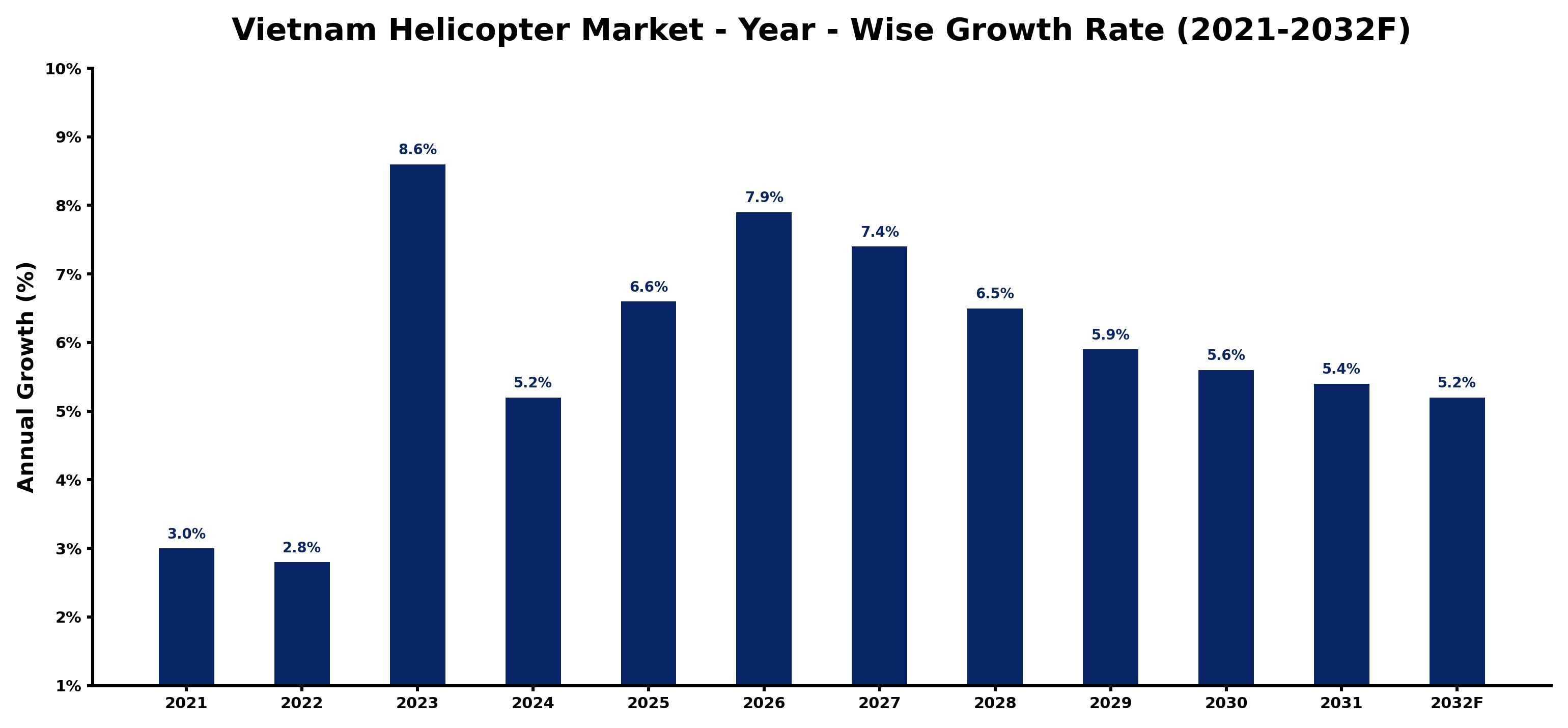
The table below presents the year‑wise growth rates along with the key drivers influencing the market
| Year | Growth Rate | Major Drivers |
| 2021 | 3.0% | Helicopter manufacturing facilities expand capacity to meet export demands |
| 2022 | 2.8% | Foreign investments in aviation boost local helicopter assembly capabilities |
| 2023 | 8.6% | Foreign investment in helicopter assembly boosts local component manufacturing |
| 2024 | 5.2% | Technology adoption in helicopter manufacturing enhanced production precision and efficiency |
| 2025 | 6.6% | Foreign investment in aerospace fuels local helicopter manufacturing growth |
| 2026 | 7.9% | Increased foreign investments boost helicopter assembly line capabilities |
| 2027 | 7.4% | Technology integration in helicopter assembly enhances manufacturing efficiency and export potential |
| 2028 | 6.5% | Foreign direct investments boost helicopter component manufacturing capabilities in Vietnam |
| 2029 | 5.9% | Foreign investment in aerospace components drives helicopter production capacity |
| 2030 | 5.6% | New helicopter assembly lines boost local job creation and exports |
| 2031 | 5.4% | Foreign investment boosts helicopter assembly facility capacity utilization |
| 2032 | 5.2% | Vietnamese defense contracts drive rotorcraft assembly plant expansions |
Note - Market size estimations and growth projections presented in this report are based on 6Wresearch's advanced forecasting approach, validated with industry datasets as of June 2026.
Vietnam Helicopter Market Synopsis
The Vietnam helicopter market stands at a pivotal juncture, characterized by surging demand across various sectors. Government initiatives to bolster defense capabilities, coupled with private sector interest in applications like tourism and agriculture, shape the industry landscape.
As aviation infrastructure continues to develop, the need for helicopters in medical evacuations, search and rescue operations, and corporate travel is becoming increasingly apparent. This multifaceted growth is indicative of a dynamic market, adapting to both local needs and broader economic trends.
Vietnam Helicopter Market Key Takeaways
- The market is expected to grow significantly due to government investment in aviation infrastructure.
- Emerging applications in tourism and agriculture are diversifying the demand for helicopters.
- Efficient transportation in challenging terrains remains a key driver for helicopter utilization.
- Infrastructure development is critical in addressing service and maintenance challenges for helicopter operators.
- Regulatory complexities present hurdles that need to be navigated for sustained market growth.
Evaluation of Restraints in Vietnam Helicopter Market
Despite the optimistic outlook for the Vietnam helicopter market, several restraints impede its progress. Navigating the intricate web of regulatory frameworks and aviation safety standards can prove challenging for operators. Additionally, the high costs of ownership and maintenance act as deterrents for potential buyers, limiting market participation. The scarcity of adequate infrastructure and service facilities further complicates operational efficiencies, leading to potential downtime and increased expenses.
Vietnam Helicopter Market Trends
The helicopter market in Vietnam is evolving, influenced by technological advancements and shifting consumer preferences. Notably, there is a growing emphasis on adopting helicopters equipped with cutting-edge technology for improved safety and operational efficiency. Moreover, a trend towards sustainable aviation solutions is emerging, with interest in fuel-efficient models gaining traction.
In the private sector, the demand for luxury and VIP helicopters is on the rise, reflecting the country's economic growth and increasing affluence. Additionally, the burgeoning tourism sector is likely to spur innovations in helicopter tourism, providing unique aerial experiences to travelers.
Vietnam Helicopter Market Opportunities
There are significant growth opportunities within the Vietnam helicopter market, particularly in underserved regions that require reliable air transport solutions. Investments in medical helicopter services present an avenue for expansion, especially in areas lacking immediate access to healthcare. Furthermore, the increasing interest in helicopter logistics for the agriculture and forestry sectors highlights a lucrative niche that can be developed.
Additionally, partnerships with technology firms to enhance operational efficiencies and reduce costs can position market players favorably amidst growing competition. As the country develops its aviation capabilities, companies can leverage government incentives aimed at fostering innovation and infrastructure improvements.
Government Initiatives in the Vietnam Helicopter Market
The Vietnamese government is proactively investing in its helicopter market as part of a broader strategy to modernize its defense forces and enhance public safety. Initiatives aimed at improving aviation infrastructure, such as establishing new helicopter bases and upgrading maintenance facilities, are critical to supporting market growth. Public spending focused on enhancing emergency response capabilities through aerial means also signals government commitment to expanding this sector.
Future Insights of the Vietnam Helicopter Market
Looking ahead to 2026-2032, the Vietnam helicopter market is poised for continued growth, driven by both domestic demand and regional security dynamics. As the economy evolves and infrastructure develops, the potential for helicopters in commercial applications will likely expand, supported by technological advancements and operational improvements. The emphasis on emergency services and rapid transport will remain critical, as will the adaptation of market players to emerging trends and consumer preferences.
Vietnam Helicopter Market Latest Developments (May 2025 - June 2026)
In recent months, the Vietnam helicopter market has seen a notable uptick in collaborative ventures aimed at expanding operational capabilities. New service agreements are being established, focusing on enhancing maintenance and support services. Meanwhile, technology investments are shaping the next generation of helicopters, with several manufacturers unveiling models tailored to local needs. Efforts to address regulatory challenges are ongoing, as stakeholders work to streamline compliance and boost operational efficiencies.
Vietnam Helicopter Market - Key Attractiveness of the Report
- 10 Years of Market Numbers
- Historical Data Starting from 2022 to 2025
- Base Year: 2025
- Forecast Data until 2032
- Key Performance Indicators Impacting the Market
- Major Upcoming Developments and Projects
Key Highlights of the Report:
- Vietnam Helicopter Market Outlook
- Market Size of Vietnam Helicopter Market, 2025
- Forecast of Vietnam Helicopter Market, 2032
- Historical Data and Forecast of Vietnam Helicopter Revenues & Volume for the Period 2022-2032F
- Vietnam Helicopter Market Trend Evolution
- Vietnam Helicopter Market Drivers and Challenges
- Vietnam Helicopter Price Trends
- Vietnam Helicopter Porter's Five Forces
- Vietnam Helicopter Industry Life Cycle
- Historical Data and Forecast of Vietnam Helicopter Market Revenues & Volume By End-users for the Period 2022-2032F
- Historical Data and Forecast of Vietnam Helicopter Market Revenues & Volume By Commercial for the Period 2022-2032F
- Historical Data and Forecast of Vietnam Helicopter Market Revenues & Volume By Military for the Period 2022-2032F
- Historical Data and Forecast of Vietnam Helicopter Market Revenues & Volume By Component for the Period 2022-2032F
- Historical Data and Forecast of Vietnam Helicopter Market Revenues & Volume By Aerostructures/Airframes for the Period 2022-2032F
- Historical Data and Forecast of Vietnam Helicopter Market Revenues & Volume By Rotary System for the Period 2022-2032F
- Historical Data and Forecast of Vietnam Helicopter Market Revenues & Volume By Engine for the Period 2022-2032F
- Historical Data and Forecast of Vietnam Helicopter Market Revenues & Volume By Undercarriage for the Period 2022-2032F
- Historical Data and Forecast of Vietnam Helicopter Market Revenues & Volume By Avionics for the Period 2022-2032F
- Historical Data and Forecast of Vietnam Helicopter Market Revenues & Volume By Cabin Interiors for the Period 2022-2032F
- Historical Data and Forecast of Vietnam Helicopter Market Revenues & Volume By Environmental Control System for the Period 2022-2032F
- Historical Data and Forecast of Vietnam Helicopter Market Revenues & Volume By Sales Channels for the Period 2022-2032F
- Historical Data and Forecast of Vietnam Helicopter Market Revenues & Volume By OEM for the Period 2022-2032F
- Historical Data and Forecast of Vietnam Helicopter Market Revenues & Volume By Maintenance for the Period 2022-2032F
- Historical Data and Forecast of Vietnam Helicopter Market Revenues & Volume By Repair for the Period 2022-2032F
- Historical Data and Forecast of Vietnam Helicopter Market Revenues & Volume By Overhaul for the Period 2022-2032F
- Vietnam Helicopter Import Export Trade Statistics
- Market Opportunity Assessment By End-users
- Market Opportunity Assessment By Component
- Market Opportunity Assessment By Sales Channels
- Vietnam Helicopter Top Companies Market Share
- Vietnam Helicopter Competitive Benchmarking By Technical and Operational Parameters
- Vietnam Helicopter Company Profiles
- Vietnam Helicopter Key Strategic Recommendations






































