Vietnam High Strength Steel Market Size, Share & Growth Rate
The Vietnam High Strength Steel Market was estimated at USD 161 Million in 2025 and is projected to reach USD 227 Million by 2032, growing at a CAGR of 5.0% from 2026 to 2032. This growth trajectory is primarily driven by the increasing demand for high-strength steel in the automotive and construction sectors, where lightweight and durable materials are essential. Innovations in steel production technology further bolster this expansion, allowing manufacturers to enhance the strength-to-weight ratio of high-strength steel products.
Vietnam High Strength Steel Market Year-wise Growth Rate and Key Drivers
This graph highlights how the Vietnam High Strength Steel Market has steadily grown over the years, supported by major growth factors.
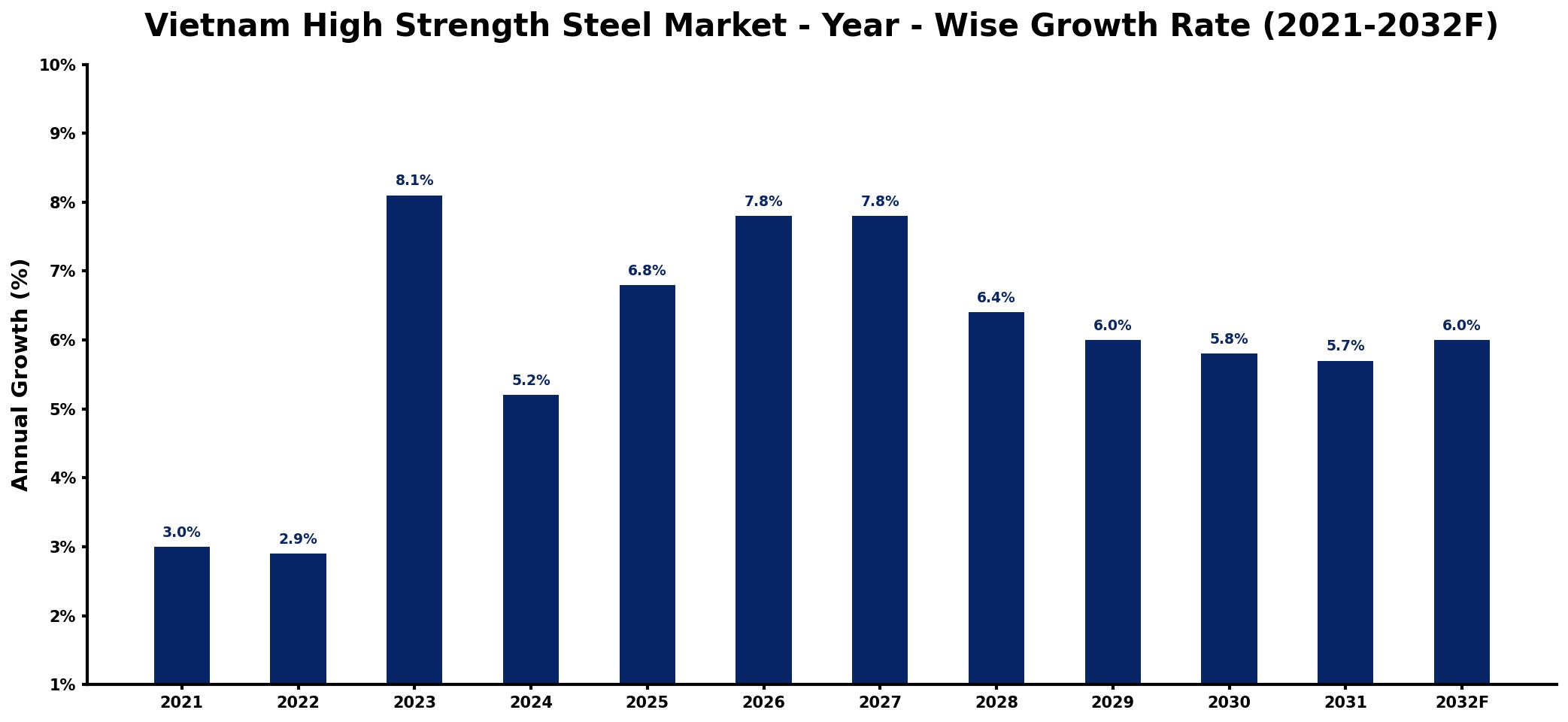
The table below presents the year‑wise growth rates along with the key drivers influencing the market
| Year | Growth Rate | Major Drivers |
| 2021 | 3.0% | Rising construction industry activities |
| 2022 | 2.9% | Increased automotive manufacturing demand |
| 2023 | 8.1% | Expansion in renewable energy projects |
| 2024 | 5.2% | Infrastructure development initiatives increase |
| 2025 | 6.8% | Growth in transportation sector investments |
| 2026 | 7.8% | Technological advancements in construction |
| 2027 | 7.8% | Boost in industrial machinery production |
| 2028 | 6.4% | Surge in real estate developments |
| 2029 | 6.0% | Emerging markets requiring innovative solutions |
| 2030 | 5.8% | Enhancements in manufacturing efficiency |
| 2031 | 5.7% | Demand from aerospace sector rises |
| 2032 | 6.0% | Sustainability trends driving new applications |
Note: Market size estimations and growth projections presented in this report are based on 6Wresearch's proprietary forecasting methodology, utilizing the latest available industry data, government publications, and primary research inputs.
Vietnam High Strength Steel Market Synopsis
The Vietnam high-strength steel market has gained momentum in recent years, fueled by the evolving needs of various industries, particularly automotive and construction. This markets direction is increasingly leaning toward more efficient production processes and environmentally friendly practices, ensuring that domestic players can meet both local and international demands.
While the market's recent growth reflects a strong recovery from the pandemic's impact, challenges remain in developing advanced alloys that meet stringent industry standards. As manufacturers invest in research and development, they seek to balance quality with sustainability, positioning themselves strategically in a competitive landscape.
Vietnam High Strength Steel Market Key Takeaways
- Increasing utilization of high-strength steel in the automotive and construction sectors is a significant growth driver.
- Research and development investments are crucial for advancing the strength-to-weight ratio of steel products.
- Environmental sustainability practices are becoming paramount for manufacturers in the high-strength steel market.
- The COVID-19 pandemic led to short-term disruptions but has subsequently catalyzed innovations in production techniques.
- Major domestic players are strengthening their market position through technological advancements and quality improvements.
Evaluation of Restraints in Vietnam High Strength Steel Market
Despite the promising growth, the Vietnam high-strength steel market grapples with notable restraints. The challenge of developing advanced alloys with superior properties is significant and often entails substantial investment in both research and production. Moreover, manufacturers face pressure to comply with stringent environmental regulations, which can complicate production processes. The need for sustainable practices, coupled with the high costs of meeting diverse industry requirements, poses ongoing hurdles that industry players must navigate to remain competitive.
Vietnam High Strength Steel Market Trends
A key trend in the Vietnam high-strength steel market is the rise of lightweight materials driven by the automotive industry's push for fuel efficiency. Manufacturers are increasingly adopting innovative steel production technologies that not only enhance performance but also lower carbon emissions. Additionally, there is a marked shift towards recycling and the use of sustainable materials in steel production, as companies aim to meet growing environmental demands. The integration of advanced analytics and automation in production processes is also gaining traction, optimizing efficiency and reducing costs.
Vietnam High Strength Steel Market Opportunities
The Vietnam high-strength steel market presents a range of opportunities for growth and investment. With infrastructure development on the rise, particularly in urban areas, demand for high-performance steel products is set to increase. Additionally, the ongoing emphasis on eco-friendly manufacturing provides an avenue for companies to differentiate themselves through sustainable practices. Collaborative ventures between local manufacturers and global players can facilitate knowledge transfer and technology adoption, paving the way for enhanced product offerings that meet international standards.
Government Initiatives in the Vietnam High Strength Steel Market
The Vietnamese government has been proactive in fostering the growth of its steel industry through various initiatives. Policies aimed at enhancing domestic production capabilities and promoting sustainable manufacturing practices are key components of the governments strategy. Public spending on infrastructure projects is expected to stimulate demand for high-strength steel products, while incentives for research and development in new materials are designed to encourage innovation. These initiatives collectively aim to strengthen the competitive position of Vietnam's steel industry on the global stage.
Future Insights of the Vietnam High Strength Steel Market
Looking ahead to 2026-2032, the Vietnam high-strength steel market is poised for significant transformation. The expected growth in construction and automotive sectors, coupled with a continued focus on lightweight materials, will drive further demand. Technological advancements in production methods and alloy development will likely facilitate the introduction of high-performance products that align with evolving industry standards. As sustainability becomes increasingly crucial, manufacturers that prioritize eco-friendly practices and innovative solutions will stand to benefit the most in this rapidly changing market landscape.
Vietnam High Strength Steel Market Latest Developments (2025 - 2026)
Recent developments in the Vietnam high-strength steel market indicate a robust trend towards innovation and sustainability. Companies are actively exploring advanced production techniques to reduce environmental impact while enhancing product performance. Collaborative partnerships between domestic and international entities are emerging, focusing on research and development of new high-strength steel alloys. Additionally, the construction sector is witnessing increased investment, further solidifying the demand for high-quality steel products.
Vietnam High Strength Steel Market - Key Attractiveness of the Report
- 10 Years of Market Numbers
- Historical Data Starting from 2022 to 2025
- Base Year: 2025
- Forecast Data until 2032
- Key Performance Indicators Impacting the Market
- Major Upcoming Developments and Projects
Key Highlights of the Report:
- Vietnam High Strength Steel Market Outlook
- Market Size of Vietnam High Strength Steel Market, 2025
- Forecast of Vietnam High Strength Steel Market, 2032
- Historical Data and Forecast of Vietnam High Strength Steel Revenues & Volume for the Period 2022-2032F
- Vietnam High Strength Steel Market Trend Evolution
- Vietnam High Strength Steel Market Drivers and Challenges
- Vietnam High Strength Steel Price Trends
- Vietnam High Strength Steel Porter's Five Forces
- Vietnam High Strength Steel Industry Life Cycle
- Historical Data and Forecast of Vietnam High Strength Steel Market Revenues & Volume By Product Type for the Period 2022-2032F
- Historical Data and Forecast of Vietnam High Strength Steel Market Revenues & Volume By Dual Phase Steel for the Period 2022-2032F
- Historical Data and Forecast of Vietnam High Strength Steel Market Revenues & Volume By Bake Hardenable Steel for the Period 2022-2032F
- Historical Data and Forecast of Vietnam High Strength Steel Market Revenues & Volume By Carbon Manganese Steel for the Period 2022-2032F
- Historical Data and Forecast of Vietnam High Strength Steel Market Revenues & Volume By Other Product Types for the Period 2022-2032F
- Historical Data and Forecast of Vietnam High Strength Steel Market Revenues & Volume By Application for the Period 2022-2032F
- Historical Data and Forecast of Vietnam High Strength Steel Market Revenues & Volume By Automotive for the Period 2022-2032F
- Historical Data and Forecast of Vietnam High Strength Steel Market Revenues & Volume By Construction for the Period 2022-2032F
- Historical Data and Forecast of Vietnam High Strength Steel Market Revenues & Volume By Yellow Goods and Mining Equipment for the Period 2022-2032F
- Historical Data and Forecast of Vietnam High Strength Steel Market Revenues & Volume By Aviation and Marine for the Period 2022-2032F
- Historical Data and Forecast of Vietnam High Strength Steel Market Revenues & Volume By Other Applications for the Period 2022-2032F
- Vietnam High Strength Steel Import Export Trade Statistics
- Market Opportunity Assessment By Product Type
- Market Opportunity Assessment By Application
- Vietnam High Strength Steel Top Companies Market Share
- Vietnam High Strength Steel Competitive Benchmarking By Technical and Operational Parameters
- Vietnam High Strength Steel Company Profiles
- Vietnam High Strength Steel Key Strategic Recommendations






































