Vietnam Household Textile Market Summary
The vietnam household textile market was estimated at USD 470 Million in 2025 and is projected to reach USD 660 Million by 2032, growing at a CAGR of 7.9% from 2026 to 2032.
Vietnam Household Textile Market Year-wise Growth Rate and Key Drivers
This graph highlights how the Vietnam Household Textile Market has steadily grown over the past five years, supported by major growth factors.
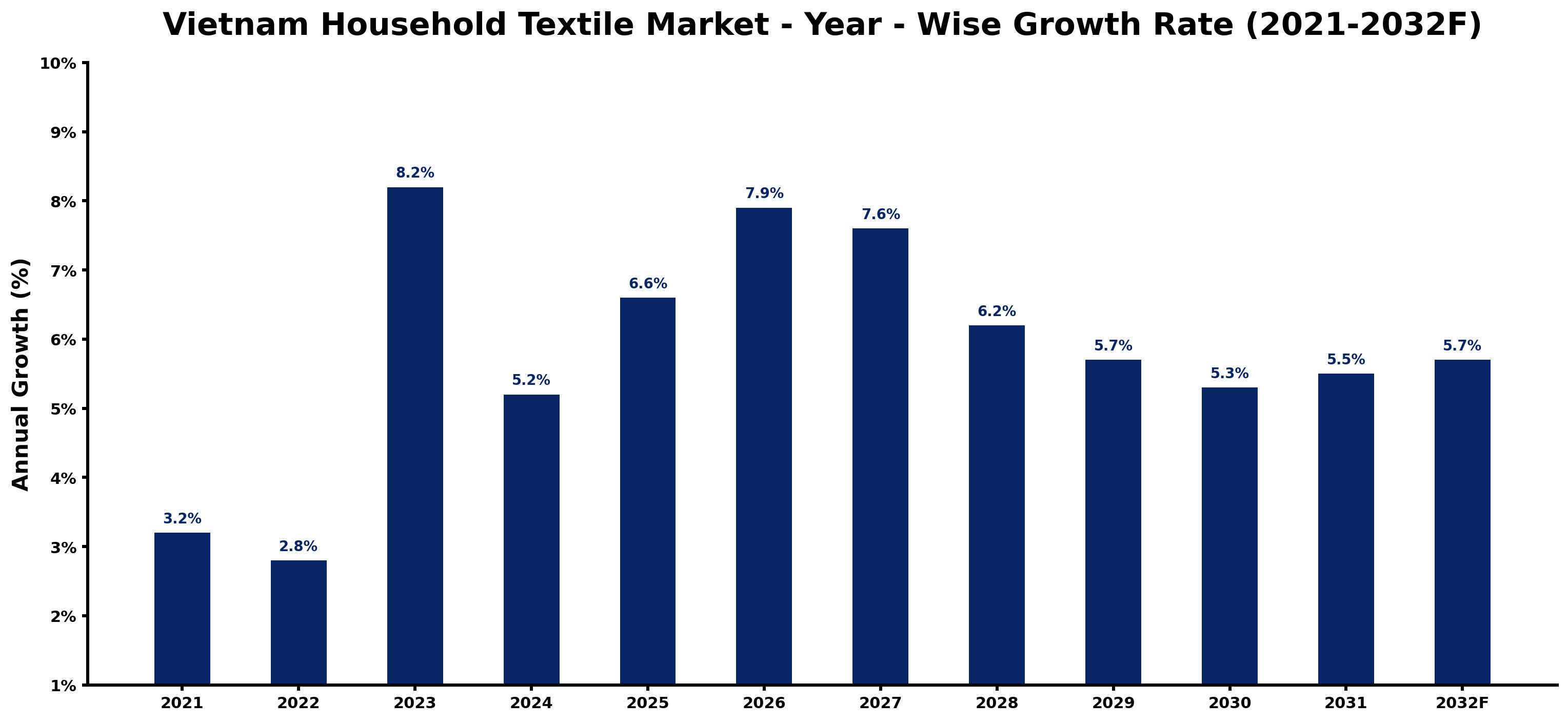
The table below presents the year wise growth rates along with the key drivers influencing the market
| Year | Growth Rate | Major Drivers |
| 2021 | 3.2% | Vietnam's textile sector begins recovering, supported by a surge in domestic consumption. |
| 2022 | 2.8% | Increased investments in sustainable materials attract environmentally conscious consumers. |
| 2023 | 8.2% | Rural electrification projects enhance manufacturing capabilities in remote textile production areas. |
| 2024 | 5.2% | E-commerce platforms expand, allowing textile brands direct access to urban households. |
| 2025 | 6.6% | Global shifts in supply chains boost Vietnam's appeal as an alternative textile hub. |
| 2026 | 7.9% | Local artisans leverage digital skills, promoting traditional textiles to a global audience. |
| 2027 | 7.6% | Affluent middle-class demographics contribute significantly to household textile demand growth. |
| 2028 | 6.2% | Sustainable production practices become a competitive differentiator among local manufacturers. |
| 2029 | 5.7% | Home improvement trends encourage higher spending on decorative textile solutions. |
| 2030 | 5.3% | Urbanization accelerates, leading to larger purchases of household textiles in cities. |
| 2031 | 5.5% | Innovation in fabric technology promotes durability, improving customer retention rates. |
| 2032 | 5.7% | The integration of smart textiles into products captures interest among tech-savvy consumers. |
Note - Market size estimations and growth projections presented in this report are based on 6Wresearch's advanced forecasting approach, validated with industry datasets as of June 2026.
Vietnam Household Textile Market Synopsis
The Vietnam Household Textile Market is projected to reach 7.9% and witness significant growth during the forecast period (2026-2032). This sector encompasses a broad spectrum of household fabrics, including bed linens, towels, curtains, rugs, and upholstery materials. The market's expansion is primarily fueled by increasing disposable incomes and a rising standard of living among consumers, who are increasingly investing in high-quality textiles to enhance their living spaces. Additionally, the booming e-commerce sector and the availability of both international and local textile manufacturers have diversified consumer choices, enabling a wider array of stylish and comfortable household textiles.
Vietnam Household Textile Market Growth Drivers
Several factors are driving the growth of the Vietnam Household Textile Market. Firstly, the upward trend in disposable income levels among the Vietnamese population empowers consumers to invest more in their homes. As standards of living improve, the desire for aesthetically pleasing and functional household textiles becomes more pronounced. Secondly, a growing focus on interior design and home decoration is enhancing the demand for fashionable textiles, compelling manufacturers to offer a plethora of designs and color schemes. Furthermore, the influence of social media platforms has led to an increased interest in home decor, with many consumers inspired by influencers and trends they observe online.
- The growing trend of home renovation elevates the need for high-quality textiles that reflect personal style.
- Social media has reshaped consumer preferences, making them seek trendy designs and unique patterns.
- The expansion of e-commerce platforms allows consumers to purchase a wider range of household textiles conveniently.
- There is an increasing inclination towards sustainable and eco-friendly products, prompting manufacturers to adopt green practices.
- The diverse product offerings cater to various consumer segments, further driving market growth.
Vietnam Household Textile Market Challenges and Restraints
Despite the promising growth potential, the Vietnam Household Textile Market faces several challenges that can inhibit its progress. One significant issue is the stiff competition posed by low-cost imports from various countries, which puts pressure on local manufacturers and can squeeze profit margins due to price wars. Additionally, the increasing preference for synthetic materials over natural fibers can lead to a decline in demand for premium quality textiles, which may adversely affect production standards. Moreover, fluctuations in the prices of raw materials like cotton and wool may create instability in manufacturing costs, further complicating market dynamics.
- Low-cost imports may reduce market share for domestic manufacturers, posing risks to local businesses.
- Consumers opting for cheaper synthetic alternatives could undermine the demand for higher-quality natural textiles.
- Price volatility of raw materials creates uncertainty in production scheduling and cost estimation.
- Economic fluctuations can impact consumer spending in discretionary categories like home textiles.
- Environmental regulations may necessitate additional compliance costs for manufacturers focusing on sustainability.
Vietnam Household Textile Market Government Investment and Initiatives
The Vietnamese government has recognized the significance of textiles as a vital sector in its economic planning, leading to various initiatives aimed at fostering growth in the Vietnam Household Textile Market. Policies promoting investment in sustainable manufacturing and innovative textile production are gaining traction, with public investment funds directed towards enhancing technology and manufacturing processes. Additionally, efforts to facilitate training and skill development among workers in the textile industry are underway, aimed at improving productivity and competitiveness. Incentives for eco-friendly practices are also being emphasized as Vietnam strives to position itself as a leader in sustainable textile production.
Vietnam Household Textile Market Latest Developments (May 2025 - June 2026)
Recent trends in the Vietnam Household Textile Market indicate a responsive shift towards online retail platforms as consumer preferences evolve. The pandemic has accelerated the adoption of e-commerce, allowing manufacturers and retailers to reach consumers directly and adapt to changing purchasing behaviors. Furthermore, a noticeable increase in consumer interest in sustainable products has prompted several brands to enhance their eco-friendly product lines. This shift is being supported by government initiatives aimed at encouraging sustainable practices within the textile sector, ensuring that the industry can meet the growing demand for environmentally responsible products.
Vietnam Household Textile Market - Key Attractiveness of the Report
- 10 Years of Market Numbers
- Historical Data Starting from 2022 to 2025
- Base Year: 2025
- Forecast Data until 2032
- Key Performance Indicators Impacting the Market
- Major Upcoming Developments and Projects
Key Highlights of the Report:
- Vietnam Household Textile Market Outlook
- Market Size of Vietnam Household Textile Market, 2025
- Forecast of Vietnam Household Textile Market, 2032
- Historical Data and Forecast of Vietnam Household Textile Revenues & Volume for the Period 2022-2032F
- Vietnam Household Textile Market Trend Evolution
- Vietnam Household Textile Market Drivers and Challenges
- Vietnam Household Textile Price Trends
- Vietnam Household Textile Porter's Five Forces
- Vietnam Household Textile Industry Life Cycle
- Historical Data and Forecast of Vietnam Household Textile Market Revenues & Volume By Type for the Period 2022-2032F
- Historical Data and Forecast of Vietnam Household Textile Market Revenues & Volume By Non-woven Textile for the Period 2022-2032F
- Historical Data and Forecast of Vietnam Household Textile Market Revenues & Volume By Woven Textile for the Period 2022-2032F
- Historical Data and Forecast of Vietnam Household Textile Market Revenues & Volume By Application for the Period 2022-2032F
- Historical Data and Forecast of Vietnam Household Textile Market Revenues & Volume By Bed for the Period 2022-2032F
- Historical Data and Forecast of Vietnam Household Textile Market Revenues & Volume By Furniture for the Period 2022-2032F
- Historical Data and Forecast of Vietnam Household Textile Market Revenues & Volume By Door & Window for the Period 2022-2032F
- Historical Data and Forecast of Vietnam Household Textile Market Revenues & Volume By Dining & Wash for the Period 2022-2032F
- Historical Data and Forecast of Vietnam Household Textile Market Revenues & Volume By Ground for the Period 2022-2032F
- Vietnam Household Textile Import Export Trade Statistics
- Market Opportunity Assessment By Type
- Market Opportunity Assessment By Application
- Vietnam Household Textile Top Companies Market Share
- Vietnam Household Textile Competitive Benchmarking By Technical and Operational Parameters
- Vietnam Household Textile Company Profiles
- Vietnam Household Textile Key Strategic Recommendations






































