Vietnam Industrial Machinery Market Size, Share & Growth Rate
The Vietnam Industrial Machinery Market was estimated at USD 437 Million in 2025 and is projected to reach USD 616 Million by 2032, growing at a CAGR of 5.0% from 2026 to 2032. This growth trajectory is fueled by Vietnam's rapid industrialization, particularly in key sectors like electronics, automotive, and textiles, where advanced machinery is increasingly necessary. Government policies promoting foreign direct investment and modernization within the manufacturing landscape are also pivotal in driving this demand.
Vietnam Industrial Machinery Market Year-wise Growth Rate and Key Drivers
This graph highlights how the Vietnam Industrial Machinery Market has steadily grown over the years, supported by major growth factors.
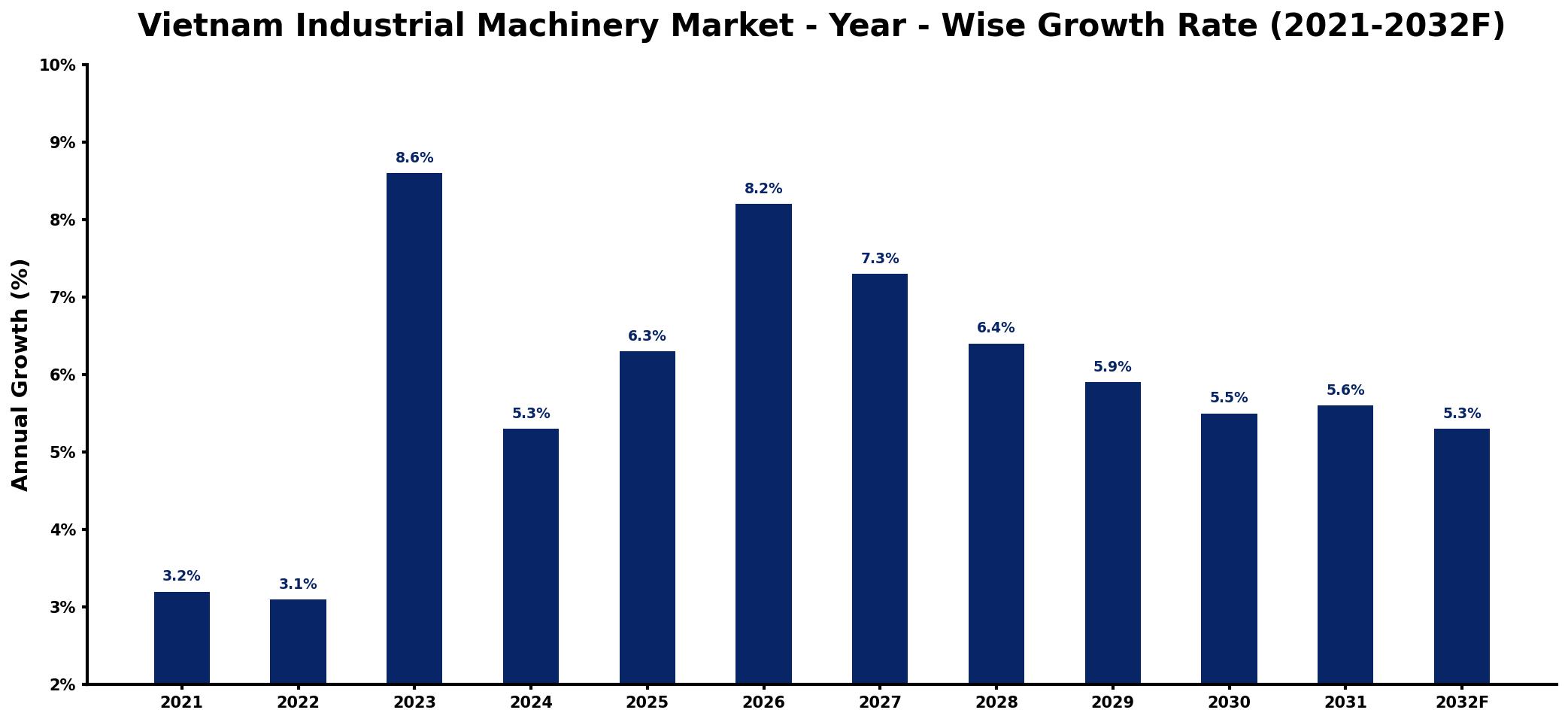
The table below presents the year‑wise growth rates along with the key drivers influencing the market
| Year | Growth Rate | Major Drivers |
| 2021 | 3.2% | Rising construction sector investments |
| 2022 | 3.1% | Increased automation in manufacturing |
| 2023 | 8.6% | Surge in renewable energy projects |
| 2024 | 5.3% | Expansion of logistics infrastructure |
| 2025 | 6.3% | Growing demand for export products |
| 2026 | 8.2% | Technological advancements in production |
| 2027 | 7.3% | Higher private sector investments |
| 2028 | 6.4% | Boost in foreign direct investment |
| 2029 | 5.9% | Increased urbanization and development |
| 2030 | 5.5% | Enhanced government infrastructure spending |
| 2031 | 5.6% | Growth in e-commerce logistics |
| 2032 | 5.3% | Rising demand for sustainable solutions |
Note: Market size estimations and growth projections presented in this report are based on 6Wresearch's proprietary forecasting methodology, utilizing the latest available industry data, government publications, and primary research inputs.
Vietnam Industrial Machinery Market Synopsis
The demand for automation systems in Vietnam is surging as industries strive for greater efficiency and productivity. As firms pivot towards more sophisticated manufacturing processes, the need for high-quality industrial machinery is more pronounced than ever, ensuring competitive positioning in regional and global markets.
Supply-wise, both domestic producers and international companies are stepping up to meet the diverse requirements of various sectors. This competitive landscape is essential for nurturing innovation, as stakeholders focus on offering cutting-edge solutions to drive operational excellence.
Vietnam Industrial Machinery Market Key Takeaways
- Rapid industrialization in Vietnam is a key driver of the machinery market.
- Advanced automation solutions are becoming essential in manufacturing processes.
- Foreign investments are significantly impacting market growth and technology adoption.
- Workforce skill gaps may impede the transition to advanced machinery and automation.
- COVID-19 has reshaped demand dynamics, emphasizing automation and efficiency.
Evaluation of Restraints in Vietnam Industrial Machinery Market
Despite the growth prospects, the Vietnam Industrial Machinery Market faces notable restraints, primarily concerning technology adoption and workforce readiness. As businesses increasingly integrate sophisticated technologies, a skilled workforce capable of operating and maintaining advanced machinery becomes paramount. However, the current educational and training infrastructure may not sufficiently support this urgent need for skilled labor. Furthermore, some enterprises may hesitate to invest heavily in advanced systems without clear indicators of returns, complicating the markets evolution.
Vietnam Industrial Machinery Market Trends
A significant trend emerging within the Vietnam Industrial Machinery Market is the shift towards Industry 4.0 technologies, promoting interconnected manufacturing processes. Companies are increasingly adopting IoT (Internet of Things) and AI-driven solutions to enhance operational efficiency. Additionally, a strong focus on sustainability is leading firms to invest in energy-efficient machinery, thereby aligning with global environmental standards. This conscious approach to modernization will shape the future trajectory of the market.
Vietnam Industrial Machinery Market Opportunities
The ongoing industrial expansion presents genuine growth opportunities within the Vietnam Industrial Machinery Market. Sectors such as electronics and automotive are ripe for investment, particularly in automation and digitization technologies. Furthermore, as local manufacturers seek to elevate their production capabilities, partnerships with technology providers can lead to innovative solutions that cater specifically to Vietnam's unique industrial landscape. These avenues represent not just growth potential but also an essential evolution of the sector.
Government Initiatives in the Vietnam Industrial Machinery Market
The Vietnamese government is actively promoting industrial development through various policies and incentives aimed at attracting foreign direct investment. These initiatives include tax breaks, subsidies for technological upgrades, and streamlined regulations to ease business operations. Such supportive measures are designed to enhance the countrys manufacturing capabilities and stimulate demand for advanced industrial machinery, ultimately aiding Vietnam's economic growth.
Future Insights of the Vietnam Industrial Machinery Market
Looking ahead to the 2026-2032 timeframe, the Vietnam Industrial Machinery Market is positioned for substantial growth as technology and innovation continue to reshape manufacturing. Increased automation and advancements in machinery are likely to drive productivity and competitiveness across industries. Moreover, as Vietnam integrates further into global supply chains, the demand for modern industrial machinery will likely surge, positioning the market as a vital component of the broader economic landscape.
Vietnam Industrial Machinery Market Latest Developments (2025 - 2026)
In recent months, the industrial machinery sector in Vietnam has seen a noticeable pivot towards automation technologies, with companies actively seeking innovative solutions to enhance efficiency. Key industry players are increasingly collaborating with technology firms to incorporate AI and robotics into their manufacturing processes. Furthermore, industry events and exhibitions are highlighting advancements in machinery technology, fostering networking opportunities among stakeholders and driving market momentum.
Vietnam Industrial Machinery Market - Key Attractiveness of the Report
- 10 Years of Market Numbers
- Historical Data Starting from 2022 to 2025
- Base Year: 2025
- Forecast Data until 2032
- Key Performance Indicators Impacting the Market
- Major Upcoming Developments and Projects
Key Highlights of the Report:
- Vietnam Industrial Machinery Market Outlook
- Market Size of Vietnam Industrial Machinery Market, 2025
- Forecast of Vietnam Industrial Machinery Market, 2032
- Historical Data and Forecast of Vietnam Industrial Machinery Revenues & Volume for the Period 2022-2032F
- Vietnam Industrial Machinery Market Trend Evolution
- Vietnam Industrial Machinery Market Drivers and Challenges
- Vietnam Industrial Machinery Price Trends
- Vietnam Industrial Machinery Porter's Five Forces
- Vietnam Industrial Machinery Industry Life Cycle
- Historical Data and Forecast of Vietnam Industrial Machinery Market Revenues & Volume By Application for the Period 2022-2032F
- Historical Data and Forecast of Vietnam Industrial Machinery Market Revenues & Volume By Agriculture for the Period 2022-2032F
- Historical Data and Forecast of Vietnam Industrial Machinery Market Revenues & Volume By Construction for the Period 2022-2032F
- Historical Data and Forecast of Vietnam Industrial Machinery Market Revenues & Volume By Packaging for the Period 2022-2032F
- Historical Data and Forecast of Vietnam Industrial Machinery Market Revenues & Volume By Food Processing for the Period 2022-2032F
- Historical Data and Forecast of Vietnam Industrial Machinery Market Revenues & Volume By Mining for the Period 2022-2032F
- Historical Data and Forecast of Vietnam Industrial Machinery Market Revenues & Volume By Semiconductor Manufacturing for the Period 2022-2032F
- Vietnam Industrial Machinery Import Export Trade Statistics
- Market Opportunity Assessment By Application
- Vietnam Industrial Machinery Top Companies Market Share
- Vietnam Industrial Machinery Competitive Benchmarking By Technical and Operational Parameters
- Vietnam Industrial Machinery Company Profiles
- Vietnam Industrial Machinery Key Strategic Recommendations






































