Vietnam Industrial Sugar Market Size, Share & Growth Rate
The Vietnam Industrial Sugar Market was estimated at USD 411 Million in 2025 and is projected to reach USD 584 Million by 2032, growing at a CAGR of 5.1% from 2026 to 2032. This growth trajectory is primarily driven by an expanding food and beverage sector, which increasingly relies on industrial sugar for processed and packaged goods. Additionally, government policies supporting sugar production continue to bolster market confidence and investment.
Vietnam Industrial Sugar Market Year-wise Growth Rate and Key Drivers
This graph highlights how the Vietnam Industrial Sugar Market has steadily grown over the years, supported by major growth factors.
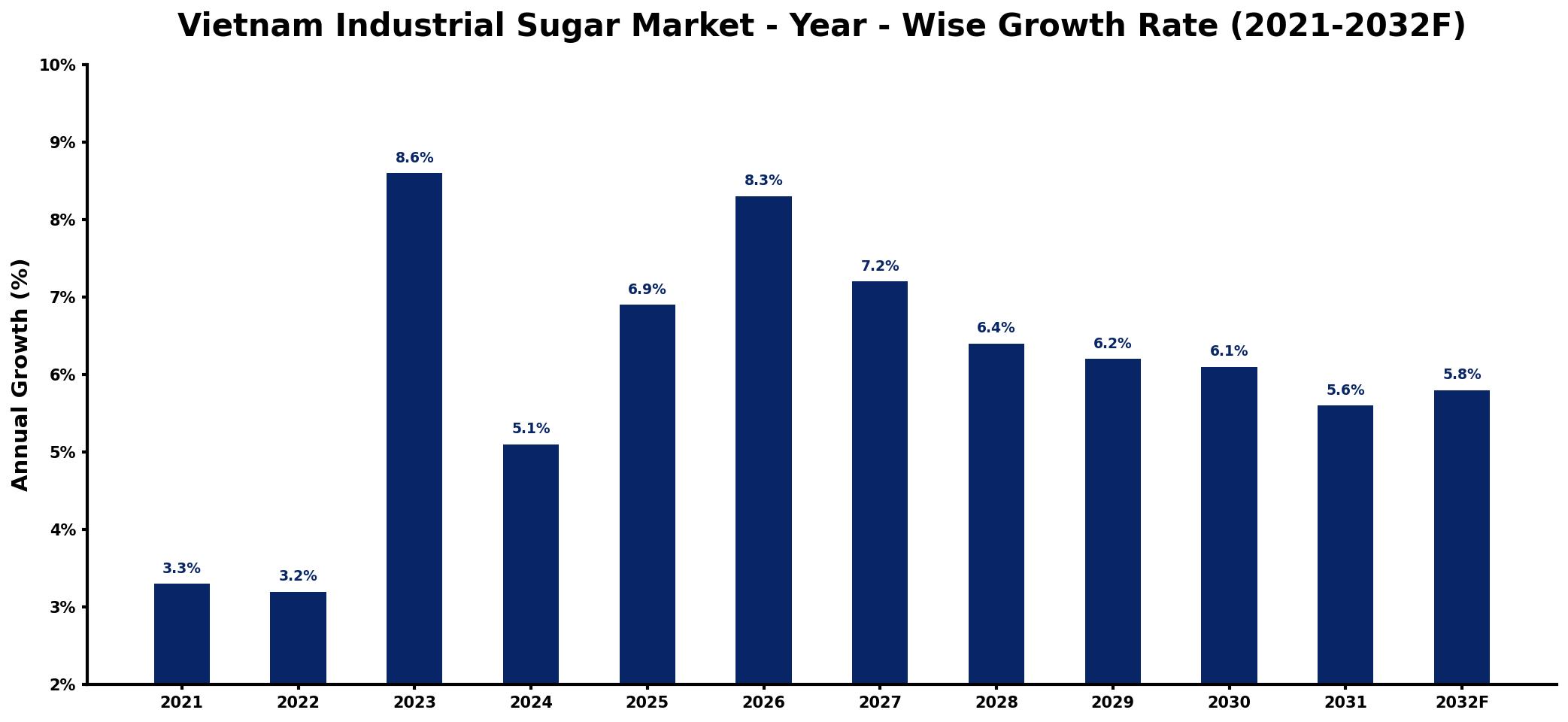
The table below presents the year‑wise growth rates along with the key drivers influencing the market
| Year | Growth Rate | Major Drivers |
| 2021 | 3.3% | Rising demand from food sector |
| 2022 | 3.2% | Increased investments in processing |
| 2023 | 8.6% | Expansion of beverage applications |
| 2024 | 5.1% | Growth in confectionery production |
| 2025 | 6.9% | Boost in export opportunities |
| 2026 | 8.3% | Technological advancements in production |
| 2027 | 7.2% | Higher consumption in hospitality industry |
| 2028 | 6.4% | Emerging markets increasing demand |
| 2029 | 6.2% | Sustainable practices gaining traction |
| 2030 | 6.1% | Diversification of product offerings |
| 2031 | 5.6% | Strengthening supply chain networks |
| 2032 | 5.8% | Rising health-conscious consumer base |
Note: Market size estimations and growth projections presented in this report are based on 6Wresearch's proprietary forecasting methodology, utilizing the latest available industry data, government publications, and primary research inputs.
Vietnam Industrial Sugar Market Synopsis
Recent developments in Vietnam's industrial sugar market reflect a robust recovery and a dynamic growth phase. The steady increase in demand, particularly in the food and beverage industries, underpins the market's upward trajectory. However, challenges remain, notably in the area of raw material sourcing and price volatility.
Looking ahead, the Vietnam Industrial Sugar Market is poised for significant expansion as consumer preferences shift towards processed foods and beverages. With a growing population and rising disposable incomes, the demand for sugar is expected to remain strong. Adherence to international quality standards will be crucial for sustaining this growth.
Vietnam Industrial Sugar Market Key Takeaways
- The Vietnam Industrial Sugar Market is on a growth trajectory, fueled by demand from the food and beverage sectors.
- Government policies and incentives are actively promoting investment and production in the sugar industry.
- Fluctuating sugar prices and global supply chain dynamics pose challenges that market participants must navigate.
- COVID-19 temporarily disrupted demand, but the market is rebounding as conditions normalize.
- Key industry players are innovating to ensure supply chain stability and quality standards.
Evaluation of Restraints in Vietnam Industrial Sugar Market
The Vietnam Industrial Sugar Market faces several restraints that could impede its growth. One of the primary concerns is the volatility of sugar prices, influenced by factors such as international trade agreements and climatic conditions affecting harvest yields. This fluctuation complicates financial planning for producers and creates uncertainties in supply chains. Furthermore, the need for high-quality raw materials necessitates stringent adherence to sourcing standards, making the production process more complex. Without addressing these challenges, companies may struggle to maintain competitive pricing while ensuring quality, which could stymie overall market growth.
Vietnam Industrial Sugar Market Trends
Several trends are shaping the Vietnam Industrial Sugar Market. A notable shift towards healthier and more sustainable products has prompted manufacturers to explore alternative sweeteners, yet traditional sugar remains a staple in many food applications. Additionally, innovations in sugar processing technology are enhancing production efficiency and quality, allowing for better scalability. The rise of e-commerce also plays a role, as more consumers seek convenience and variety in their food choices. Such trends indicate that while industrial sugar remains vital, adaptability will be key to meeting evolving consumer preferences.
Vietnam Industrial Sugar Market Opportunities
The outlook for growth in the Vietnam Industrial Sugar Market presents numerous opportunities for investors. As the food and beverage industry expands, especially with the increased demand for processed foods, there is potential for significant market penetration. Furthermore, exploring export opportunities to neighboring countries can enhance revenue streams for domestic producers. Engaging in sustainable practices and developing specialty sugars for niche markets may also attract health-conscious consumers. By capitalizing on these trends and diversifying product offerings, stakeholders can position themselves favorably in a competitive landscape.
Government Initiatives in the Vietnam Industrial Sugar Market
The Vietnamese government has implemented various initiatives to bolster the sugar industry, emphasizing the importance of self-sufficiency in sugar production. Through policies that provide subsidies and financial incentives, the government aims to enhance local sugar production capacities. These initiatives not only foster growth in the sector but also seek to stabilize prices, ensuring that domestic producers can compete effectively against imported sugar. Furthermore, government efforts to improve infrastructure and streamline regulatory processes are designed to facilitate better supply chain management.
Future Insights of the Vietnam Industrial Sugar Market
As we move into the 2026-2032 period, the Vietnam Industrial Sugar Market is expected to continue on its growth path, supported by favorable demographic trends and economic expansion. Demand from the food and beverage industry will likely be the primary driver, but as consumers become more discerning, quality and sustainability will increasingly influence purchasing decisions. Innovations in production processes may also reduce costs and improve product quality, positioning companies favorably for future challenges. A proactive approach to market dynamics will be essential for stakeholders aiming to capitalize on emerging opportunities.
Vietnam Industrial Sugar Market Latest Developments (2025 - 2026)
Recent developments within the Vietnam Industrial Sugar Market indicate a strong recovery as industries adapt post-pandemic. Companies are innovating in processing technologies, aiming to enhance efficiency and product quality. Additionally, market players are increasingly focusing on sustainable practices to meet consumer demand for eco-friendly products. These shifts signify a proactive approach to align with changing market dynamics while ensuring resilience in the supply chain.
Vietnam Industrial Sugar Market - Key Attractiveness of the Report
- 10 Years of Market Numbers
- Historical Data Starting from 2022 to 2025
- Base Year: 2025
- Forecast Data until 2032
- Key Performance Indicators Impacting the Market
- Major Upcoming Developments and Projects
Key Highlights of the Report:
- Vietnam Industrial Sugar Market Outlook
- Market Size of Vietnam Industrial Sugar Market, 2025
- Forecast of Vietnam Industrial Sugar Market, 2032
- Historical Data and Forecast of Vietnam Industrial Sugar Revenues & Volume for the Period 2022-2032F
- Vietnam Industrial Sugar Market Trend Evolution
- Vietnam Industrial Sugar Market Drivers and Challenges
- Vietnam Industrial Sugar Price Trends
- Vietnam Industrial Sugar Porter's Five Forces
- Vietnam Industrial Sugar Industry Life Cycle
- Historical Data and Forecast of Vietnam Industrial Sugar Market Revenues & Volume By Type for the Period 2022-2032F
- Historical Data and Forecast of Vietnam Industrial Sugar Market Revenues & Volume By White sugar for the Period 2022-2032F
- Historical Data and Forecast of Vietnam Industrial Sugar Market Revenues & Volume By Brown sugar for the Period 2022-2032F
- Historical Data and Forecast of Vietnam Industrial Sugar Market Revenues & Volume By Liquid sugar for the Period 2022-2032F
- Historical Data and Forecast of Vietnam Industrial Sugar Market Revenues & Volume By Form for the Period 2022-2032F
- Historical Data and Forecast of Vietnam Industrial Sugar Market Revenues & Volume By Granulated for the Period 2022-2032F
- Historical Data and Forecast of Vietnam Industrial Sugar Market Revenues & Volume By Powdered for the Period 2022-2032F
- Historical Data and Forecast of Vietnam Industrial Sugar Market Revenues & Volume By Syrup for the Period 2022-2032F
- Historical Data and Forecast of Vietnam Industrial Sugar Market Revenues & Volume By Application for the Period 2022-2032F
- Historical Data and Forecast of Vietnam Industrial Sugar Market Revenues & Volume By Dairy for the Period 2022-2032F
- Historical Data and Forecast of Vietnam Industrial Sugar Market Revenues & Volume By Bakery for the Period 2022-2032F
- Historical Data and Forecast of Vietnam Industrial Sugar Market Revenues & Volume By Confectionery for the Period 2022-2032F
- Historical Data and Forecast of Vietnam Industrial Sugar Market Revenues & Volume By Beverage for the Period 2022-2032F
- Historical Data and Forecast of Vietnam Industrial Sugar Market Revenues & Volume By Canned & frozen foods for the Period 2022-2032F
- Historical Data and Forecast of Vietnam Industrial Sugar Market Revenues & Volume By Pharmaceuticals for the Period 2022-2032F
- Historical Data and Forecast of Vietnam Industrial Sugar Market Revenues & Volume By Other food items for the Period 2022-2032F
- Historical Data and Forecast of Vietnam Industrial Sugar Market Revenues & Volume By Source for the Period 2022-2032F
- Historical Data and Forecast of Vietnam Industrial Sugar Market Revenues & Volume By Cane sugar for the Period 2022-2032F
- Historical Data and Forecast of Vietnam Industrial Sugar Market Revenues & Volume By Beet sugar for the Period 2022-2032F
- Vietnam Industrial Sugar Import Export Trade Statistics
- Market Opportunity Assessment By Type
- Market Opportunity Assessment By Form
- Market Opportunity Assessment By Application
- Market Opportunity Assessment By Source
- Vietnam Industrial Sugar Top Companies Market Share
- Vietnam Industrial Sugar Competitive Benchmarking By Technical and Operational Parameters
- Vietnam Industrial Sugar Company Profiles
- Vietnam Industrial Sugar Key Strategic Recommendations






































