Vietnam Malt Beverages Market Summary
The vietnam malt beverages market was estimated at USD 1404 Million in 2025 and is projected to reach USD 2251 Million by 2032, growing at a CAGR of 10.3% from 2026 to 2032.
Vietnam Malt Beverages Market Year-wise Growth Rate and Key Drivers
This graph highlights how the Vietnam Malt Beverages Market has steadily grown over the past five years, supported by major growth factors.
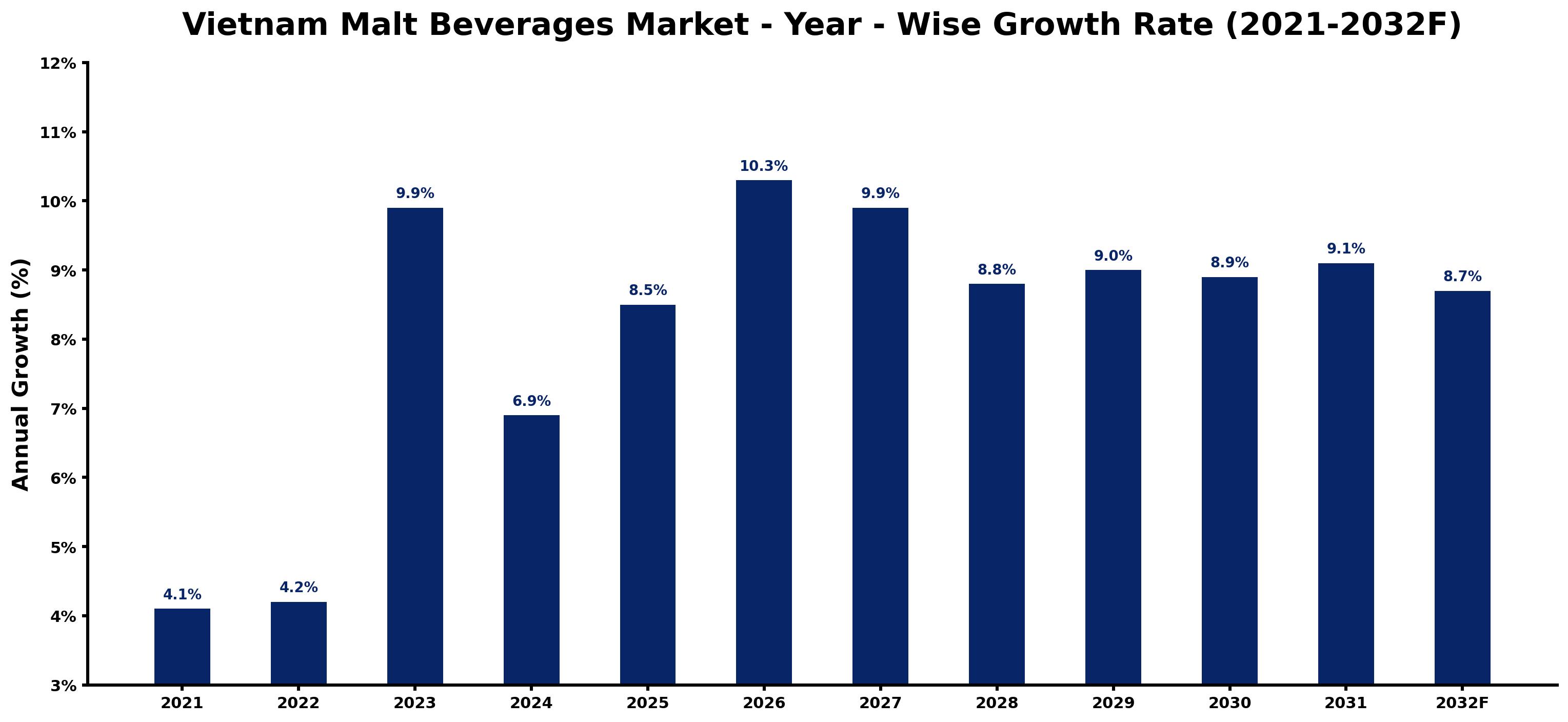
The table below presents the year wise growth rates along with the key drivers influencing the market
| Year | Growth Rate | Major Drivers |
| 2021 | 4.1% | Vietnam's youthful population increasingly seeks non-alcoholic beverage alternatives. |
| 2022 | 4.2% | Local breweries innovate unique flavor profiles catering to consumer preferences. |
| 2023 | 9.9% | Urbanization trends spur demand for convenient, ready-to-drink malt beverages. |
| 2024 | 6.9% | Health-conscious consumers favor malt drinks for their perceived nutritional benefits. |
| 2025 | 8.5% | E-commerce platforms enhance accessibility, promoting online sales of malt beverages. |
| 2026 | 10.3% | Collaborations between local producers and international brands expand market reach. |
| 2027 | 9.9% | Vietnam's expanding middle class increases disposable income for premium products. |
| 2028 | 8.8% | Social media marketing effectively engages younger demographics, boosting brand loyalty. |
| 2029 | 9.0% | Sustainability initiatives influence consumer choices towards eco-friendly packaging options. |
| 2030 | 8.9% | Tourism growth drives demand for local malt beverages among international visitors. |
| 2031 | 9.1% | Innovative brewing techniques enhance flavor and quality, attracting discerning consumers. |
| 2032 | 8.7% | Cultural shifts encourage malt beverages as essential components of social gatherings. |
Note - Market size estimations and growth projections presented in this report are based on 6Wresearch's advanced forecasting approach, validated with industry datasets as of June 2026.
Vietnam Malt Beverages Market Synopsis
The Vietnam Malt Beverages Market is projected to reach 10.3% and witness significant growth during the forecast period (2026-2032). This market encompasses a variety of malt-based products, including both alcoholic and non-alcoholic beverages, which have become increasingly popular among consumers. The ongoing transformation in consumer lifestyles, combined with the rapid growth of the Vietnamese economy, is propelling the demand for malt beverages, highlighting their integral role in the beverage sector.
Vietnam Malt Beverages Market Growth Drivers
Several factors are driving the expansion of the Vietnam Malt Beverages Market.
- The youth demographic is a major contributor to the market's growth, as Vietnam's expanding young population tends to favor malt beverages, reflecting a shift in consumption patterns towards these products.
- Urbanization has led to an increased number of consumers in cities, enhancing accessibility to malt beverages and promoting a culture of socializing where these drinks are often preferred.
- Rising disposable incomes have encouraged consumers to spend more on premium products, enabling the market to cater to a growing interest in innovative malt beverage offerings.
- The influence of Western culture, particularly in urban areas, has popularized malt beverages as a go-to choice, further driving their acceptance among the youth.
- Health trends have contributed significantly to the demand for non-alcoholic malt beverages as consumers prioritize health and wellness, leading to increased interest in low-alcohol options.
Vietnam Malt Beverages Market Challenges and Restraints
Despite its promising potential, the Vietnam Malt Beverages Market faces several challenges that could impede growth prospects.
- The market is subject to stringent regulations and taxation policies, particularly affecting the alcoholic beverage segment, which can lead to compliance challenges for manufacturers.
- Intense competition exists within the market, with numerous domestic and international brands vying for market share, resulting in pricing pressures and increased marketing expenditures.
- Changes in consumer preferences can be rapid, necessitating that manufacturers stay agile and responsive to emerging trends to maintain market relevance.
- Economic fluctuations can impact disposable incomes and consumer spending, posing risks for the premium segment of malt beverages, which relies heavily on consumer confidence.
- The COVID-19 pandemic has altered consumer behavior, leading to potential long-term shifts in purchasing patterns that could affect future growth.
Vietnam Malt Beverages Market COVID-19 Impact
The COVID-19 pandemic, which peaked in 2025, had a profound impact on the Vietnam Malt Beverages Market. The closure of bars, restaurants, and entertainment venues during lockdowns significantly reduced on-trade sales of alcoholic beverages.
Conversely, the market saw a notable rise in off-trade sales as consumers increased their purchases of malt beverages for home consumption. Lockdowns also prompted shifts in preferences, with a greater demand for non-alcoholic malt beverages as health-conscious choices gained traction among consumers.
Vietnam Malt Beverages Market Government Investment and Initiatives
The government of Vietnam has implemented various policies aimed at supporting the growth of the malt beverages sector as part of its broader strategy to enhance the agricultural and food processing industries.
- Investment in infrastructure improvements is envisioned to facilitate the production and distribution of malt beverages, thereby increasing supply chain efficiency.
- Government initiatives to promote tourism and the food culture of Vietnam indirectly benefit the malt beverages market, as international tourists often seek local beverage experiences.
- Regulatory bodies are working to create a more favorable environment for manufacturers by addressing compliance issues and reducing bureaucracy in the startup process for new brewing enterprises.
- Public awareness campaigns focused on responsible drinking can foster a healthier market environment, benefiting both consumers and producers.
- Support for innovation and development of new beverage formulations through grants and funding initiatives can stimulate growth within the malt beverage sector.
Vietnam Malt Beverages Market Latest Developments (May 2025 - June 2026)
Recent developments in the Vietnam Malt Beverages Market from May 2025 to June 2026 have illustrated a shift in industry dynamics. The emphasis on health has led to an uptick in the introduction of low-calorie and non-alcoholic malt beverages, catering to the health-conscious consumer.
Moreover, industry players are increasingly focusing on product differentiation as a strategy to capture greater market share. This approach includes collaborations with local fruits and flavors to create unique offerings that resonate with local tastes.
Additionally, sustainability has gained traction as a central theme, prompting manufacturers to adopt eco-friendly practices and packaging solutions, aligning with global trends towards sustainability. These developments reflect a responsive market that is adapting to both consumer preferences and regulatory considerations.
Vietnam Malt Beverages Market - Key Attractiveness of the Report
- 10 Years of Market Numbers
- Historical Data Starting from 2022 to 2025
- Base Year: 2025
- Forecast Data until 2032
- Key Performance Indicators Impacting the Market
- Major Upcoming Developments and Projects
Key Highlights of the Report:
- Vietnam Malt Beverages Market Outlook
- Market Size of Vietnam Malt Beverages Market, 2025
- Forecast of Vietnam Malt Beverages Market, 2032
- Historical Data and Forecast of Vietnam Malt Beverages Revenues & Volume for the Period 2022-2032F
- Vietnam Malt Beverages Market Trend Evolution
- Vietnam Malt Beverages Market Drivers and Challenges
- Vietnam Malt Beverages Price Trends
- Vietnam Malt Beverages Porter's Five Forces
- Vietnam Malt Beverages Industry Life Cycle
- Historical Data and Forecast of Vietnam Malt Beverages Market Revenues & Volume By Product Type for the Period 2022-2032F
- Historical Data and Forecast of Vietnam Malt Beverages Market Revenues & Volume By Flavored for the Period 2022-2032F
- Historical Data and Forecast of Vietnam Malt Beverages Market Revenues & Volume By Unflavored for the Period 2022-2032F
- Historical Data and Forecast of Vietnam Malt Beverages Market Revenues & Volume By Applications for the Period 2022-2032F
- Historical Data and Forecast of Vietnam Malt Beverages Market Revenues & Volume By Alcoholic for the Period 2022-2032F
- Historical Data and Forecast of Vietnam Malt Beverages Market Revenues & Volume By Non-Alcoholic for the Period 2022-2032F
- Vietnam Malt Beverages Import Export Trade Statistics
- Market Opportunity Assessment By Product Type
- Market Opportunity Assessment By Applications
- Vietnam Malt Beverages Top Companies Market Share
- Vietnam Malt Beverages Competitive Benchmarking By Technical and Operational Parameters
- Vietnam Malt Beverages Company Profiles
- Vietnam Malt Beverages Key Strategic Recommendations






































