Vietnam Metal Fabrication Market Size, Share & Growth Rate
The Vietnam Metal Fabrication Market was estimated at USD 1291 Million in 2025 and is projected to reach USD 1835 Million by 2032, growing at a CAGR of 5.2% from 2026 to 2032. This growth trajectory is largely driven by the rapid expansion of Vietnam's manufacturing and construction sectors, where precision-engineered components are essential. The increasing adoption of automation and technological advancements further enhances the demand for customized metal solutions across various industries.
Vietnam Metal Fabrication Market Year-wise Growth Rate and Key Drivers
This graph highlights how the Vietnam Metal Fabrication Market has steadily grown over the years, supported by major growth factors.
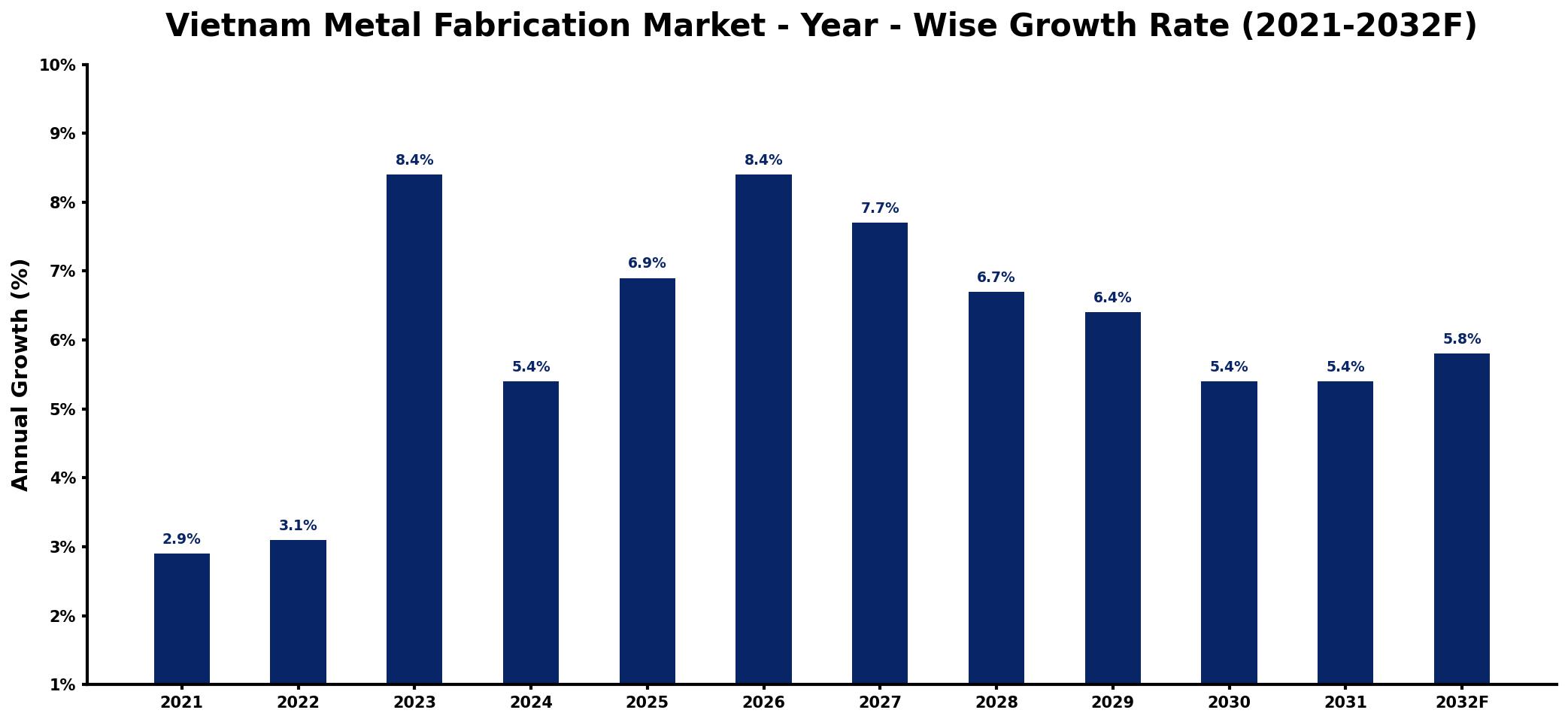
The table below presents the year‑wise growth rates along with the key drivers influencing the market
| Year | Growth Rate | Major Drivers |
| 2021 | 2.9% | Rising construction sector investments |
| 2022 | 3.1% | Infrastructure projects driving demand |
| 2023 | 8.4% | Increased automotive production capacity |
| 2024 | 5.4% | Growing renewable energy initiatives |
| 2025 | 6.9% | Expansion of manufacturing facilities |
| 2026 | 8.4% | Surge in export opportunities |
| 2027 | 7.7% | Technological advancements enhancing capabilities |
| 2028 | 6.7% | Increased focus on sustainability practices |
| 2029 | 6.4% | Growing domestic consumer markets |
| 2030 | 5.4% | Rising demand for customized solutions |
| 2031 | 5.4% | Investments in smart technology integration |
| 2032 | 5.8% | Emergence of new industry standards |
Note: Market size estimations and growth projections presented in this report are based on 6Wresearch's proprietary forecasting methodology, utilizing the latest available industry data, government publications, and primary research inputs.
Vietnam Metal Fabrication Market Synopsis
The Vietnam Metal Fabrication market has gained significant momentum in recent years, fueled by the country's industrial growth and rising infrastructural development. However, as we look towards the future, the landscape is set to evolve with a stronger emphasis on quality, innovation, and customer-centric solutions.
With the escalating demand for custom metal components across sectors such as automotive, aerospace, and construction, local fabricators are poised to adapt and thrive. As competition intensifies, an increasing focus on efficiency and advanced manufacturing technologies will be paramount to maintaining market share and meeting customer expectations.
Vietnam Metal Fabrication Market Key Takeaways
- The market is driven by robust demand from the manufacturing and construction sectors.
- Technological advancements are leading to increased automation and precision in metal fabrication processes.
- Local manufacturers are focusing on enhancing quality assurance and project timelines to stay competitive.
- The impact of COVID-19 has reshaped operational strategies and highlighted the importance of digitalization.
- The market presents considerable growth potential, with substantial investments expected in advanced manufacturing technologies.
Evaluation of Restraints in Vietnam Metal Fabrication Market
Despite the positive growth outlook, the Vietnam Metal Fabrication market faces several restraints. Fluctuating raw material prices can create financial unpredictability for fabricators, impacting their profitability. Additionally, the industry grapples with a skills gap, as the demand for technically proficient workers exceeds supply. Moreover, stringent quality assurance standards and the need to meet increasingly complex project timelines challenge fabricators to streamline operations while maintaining high standards. Addressing these restraints is critical for firms aiming to capture market opportunities effectively.
Vietnam Metal Fabrication Market Trends
Currently, a prominent trend in the Vietnam Metal Fabrication market is the integration of advanced technologies, such as robotics and IoT, to enhance operational efficiency. This shift not only improves production capabilities but also fosters innovation in product offerings. Furthermore, a growing emphasis on sustainable manufacturing practices is emerging, with more companies seeking eco-friendly materials and processes. Digitalization is also transforming how businesses operate, enabling better communication, project management, and customer engagement.
Vietnam Metal Fabrication Market Opportunities
There are substantial opportunities for growth within the Vietnam Metal Fabrication market. Companies that invest in advanced manufacturing technologies, such as 3D printing and additive manufacturing, stand to gain a competitive edge. Additionally, as Vietnam positions itself as a manufacturing hub in Southeast Asia, the demand for high-quality metal components in both domestic and international markets will surge. Strategic partnerships and collaborations can also unlock new avenues for innovation and market expansion.
Government Initiatives in the Vietnam Metal Fabrication Market
The Vietnamese government has implemented various policies aimed at boosting the industrial sector, including initiatives to support the metal fabrication industry. Public investment in infrastructure development is expected to drive demand for metal components significantly. Additionally, the government promotes technological upgrades in manufacturing through funding programs and incentives aimed at enhancing competitiveness and sustainability. Such support is crucial for advancing the capabilities of local fabricators and fostering a resilient manufacturing ecosystem.
Future Insights of the Vietnam Metal Fabrication Market
Looking ahead to 2026-2032, the Vietnam Metal Fabrication market is on a trajectory of sustained growth. Continued urbanization and industrialization will likely further catalyze demand for metal fabrication services. The increasing necessity for custom, high-precision components will drive innovation, pushing fabricators to embrace cutting-edge technologies. Moreover, as global trends shift toward sustainable manufacturing, those who adapt to these changes will find themselves well-positioned to capitalize on new opportunities and meet evolving customer demands.
Vietnam Metal Fabrication Market Latest Developments (2025 - 2026)
Recent industry developments indicate a trend towards consolidation among smaller fabricators as they seek to compete with larger companies. Advancements in automation technology are enabling greater efficiency in production processes, while digital tools are increasingly being adopted for project management. The market has also seen increased collaboration among industry players to share best practices and enhance operational efficiencies. Overall, the focus on innovation and adaptation remains strong as the industry seeks to recover and grow post-pandemic.
Vietnam Metal Fabrication Market - Key Attractiveness of the Report
- 10 Years of Market Numbers
- Historical Data Starting from 2022 to 2025
- Base Year: 2025
- Forecast Data until 2032
- Key Performance Indicators Impacting the Market
- Major Upcoming Developments and Projects
Key Highlights of the Report:
- Vietnam Metal Fabrication Market Outlook
- Market Size of Vietnam Metal Fabrication Market, 2025
- Forecast of Vietnam Metal Fabrication Market, 2032
- Historical Data and Forecast of Vietnam Metal Fabrication Revenues & Volume for the Period 2022-2032F
- Vietnam Metal Fabrication Market Trend Evolution
- Vietnam Metal Fabrication Market Drivers and Challenges
- Vietnam Metal Fabrication Price Trends
- Vietnam Metal Fabrication Porter's Five Forces
- Vietnam Metal Fabrication Industry Life Cycle
- Historical Data and Forecast of Vietnam Metal Fabrication Market Revenues & Volume By End-user Industry for the Period 2022-2032F
- Historical Data and Forecast of Vietnam Metal Fabrication Market Revenues & Volume By Manufacturing for the Period 2022-2032F
- Historical Data and Forecast of Vietnam Metal Fabrication Market Revenues & Volume By Power and Utilities for the Period 2022-2032F
- Historical Data and Forecast of Vietnam Metal Fabrication Market Revenues & Volume By Construction for the Period 2022-2032F
- Historical Data and Forecast of Vietnam Metal Fabrication Market Revenues & Volume By Oil and Gas for the Period 2022-2032F
- Historical Data and Forecast of Vietnam Metal Fabrication Market Revenues & Volume By Other End-user Industries for the Period 2022-2032F
- Historical Data and Forecast of Vietnam Metal Fabrication Market Revenues & Volume By Metal Folding for the Period 2022-2032F
- Historical Data and Forecast of Vietnam Metal Fabrication Market Revenues & Volume By Product category for the Period 2022-2032F
- Historical Data and Forecast of Vietnam Metal Fabrication Market Revenues & Volume By Structural steel fabrication for the Period 2022-2032F
- Historical Data and Forecast of Vietnam Metal Fabrication Market Revenues & Volume By Process Equipment Fabrication for the Period 2022-2032F
- Vietnam Metal Fabrication Import Export Trade Statistics
- Market Opportunity Assessment By End-user Industry
- Market Opportunity Assessment By Product category
- Vietnam Metal Fabrication Top Companies Market Share
- Vietnam Metal Fabrication Competitive Benchmarking By Technical and Operational Parameters
- Vietnam Metal Fabrication Company Profiles
- Vietnam Metal Fabrication Key Strategic Recommendations






































