Vietnam Ore & Alloys Market Size, Share & Growth Rate
The Vietnam Ore & Alloys Market was estimated at USD 1012 Million in 2025 and is projected to reach USD 1439 Million by 2032, growing at a CAGR of 5.2% from 2026 to 2032. This growth trajectory is primarily driven by the escalating demand for critical alloying materials such as ferrochrome, ferromanganese, and ferrosilicon across steelmaking and automotive sectors. Furthermore, advancements in alloy production processes are contributing to enhanced supply chain efficiencies, positioning the market for robust expansion.
Vietnam Ore & Alloys Market Year-wise Growth Rate and Key Drivers
This graph highlights how the Vietnam Ore & Alloys Market has steadily grown over the years, supported by major growth factors.
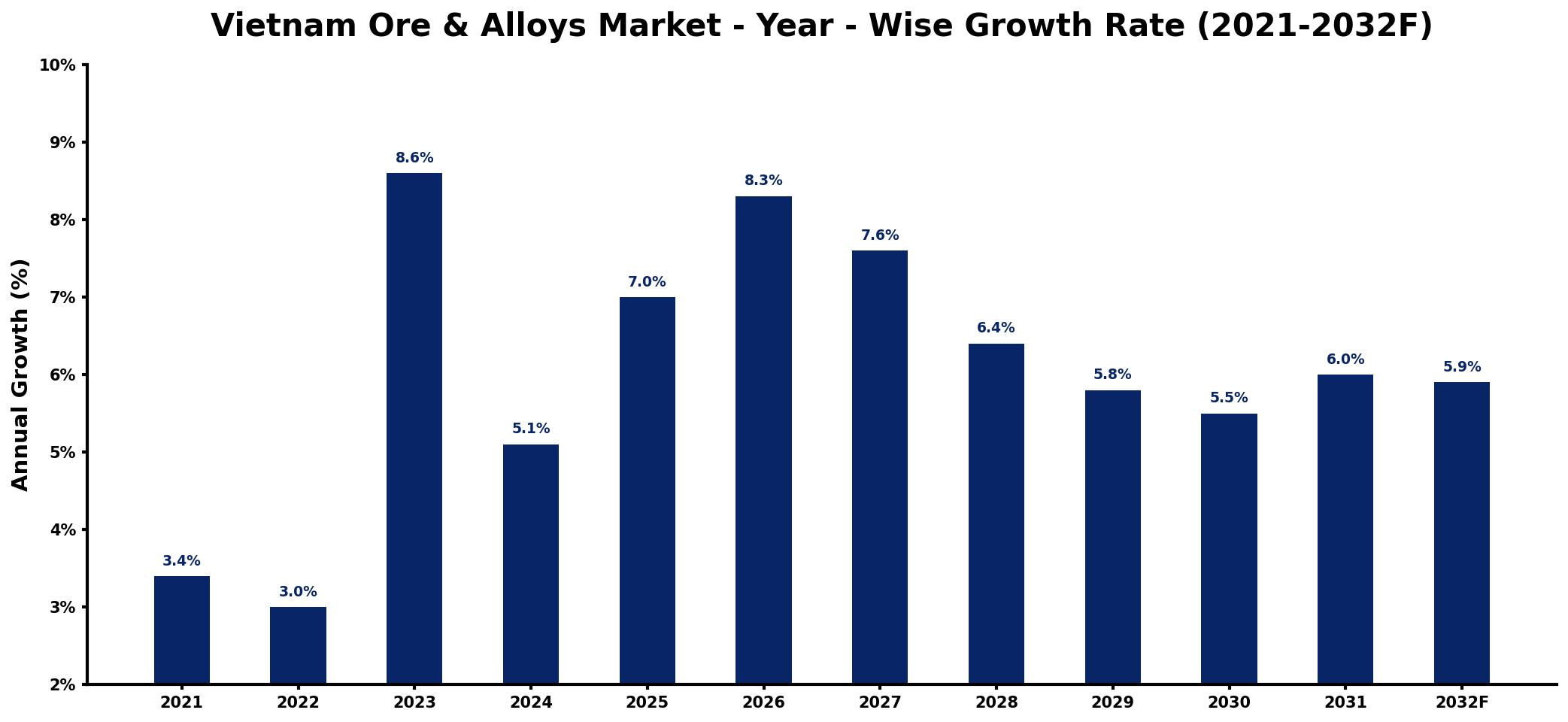
The table below presents the year‑wise growth rates along with the key drivers influencing the market
| Year | Growth Rate | Major Drivers |
| 2021 | 3.4% | Rising construction sector demands materials |
| 2022 | 3.0% | Increased investments in infrastructure projects |
| 2023 | 8.6% | Surge in renewable energy initiatives |
| 2024 | 5.1% | Growing automotive manufacturing sector needs |
| 2025 | 7.0% | Expansion of electronics manufacturing capacity |
| 2026 | 8.3% | growing emerging market penetration |
| 2027 | 7.6% | Higher demand from industrial applications |
| 2028 | 6.4% | Increased focus on sustainability efforts |
| 2029 | 5.8% | Revival of global trade activities |
| 2030 | 5.5% | Emergence of new technological applications |
| 2031 | 6.0% | Strengthening regional supply chains efficiency |
| 2032 | 5.9% | Growth in consumer electronics market |
Note: Market size estimations and growth projections presented in this report are based on 6Wresearch's proprietary forecasting methodology, utilizing the latest available industry data, government publications, and primary research inputs.
Vietnam Ore & Alloys Market Synopsis
The Vietnam Ore & Alloys Market has shown remarkable resilience and adaptability in recent years, particularly following the challenges posed by the COVID-19 pandemic. As industrial sectors rebound, the demand for high-quality ore alloys is poised to escalate, aligning with the nation's broader economic growth and increasing industrialization.
Looking ahead, the market is set to evolve further with innovations in production techniques and a focus on sustainability. This evolution is crucial as industries seek to enhance their operational efficiencies while adhering to stringent environmental standards. The increasing reliance on alloys across diverse applications underscores the importance of this sector in Vietnam's economic landscape.
- The market is anticipated to grow significantly, reflecting the increasing reliance on alloying elements in multiple industries.
- Domestic and international suppliers are working to meet rising standards for quality and sustainability.
- Supply chain adaptations following the pandemic illustrate the market's resilience and agility.
- Emerging technologies in alloy production are shaping competitive advantages for key players.
- Government initiatives are fostering a conducive environment for investments in the ore alloys sector.
While the Vietnam Ore & Alloys Market exhibits promising growth potential, several restraints must be navigated. Responsible sourcing remains a paramount challenge, as manufacturers grapple with ensuring sustainable practices amidst rising global demand. Quality control processes must be stringent to comply with international standards, which can often strain operational capabilities. Additionally, fluctuations in global demand, influenced by geopolitical factors, can create unpredictability, requiring market participants to be agile in their strategies.
Current trends in the Vietnam Ore & Alloys Market indicate a shift towards eco-friendly production practices, driven by both consumer demand and regulatory frameworks. The adoption of innovative technologies aimed at enhancing alloy properties is gaining traction, including advancements in recycling and waste management. Furthermore, the automotive industry's transition towards electric vehicles is creating new demands for specialized alloys, further broadening the market landscape.
Significant growth opportunities exist within the Vietnam Ore & Alloys Market, particularly in the realm of advanced manufacturing and green technologies. Investment in R&D can yield new alloy compositions that meet the evolving needs of various sectors. Furthermore, strategic partnerships between domestic and international firms could enhance resource sharing and expand market reach. The ongoing infrastructure development in Vietnam also presents a fertile ground for increased consumption of ore alloys.
The Vietnamese government is actively supporting the ore alloys market through various policies aimed at promoting sustainable industrial practices. Incentives for eco-friendly production, along with initiatives to enhance technological capabilities, are being implemented. Additionally, public investments in infrastructure are creating a robust demand for steel and allied products, thereby bolstering the ore alloys sector. These measures underscore the government's commitment to fostering a resilient industrial landscape.
From 2026 to 2032, the Vietnam Ore & Alloys Market is expected to witness transformative changes driven by technological innovations and a concerted focus on sustainability. The increasing adoption of advanced alloys, coupled with heightened consumer awareness regarding environmental impacts, will further influence market dynamics. As industries pivot towards greener practices, those engaged in responsible sourcing and production are likely to emerge as market leaders in this evolving landscape.
Recent developments within the Vietnam Ore & Alloys Market indicate a proactive approach among manufacturers to mitigate previous supply chain disruptions. Companies are investing in advanced production technologies to enhance efficiency and reduce waste. There is also a notable increase in collaborative efforts between domestic suppliers and international players, aimed at streamlining sourcing strategies and expanding market presence. These moves reflect an industry adapting to both challenges and opportunities in a rapidly changing environment.
- 10 Years of Market Numbers
- Historical Data Starting from 2022 to 2025
- Base Year: 2025
- Forecast Data until 2032
- Key Performance Indicators Impacting the Market
- Major Upcoming Developments and Projects
Key Highlights of the Report:
- Vietnam Ore & Alloys Market Outlook
- Market Size of Vietnam Ore & Alloys Market, 2025
- Forecast of Vietnam Ore & Alloys Market, 2032
- Historical Data and Forecast of Vietnam Ore & Alloys Revenues & Volume for the Period 2022-2032F
- Vietnam Ore & Alloys Market Trend Evolution
- Vietnam Ore & Alloys Market Drivers and Challenges
- Vietnam Ore & Alloys Price Trends
- Vietnam Ore & Alloys Porter's Five Forces
- Vietnam Ore & Alloys Industry Life Cycle
- Historical Data and Forecast of Vietnam Ore & Alloys Market Revenues & Volume By Product Type for the Period 2022-2032F
- Historical Data and Forecast of Vietnam Ore & Alloys Market Revenues & Volume By Chrome Ore for the Period 2022-2032F
- Historical Data and Forecast of Vietnam Ore & Alloys Market Revenues & Volume By Manganese Ore for the Period 2022-2032F
- Historical Data and Forecast of Vietnam Ore & Alloys Market Revenues & Volume By Ferro-chrome for the Period 2022-2032F
- Historical Data and Forecast of Vietnam Ore & Alloys Market Revenues & Volume By Ferro-manganese for the Period 2022-2032F
- Historical Data and Forecast of Vietnam Ore & Alloys Market Revenues & Volume By Ferro-nickel for the Period 2022-2032F
- Historical Data and Forecast of Vietnam Ore & Alloys Market Revenues & Volume By Ferro- Silicon for the Period 2022-2032F
- Historical Data and Forecast of Vietnam Ore & Alloys Market Revenues & Volume By Silico-manganese for the Period 2022-2032F
- Historical Data and Forecast of Vietnam Chrome Ore Ore & Alloys Market Revenues & Volume By Others for the Period 2022-2032F
- Historical Data and Forecast of Vietnam Ore & Alloys Market Revenues & Volume By Application for the Period 2022-2032F
- Historical Data and Forecast of Vietnam Ore & Alloys Market Revenues & Volume By Automobiles for the Period 2022-2032F
- Historical Data and Forecast of Vietnam Ore & Alloys Market Revenues & Volume By Surgical Tools for the Period 2022-2032F
- Historical Data and Forecast of Vietnam Ore & Alloys Market Revenues & Volume By Aerospace Industry for the Period 2022-2032F
- Historical Data and Forecast of Vietnam Ore & Alloys Market Revenues & Volume By Buildings for the Period 2022-2032F
- Historical Data and Forecast of Vietnam Ore & Alloys Market Revenues & Volume By Others for the Period 2022-2032F
- Vietnam Ore & Alloys Import Export Trade Statistics
- Market Opportunity Assessment By Product Type
- Market Opportunity Assessment By Application
- Vietnam Ore & Alloys Top Companies Market Share
- Vietnam Ore & Alloys Competitive Benchmarking By Technical and Operational Parameters
- Vietnam Ore & Alloys Company Profiles
- Vietnam Ore & Alloys Key Strategic Recommendations






































