Vietnam Petroleum Refining Products Market Summary
The vietnam petroleum refining products market was estimated at USD 200 Million in 2025 and is projected to reach USD 281 Million by 2032, growing at a CAGR of 7.7% from 2026 to 2032.
Vietnam Petroleum Refining Products Market Year-wise Growth Rate and Key Drivers
This graph highlights how the Vietnam Petroleum Refining Products Market has steadily grown over the past five years, supported by major growth factors.
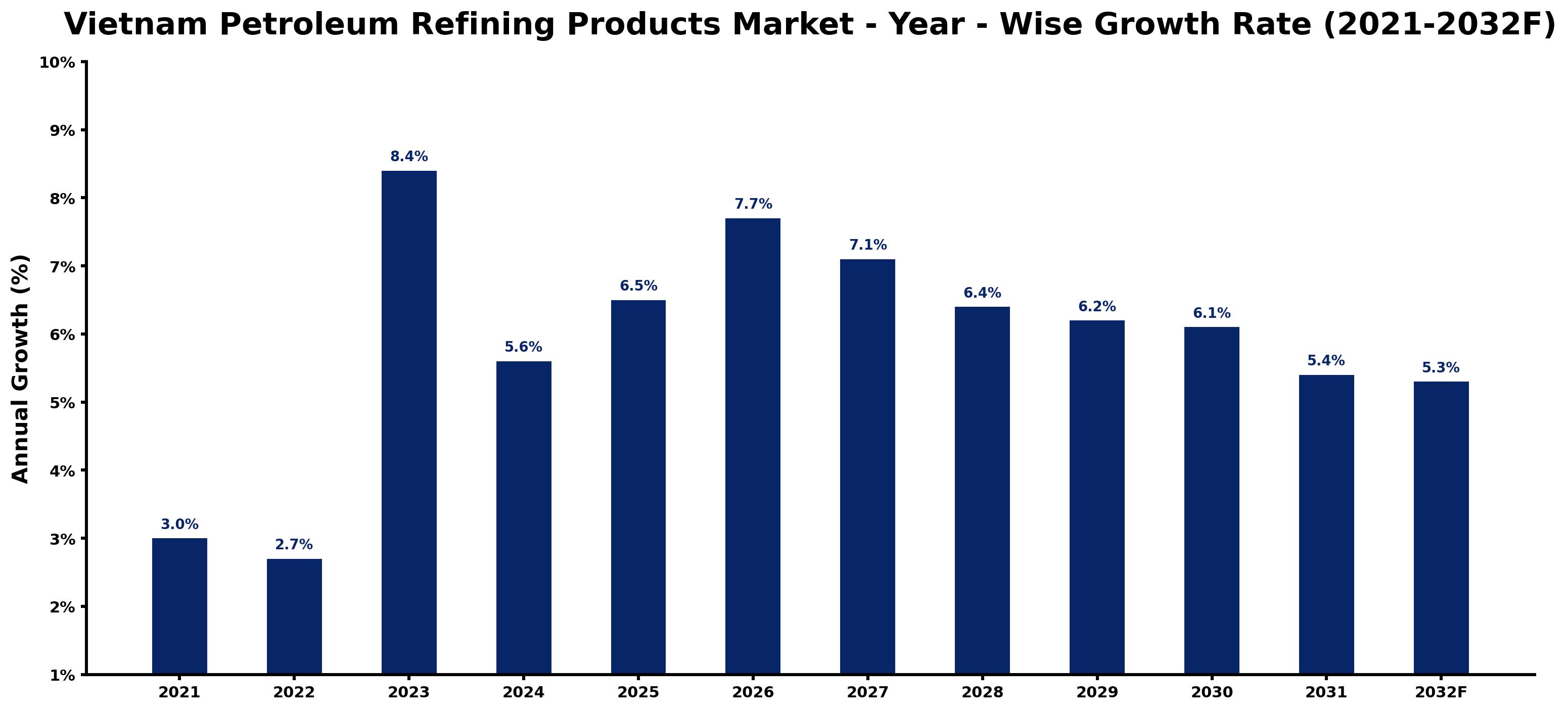
The table below presents the year wise growth rates along with the key drivers influencing the market
| Year | Growth Rate | Major Drivers |
| 2021 | 3.0% | Post-lockdown retail projects highlighted the importance of refined petroleum products. |
| 2022 | 2.7% | Manufacturing sectors began relocating, intensifying the demand for energy resources. |
| 2023 | 8.4% | Infrastructure expansions in urban areas reflected a surge in petroleum consumption. |
| 2024 | 5.6% | Increased investments in transportation networks boosted the need for refined fuels. |
| 2025 | 6.5% | Rural electrification programs prompted higher consumption of petroleum products in remote areas. |
| 2026 | 7.7% | Technological upgrades in refineries improved production efficiency and output quality. |
| 2027 | 7.1% | Global oil prices stabilized, creating favorable conditions for local market growth. |
| 2028 | 6.4% | Emerging industries sought reliable energy sources to support operational demands. |
| 2029 | 6.2% | Competitive pricing strategies attracted new entrants into the petroleum refining sector. |
| 2030 | 6.1% | Urbanization trends resulted in significant shifts in energy consumption patterns. |
| 2031 | 5.4% | Environmental awareness influenced a transition towards cleaner refining technologies. |
| 2032 | 5.3% | Innovation in logistics and distribution enhanced market reach of petroleum products. |
Note - Market size estimations and growth projections presented in this report are based on 6Wresearch's advanced forecasting approach, validated with industry datasets as of June 2026.
Vietnam Petroleum Refining Products Market Synopsis
The Vietnam Petroleum Refining Products Market is projected to reach 7.7% and witness significant growth during the forecast period (2026-2032). This dynamic market is pivotal in addressing the energy needs of an expanding industrial sector and the growing population in Vietnam. The range of refined products includes essential fuels such as gasoline, diesel, and jet fuel, as well as critical petrochemical products. The increasing industrial activities and the rapid pace of economic development have stimulated demand across various sectors of the economy. The Vietnamese petroleum refining landscape is further shaped by global crude oil price fluctuations, geopolitical influences, and domestic policies focused on energy security and environmental sustainability.
Vietnam Petroleum Refining Products Market Growth Drivers
The Vietnam Petroleum Refining Products Market is driven by multiple factors that shape demand for refined petroleum. Firstly, the country's robust economic growth and ongoing industrialization are primary catalysts. As industries expand, so does the consumption of energy sources, particularly refined petroleum products such as diesel and jet fuel, which are critical for transportation and logistics.
- Economic Development: Vietnam's economic growth trajectory has led to increased energy consumption, driving demand for gasoline and diesel.
- Transportation Sector Expansion: The rising automotive and aviation sectors have escalated the requirement for gasoline and jet fuel.
- Urbanization: A growing urban population has significantly raised energy needs for transportation, electricity, and domestic use.
- Investment in Infrastructure: The government's focus on infrastructure development contributes to demand for various petrochemical products as feedstock.
- Energy Hub Potential: Vietnam's strategic geographical position enhances its potential to become a significant energy hub in Southeast Asia, attracting investments in petroleum refining.
Vietnam Petroleum Refining Products Market Challenges and Restraints
While there are notable growth drivers, the Vietnam Petroleum Refining Products Market also contends with significant challenges. Environmental concerns have emerged as a pressing issue, with increasing scrutiny over the industry's impact on climate change and air quality.
- Regulatory Pressures: Stricter environmental regulations necessitate substantial investment in cleaner technologies and practices.
- Shift to Renewable Energy: The global push towards renewable energy sources creates competitive pressure on the petroleum refining sector.
- Price Volatility: Fluctuations in global oil prices pose financial risks, impacting profitability and operational stability.
- Public Perception: Growing public awareness regarding environmental impacts can affect market dynamics and consumer preferences.
- Sustainability Initiatives: The need to adopt sustainable practices may incur additional costs, challenging existing operational frameworks.
Vietnam Petroleum Refining Products Market Government Investment and Initiatives
The Vietnamese government plays a crucial role in shaping the dynamics of the petroleum refining products market through various initiatives and investments aimed at enhancing energy security and environmental sustainability. Significant public spending has been directed towards improving existing refining infrastructure and increasing capacity to meet domestic demands.
- Energy Security Policies: The government has enacted policies to boost the domestic production of petroleum products, reducing dependence on imports.
- Infrastructure Development: Investments in upgrading refining facilities are being prioritized to enhance operational efficiencies and output.
- Environmental Programs: Initiatives to promote cleaner technologies in refining processes are underway, focusing on reducing emissions and waste.
- Incentives for Renewable Integration: The government is exploring opportunities to integrate renewable energy sources within the existing framework of petroleum refining.
- Regional Collaboration: Efforts to collaborate with neighboring countries on energy projects are being explored to strengthen regional energy security.
Vietnam Petroleum Refining Products Market Latest Developments (May 2025 - June 2026)
During the period from May 2025 to June 2026, the Vietnam Petroleum Refining Products Market has experienced notable developments that reflect both the challenges and opportunities present in the sector. The emphasis on sustainability has intensified, with governmental and industry stakeholders focusing on integrating greener practices within the refining processes.
- Enhanced Environmental Regulations: New regulations aimed at reducing emissions have been introduced, necessitating compliance from refineries.
- Investment in Technology: There has been a notable increase in investment geared towards modernizing refining technologies, emphasizing efficiency and lower environmental impact.
- Market Recovery Trends: Following the disruptions caused by COVID-19, there has been a gradual recovery in demand for petroleum products as economic activities resume.
- Strategic Partnerships: Collaborations between public and private sectors are being fostered to address challenges in supply and sustainability.
- Focus on Domestic Production: A renewed strategic focus on bolstering domestic refining capacities has emerged to reduce reliance on foreign oil imports.
Vietnam Petroleum Refining Products Market - Key Attractiveness of the Report
- 10 Years of Market Numbers
- Historical Data Starting from 2022 to 2025
- Base Year: 2025
- Forecast Data until 2032
- Key Performance Indicators Impacting the Market
- Major Upcoming Developments and Projects
Key Highlights of the Report:
- Vietnam Petroleum Refining Products Market Outlook
- Market Size of Vietnam Petroleum Refining Products Market, 2025
- Forecast of Vietnam Petroleum Refining Products Market, 2032
- Historical Data and Forecast of Vietnam Petroleum Refining Products Revenues & Volume for the Period 2022-2032F
- Vietnam Petroleum Refining Products Market Trend Evolution
- Vietnam Petroleum Refining Products Market Drivers and Challenges
- Vietnam Petroleum Refining Products Price Trends
- Vietnam Petroleum Refining Products Porter's Five Forces
- Vietnam Petroleum Refining Products Industry Life Cycle
- Historical Data and Forecast of Vietnam Petroleum Refining Products Market Revenues & Volume By Type for the Period 2022-2032F
- Historical Data and Forecast of Vietnam Petroleum Refining Products Market Revenues & Volume By Ethane & LPG for the Period 2022-2032F
- Historical Data and Forecast of Vietnam Petroleum Refining Products Market Revenues & Volume By Gasoline for the Period 2022-2032F
- Historical Data and Forecast of Vietnam Petroleum Refining Products Market Revenues & Volume By Diesel/Gasoil for the Period 2022-2032F
- Historical Data and Forecast of Vietnam Petroleum Refining Products Market Revenues & Volume By Jet/Kerosene for the Period 2022-2032F
- Historical Data and Forecast of Vietnam Petroleum Refining Products Market Revenues & Volume By Naphtha for the Period 2022-2032F
- Historical Data and Forecast of Vietnam Petroleum Refining Products Market Revenues & Volume By Fuel Oil for the Period 2022-2032F
- Historical Data and Forecast of Vietnam Petroleum Refining Products Market Revenues & Volume By Others for the Period 2022-2032F
- Historical Data and Forecast of Vietnam Petroleum Refining Products Market Revenues & Volume By End-users for the Period 2022-2032F
- Historical Data and Forecast of Vietnam Petroleum Refining Products Market Revenues & Volume By Transportation for the Period 2022-2032F
- Historical Data and Forecast of Vietnam Petroleum Refining Products Market Revenues & Volume By Others for the Period 2022-2032F
- Vietnam Petroleum Refining Products Import Export Trade Statistics
- Market Opportunity Assessment By Type
- Market Opportunity Assessment By End-users
- Vietnam Petroleum Refining Products Top Companies Market Share
- Vietnam Petroleum Refining Products Competitive Benchmarking By Technical and Operational Parameters
- Vietnam Petroleum Refining Products Company Profiles
- Vietnam Petroleum Refining Products Key Strategic Recommendations






































