Vietnam Polyvinyl Chloride (PVC) Market Size, Share & Growth Rate
The Vietnam Polyvinyl Chloride (PVC) Market was estimated at USD 400 Million in 2025 and is projected to reach USD 564 Million by 2032, growing at a CAGR of 5.0% from 2026 to 2032. This growth trajectory is largely fueled by the booming construction sector, which is a primary consumer of PVC for a variety of applications, from pipes to flooring. Additionally, the increasing demand from the automotive and packaging industries is further propelling market expansion, as manufacturers seek cost-effective and versatile materials.
Vietnam Polyvinyl Chloride (PVC) Market Year-wise Growth Rate and Key Drivers
This graph highlights how the Vietnam Polyvinyl Chloride (PVC) Market has steadily grown over the years, supported by major growth factors.
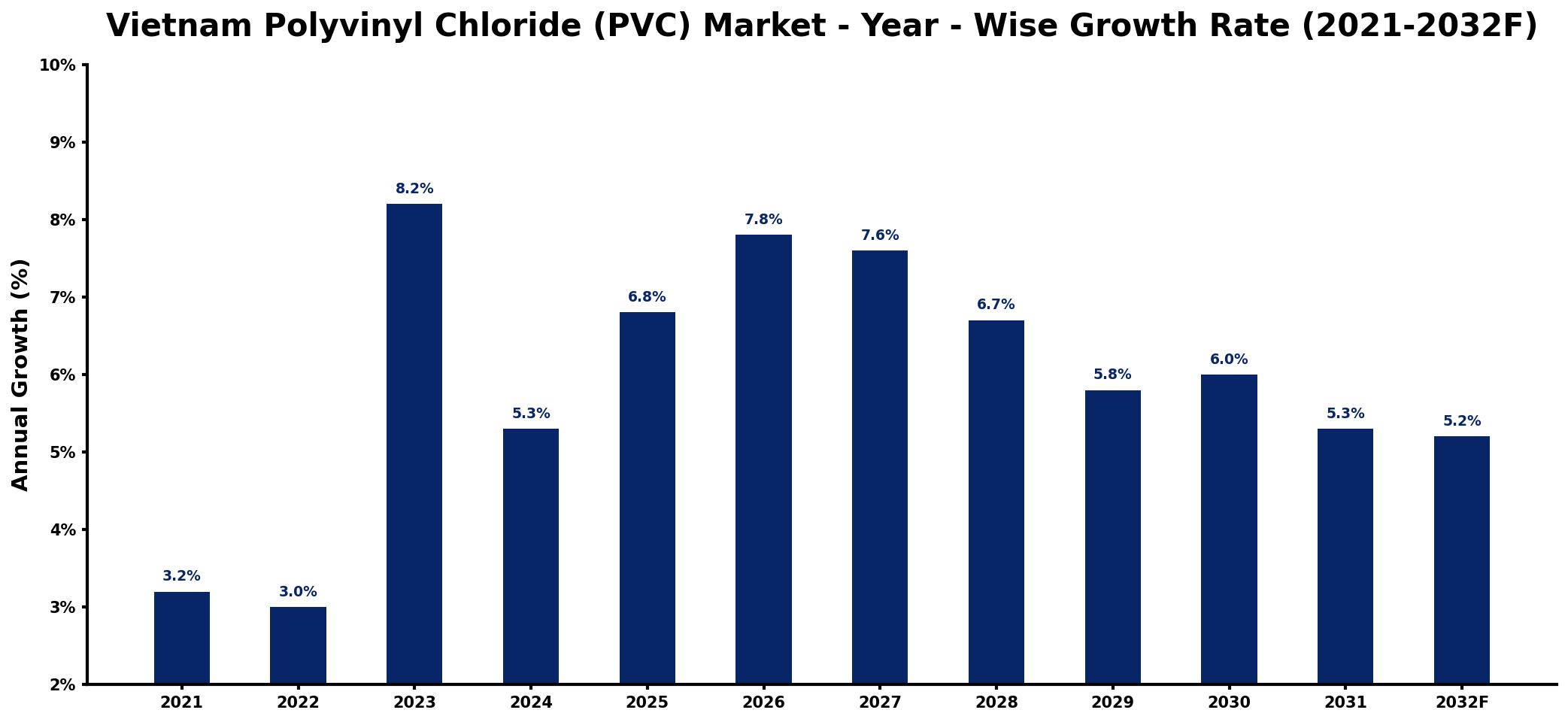
The table below presents the year‑wise growth rates along with the key drivers influencing the market
| Year | Growth Rate | Major Drivers |
| 2021 | 3.2% | Rising construction sector investments |
| 2022 | 3.0% | Increased demand from packaging industry |
| 2023 | 8.2% | Expansion in automotive manufacturing capacity |
| 2024 | 5.3% | Growth in consumer goods production |
| 2025 | 6.8% | Surge in infrastructure development projects |
| 2026 | 7.8% | Emerging renewable energy initiatives |
| 2027 | 7.6% | Boost in healthcare product applications |
| 2028 | 6.7% | Advancements in building materials technology |
| 2029 | 5.8% | growing emerging market penetration |
| 2030 | 6.0% | Increased focus on sustainable solutions |
| 2031 | 5.3% | Rising interest in home improvement |
| 2032 | 5.2% | Expansion of export markets opportunities |
Note: Market size estimations and growth projections presented in this report are based on 6Wresearch's proprietary forecasting methodology, utilizing the latest available industry data, government publications, and primary research inputs.
Vietnam Polyvinyl Chloride (PVC) Market Synopsis
The strongest force shaping the Vietnam PVC market today is the rapid growth of the construction sector. With significant infrastructure projects and real estate developments underway, the demand for PVC products is surging, solidifying its role as an essential material in the building and construction industries.
Moreover, the automotive industry's reliance on PVC for both interior and exterior components is reshaping the market landscape. As companies prioritize product quality and compliance, the Vietnamese PVC market is adapting to meet these evolving demands while also exploring more sustainable practices.
Vietnam Polyvinyl Chloride (PVC) Market Key Takeaways
- The market is driven primarily by growth in construction and infrastructure projects.
- Increased utilization of PVC in automotive components is significant.
- Environmental sustainability concerns are shaping production practices.
- Domestic production, combined with imports, creates a competitive landscape.
- Awareness of recycling and eco-friendly alternatives is on the rise.
Evaluation of Restraints in Vietnam Polyvinyl Chloride (PVC) Market
While the Vietnam PVC market exhibits robust growth potential, it faces notable restraints primarily due to environmental concerns. The scrutiny surrounding PVC's impact on health and the environment is leading to increased regulations. These regulations compel manufacturers to invest in eco-friendly processes, which can raise production costs and potentially affect profit margins. Striking a balance between meeting regulatory requirements and maintaining cost-effectiveness remains a challenge for industry players.
Vietnam Polyvinyl Chloride (PVC) Market Trends
Current trends in the Vietnam PVC market reflect a shift towards sustainability, with manufacturers exploring biodegradable and recyclable PVC alternatives. The rise of green building practices and the emphasis on eco-friendly materials in construction are also influencing demand. Technological advancements are driving innovation in product development, with more efficient manufacturing processes being adopted to enhance productivity while minimizing environmental impact.
Vietnam Polyvinyl Chloride (PVC) Market Opportunities
Investment opportunities abound in the Vietnam PVC market, particularly for companies focused on sustainable manufacturing practices. As consumer demand for eco-friendly products increases, the market is ripe for the introduction of innovative materials. Additionally, the ongoing expansion of infrastructure and real estate projects presents a substantial avenue for growth, encouraging stakeholders to enhance their offerings and capitalize on emerging trends.
Government Initiatives in the Vietnam Polyvinyl Chloride (PVC) Market
The Vietnamese government is actively promoting policies aimed at fostering sustainable industrial practices. Initiatives designed to enhance environmental protection and encourage the recycling of plastics, including PVC, are gaining traction. Additionally, public investment in infrastructure is creating a favorable environment for the growth of the PVC market, as demand for construction materials continues to rise.
Future Insights of the Vietnam Polyvinyl Chloride (PVC) Market
Looking ahead to 2026-2032, the Vietnam PVC market is poised for continued expansion, driven by infrastructural development and a growing emphasis on sustainability. As manufacturers adapt to evolving regulations and consumer preferences, the market will likely see a diversification of product offerings that align with eco-friendly standards. The interplay of domestic production and imports will further shape market dynamics, as industry players strive to remain competitive in a rapidly changing landscape.
Vietnam Polyvinyl Chloride (PVC) Market Latest Developments (2025 - 2026)
Recent developments in the Vietnam PVC market indicate a strong push towards innovation in manufacturing processes. Companies are increasingly adopting advanced technologies aimed at improving efficiency and reducing environmental impact. Additionally, collaborative efforts among industry stakeholders to promote recycling and eco-friendly practices have gained momentum, reflecting a collective commitment to addressing sustainability challenges.
Vietnam Polyvinyl Chloride (PVC) Market - Key Attractiveness of the Report
- 10 Years of Market Numbers
- Historical Data Starting from 2022 to 2025
- Base Year: 2025
- Forecast Data until 2032
- Key Performance Indicators Impacting the Market
- Major Upcoming Developments and Projects
Key Highlights of the Report:
- Vietnam Polyvinyl Chloride (PVC) Market Outlook
- Market Size of Vietnam Polyvinyl Chloride (PVC) Market, 2025
- Forecast of Vietnam Polyvinyl Chloride (PVC) Market, 2032
- Historical Data and Forecast of Vietnam Polyvinyl Chloride (PVC) Revenues & Volume for the Period 2022-2032F
- Vietnam Polyvinyl Chloride (PVC) Market Trend Evolution
- Vietnam Polyvinyl Chloride (PVC) Market Drivers and Challenges
- Vietnam Polyvinyl Chloride (PVC) Price Trends
- Vietnam Polyvinyl Chloride (PVC) Porter's Five Forces
- Vietnam Polyvinyl Chloride (PVC) Industry Life Cycle
- Historical Data and Forecast of Vietnam Polyvinyl Chloride (PVC) Market Revenues & Volume By Product Type for the Period 2022-2032F
- Historical Data and Forecast of Vietnam Polyvinyl Chloride (PVC) Market Revenues & Volume By Rigid PVC for the Period 2022-2032F
- Historical Data and Forecast of Vietnam Polyvinyl Chloride (PVC) Market Revenues & Volume By Flexible PVC for the Period 2022-2032F
- Historical Data and Forecast of Vietnam Polyvinyl Chloride (PVC) Market Revenues & Volume By Low-smoke PVC for the Period 2022-2032F
- Historical Data and Forecast of Vietnam Polyvinyl Chloride (PVC) Market Revenues & Volume By Chlorinated PVC for the Period 2022-2032F
- Historical Data and Forecast of Vietnam Polyvinyl Chloride (PVC) Market Revenues & Volume By Stabilizer Type for the Period 2022-2032F
- Historical Data and Forecast of Vietnam Polyvinyl Chloride (PVC) Market Revenues & Volume By Calcium-based Stabilizers for the Period 2022-2032F
- Historical Data and Forecast of Vietnam Polyvinyl Chloride (PVC) Market Revenues & Volume By Lead-based Stabilizers for the Period 2022-2032F
- Historical Data and Forecast of Vietnam Polyvinyl Chloride (PVC) Market Revenues & Volume By Tin and Organotin-based for the Period 2022-2032F
- Historical Data and Forecast of Vietnam Polyvinyl Chloride (PVC) Market Revenues & Volume By Barium-based for the Period 2022-2032F
- Historical Data and Forecast of Vietnam Polyvinyl Chloride (PVC) Market Revenues & Volume By Other Stabilizer Types for the Period 2022-2032F
- Historical Data and Forecast of Vietnam Polyvinyl Chloride (PVC) Market Revenues & Volume By Application for the Period 2022-2032F
- Historical Data and Forecast of Vietnam Polyvinyl Chloride (PVC) Market Revenues & Volume By Pipes and Fittings for the Period 2022-2032F
- Historical Data and Forecast of Vietnam Polyvinyl Chloride (PVC) Market Revenues & Volume By Film and Sheets for the Period 2022-2032F
- Historical Data and Forecast of Vietnam Polyvinyl Chloride (PVC) Market Revenues & Volume By Wire and Cables for the Period 2022-2032F
- Historical Data and Forecast of Vietnam Polyvinyl Chloride (PVC) Market Revenues & Volume By Bottles for the Period 2022-2032F
- Historical Data and Forecast of Vietnam Polyvinyl Chloride (PVC) Market Revenues & Volume By Profiles for the Period 2022-2032F
- Historical Data and Forecast of Vietnam Polyvinyl Chloride (PVC) Market Revenues & Volume By Hoses for the Period 2022-2032F
- Historical Data and Forecast of Vietnam Polyvinyl Chloride (PVC) Market Revenues & Volume By Tubings for the Period 2022-2032F
- Historical Data and Forecast of Vietnam Polyvinyl Chloride (PVC) Market Revenues & Volume By Other Applications for the Period 2022-2032F
- Historical Data and Forecast of Vietnam Polyvinyl Chloride (PVC) Market Revenues & Volume By End-user Industry for the Period 2022-2032F
- Historical Data and Forecast of Vietnam Polyvinyl Chloride (PVC) Market Revenues & Volume By Building and Construction for the Period 2022-2032F
- Historical Data and Forecast of Vietnam Polyvinyl Chloride (PVC) Market Revenues & Volume By Automotive for the Period 2022-2032F
- Historical Data and Forecast of Vietnam Polyvinyl Chloride (PVC) Market Revenues & Volume By Electrical and Electronics for the Period 2022-2032F
- Historical Data and Forecast of Vietnam Polyvinyl Chloride (PVC) Market Revenues & Volume By Packaging for the Period 2022-2032F
- Historical Data and Forecast of Vietnam Polyvinyl Chloride (PVC) Market Revenues & Volume By Footwear for the Period 2022-2032F
- Historical Data and Forecast of Vietnam Polyvinyl Chloride (PVC) Market Revenues & Volume By Healthcare for the Period 2022-2032F
- Historical Data and Forecast of Vietnam Polyvinyl Chloride (PVC) Market Revenues & Volume By Other End-user Industries for the Period 2022-2032F
- Vietnam Polyvinyl Chloride (PVC) Import Export Trade Statistics
- Market Opportunity Assessment By Product Type
- Market Opportunity Assessment By Stabilizer Type
- Market Opportunity Assessment By Application
- Market Opportunity Assessment By End-user Industry
- Vietnam Polyvinyl Chloride (PVC) Top Companies Market Share
- Vietnam Polyvinyl Chloride (PVC) Competitive Benchmarking By Technical and Operational Parameters
- Vietnam Polyvinyl Chloride (PVC) Company Profiles
- Vietnam Polyvinyl Chloride (PVC) Key Strategic Recommendations






































