Vietnam Printed Electronics Market Size, Share & Growth Rate
The Vietnam Printed Electronics Market was estimated at USD 313 Million in 2025 and is projected to reach USD 441 Million by 2032, growing at a CAGR of 5.0% from 2026 to 2032. This promising trajectory is primarily fueled by the rising demand for flexible displays and smart packaging solutions, driving innovation in manufacturing processes. Furthermore, advancements in conductive ink formulations and increased integration of printed electronics within IoT applications are expected to significantly enhance market growth.
Vietnam Printed Electronics Market Year-wise Growth Rate and Key Drivers
This graph highlights how the Vietnam Printed Electronics Market has steadily grown over the years, supported by major growth factors.
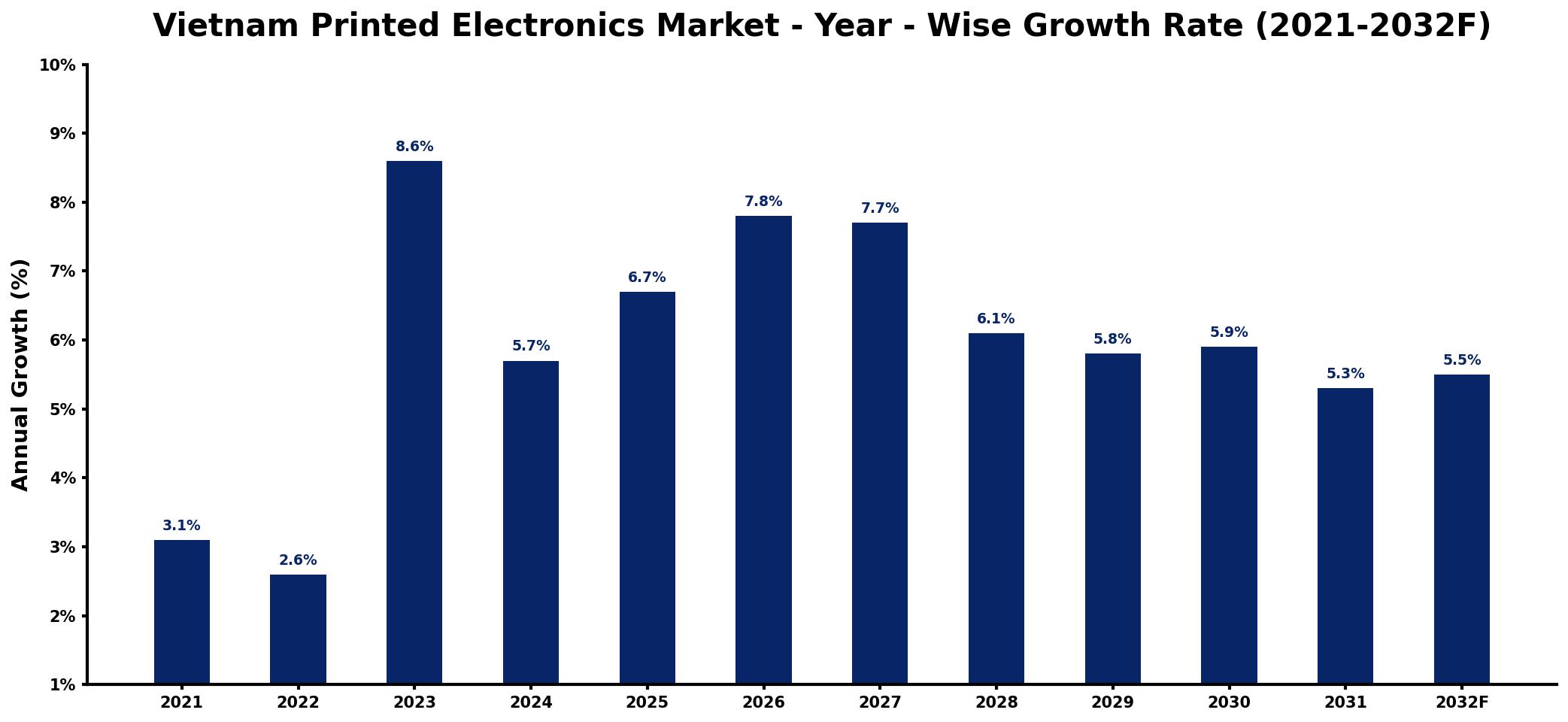
The table below presents the year‑wise growth rates along with the key drivers influencing the market
| Year | Growth Rate | Major Drivers |
| 2021 | 3.1% | Rising demand for innovative applications |
| 2022 | 2.6% | Increased investments in technology development |
| 2023 | 8.6% | Expansion of smart packaging solutions |
| 2024 | 5.7% | Growing interest in sustainable materials |
| 2025 | 6.7% | Emergence of wearable health devices |
| 2026 | 7.8% | expanding industrial usage applications |
| 2027 | 7.7% | Enhanced consumer awareness of sustainability |
| 2028 | 6.1% | Development of flexible display technologies |
| 2029 | 5.8% | Growth in automotive interior applications |
| 2030 | 5.9% | improved raw material availability |
| 2031 | 5.3% | rising export shipment volumes |
| 2032 | 5.5% | Advancements in manufacturing processes |
Note: Market size estimations and growth projections presented in this report are based on 6Wresearch's proprietary forecasting methodology, utilizing the latest available industry data, government publications, and primary research inputs.
Vietnam Printed Electronics Market Synopsis
Vietnam's printed electronics landscape is rapidly evolving, with a marked increase in the production of electronic components leveraging advanced printing technologies. The ability to create flexible circuits and sensors at a lower cost makes this sector particularly appealing to various industries, further driving its expansion.
As consumer preferences shift towards lightweight and adaptable electronic products, manufacturers are increasingly exploring printed electronics. The market serves diverse applications, from RFID tags to innovative display technologies, showcasing the versatility of printing technologies in contemporary electronic solutions.
Vietnam Printed Electronics Market Key Takeaways
- The market is witnessing robust growth driven by advancements in flexible display technology.
- Cost-effectiveness of printed electronics enhances their appeal across multiple industries.
- Integration into IoT applications is a significant factor propelling market development.
- Ongoing innovations in printing technology are reshaping production capabilities.
- The post-pandemic recovery indicates a resurgence in demand for printed electronic components.
Evaluation of Restraints in Vietnam Printed Electronics Market
Despite its promising outlook, the Vietnam printed electronics market faces challenges that may hinder its growth. The need to ensure high-quality and reliable components while maintaining cost-effectiveness remains a priority for manufacturers. Additionally, the pressure to meet stringent industry standards for electronic components further complicates production processes. Market participants must remain vigilant regarding advancements in technology and evolving application requirements to stay competitive in this dynamic landscape.
Vietnam Printed Electronics Market Trends
Several key trends are currently shaping the Vietnam printed electronics market. The ongoing digital transformation is pushing businesses to explore new applications, particularly in the areas of smart packaging and wearable technologies. Furthermore, the development of eco-friendly inks and sustainable production practices is gaining traction, reflecting a broader industry commitment to sustainability. As more companies seek to incorporate printed electronics into their product lines, the emphasis on innovation and adaptability is increasingly becoming a market standard.
Vietnam Printed Electronics Market Opportunities
The Vietnam printed electronics market presents numerous growth opportunities, particularly for businesses that can leverage the demand for personalized and smart products. Innovations in conductive inks are opening avenues for new applications, including healthcare sensors and interactive packaging solutions. Additionally, partnerships and collaborations between tech companies and research institutions can spur advancements in printed electronics technologies, paving the way for expanded market penetration and enhanced product offerings.
Government Initiatives in the Vietnam Printed Electronics Market
The Vietnamese government is actively promoting the development of the printed electronics sector as part of its broader push to enhance technological capabilities across industries. Various initiatives aim to foster research and development, incentivize investments in advanced manufacturing, and support the integration of innovative technologies in electronic production. These policies are designed to position Vietnam as a competitive player in the global electronics market.
Future Insights of the Vietnam Printed Electronics Market
Looking ahead to the period from 2026 to 2032, the Vietnam printed electronics market is poised for significant advancements. As manufacturers increasingly adopt cutting-edge printing technologies, there will be a greater focus on enhancing product performance and functionality. The market will likely continue to evolve alongside technological innovations, particularly in the realms of IoT and smart devices. This anticipated growth will require stakeholders to adopt forward-thinking strategies that prioritize flexibility, efficiency, and sustainability in production processes.
Vietnam Printed Electronics Market Latest Developments (2025 - 2026)
Recent trends indicate a resurgence in the printed electronics market following the impacts of the COVID-19 pandemic. Companies are increasingly investing in R&D to develop next-generation printed electronic solutions that cater to both consumer and industrial applications. Partnerships between technology firms and local manufacturers are also becoming more prevalent, enhancing resource sharing and innovation. The focus remains on expanding product offerings that meet evolving market demands while maintaining cost-effectiveness.
Vietnam Printed Electronics Market - Key Attractiveness of the Report
- 10 Years of Market Numbers
- Historical Data Starting from 2022 to 2025
- Base Year: 2025
- Forecast Data until 2032
- Key Performance Indicators Impacting the Market
- Major Upcoming Developments and Projects
Key Highlights of the Report:
- Vietnam Printed Electronics Market Outlook
- Market Size of Vietnam Printed Electronics Market, 2025
- Forecast of Vietnam Printed Electronics Market, 2032
- Historical Data and Forecast of Vietnam Printed Electronics Revenues & Volume for the Period 2022-2032F
- Vietnam Printed Electronics Market Trend Evolution
- Vietnam Printed Electronics Market Drivers and Challenges
- Vietnam Printed Electronics Price Trends
- Vietnam Printed Electronics Porter's Five Forces
- Vietnam Printed Electronics Industry Life Cycle
- Historical Data and Forecast of Vietnam Printed Electronics Market Revenues & Volume By Material for the Period 2022-2032F
- Historical Data and Forecast of Vietnam Printed Electronics Market Revenues & Volume By Ink for the Period 2022-2032F
- Historical Data and Forecast of Vietnam Printed Electronics Market Revenues & Volume By Substrate for the Period 2022-2032F
- Historical Data and Forecast of Vietnam Printed Electronics Market Revenues & Volume By Technology for the Period 2022-2032F
- Historical Data and Forecast of Vietnam Printed Electronics Market Revenues & Volume By Screen for the Period 2022-2032F
- Historical Data and Forecast of Vietnam Printed Electronics Market Revenues & Volume By Inkjet for the Period 2022-2032F
- Historical Data and Forecast of Vietnam Printed Electronics Market Revenues & Volume By Flexographic for the Period 2022-2032F
- Historical Data and Forecast of Vietnam Printed Electronics Market Revenues & Volume By Gravure for the Period 2022-2032F
- Historical Data and Forecast of Vietnam Printed Electronics Market Revenues & Volume By Device for the Period 2022-2032F
- Historical Data and Forecast of Vietnam Printed Electronics Market Revenues & Volume By Displays for the Period 2022-2032F
- Historical Data and Forecast of Vietnam Printed Electronics Market Revenues & Volume By Photovoltaic for the Period 2022-2032F
- Historical Data and Forecast of Vietnam Printed Electronics Market Revenues & Volume By Lighting for the Period 2022-2032F
- Historical Data and Forecast of Vietnam Printed Electronics Market Revenues & Volume By RFID for the Period 2022-2032F
- Historical Data and Forecast of Vietnam Printed Electronics Market Revenues & Volume By Others for the Period 2022-2032F
- Vietnam Printed Electronics Import Export Trade Statistics
- Market Opportunity Assessment By Material
- Market Opportunity Assessment By Technology
- Market Opportunity Assessment By Device
- Vietnam Printed Electronics Top Companies Market Share
- Vietnam Printed Electronics Competitive Benchmarking By Technical and Operational Parameters
- Vietnam Printed Electronics Company Profiles
- Vietnam Printed Electronics Key Strategic Recommendations






































