Vietnam Process Automation And Instrumentation Market Size, Share & Growth Rate
The Vietnam Process Automation And Instrumentation Market was estimated at USD 420 Million in 2025 and is projected to reach USD 639 Million by 2032, growing at a CAGR of 6.2% from 2026 to 2032. This promising trajectory is largely propelled by a strong push for operational efficiencies within key sectors like manufacturing, oil and gas, and chemical processing. The fusion of IoT technologies and principles of Industry 4.0 is reshaping industrial processes and driving an unprecedented demand for automation solutions.
Vietnam Process Automation And Instrumentation Market Year-wise Growth Rate and Key Drivers
This graph highlights how the Vietnam Process Automation And Instrumentation Market has steadily grown over the years, supported by major growth factors.
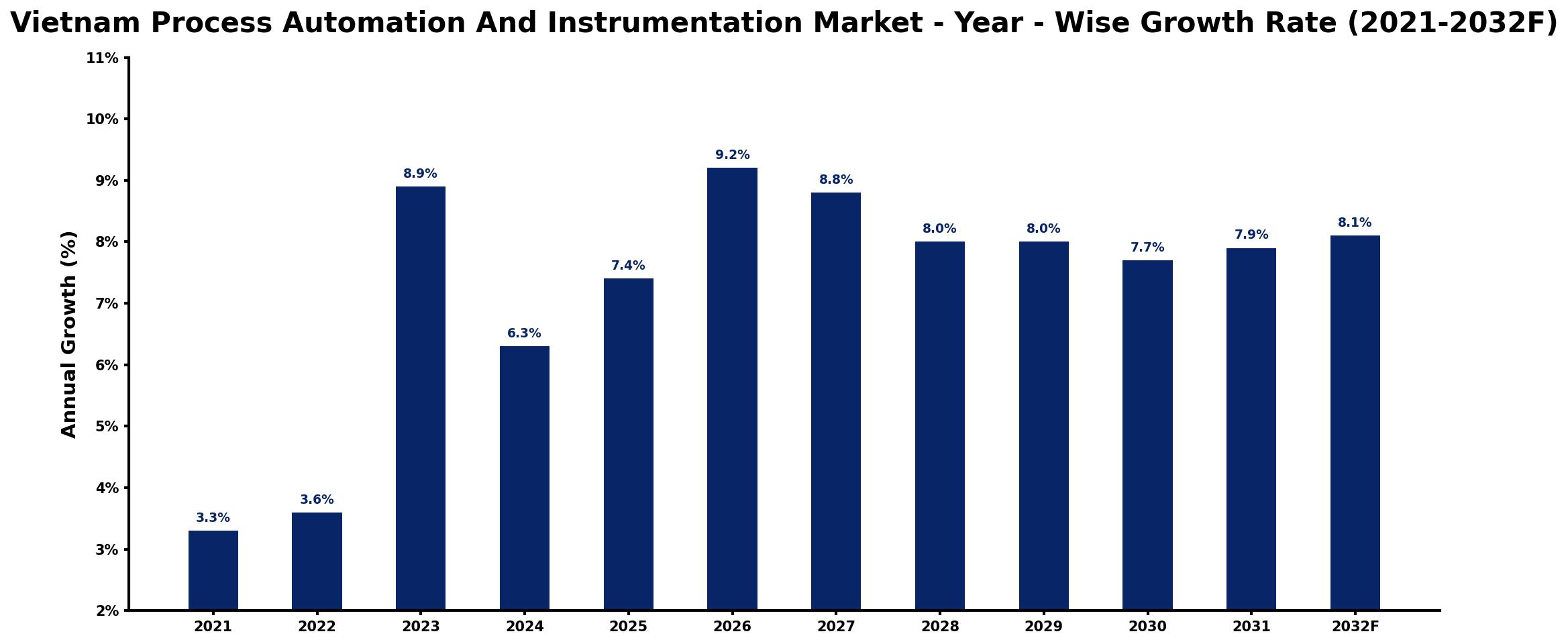
The table below presents the year‑wise growth rates along with the key drivers influencing the market
| Year | Growth Rate | Major Drivers |
| 2021 | 3.3% | Rising demand for smart technologies |
| 2022 | 3.6% | Increased investments in manufacturing sectors |
| 2023 | 8.9% | Expansion of renewable energy projects |
| 2024 | 6.3% | Growing focus on operational efficiency |
| 2025 | 7.4% | Surge in urban infrastructure development |
| 2026 | 9.2% | Advancements in digital transformation initiatives |
| 2027 | 8.8% | Higher adoption of IoT solutions |
| 2028 | 8.0% | Emerging trends in data analytics |
| 2029 | 8.0% | Strengthening regulatory compliance requirements |
| 2030 | 7.7% | Increasing need for real-time monitoring |
| 2031 | 7.9% | Growth in industrial safety standards |
| 2032 | 8.1% | Rising interest in sustainable practices |
Note: Market size estimations and growth projections presented in this report are based on 6Wresearch's proprietary forecasting methodology, utilizing the latest available industry data, government publications, and primary research inputs.
Vietnam Process Automation And Instrumentation Market Synopsis
The most significant force shaping the Vietnam Process Automation and Instrumentation Market today is the increasing need for advanced automation solutions. As industries strive for higher productivity, reduced operational costs, and enhanced product quality, automation becomes indispensable. This shift is notably evident in sectors such as chemicals, pharmaceuticals, and food processing, where streamlined processes can result in substantial competitive advantages.
The impact of Industry 4.0 is also profound, with companies looking to integrate digital technologies to optimize their operations. Automation technologies like sensors, controllers, and sophisticated software are witnessing heightened demand. Coupled with government support for digitalization efforts, Vietnam's market is positioned for robust growth in the coming years.
Vietnam Process Automation And Instrumentation Market Key Takeaways
- The market is experiencing significant growth fueled by demands for efficiency and quality control.
- Technological advancements in automation and instrumentation are transforming traditional industrial practices.
- Government initiatives encouraging Industry 4.0 are boosting market adoption rates.
- Remote monitoring solutions have gained traction, particularly following the COVID-19 pandemic.
- There is an escalating need for skilled labor to support complex automation systems.
Evaluation of Restraints in Vietnam Process Automation And Instrumentation Market
Despite the optimistic outlook, several constraints can impede the Vietnam Process Automation and Instrumentation Market's growth. A significant challenge lies in the skilled labor shortage. The increasing complexity of automation systems necessitates a workforce proficient in advanced technologies, which is currently limited in Vietnam. Furthermore, many industries are hesitant to make the initial investments required for automation, often opting for traditional methods due to perceived risks, thereby slowing the overall market adoption rate.
Vietnam Process Automation And Instrumentation Market Trends
The market is witnessing several key trends that are influencing demand and technology adoption. Firstly, the integration of smart sensors and advanced analytics into automation processes is becoming a standard practice, enabling real-time decision-making and operational insights. Additionally, there's a growing interest in cloud-based automation solutions, which provide flexibility and scalability, particularly attractive to small and medium-sized enterprises. Lastly, sustainability initiatives are prompting industries to adopt automation solutions that minimize waste and energy consumption.
Vietnam Process Automation And Instrumentation Market Opportunities
Opportunities abound within the Vietnam Process Automation and Instrumentation Market. The chemical and food processing industries are particularly ripe for automation advancements, as they seek to enhance product consistency and compliance with safety regulations. Additionally, as companies increasingly recognize the role of automation in ensuring operational resilience, investments in smart automation systems are likely to surge. There is also potential for growth in the remote monitoring solutions market, driven by the need for effective management amid resource constraints.
Government Initiatives in the Vietnam Process Automation And Instrumentation Market
The Vietnamese government is actively promoting Industry 4.0, which is encouraging the adoption of advanced automation technologies. Policies aimed at digital transformation and investment incentives for tech-driven industries are helping to set a favorable environment for the growth of the process automation market. Public spending in infrastructure and technology development further underscores the government's commitment to enhancing Vietnam's industrial capabilities.
Future Insights of the Vietnam Process Automation And Instrumentation Market
Looking towards 2026-2032, the Vietnam Process Automation and Instrumentation Market is expected to continue its upward trajectory. The relentless pace of technological innovation and the continuing emphasis on operational efficiency will likely keep driving the demand for automation solutions. Additionally, as industries recover from the pandemic, investments will increasingly focus on future-proofing operations through automation and digital solutions, indicating a sustained growth phase for this market.
Vietnam Process Automation And Instrumentation Market Latest Developments (2025 - 2026)
In recent months, the Vietnam Process Automation and Instrumentation Market has seen a surge in the adoption of cloud-based automation solutions as companies pivot to remote operational models. Furthermore, a noticeable increase in partnerships between technology providers and manufacturing firms has emerged, aimed at enhancing operational efficiencies through shared innovations. The trend towards sustainable practices is also evident, with several companies launching initiatives to integrate greener technologies into their automation processes.
Vietnam Process Automation And Instrumentation Market - Key Attractiveness of the Report
- 10 Years of Market Numbers
- Historical Data Starting from 2022 to 2025
- Base Year: 2025
- Forecast Data until 2032
- Key Performance Indicators Impacting the Market
- Major Upcoming Developments and Projects
Key Highlights of the Report:
- Vietnam Process Automation And Instrumentation Market Outlook
- Market Size of Vietnam Process Automation And Instrumentation Market, 2025
- Forecast of Vietnam Process Automation And Instrumentation Market, 2032
- Historical Data and Forecast of Vietnam Process Automation And Instrumentation Revenues & Volume for the Period 2022-2032F
- Vietnam Process Automation And Instrumentation Market Trend Evolution
- Vietnam Process Automation And Instrumentation Market Drivers and Challenges
- Vietnam Process Automation And Instrumentation Price Trends
- Vietnam Process Automation And Instrumentation Porter's Five Forces
- Vietnam Process Automation And Instrumentation Industry Life Cycle
- Historical Data and Forecast of Vietnam Process Automation And Instrumentation Market Revenues & Volume By Instrument for the Period 2022-2032F
- Historical Data and Forecast of Vietnam Process Automation And Instrumentation Market Revenues & Volume By Field Instruments for the Period 2022-2032F
- Historical Data and Forecast of Vietnam Process Automation And Instrumentation Market Revenues & Volume By Control Valve for the Period 2022-2032F
- Historical Data and Forecast of Vietnam Process Automation And Instrumentation Market Revenues & Volume By Analytical Instruments for the Period 2022-2032F
- Historical Data and Forecast of Vietnam Process Automation And Instrumentation Market Revenues & Volume By Solution for the Period 2022-2032F
- Historical Data and Forecast of Vietnam Process Automation And Instrumentation Market Revenues & Volume By Advanced Process Control (APC) for the Period 2022-2032F
- Historical Data and Forecast of Vietnam Process Automation And Instrumentation Market Revenues & Volume By Distributed Control System (DCS) for the Period 2022-2032F
- Historical Data and Forecast of Vietnam Process Automation And Instrumentation Market Revenues & Volume By Human Machine Interaction (HMI) for the Period 2022-2032F
- Historical Data and Forecast of Vietnam Process Automation And Instrumentation Market Revenues & Volume By Manufacturing Execution System (MES) for the Period 2022-2032F
- Historical Data and Forecast of Vietnam Process Automation And Instrumentation Market Revenues & Volume By Programmable Logic Controller (PLC) for the Period 2022-2032F
- Historical Data and Forecast of Vietnam Process Automation And Instrumentation Market Revenues & Volume By Safety Automation for the Period 2022-2032F
- Historical Data and Forecast of Vietnam Process Automation And Instrumentation Market Revenues & Volume By Supervisory Control and Data Acquisition (SCADA) for the Period 2022-2032F
- Historical Data and Forecast of Vietnam Process Automation And Instrumentation Market Revenues & Volume By End-user Industry for the Period 2022-2032F
- Historical Data and Forecast of Vietnam Process Automation And Instrumentation Market Revenues & Volume By Oil and Gas for the Period 2022-2032F
- Historical Data and Forecast of Vietnam Process Automation And Instrumentation Market Revenues & Volume By Food and Beverage for the Period 2022-2032F
- Historical Data and Forecast of Vietnam Process Automation And Instrumentation Market Revenues & Volume By Pharmaceutical and Biopharma for the Period 2022-2032F
- Historical Data and Forecast of Vietnam Process Automation And Instrumentation Market Revenues & Volume By Chemical and Petrochemical for the Period 2022-2032F
- Historical Data and Forecast of Vietnam Process Automation And Instrumentation Market Revenues & Volume By Other End-user Industries for the Period 2022-2032F
- Vietnam Process Automation And Instrumentation Import Export Trade Statistics
- Market Opportunity Assessment By Instrument
- Market Opportunity Assessment By Solution
- Market Opportunity Assessment By End-user Industry
- Vietnam Process Automation And Instrumentation Top Companies Market Share
- Vietnam Process Automation And Instrumentation Competitive Benchmarking By Technical and Operational Parameters
- Vietnam Process Automation And Instrumentation Company Profiles
- Vietnam Process Automation And Instrumentation Key Strategic Recommendations






































