Vietnam Radar Systems Market Size, Share & Growth Rate
The Vietnam Radar Systems Market was estimated at USD 208 Million in 2025 and is projected to reach USD 292 Million by 2032, growing at a CAGR of 5.0% from 2026 to 2032. This growth trajectory is fueled by the country's strategic emphasis on national security, particularly in light of its geopolitical location near the South China Sea. Additionally, increased investments in civil applications such as aviation and meteorology are bolstering demand, as infrastructure modernization and enhanced maritime activities gain momentum.
Vietnam Radar Systems Market Year-wise Growth Rate and Key Drivers
This graph highlights how the Vietnam Radar Systems Market has steadily grown over the years, supported by major growth factors.
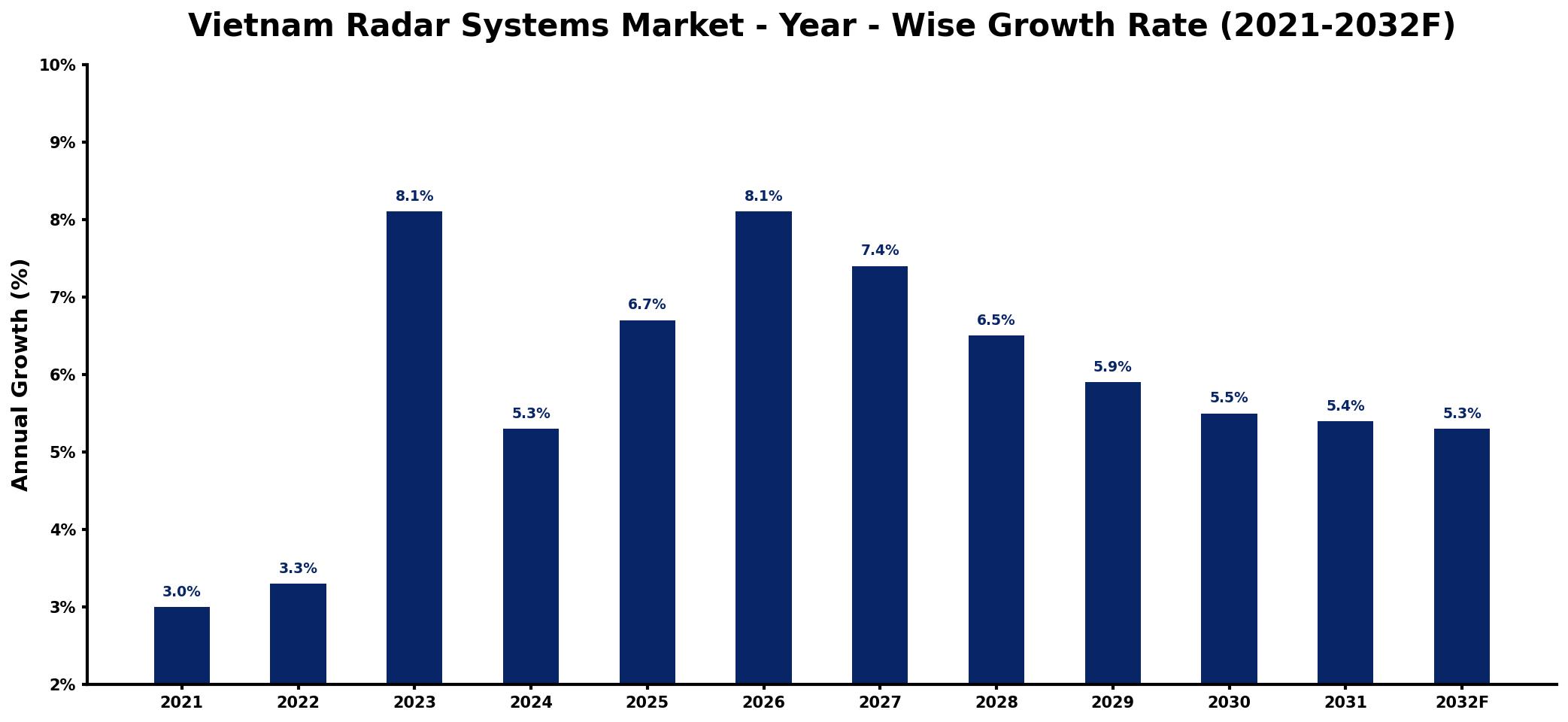
The table below presents the year‑wise growth rates along with the key drivers influencing the market
| Year | Growth Rate | Major Drivers |
| 2021 | 3.0% | Increased defense spending initiatives |
| 2022 | 3.3% | Growing demand for surveillance technologies |
| 2023 | 8.1% | Expansion of national security programs |
| 2024 | 5.3% | Rising investments in military modernization |
| 2025 | 6.7% | Enhancements in border security measures |
| 2026 | 8.1% | Advancements in aerospace technology applications |
| 2027 | 7.4% | Emerging needs for coastal monitoring |
| 2028 | 6.5% | Strengthening of regional defense partnerships |
| 2029 | 5.9% | Demand for advanced detection capabilities |
| 2030 | 5.5% | Integration of smart city solutions |
| 2031 | 5.4% | increased overall sector activity |
| 2032 | 5.3% | Increased interest in research collaborations |
Note: Market size estimations and growth projections presented in this report are based on 6Wresearch's proprietary forecasting methodology, utilizing the latest available industry data, government publications, and primary research inputs.
Vietnam Radar Systems Market Synopsis
The Vietnam radar systems market is currently witnessing a robust phase of expansion, with significant advancements in both defense and civilian sectors. As the nation strives to bolster its national security and modernization efforts, radar technology is becoming increasingly integral to military operations and civilian applications such as transportation and weather monitoring.
Looking ahead, the market is expected to continue its positive trajectory driven by an evolving defense posture and rising demand for sophisticated radar solutions. Investments in infrastructure and technology are being prioritized, enhancing Vietnam's capabilities in surveillance, air traffic management, and disaster preparedness.
Vietnam Radar Systems Market Key Takeaways
- The market is projected to grow from USD 208 Million in 2025 to USD 292 Million by 2032.
- Geopolitical tensions and coastal security needs are primary drivers of radar technology adoption.
- Civilian applications in aviation and meteorology are gaining traction, expanding overall market potential.
- Government initiatives are focused on enhancing national security and disaster management capabilities.
- Emerging technologies and modernization efforts are vital for market competitiveness and innovation.
Evaluation of Restraints in Vietnam Radar Systems Market
While the Vietnam radar systems market is poised for growth, it faces several restraints that could impact its overall potential. National security concerns compel the government to allocate significant budgets towards defense, which can sometimes limit investments in civilian radar applications. Additionally, the requirement for ongoing technological upgrades demands considerable financial resources, creating budget constraints that can hinder market expansion. Furthermore, the market must navigate the complexities of a competitive landscape, where staying ahead of emerging technologies is crucial to sustaining growth.
Vietnam Radar Systems Market Trends
Recent trends highlight a shift towards advanced radar systems that incorporate artificial intelligence and machine learning. These technologies are enhancing situational awareness and operational efficiency, not just in military applications but also in aviation and weather forecasting. Another emerging trend is the increasing collaboration between government and private sectors to drive innovation in radar technologies, fostering an environment conducive to research and development.
Vietnam Radar Systems Market Opportunities
Significant growth opportunities lie in the ongoing modernization of military capabilities and the expansion of the aviation industry in Vietnam. The government's focus on enhancing maritime security further opens avenues for investment in radar technologies tailored to naval applications. Additionally, as the nation grapples with climate change and natural disasters, there is a growing need for sophisticated meteorological radar systems that can provide accurate weather forecasts and early warning signals.
Government Initiatives in the Vietnam Radar Systems Market
The Vietnamese government is actively promoting initiatives aimed at enhancing national security and disaster management. Public spending is being directed towards the development of defense capabilities, including radar systems, to better monitor territorial waters and airspace. Moreover, programs that encourage technological advancements in civilian applications highlight the governments commitment to fostering growth in the radar systems market, which is crucial for both public safety and economic development.
Future Insights of the Vietnam Radar Systems Market
From 2026 to 2032, the Vietnam radar systems market is set to evolve with a stronger emphasis on integrated systems capable of addressing both defense and civilian needs. The anticipated growth in regional maritime activities will necessitate advanced surveillance capabilities. Furthermore, as Vietnam solidifies its position as an emerging market in Southeast Asia, investments in radar technologies will become increasingly critical, ensuring the nation remains resilient in the face of evolving challenges.
Vietnam Radar Systems Market Latest Developments (2025 - 2026)
In recent months, the Vietnam radar systems market has witnessed notable advancements, particularly in the realms of military procurement and infrastructure projects. Initiatives aimed at enhancing coastal surveillance capabilities have gained traction, alongside the implementation of new technologies to improve air traffic management. The collaborative efforts between government entities and private sector players are paving the way for innovative radar solutions tailored to Vietnam's unique security landscape.
Vietnam Radar Systems Market - Key Attractiveness of the Report
- 10 Years of Market Numbers
- Historical Data Starting from 2022 to 2025
- Base Year: 2025
- Forecast Data until 2032
- Key Performance Indicators Impacting the Market
- Major Upcoming Developments and Projects
Key Highlights of the Report:
- Vietnam Radar Systems Market Outlook
- Market Size of Vietnam Radar Systems Market, 2025
- Forecast of Vietnam Radar Systems Market, 2032
- Historical Data and Forecast of Vietnam Radar Systems Revenues & Volume for the Period 2022-2032F
- Vietnam Radar Systems Market Trend Evolution
- Vietnam Radar Systems Market Drivers and Challenges
- Vietnam Radar Systems Price Trends
- Vietnam Radar Systems Porter's Five Forces
- Vietnam Radar Systems Industry Life Cycle
- Historical Data and Forecast of Vietnam Radar Systems Market Revenues & Volume By Type for the Period 2022-2032F
- Historical Data and Forecast of Vietnam Radar Systems Market Revenues & Volume By Continuous Wave RADAR Systems for the Period 2022-2032F
- Historical Data and Forecast of Vietnam Radar Systems Market Revenues & Volume By Pulsated Wave RADAR Systems for the Period 2022-2032F
- Historical Data and Forecast of Vietnam Radar Systems Market Revenues & Volume By Application for the Period 2022-2032F
- Historical Data and Forecast of Vietnam Radar Systems Market Revenues & Volume By Airborne for the Period 2022-2032F
- Historical Data and Forecast of Vietnam Radar Systems Market Revenues & Volume By Land-based for the Period 2022-2032F
- Historical Data and Forecast of Vietnam Radar Systems Market Revenues & Volume By Naval for the Period 2022-2032F
- Historical Data and Forecast of Vietnam Radar Systems Market Revenues & Volume By End-user Industry for the Period 2022-2032F
- Historical Data and Forecast of Vietnam Radar Systems Market Revenues & Volume By Aviation for the Period 2022-2032F
- Historical Data and Forecast of Vietnam Radar Systems Market Revenues & Volume By Maritime Applications for the Period 2022-2032F
- Historical Data and Forecast of Vietnam Radar Systems Market Revenues & Volume By Automotive for the Period 2022-2032F
- Historical Data and Forecast of Vietnam Radar Systems Market Revenues & Volume By Military & Defense for the Period 2022-2032F
- Vietnam Radar Systems Import Export Trade Statistics
- Market Opportunity Assessment By Type
- Market Opportunity Assessment By Application
- Market Opportunity Assessment By End-user Industry
- Vietnam Radar Systems Top Companies Market Share
- Vietnam Radar Systems Competitive Benchmarking By Technical and Operational Parameters
- Vietnam Radar Systems Company Profiles
- Vietnam Radar Systems Key Strategic Recommendations






































