Vietnam Seafood Processing Market Size, Share & Growth Rate
The Vietnam Seafood Processing Market was estimated at USD 785 Million in 2025 and is projected to reach USD 1113 Million by 2032, growing at a CAGR of 5.1% from 2026 to 2032. This growth trajectory is fueled by Vietnam's vast seafood resources and a well-developed infrastructure for processing. As global demand for processed seafood continues to rise, the market is poised to leverage its competitive cost structure and innovation to expand its footprint in both domestic and international arenas.
Vietnam Seafood Processing Market Year-wise Growth Rate and Key Drivers
This graph highlights how the Vietnam Seafood Processing Market has steadily grown over the years, supported by major growth factors.
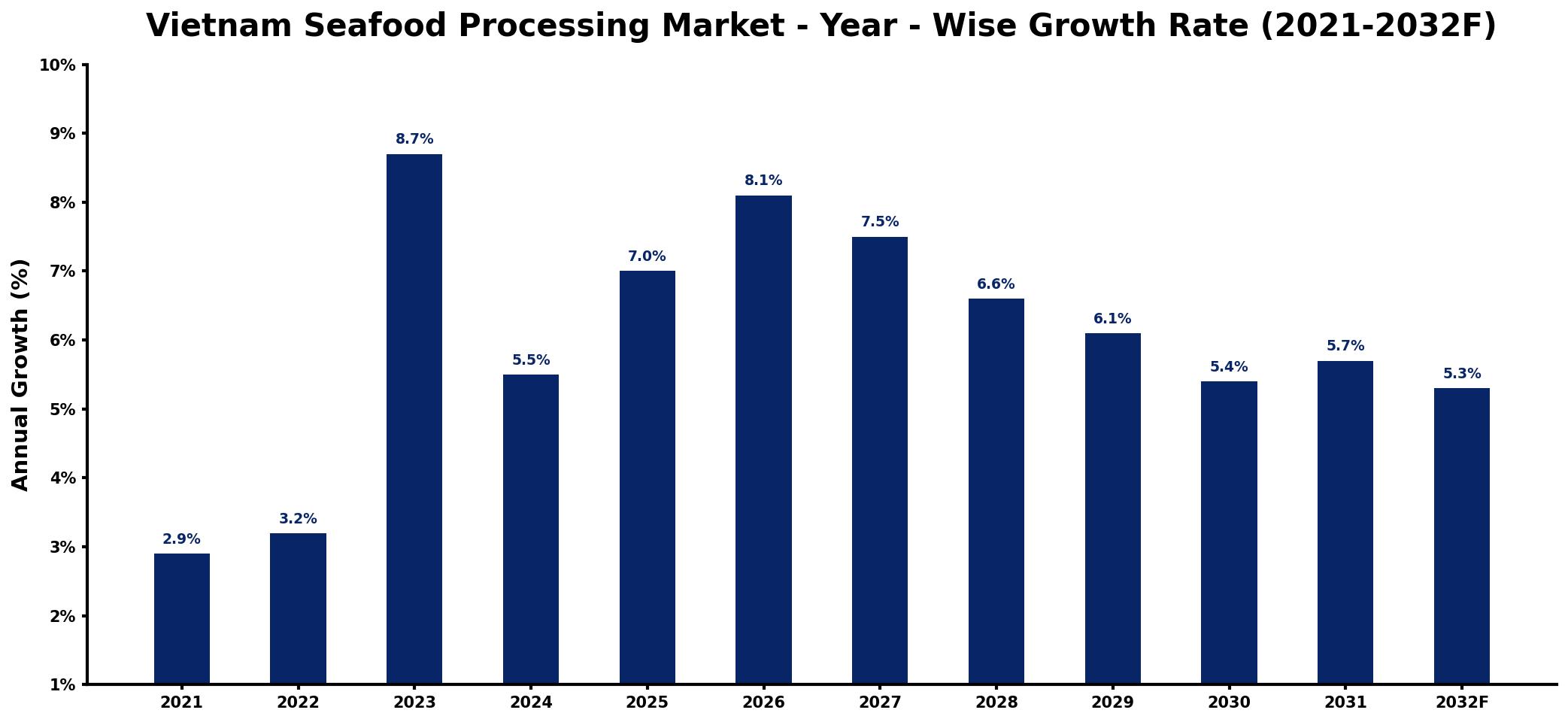
The table below presents the year‑wise growth rates along with the key drivers influencing the market
| Year | Growth Rate | Major Drivers |
| 2021 | 2.9% | Increased global demand for exports |
| 2022 | 3.2% | Expansion of aquaculture facilities |
| 2023 | 8.7% | Rising consumer health consciousness |
| 2024 | 5.5% | Growth in international partnerships |
| 2025 | 7.0% | Investment in sustainable practices |
| 2026 | 8.1% | Technological advancements in logistics |
| 2027 | 7.5% | Emergence of new markets abroad |
| 2028 | 6.6% | Development of value-added products |
| 2029 | 6.1% | Strengthening of regulatory frameworks |
| 2030 | 5.4% | Enhancement of supply chain efficiency |
| 2031 | 5.7% | Growing popularity of frozen options |
| 2032 | 5.3% | Increased focus on quality standards |
Note: Market size estimations and growth projections presented in this report are based on 6Wresearch's proprietary forecasting methodology, utilizing the latest available industry data, government publications, and primary research inputs.
Vietnam Seafood Processing Market Synopsis
Vietnam's seafood processing industry stands out for its remarkable capabilities in producing a diverse array of processed products, from frozen fillets to ready-to-eat meals. The strategic location of processing facilities near abundant raw material sources enables efficiencies that are critical in this competitive market.
With a focus on meeting international quality standards, Vietnamese processors are continually evolving their product offerings to cater to the tastes of global consumers. This adaptability has solidified Vietnam's status as a key player in the international seafood market, particularly in high-demand segments such as frozen and canned seafood.
Vietnam Seafood Processing Market Key Takeaways
- Vietnams seafood processing sector is critical for enhancing value in the global seafood supply chain.
- Growing consumer preference for ready-to-eat and convenience food options drives demand for processed seafood.
- Innovation in processing techniques and product development remains a focus area for maintaining competitive advantage.
- The sector's robust export orientation contributes significantly to Vietnam's economy, reinforcing its strategic importance.
- Skilled labor availability and favorable production costs bolster Vietnam's attractiveness for seafood processing investments.
Evaluation of Restraints in Vietnam Seafood Processing Market
Despite its many strengths, the Vietnam seafood processing market faces notable constraints that could hinder its growth. Supply chain vulnerabilities, particularly regarding raw material availability, create potential disruptions that processors must navigate. Moreover, maintaining rigorous quality control to meet the evolving international standards presents an ongoing challenge. Consumer preferences are shifting towards healthier and more sustainable options, necessitating that processors stay agile and responsive to these trends. The ability to adapt will be paramount for sustaining growth and innovation in this competitive landscape.
Vietnam Seafood Processing Market Trends
Key trends are shaping the Vietnam seafood processing market as it moves forward. One notable trend is the increasing use of automation and advanced technologies to enhance processing efficiency and product quality. Additionally, there's a growing emphasis on sustainability, as consumers demand more environmentally friendly production methods. Furthermore, the expansion of online retail channels is transforming how processed seafood products reach consumers, providing new opportunities for market participants to engage with a broader audience.
Vietnam Seafood Processing Market Opportunities
The market offers numerous growth avenues, especially for businesses that can effectively tap into emerging consumer trends. The rising global inclination towards healthy eating presents opportunities for the development of value-added seafood products that emphasize nutrition and sustainability. Moreover, expanding export capabilities to capitalize on the growing demand in international markets, particularly in Asia and North America, can provide a significant competitive edge. Investment in research and development to create innovative product lines could also yield substantial returns in the coming years.
Government Initiatives in the Vietnam Seafood Processing Market
The Vietnamese government has been proactive in supporting the seafood processing industry through various initiatives aimed at enhancing competitiveness and sustainability. Policies promoting investment in technology upgrades and infrastructure development are critical to boosting processing capabilities. Moreover, government programs that encourage adherence to international quality standards and certifications play a vital role in facilitating export opportunities. Collaborative efforts between public and private sectors aim to position Vietnam as a leading seafood processing hub in the region.
Future Insights of the Vietnam Seafood Processing Market
Looking ahead to 2026-2032, the Vietnam seafood processing market is expected to continue its upward trajectory. With ongoing investments in technology and innovation, companies are likely to enhance their processing efficiencies and product offerings. The focus on sustainability and consumer health will further shape market dynamics, compelling processors to innovate to meet new consumer preferences. The combination of these factors, along with robust export capabilities, positions Vietnam to not only respond to global market demands but also to set trends within the industry.
Vietnam Seafood Processing Market Latest Developments (2025 - 2026)
Recent months have seen a surge in technological advancements within the Vietnam seafood processing sector, with many companies embracing automation to improve production efficiency. The rise of e-commerce has also prompted processors to explore innovative distribution channels, reaching consumers directly. Furthermore, there has been heightened interest in sustainable practices, with numerous initiatives launched aimed at minimizing environmental impact while enhancing product traceability. The industry remains dynamic, adapting to changes in consumer preferences and global market demands.
Vietnam Seafood Processing Market - Key Attractiveness of the Report
- 10 Years of Market Numbers
- Historical Data Starting from 2022 to 2025
- Base Year: 2025
- Forecast Data until 2032
- Key Performance Indicators Impacting the Market
- Major Upcoming Developments and Projects
Key Highlights of the Report:
- Vietnam Seafood Processing Market Outlook
- Market Size of Vietnam Seafood Processing Market, 2025
- Forecast of Vietnam Seafood Processing Market, 2032
- Historical Data and Forecast of Vietnam Seafood Processing Revenues & Volume for the Period 2022-2032F
- Vietnam Seafood Processing Market Trend Evolution
- Vietnam Seafood Processing Market Drivers and Challenges
- Vietnam Seafood Processing Price Trends
- Vietnam Seafood Processing Porter's Five Forces
- Vietnam Seafood Processing Industry Life Cycle
- Historical Data and Forecast of Vietnam Seafood Processing Market Revenues & Volume By Equipment Type for the Period 2022-2032F
- Historical Data and Forecast of Vietnam Seafood Processing Market Revenues & Volume By Gutting Equipment for the Period 2022-2032F
- Historical Data and Forecast of Vietnam Seafood Processing Market Revenues & Volume By Sealing Equipment for the Period 2022-2032F
- Historical Data and Forecast of Vietnam Seafood Processing Market Revenues & Volume By Filleting Equipment for the Period 2022-2032F
- Historical Data and Forecast of Vietnam Seafood Processing Market Revenues & Volume By Deboning Equipment for the Period 2022-2032F
- Historical Data and Forecast of Vietnam Seafood Processing Market Revenues & Volume By other Equipment for the Period 2022-2032F
- Historical Data and Forecast of Vietnam Seafood Processing Market Revenues & Volume By Category for the Period 2022-2032F
- Historical Data and Forecast of Vietnam Seafood Processing Market Revenues & Volume By Single-Function Equipment for the Period 2022-2032F
- Historical Data and Forecast of Vietnam Seafood Processing Market Revenues & Volume By Multi-Function Equipment for the Period 2022-2032F
- Historical Data and Forecast of Vietnam Seafood Processing Market Revenues & Volume By Seafood Type for the Period 2022-2032F
- Historical Data and Forecast of Vietnam Seafood Processing Market Revenues & Volume By Fish for the Period 2022-2032F
- Historical Data and Forecast of Vietnam Seafood Processing Market Revenues & Volume By Crustaceans for the Period 2022-2032F
- Historical Data and Forecast of Vietnam Seafood Processing Market Revenues & Volume By Mollusks for the Period 2022-2032F
- Historical Data and Forecast of Vietnam Seafood Processing Market Revenues & Volume By others for the Period 2022-2032F
- Vietnam Seafood Processing Import Export Trade Statistics
- Market Opportunity Assessment By Equipment Type
- Market Opportunity Assessment By Category
- Market Opportunity Assessment By Seafood Type
- Vietnam Seafood Processing Top Companies Market Share
- Vietnam Seafood Processing Competitive Benchmarking By Technical and Operational Parameters
- Vietnam Seafood Processing Company Profiles
- Vietnam Seafood Processing Key Strategic Recommendations






































