Vietnam Seamless Steel Pipes Market Size Growth Rate
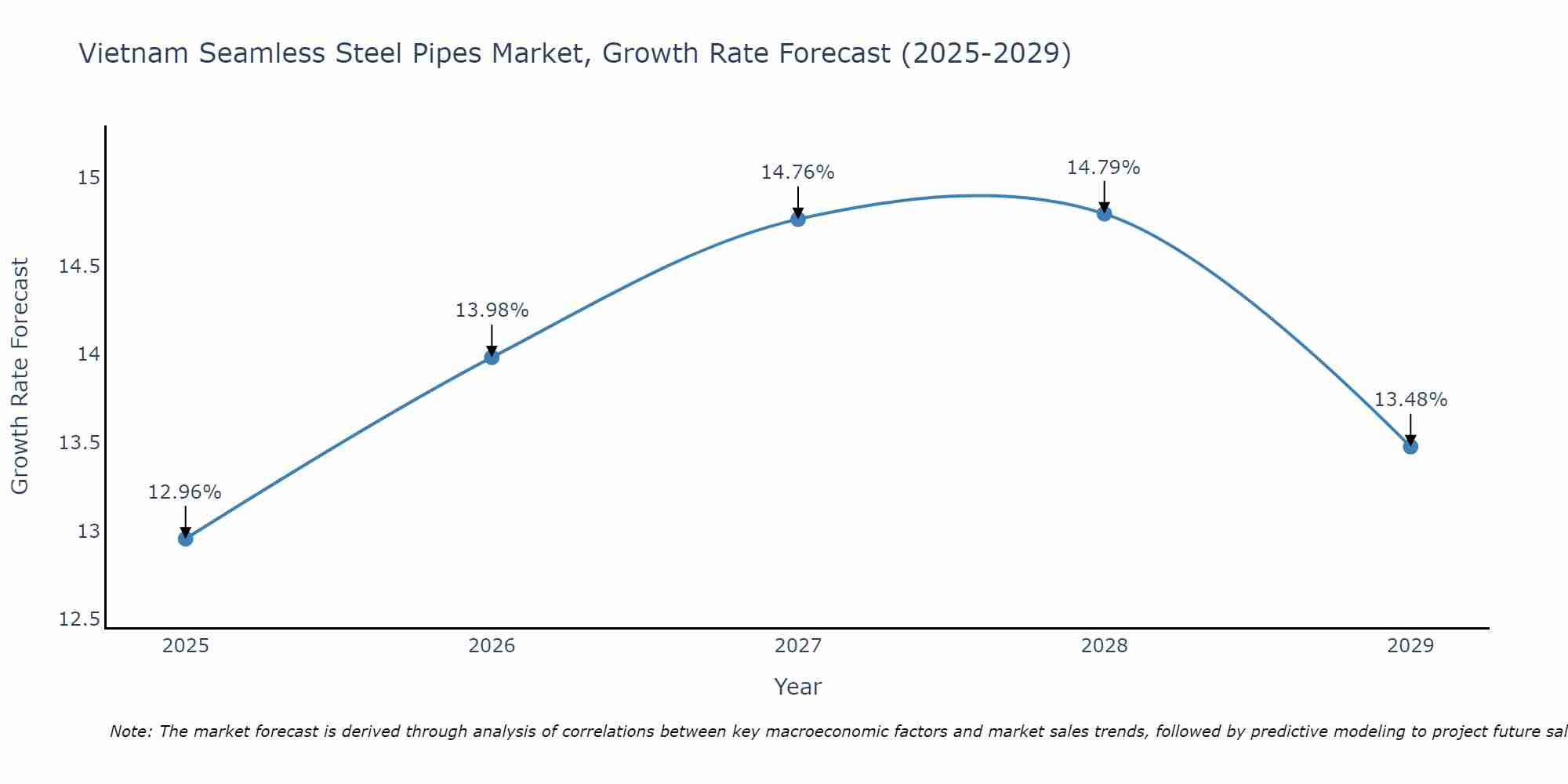
The Vietnam Seamless Steel Pipes Market is projected to witness mixed growth rate patterns during 2025 to 2029. Growth accelerates to 14.79% in 2028, following an initial rate of 12.96%, before easing to 13.48% at the end of the period.
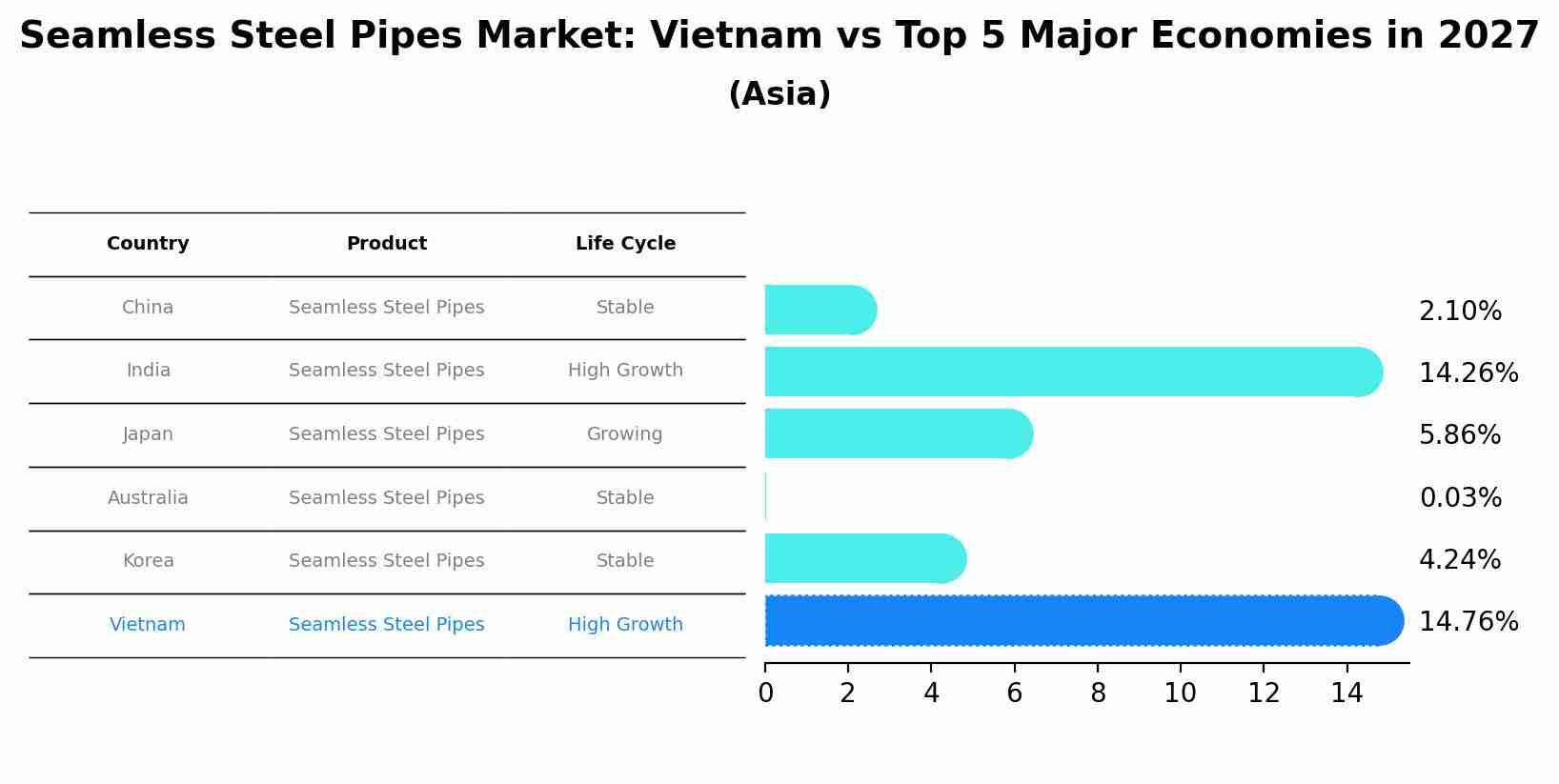
Seamless Steel Pipes Market: Vietnam vs Top 5 Major Economies in 2027 (Asia)
The Seamless Steel Pipes market in Vietnam is projected to grow at a high growth rate of 14.76% by 2027, within the Asia region led by China, along with other countries like India, Japan, Australia and South Korea, collectively shaping a dynamic and evolving market environment driven by innovation and increasing adoption of emerging technologies.
Vietnam Seamless Steel Pipes Market Synopsis
The Vietnam seamless steel pipes market caters to industries requiring high-performance pipes for critical applications, including oil and gas exploration, power generation, and automotive manufacturing. Seamless steel pipes offer superior strength and reliability, making them suitable for demanding environments. Vietnam industrial growth, infrastructure development, and energy sector expansion have driven the demand for seamless steel pipes. The market is characterized by a mix of domestic manufacturers and international suppliers, offering a wide range of sizes and specifications to meet diverse industry needs. As Vietnam industries continue to evolve and modernize, the seamless steel pipes market is expected to grow.
Drivers of the Market
The seamless steel pipes market in Vietnam is thriving due to its wide applications in various industries, including oil and gas, automotive, and construction. Seamless steel pipes offer high strength and reliability, making them suitable for demanding environments. The growth of industries and infrastructure projects that require seamless steel pipes contributes to market expansion.
Challenges of the Market
The seamless steel pipes market in Vietnam faces a series of challenges, including competition from global players and the need for technological advancements. Established international companies often dominate this market, making it challenging for local manufacturers to gain a significant market share. To compete effectively, domestic producers must invest in advanced manufacturing processes and quality control measures. Moreover, the market is influenced by fluctuations in steel prices, which can affect production costs and pricing competitiveness. Additionally, environmental regulations and sustainability concerns are pushing the industry to adopt cleaner production methods, which can be capital-intensive. Furthermore, logistics and transportation challenges can impact the timely delivery of seamless steel pipes, affecting customer satisfaction and project timelines.
COVID-19 Impact on the Market
The seamless steel pipes market in Vietnam faced challenges during the pandemic, especially in the energy and manufacturing sectors. Reduced demand for oil and gas and disruptions in industrial production impacted the market. However, as the economy reopened and infrastructure projects resumed, there was a gradual recovery in demand for seamless steel pipes, particularly in construction and transportation applications.
Key Players in the Market
Leading players in the Vietnam seamless steel pipes market are likely to include established steel manufacturers such as Hoa Phat Group, Formosa Ha Tinh Steel Corporation, and VNSteel (Vietnam Steel Corporation). These companies have significant manufacturing capacities and are well-positioned to serve the growing demand for steel pipes in construction and infrastructure projects.
Key Highlights of the Report:
- Vietnam Seamless Steel Pipes Market Outlook
- Market Size of Vietnam Seamless Steel Pipes Market, 2024
- Forecast of Vietnam Seamless Steel Pipes Market, 2031
- Historical Data and Forecast of Vietnam Seamless Steel Pipes Revenues & Volume for the Period 2021-2031
- Vietnam Seamless Steel Pipes Market Trend Evolution
- Vietnam Seamless Steel Pipes Market Drivers and Challenges
- Vietnam Seamless Steel Pipes Price Trends
- Vietnam Seamless Steel Pipes Porter's Five Forces
- Vietnam Seamless Steel Pipes Industry Life Cycle
- Historical Data and Forecast of Vietnam Seamless Steel Pipes Market Revenues & Volume By Type for the Period 2021-2031
- Historical Data and Forecast of Vietnam Seamless Steel Pipes Market Revenues & Volume By Hot Finished Seamless Pipes for the Period 2021-2031
- Historical Data and Forecast of Vietnam Seamless Steel Pipes Market Revenues & Volume By Cold Finished Seamless Pipes for the Period 2021-2031
- Historical Data and Forecast of Vietnam Seamless Steel Pipes Market Revenues & Volume By Materials for the Period 2021-2031
- Historical Data and Forecast of Vietnam Seamless Steel Pipes Market Revenues & Volume By Steel & Alloys for the Period 2021-2031
- Historical Data and Forecast of Vietnam Seamless Steel Pipes Market Revenues & Volume By Copper & Alloys for the Period 2021-2031
- Historical Data and Forecast of Vietnam Seamless Steel Pipes Market Revenues & Volume By Nickel & Alloys for the Period 2021-2031
- Historical Data and Forecast of Vietnam Seamless Steel Pipes Market Revenues & Volume By Others for the Period 2021-2031
- Historical Data and Forecast of Vietnam Seamless Steel Pipes Market Revenues & Volume By Production Process for the Period 2021-2031
- Historical Data and Forecast of Vietnam Seamless Steel Pipes Market Revenues & Volume By Continuous Mandrel rolling for the Period 2021-2031
- Historical Data and Forecast of Vietnam Seamless Steel Pipes Market Revenues & Volume By Multi-stand Plug Mill for the Period 2021-2031
- Historical Data and Forecast of Vietnam Seamless Steel Pipes Market Revenues & Volume By Cross-roll Piercing & Pilger Rolling for the Period 2021-2031
- Historical Data and Forecast of Vietnam Seamless Steel Pipes Market Revenues & Volume By End-use Industry for the Period 2021-2031
- Historical Data and Forecast of Vietnam Seamless Steel Pipes Market Revenues & Volume By Oil & Gas for the Period 2021-2031
- Historical Data and Forecast of Vietnam Seamless Steel Pipes Market Revenues & Volume By Infrastructure & Construction for the Period 2021-2031
- Historical Data and Forecast of Vietnam Seamless Steel Pipes Market Revenues & Volume By Power Generation for the Period 2021-2031
- Historical Data and Forecast of Vietnam Seamless Steel Pipes Market Revenues & Volume By Automotive for the Period 2021-2031
- Historical Data and Forecast of Vietnam Seamless Steel Pipes Market Revenues & Volume By Engineering for the Period 2021-2031
- Historical Data and Forecast of Vietnam Seamless Steel Pipes Market Revenues & Volume By Others for the Period 2021-2031
- Vietnam Seamless Steel Pipes Import Export Trade Statistics
- Market Opportunity Assessment By Type
- Market Opportunity Assessment By Materials
- Market Opportunity Assessment By Production Process
- Market Opportunity Assessment By End-use Industry
- Vietnam Seamless Steel Pipes Top Companies Market Share
- Vietnam Seamless Steel Pipes Competitive Benchmarking By Technical and Operational Parameters
- Vietnam Seamless Steel Pipes Company Profiles
- Vietnam Seamless Steel Pipes Key Strategic Recommendations






































