Vietnam Semiconductor Foundry Market Size, Share & Growth Rate
The Vietnam Semiconductor Foundry Market was estimated at USD 389 Million in 2025 and is projected to reach USD 548 Million by 2032, growing at a CAGR of 5.0% from 2026 to 2032. This growth is primarily fueled by the escalating demand for electronic devices across various sectors including consumer electronics, automotive, and emerging technologies such as 5G and IoT. Vietnam's strategic location and proactive government policies create a favorable environment for semiconductor manufacturers, ensuring sustained market expansion.
Vietnam Semiconductor Foundry Market Year-wise Growth Rate and Key Drivers
This graph highlights how the Vietnam Semiconductor Foundry Market has steadily grown over the years, supported by major growth factors.
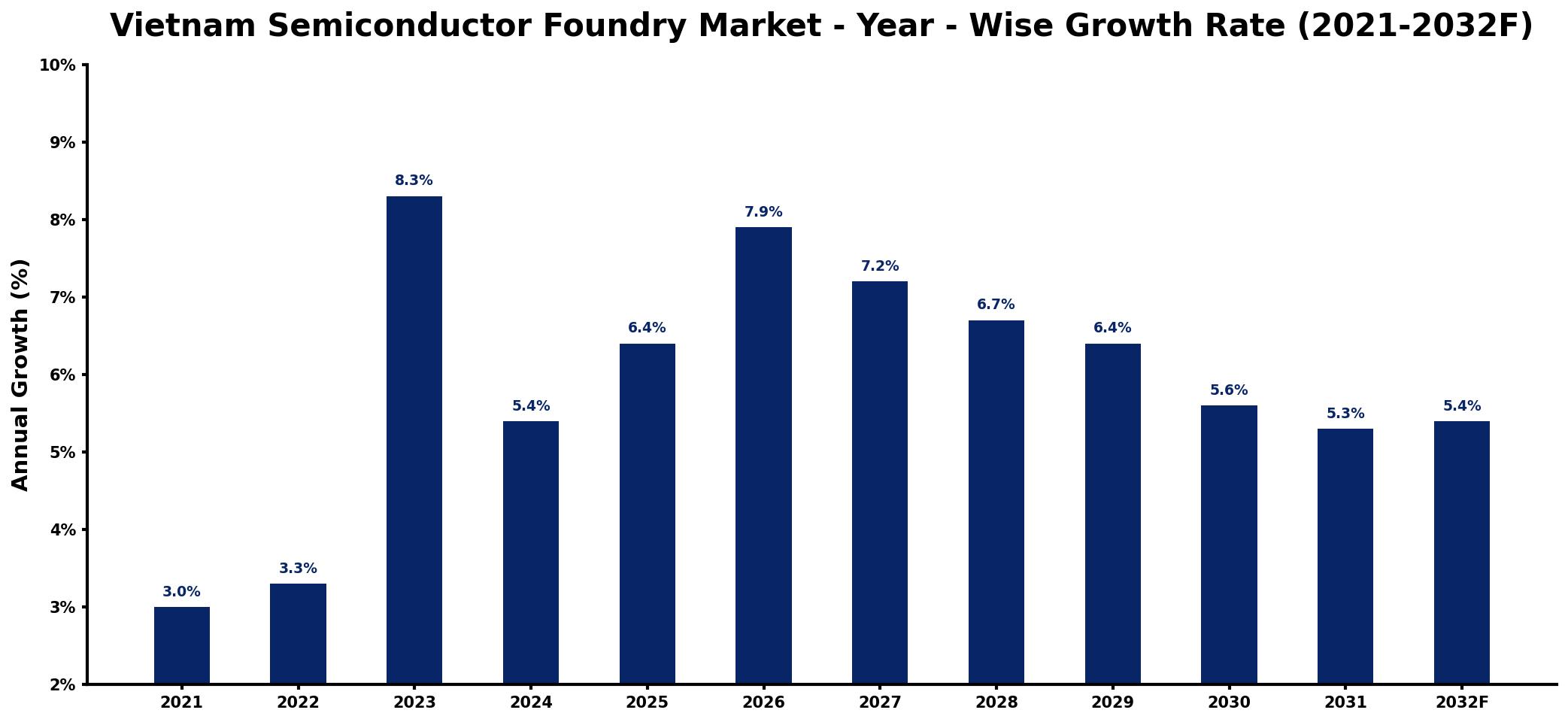
The table below presents the year‑wise growth rates along with the key drivers influencing the market
| Year | Growth Rate | Major Drivers |
| 2021 | 3.0% | Rising demand for electronics manufacturing |
| 2022 | 3.3% | Increased investments in technology infrastructure |
| 2023 | 8.3% | Growth in automotive electronics sector |
| 2024 | 5.4% | Expansion of 5G network deployment |
| 2025 | 6.4% | Surge in IoT device production |
| 2026 | 7.9% | Growing applications in artificial intelligence |
| 2027 | 7.2% | Strengthening of renewable energy technologies |
| 2028 | 6.7% | Advancements in consumer electronics innovation |
| 2029 | 6.4% | Increased focus on smart devices |
| 2030 | 5.6% | Emergence of next-gen computing solutions |
| 2031 | 5.3% | Heightened demand for wearable technology |
| 2032 | 5.4% | Development of advanced healthcare technologies |
Note: Market size estimations and growth projections presented in this report are based on 6Wresearch's proprietary forecasting methodology, utilizing the latest available industry data, government publications, and primary research inputs.
Vietnam Semiconductor Foundry Market Synopsis
The increasing reliance on integrated circuits (ICs) in consumer electronics and smart technologies significantly drives the Vietnam semiconductor foundry market. With a dedicated workforce and government backing, Vietnam is poised to attract substantial foreign investment in semiconductor manufacturing.
As global companies seek to diversify their supply chains, Vietnam's semiconductor sector emerges as a critical player. This positioning is reinforced by the growing adoption of innovative technologies that demand advanced semiconductor solutions, making the market ripe for development.
Vietnam Semiconductor Foundry Market Key Takeaways
- The market is expected to grow significantly due to increased demand for semiconductors in various industries.
- Government initiatives play a crucial role in fostering a conducive environment for semiconductor manufacturing.
- Challenges related to technology and talent retention persist but are being addressed through strategic investments.
- Emerging technologies like 5G and IoT represent significant growth drivers for the foundry market.
- The global semiconductor landscape's disruptions have heightened Vietnam's importance as a manufacturing hub.
Evaluation of Restraints in Vietnam Semiconductor Foundry Market
Despite promising growth, the Vietnam semiconductor foundry market faces several significant restraints. Technological advancement poses a primary challenge, as many local foundries may lack the substantial investment required for cutting-edge research and development. This technological gap makes it difficult for smaller players to compete effectively against established global giants. Moreover, the competitive landscape is intensified by recent global semiconductor supply chain disruptions, which could hinder investment and growth. Additionally, securing and retaining skilled personnel remains crucial, as the demand for qualified engineers continues to outpace supply.
Vietnam Semiconductor Foundry Market Trends
The Vietnam semiconductor foundry market is currently witnessing several transformative trends. A notable trend is the increasing demand for localized supply chains, as companies look to mitigate risks associated with global shortages. Furthermore, the rise of electric vehicles and autonomous driving technologies has spurred advancements in automotive semiconductors. Additionally, the country's emphasis on digital transformation aligns with the growing need for integrated circuits in IoT devices, creating new avenues for market growth.
Vietnam Semiconductor Foundry Market Opportunities
There are numerous growth opportunities in the Vietnam semiconductor foundry market. The government's commitment to developing a robust semiconductor ecosystem bodes well for attracting foreign direct investment. Additionally, as Vietnam becomes increasingly recognized as a manufacturing hub, local firms can capitalize on partnerships with global semiconductor giants. Moreover, the ongoing digital transformation across industries presents opportunities for local foundries to innovate and develop specialized semiconductor solutions tailored to specific market needs.
Government Initiatives in the Vietnam Semiconductor Foundry Market
The Vietnamese government has recognized the strategic significance of the semiconductor manufacturing sector and is actively implementing initiatives to bolster its growth. Supportive policies include tax incentives, infrastructure development, and targeted programs aimed at skill enhancement within the workforce. These initiatives aim to create a favorable investment climate and encourage both domestic and foreign companies to establish manufacturing operations in the country.
Future Insights of the Vietnam Semiconductor Foundry Market
Looking ahead to the 2026-2032 period, the Vietnam semiconductor foundry market is positioned for robust growth. As local foundries invest in advanced technologies and expand their manufacturing capabilities, they are likely to capture a larger share of the global market. The increasing integration of advanced semiconductor technologies in various applications—from consumer electronics to automotive systems—will further catalyze demand. In addition, collaborations between the government and private sector will enhance Vietnam's competitiveness on the global stage.
Vietnam Semiconductor Foundry Market Latest Developments (2025 - 2026)
Recently, the Vietnam semiconductor foundry market has seen an uptick in investment interest as major global players explore opportunities in the region. Developments in infrastructure, alongside governmental support, indicate a stronger push towards creating a comprehensive semiconductor ecosystem. As the demand for chips continues to escalate, local manufacturers are likely to align with technological advancements, ensuring they stay relevant in an increasingly competitive market.
Vietnam Semiconductor Foundry Market - Key Attractiveness of the Report
- 10 Years of Market Numbers
- Historical Data Starting from 2022 to 2025
- Base Year: 2025
- Forecast Data until 2032
- Key Performance Indicators Impacting the Market
- Major Upcoming Developments and Projects
Key Highlights of the Report:
- Vietnam Semiconductor Foundry Market Outlook
- Market Size of Vietnam Semiconductor Foundry Market, 2025
- Forecast of Vietnam Semiconductor Foundry Market, 2032
- Historical Data and Forecast of Vietnam Semiconductor Foundry Revenues & Volume for the Period 2022-2032F
- Vietnam Semiconductor Foundry Market Trend Evolution
- Vietnam Semiconductor Foundry Market Drivers and Challenges
- Vietnam Semiconductor Foundry Price Trends
- Vietnam Semiconductor Foundry Porter's Five Forces
- Vietnam Semiconductor Foundry Industry Life Cycle
- Historical Data and Forecast of Vietnam Semiconductor Foundry Market Revenues & Volume By Technology Node for the Period 2022-2032F
- Historical Data and Forecast of Vietnam Semiconductor Foundry Market Revenues & Volume By 10/7/5 nm for the Period 2022-2032F
- Historical Data and Forecast of Vietnam Semiconductor Foundry Market Revenues & Volume By 16/14 nm for the Period 2022-2032F
- Historical Data and Forecast of Vietnam Semiconductor Foundry Market Revenues & Volume By 20 nm for the Period 2022-2032F
- Historical Data and Forecast of Vietnam Semiconductor Foundry Market Revenues & Volume By 28 nm for the Period 2022-2032F
- Historical Data and Forecast of Vietnam Semiconductor Foundry Market Revenues & Volume By 45/40 nm for the Period 2022-2032F
- Historical Data and Forecast of Vietnam Semiconductor Foundry Market Revenues & Volume By 65 nm for the Period 2022-2032F
- Historical Data and Forecast of Vietnam Semiconductor Foundry Market Revenues & Volume By Other for the Period 2022-2032F
- Historical Data and Forecast of Vietnam Semiconductor Foundry Market Revenues & Volume By Application for the Period 2022-2032F
- Historical Data and Forecast of Vietnam Semiconductor Foundry Market Revenues & Volume By Consumer Electronics and Communication for the Period 2022-2032F
- Historical Data and Forecast of Vietnam Semiconductor Foundry Market Revenues & Volume By Automotive for the Period 2022-2032F
- Historical Data and Forecast of Vietnam Semiconductor Foundry Market Revenues & Volume By Industrial for the Period 2022-2032F
- Historical Data and Forecast of Vietnam Semiconductor Foundry Market Revenues & Volume By HPC for the Period 2022-2032F
- Historical Data and Forecast of Vietnam Semiconductor Foundry Market Revenues & Volume By Other Applications for the Period 2022-2032F
- Vietnam Semiconductor Foundry Import Export Trade Statistics
- Market Opportunity Assessment By Technology Node
- Market Opportunity Assessment By Application
- Vietnam Semiconductor Foundry Top Companies Market Share
- Vietnam Semiconductor Foundry Competitive Benchmarking By Technical and Operational Parameters
- Vietnam Semiconductor Foundry Company Profiles
- Vietnam Semiconductor Foundry Key Strategic Recommendations






































