Vietnam Shapewear Market Size, Share & Growth Rate
The Vietnam Shapewear Market was estimated at USD 737 Million in 2025 and is projected to reach USD 1050 Million by 2032, growing at a CAGR of 5.2% from 2026 to 2032. This growth trajectory is underpinned by the evolving fashion landscape, with an increasing number of consumers prioritizing body shaping and comfort. The shift towards form-fitting clothing and the rising popularity of fitness culture further amplify the demand for shapewear products.
Vietnam Shapewear Market Year-wise Growth Rate and Key Drivers
This graph highlights how the Vietnam Shapewear Market has steadily grown over the years, supported by major growth factors.
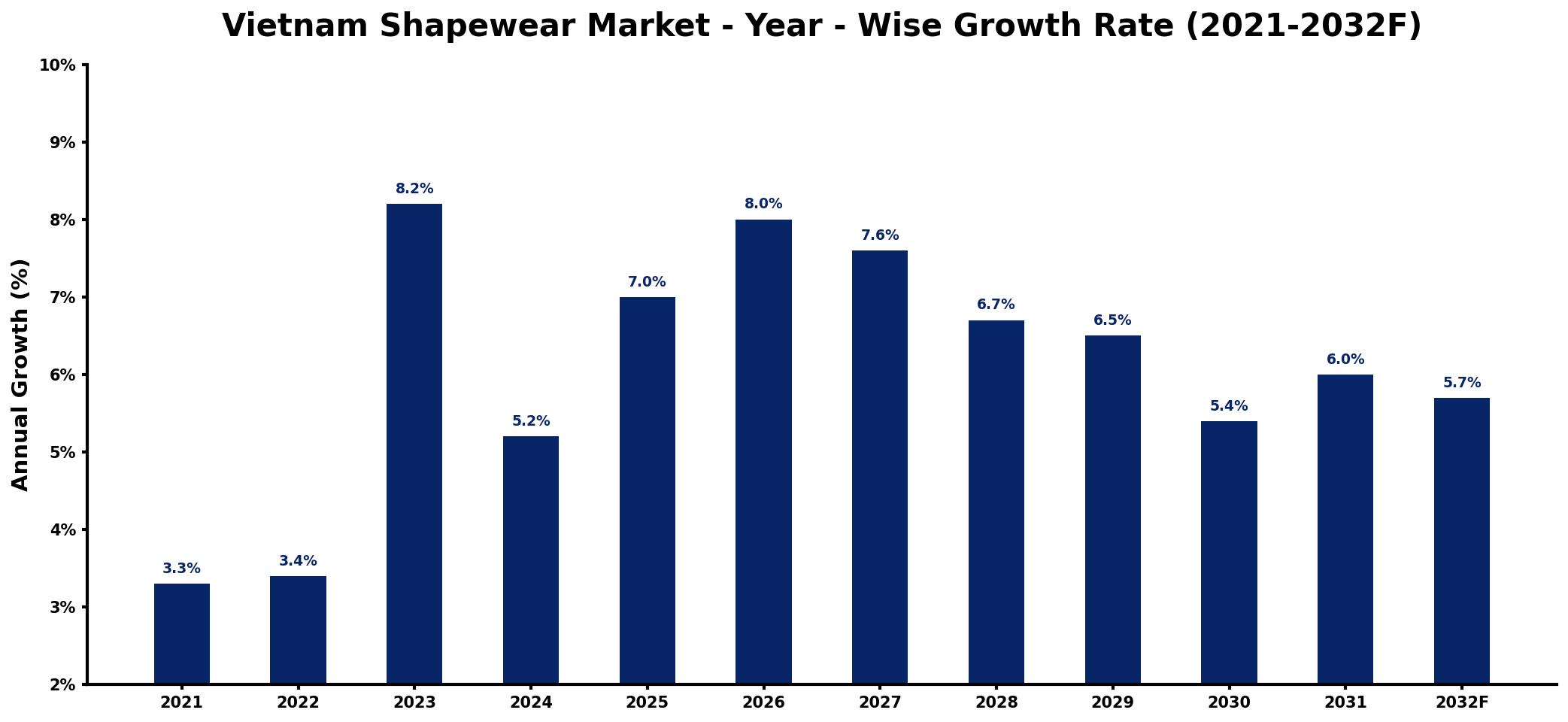
The table below presents the year‑wise growth rates along with the key drivers influencing the market
| Year | Growth Rate | Major Drivers |
| 2021 | 3.3% | Rising health consciousness among consumers |
| 2022 | 3.4% | Growth in online retail channels |
| 2023 | 8.2% | Increased social media influence |
| 2024 | 5.2% | Expanding women's fashion market |
| 2025 | 7.0% | Surge in fitness culture adoption |
| 2026 | 8.0% | Growing disposable income levels |
| 2027 | 7.6% | Heightened focus on body positivity |
| 2028 | 6.7% | Emergence of innovative fabric technologies |
| 2029 | 6.5% | Strengthened celebrity endorsements impact |
| 2030 | 5.4% | Diversification of product offerings available |
| 2031 | 6.0% | Enhancement of customer loyalty programs |
| 2032 | 5.7% | Expansion of eco-friendly product lines |
Note: Market size estimations and growth projections presented in this report are based on 6Wresearch's proprietary forecasting methodology, utilizing the latest available industry data, government publications, and primary research inputs.
Vietnam Shapewear Market Synopsis
The demand for shapewear in Vietnam is heavily influenced by contemporary fashion trends, with consumers increasingly seeking versatile options that enhance body confidence. Products like bodysuits and waist trainers have gained traction, appealing to a demographic eager for both style and comfort.
Supply in the market has expanded, with local manufacturers innovating in fabric technology and design. This has led to a diverse range of offerings catering to various body types and personal preferences, ensuring that consumers have access to shapewear that fits their specific needs.
Vietnam Shapewear Market Key Takeaways
- Shapewear is increasingly viewed as an essential fashion item, driving a surge in demand among consumers.
- Growing health consciousness and changing beauty standards are propelling market growth.
- The rise of e-commerce platforms has made shapewear more accessible than ever before.
- Domestic brands are innovating to meet consumer preferences while competing with established international names.
- Post-pandemic recovery is expected to further boost demand as consumers return to social activities.
Evaluation of Restraints in Vietnam Shapewear Market
Despite promising growth, the Vietnam shapewear market faces several restraints. A notable challenge lies in consumer awareness, as many potential buyers may not fully understand the benefits of shapewear. Competing with traditional undergarments, which are often perceived as more comfortable or familiar, poses another hurdle. To overcome these challenges, brands must invest in educational campaigns that highlight the advantages of shapewear, alongside comfortable and innovative designs to enhance consumer uptake.
Vietnam Shapewear Market Trends
The trend of body positivity is gaining momentum, influencing shapewear designs to cater to a broader spectrum of body types. Additionally, sustainability is becoming a pivotal factor, with brands beginning to explore eco-friendly materials in their shapewear lines. Innovations in fabric technology, such as moisture-wicking and breathable materials, are also reshaping the product landscape, enhancing both comfort and functionality for consumers.
Vietnam Shapewear Market Opportunities
A significant opportunity lies in tapping into the growing e-commerce sector. As online shopping becomes increasingly popular, brands that effectively leverage digital platforms can expand their reach and boost sales. Furthermore, collaboration with fashion influencers presents a compelling strategy to enhance brand visibility and credibility, particularly among younger consumers who seek authenticity in brand engagement.
Government Initiatives in the Vietnam Shapewear Market
The Vietnamese government has been promoting domestic manufacturing and encouraging businesses to explore innovative designs and materials through various initiatives. Support for e-commerce growth is also evident, as policies aimed at digitizing the retail space are being implemented. Such measures create a favorable environment for the shapewear market to thrive, allowing brands to capitalize on emerging opportunities.
Future Insights of the Vietnam Shapewear Market
Looking ahead to the period between 2026 and 2032, the Vietnam shapewear market is expected to continue its upward trajectory. The integration of technology in both manufacturing and marketing will likely play a crucial role in meeting evolving consumer demands. Moreover, the emphasis on health and wellness will further reinforce the market's expansion as consumers seek products that align with their active lifestyles.
Vietnam Shapewear Market Latest Developments (2025 - 2026)
The shapewear industry in Vietnam is currently witnessing notable shifts, particularly towards online retailing. A number of brands have pivoted towards enhancing their digital marketing strategies, recognizing the necessity for a robust online presence. Additionally, there has been an uptick in collaborations with local influencers, which is resonating well with consumers, leading to increased brand engagement and loyalty.
Vietnam Shapewear Market - Key Attractiveness of the Report
- 10 Years of Market Numbers
- Historical Data Starting from 2022 to 2025
- Base Year: 2025
- Forecast Data until 2032
- Key Performance Indicators Impacting the Market
- Major Upcoming Developments and Projects
Key Highlights of the Report:
- Vietnam Shapewear Market Outlook
- Market Size of Vietnam Shapewear Market, 2025
- Forecast of Vietnam Shapewear Market, 2032
- Historical Data and Forecast of Vietnam Shapewear Revenues & Volume for the Period 2022-2032F
- Vietnam Shapewear Market Trend Evolution
- Vietnam Shapewear Market Drivers and Challenges
- Vietnam Shapewear Price Trends
- Vietnam Shapewear Porter's Five Forces
- Vietnam Shapewear Industry Life Cycle
- Historical Data and Forecast of Vietnam Shapewear Market Revenues & Volume By End-user for the Period 2022-2032F
- Historical Data and Forecast of Vietnam Shapewear Market Revenues & Volume By Male for the Period 2022-2032F
- Historical Data and Forecast of Vietnam Shapewear Market Revenues & Volume By Female for the Period 2022-2032F
- Historical Data and Forecast of Vietnam Shapewear Market Revenues & Volume By Distribution Channel for the Period 2022-2032F
- Historical Data and Forecast of Vietnam Shapewear Market Revenues & Volume By Hypermarkets & Supermarkets for the Period 2022-2032F
- Historical Data and Forecast of Vietnam Shapewear Market Revenues & Volume By Specialty Stores for the Period 2022-2032F
- Historical Data and Forecast of Vietnam Shapewear Market Revenues & Volume By Online for the Period 2022-2032F
- Historical Data and Forecast of Vietnam Shapewear Market Revenues & Volume By Others for the Period 2022-2032F
- Vietnam Shapewear Import Export Trade Statistics
- Market Opportunity Assessment By End-user
- Market Opportunity Assessment By Distribution Channel
- Vietnam Shapewear Top Companies Market Share
- Vietnam Shapewear Competitive Benchmarking By Technical and Operational Parameters
- Vietnam Shapewear Company Profiles
- Vietnam Shapewear Key Strategic Recommendations






































