Vietnam Sports Nutrition Market Size, Share & Growth Rate
The Vietnam Sports Nutrition Market was estimated at USD 1140 Million in 2025 and is projected to reach USD 1619 Million by 2032, growing at a CAGR of 5.1% from 2026 to 2032. This growth is driven by a surge in health consciousness among Vietnamese consumers, alongside an increasing participation in fitness and sports activities. The influence of social media and fitness influencers has also played a pivotal role, as they encourage individuals to adopt healthier lifestyles supported by sports nutrition products.
Vietnam Sports Nutrition Market Year-wise Growth Rate and Key Drivers
This graph highlights how the Vietnam Sports Nutrition Market has steadily grown over the years, supported by major growth factors.
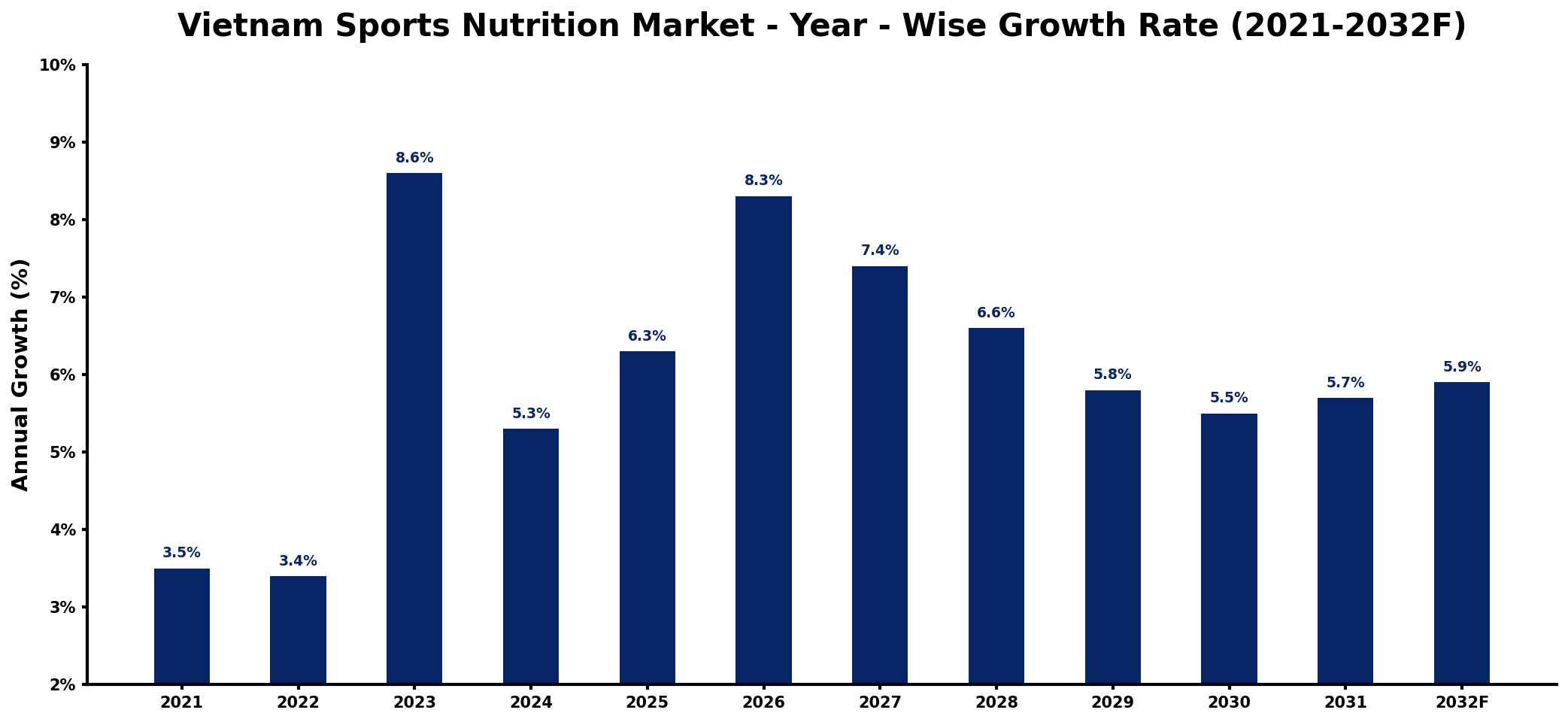
The table below presents the year‑wise growth rates along with the key drivers influencing the market
| Year | Growth Rate | Major Drivers |
| 2021 | 3.5% | Rise in fitness center memberships |
| 2022 | 3.4% | Increasing awareness of health benefits |
| 2023 | 8.6% | Growth in online fitness platforms |
| 2024 | 5.3% | Expansion of retail distribution channels |
| 2025 | 6.3% | Surge in youth athletic participation |
| 2026 | 8.3% | Investment in health promotion campaigns |
| 2027 | 7.4% | Development of innovative product offerings |
| 2028 | 6.6% | Rising demand for plant-based alternatives |
| 2029 | 5.8% | Increase in personalized health services |
| 2030 | 5.5% | increased pharmaceutical industry usage |
| 2031 | 5.7% | improved raw material availability |
| 2032 | 5.9% | Emergence of fitness influencer marketing |
Note: Market size estimations and growth projections presented in this report are based on 6Wresearch's proprietary forecasting methodology, utilizing the latest available industry data, government publications, and primary research inputs.
Vietnam Sports Nutrition Market Synopsis
Recently, the Vietnam sports nutrition market has seen a revitalization as consumers shift towards more active lifestyles. This rising momentum is evident as people increasingly recognize the importance of nutrition in achieving their fitness goals. Looking ahead, the market is anticipated to expand further, fueled by the ongoing trend of fitness and wellness, which has taken root across various demographics in the country.
The integration of sports nutrition into daily diets is becoming more common, yet many consumers still lack a full understanding of the benefits these products can offer. As education around these products improves, and as consumers grow more discerning about quality and effectiveness, the market will likely experience even greater growth and diversification.
Vietnam Sports Nutrition Market Key Takeaways
- The market is experiencing robust growth fueled by increased fitness participation.
- Social media is a key driver for consumer awareness and product adoption.
- There is a notable shift towards home fitness, boosting demand for sports nutrition.
- Education on the benefits and safety of sports nutrition products remains crucial.
- Traditional diets continue to compete with modern sports nutrition offerings.
Evaluation of Restraints in Vietnam Sports Nutrition Market
Despite the positive growth trajectory, several challenges persist in the Vietnam sports nutrition market. A significant barrier is the need for consumer education; many potential buyers are still unaware of the precise benefits of sports supplements, which hinders broader acceptance. Building trust around the quality and safety of these products is essential, especially as the market grapples with skepticism stemming from limited regulatory oversight. Additionally, entrenched traditional dietary habits and insufficient distribution networks pose further challenges to market penetration and growth.
Vietnam Sports Nutrition Market Trends
The landscape of the Vietnam sports nutrition market is rapidly evolving, with several notable trends emerging. First, the rise of plant-based and natural ingredients is gaining traction among health-conscious consumers, leading to a shift in product formulations. Furthermore, personalized nutrition is becoming increasingly popular, as individuals seek tailored products that align with their unique fitness goals. Another trend is the incorporation of technology, with mobile apps and wearable devices playing a key role in engaging consumers and enhancing their fitness experiences.
Vietnam Sports Nutrition Market Opportunities
Opportunities for growth in the Vietnam sports nutrition market are vast. The increasing number of gyms and fitness centers opens new distribution channels for sports nutrition products. Additionally, the expansion of e-commerce platforms presents a unique avenue to reach a broader audience, particularly younger consumers. Collaborations with fitness influencers and health professionals can further drive brand awareness and consumer trust, enabling companies to capture a larger market share. Lastly, innovations in product formulations that cater to specific consumer needs, such as weight management or muscle recovery, can stimulate additional demand.
Government Initiatives in the Vietnam Sports Nutrition Market
The Vietnamese government has shown a commitment to enhancing public health and wellness, which indirectly supports the sports nutrition market. Initiatives focused on promoting physical activity and healthy lifestyles are increasingly prevalent. Public spending on health awareness campaigns and nutrition education programs aims to inform consumers about the benefits of balanced diets, including sports nutrition products. While specific regulatory frameworks for sports nutrition products remain in development, the government's overall support for health-centric policies bodes well for market growth.
Future Insights of the Vietnam Sports Nutrition Market
As we look to the future, the Vietnam sports nutrition market is poised for significant growth through 2032. The anticipated uptick in health awareness among the population, coupled with an ongoing trend of fitness integration into daily routines, will likely drive demand for sports nutrition products. Furthermore, the gradual recovery from the COVID-19 pandemic is expected to catalyze a return to active lifestyles, solidifying the market's trajectory. By focusing on consumer education and leveraging technological advancements, businesses can capitalize on emerging opportunities and contribute to the overall evolution of the sports nutrition landscape.
Vietnam Sports Nutrition Market Latest Developments (2025 - 2026)
The Vietnam sports nutrition market has recently witnessed an influx of new product launches that cater to evolving consumer preferences. As fitness enthusiasts increasingly seek out innovative supplements that prioritize natural ingredients, many companies have begun reformulating their offerings. Additionally, the rise of online sales channels has led to more competitive pricing strategies and promotional campaigns, making these products more accessible to a broader consumer base. Collaborations with local gyms and health clubs have also gained traction, helping brands enhance their visibility and credibility in the marketplace.
Vietnam Sports Nutrition Market - Key Attractiveness of the Report
- 10 Years of Market Numbers
- Historical Data Starting from 2022 to 2025
- Base Year: 2025
- Forecast Data until 2032
- Key Performance Indicators Impacting the Market
- Major Upcoming Developments and Projects
Key Highlights of the Report:
- Vietnam Sports Nutrition Market Outlook
- Market Size of Vietnam Sports Nutrition Market, 2025
- Forecast of Vietnam Sports Nutrition Market, 2032
- Historical Data and Forecast of Vietnam Sports Nutrition Revenues & Volume for the Period 2022-2032F
- Vietnam Sports Nutrition Market Trend Evolution
- Vietnam Sports Nutrition Market Drivers and Challenges
- Vietnam Sports Nutrition Price Trends
- Vietnam Sports Nutrition Porter's Five Forces
- Vietnam Sports Nutrition Industry Life Cycle
- Historical Data and Forecast of Vietnam Sports Nutrition Market Revenues & Volume By Type for the Period 2022-2032F
- Historical Data and Forecast of Vietnam Sports Nutrition Market Revenues & Volume By Sports Food for the Period 2022-2032F
- Historical Data and Forecast of Vietnam Sports Nutrition Market Revenues & Volume By Sports Drinks for the Period 2022-2032F
- Historical Data and Forecast of Vietnam Sports Nutrition Market Revenues & Volume By Sports Supplements for the Period 2022-2032F
- Historical Data and Forecast of Vietnam Sports Nutrition Market Revenues & Volume By Distribution Channel for the Period 2022-2032F
- Historical Data and Forecast of Vietnam Sports Nutrition Market Revenues & Volume By Supermarkets/Hypermarkets for the Period 2022-2032F
- Historical Data and Forecast of Vietnam Sports Nutrition Market Revenues & Volume By Specialty Stores for the Period 2022-2032F
- Historical Data and Forecast of Vietnam Sports Nutrition Market Revenues & Volume By Convenience Stores for the Period 2022-2032F
- Historical Data and Forecast of Vietnam Sports Nutrition Market Revenues & Volume By Online Stores for the Period 2022-2032F
- Historical Data and Forecast of Vietnam Sports Nutrition Market Revenues & Volume By Other Distribution Channels for the Period 2022-2032F
- Vietnam Sports Nutrition Import Export Trade Statistics
- Market Opportunity Assessment By Type
- Market Opportunity Assessment By Distribution Channel
- Vietnam Sports Nutrition Top Companies Market Share
- Vietnam Sports Nutrition Competitive Benchmarking By Technical and Operational Parameters
- Vietnam Sports Nutrition Company Profiles
- Vietnam Sports Nutrition Key Strategic Recommendations






































