Vietnam Talc and Steatite Market Size, Share & Growth Rate
The Vietnam Talc and Steatite Market was estimated at USD 464 Million in 2025 and is projected to reach USD 659 Million by 2032, growing at a CAGR of 5.1% from 2026 to 2032. This growth trajectory is primarily driven by an expanding cosmetics and personal care industry, where talc serves as an essential ingredient in numerous products. Furthermore, the increasing utilization of talc in the automotive and ceramics sectors enhances the market dynamics, capitalizing on both domestic demand and export opportunities.
Vietnam Talc and Steatite Market Year-wise Growth Rate and Key Drivers
This graph highlights how the Vietnam Talc and Steatite Market has steadily grown over the years, supported by major growth factors.
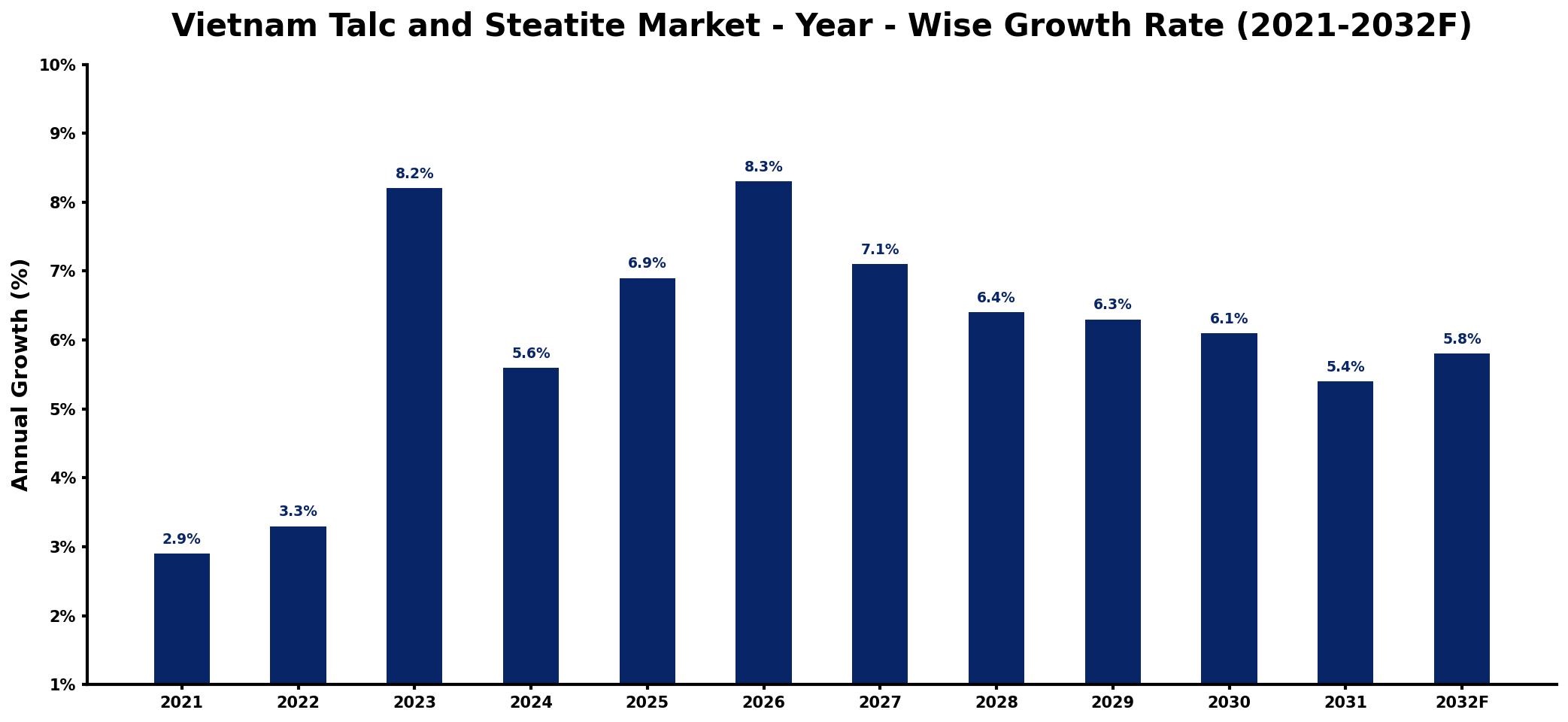
The table below presents the year‑wise growth rates along with the key drivers influencing the market
| Year | Growth Rate | Major Drivers |
| 2021 | 2.9% | Increased demand from cosmetics sector |
| 2022 | 3.3% | Growth in construction material applications |
| 2023 | 8.2% | Surge in plastics manufacturing needs |
| 2024 | 5.6% | rising end-use demand growth |
| 2025 | 6.9% | Expansion of paper industry requirements |
| 2026 | 8.3% | Higher utilization in automotive sector |
| 2027 | 7.1% | Boost in rubber production activities |
| 2028 | 6.4% | Increased investment in pharmaceuticals |
| 2029 | 6.3% | Growing demand from food packaging |
| 2030 | 6.1% | Rising popularity in electronic devices |
| 2031 | 5.4% | Strengthened demand in textile industry |
| 2032 | 5.8% | stronger distribution network expansion |
Note: Market size estimations and growth projections presented in this report are based on 6Wresearch's proprietary forecasting methodology, utilizing the latest available industry data, government publications, and primary research inputs.
Vietnam Talc and Steatite Market Synopsis
In recent years, the Vietnam talc and steatite market has gained significant momentum, driven largely by surging demand from the cosmetics and personal care industries. As companies innovate and expand their product lines, the market is poised for sustained growth. Looking ahead, the broadening applications of talc in sectors such as automotive manufacturing and ceramics further underpin future market potential.
However, the market is not without challenges. Factors such as fluctuating demand from end-use sectors and environmental sustainability issues pose challenges to growth. Nonetheless, the ongoing research efforts to develop new applications present a silver lining, promising additional avenues for market expansion.
Vietnam Talc and Steatite Market Key Takeaways
- The market is experiencing steady growth driven by the booming cosmetics sector.
- Talc is increasingly used in automotive and ceramics applications, enhancing market demand.
- Ongoing research is likely to uncover new applications for talc and steatite.
- Environmental concerns are prompting industry players to adopt sustainable practices.
- The market remains resilient, even amidst fluctuations due to global economic conditions.
Evaluation of Restraints in Vietnam Talc and Steatite Market
While the Vietnam talc and steatite market showcases promising growth, there are notable restraints that can impede progress. Volatility in demand from key sectors such as cosmetics and plastics creates uncertainty for market players. Additionally, growing environmental concerns regarding mining practices necessitate a shift towards more sustainable sourcing solutions. This demand for compliance not only influences production capabilities but also affects the reputation of companies involved in talc extraction and processing, creating hurdles in establishing market stability.
Vietnam Talc and Steatite Market Trends
Current trends in the Vietnam talc and steatite market reflect a robust shift towards sustainability and product innovation. Manufacturers are increasingly prioritizing eco-friendly practices, responding to consumer preferences for responsibly sourced materials. Additionally, theres a noticeable rise in the development of talc-based products tailored for specific applications within the automotive and electronics sectors, indicating a diversification of usage that could shape future market dynamics.
Vietnam Talc and Steatite Market Opportunities
The Vietnam talc and steatite market presents several genuine growth opportunities for investors and stakeholders. With rising disposable incomes, the demand for premium cosmetic products that feature talc is on the rise. Furthermore, the ongoing exploration of new applications in high-tech industries suggests that companies can tap into lucrative markets beyond traditional uses. Expanding research and development efforts can also uncover niche applications, further solidifying the market's growth potential.
Government Initiatives in the Vietnam Talc and Steatite Market
The Vietnamese government has been proactive in promoting the mining and processing sectors, including talc and steatite. Various initiatives aimed at enhancing sustainable mining practices have emerged, along with funding programs for technological advancements in mineral extraction. Additionally, policies supporting the growth of the cosmetics and manufacturing industries indirectly benefit the talc and steatite market by boosting domestic demand and improving market conditions.
Future Insights of the Vietnam Talc and Steatite Market
Looking ahead to 2026-2032, the Vietnam talc and steatite market is poised for significant expansion. Continued innovation in product formulations, particularly within the cosmetics and automotive sectors, will likely drive demand. Moreover, the increasing focus on sustainability will compel companies to adopt responsible practices while exploring new applications for talc. As global economic conditions stabilize, the outlook remains optimistic, fostering an environment conducive to investment and growth.
Vietnam Talc and Steatite Market Latest Developments (2025 - 2026)
Recent developments in the Vietnam talc and steatite market reflect a shift towards increased innovation and sustainability. Several industry players have initiated programs aimed at enhancing their production capabilities while reducing their environmental footprint. Additionally, collaborations focused on research have emerged, targeting new applications for talc, particularly in the growing electronics sector. These trends signal an adaptive market landscape, primed for future growth.
Vietnam Talc and Steatite Market - Key Attractiveness of the Report
- 10 Years of Market Numbers
- Historical Data Starting from 2022 to 2025
- Base Year: 2025
- Forecast Data until 2032
- Key Performance Indicators Impacting the Market
- Major Upcoming Developments and Projects
Key Highlights of the Report:
- Vietnam Talc and Steatite Market Outlook
- Market Size of Vietnam Talc and Steatite Market, 2025
- Forecast of Vietnam Talc and Steatite Market, 2032
- Historical Data and Forecast of Vietnam Talc and Steatite Revenues & Volume for the Period 2022-2032F
- Vietnam Talc and Steatite Market Trend Evolution
- Vietnam Talc and Steatite Market Drivers and Challenges
- Vietnam Talc and Steatite Price Trends
- Vietnam Talc and Steatite Porter's Five Forces
- Vietnam Talc and Steatite Industry Life Cycle
- Historical Data and Forecast of Vietnam Talc and Steatite Market Revenues & Volume By Product Type for the Period 2022-2032F
- Historical Data and Forecast of Vietnam Talc and Steatite Market Revenues & Volume By Crushed for the Period 2022-2032F
- Historical Data and Forecast of Vietnam Talc and Steatite Market Revenues & Volume By Powdered for the Period 2022-2032F
- Vietnam Talc and Steatite Import Export Trade Statistics
- Market Opportunity Assessment By Product Type
- Vietnam Talc and Steatite Top Companies Market Share
- Vietnam Talc and Steatite Competitive Benchmarking By Technical and Operational Parameters
- Vietnam Talc and Steatite Company Profiles
- Vietnam Talc and Steatite Key Strategic Recommendations






































