Vietnam Television Market Summary
The vietnam television market was estimated at USD 936 Million in 2025 and is projected to reach USD 1504 Million by 2032, growing at a CAGR of 10.5% from 2026 to 2032.
Vietnam Television Market Year-wise Growth Rate and Key Drivers
This graph highlights how the Vietnam Television Market has steadily grown over the past five years, supported by major growth factors.
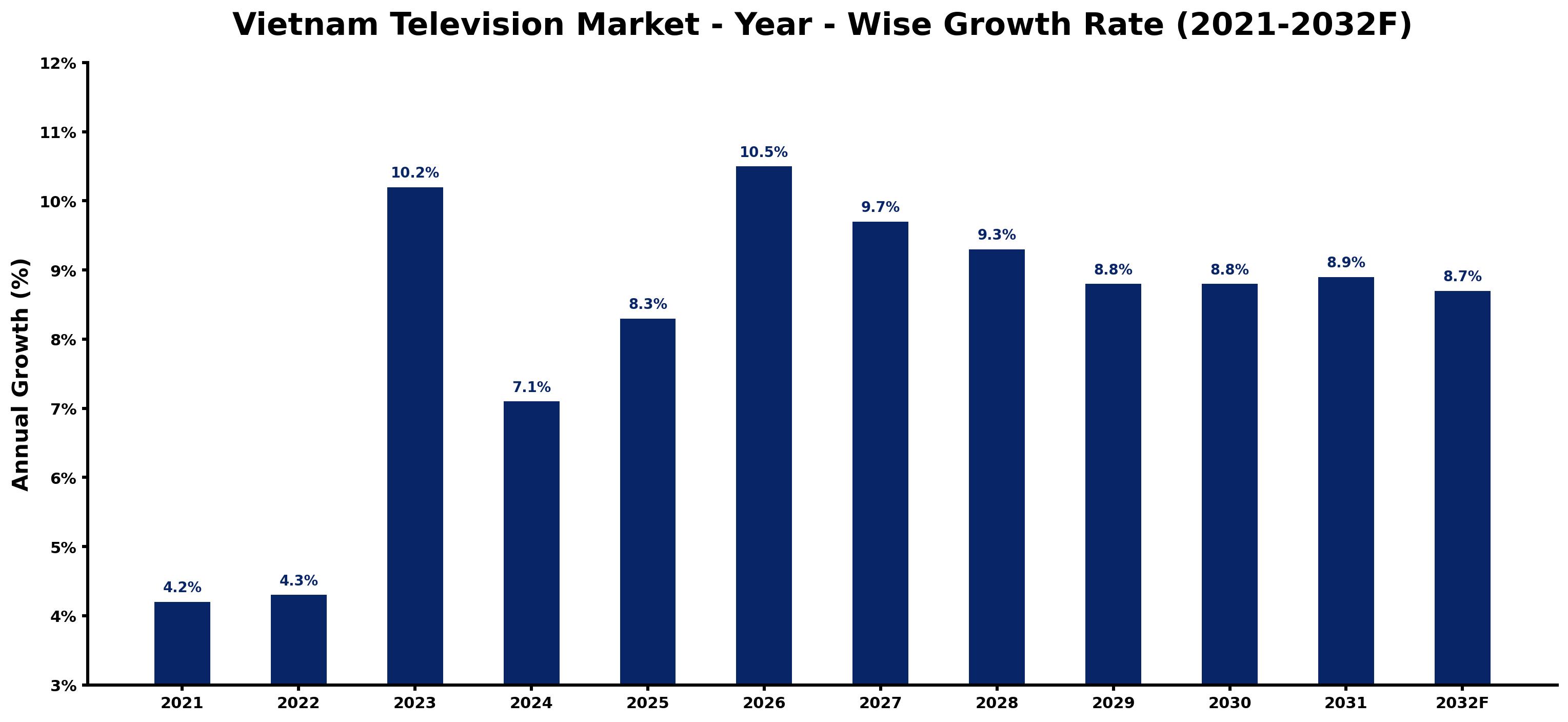
The table below presents the year wise growth rates along with the key drivers influencing the market
| Year | Growth Rate | Major Drivers |
| 2021 | 4.2% | Vietnam's urbanization trend boosts demand for diverse entertainment channels and content. |
| 2022 | 4.3% | Increased smartphone penetration enhances access to streaming services in urban households. |
| 2023 | 10.2% | Local content production gains traction, attracting younger audiences and advertisers alike. |
| 2024 | 7.1% | Regional players invest heavily in localizing international content for Vietnamese viewers. |
| 2025 | 8.3% | Emerging rural internet infrastructure opens new markets for telecommunications and television. |
| 2026 | 10.5% | The integration of smart TVs alters viewing habits, enhancing user engagement and retention. |
| 2027 | 9.7% | Competition among platforms fosters innovative content strategies, enriching viewer experiences. |
| 2028 | 9.3% | Shifts to hybrid viewing models blend traditional broadcasting with online streaming preferences. |
| 2029 | 8.8% | Advertising revenues increase as brands target the expanding digital-savvy consumer base. |
| 2030 | 8.8% | Investment in production hubs elevates Vietnam's stature in regional media landscapes. |
| 2031 | 8.9% | Collaborations with global studios expand avenues for co-productions and storytelling. |
| 2032 | 8.7% | Technological advancements in virtual reality reshape immersive content consumption patterns. |
Note - Market size estimations and growth projections presented in this report are based on 6Wresearch's advanced forecasting approach, validated with industry datasets as of June 2026.
Vietnam Television Market Synopsis
The Vietnam Television Market is projected to reach 10.5% and witness significant growth during the forecast period (2026-2032). This growth is attributed to a combination of factors, including the booming middle-class population, rising disposable incomes, and government initiatives that encourage the enhancement of digital broadcasting services. As the predominant source of entertainment and information in Vietnam, television viewing remains a critical part of daily life, and the advent of digital technology has intensified the appetite for smarter, internet-enabled devices. The ongoing economic development in Vietnam is steering consumers towards elevated viewing experiences, which is driving the demand for televisions and propelling market expansion.
Vietnam Television Market Growth Drivers
Several pivotal elements contribute to the growth trajectory of the Vietnam television market. The first key driver is the substantial expansion of the middle-class demographic, coupled with a rise in disposable incomes. As more consumers gain financial stability, their willingness to invest in electronics, particularly televisions, has increased.
- The transition from analog to digital broadcasting has empowered consumers to upgrade their televisions, enhancing their access to superior channels and content.
- The surge in popularity of smart TVs, driven by the increasing use of online streaming services, has further stimulated market growth, as consumers seek to combine traditional viewing with modern streaming capabilities.
- Marketing strategies that focus on emphasizing the entertainment value and interactivity of smart TVs have effectively attracted curious consumers looking for enriched viewing experiences.
- Rising consumer engagement with diverse online content is leading to a greater demand for television sets that can seamlessly integrate with other digital services.
- Local manufacturers are adapting to these shifts by innovating product features and improving the overall quality of televisions, making them more appealing to tech-savvy consumers.
Vietnam Television Market Challenges and Restraints
Despite its continued growth, the Vietnam television market faces various challenges. A primary concern is the intense competition posed by alternative digital entertainment platforms, such as smartphones and tablets. This competition necessitates that the television industry differentiate itself with unique content offerings and interactive features to maintain viewer interest.
- Price sensitivity among the consumer base remains a significant barrier, as many consumers may hesitate to invest in higher-end television models due to budget constraints.
- In order to appeal to a broader audience, it is crucial for manufacturers to provide competitive pricing strategies that encompass a range of products at different price points.
- The evolution of consumer preferences, driven by fast-paced technological advancements, demands continuous product innovation and adaptability from television manufacturers.
- Market players must also tackle the issue of counterfeit or substandard products, which can undermine consumer trust and affect overall market growth.
- The necessity for effective distribution channels that can handle an increased influx of modern television units is another challenge facing the industry.
Vietnam Television Market Government Investment and Initiatives
The Vietnamese government has recognized the importance of a robust television market for enhancing public access to information and entertainment. Consequently, various initiatives have been launched to support the industry's digital transformation.
- Public policy frameworks encourage the transition from analog to digital broadcasting, promoting better-quality content and expanding the range of available programming.
- Investments in telecommunications infrastructure are being made to facilitate smoother digital broadcasting and ensure that rural areas have access to quality television services.
- Government incentives aimed at upgrading broadcast technologies have bolstered the industry's commitment to modernizing networks and enhancing viewer experiences.
- Collaborations between the government and private sectors are fostering innovation, as initiatives focus on developing new content delivery mechanisms that are both efficient and accessible.
- Training programs and workshops are being organized to improve the skills of local professionals in the broadcasting sector, ensuring that the workforce is equipped to meet contemporary market demands.
Vietnam Television Market Latest Developments (May 2025 - June 2026)
The Vietnam television market has seen notable strategic developments from May 2025 to June 2026. During this period, the shift toward digital services has gained momentum, with increased consumer adoption of smart and internet-enabled televisions. Manufacturers are responding to this trend by introducing innovative features that cater to the growing demand for streaming capabilities and interactive functionalities.
- Emerging trends indicate a focus on sustainability, with companies exploring eco-friendly materials and energy-efficient technologies in television production.
- Content partnerships with local and international streaming services have expanded, enhancing accessible programming options for consumers and attracting a diverse audience base.
- The industry has experienced advancements in 4K and 8K television technology, pushing consumers towards higher-quality viewing experiences.
- Increased competition has prompted manufacturers to enhance customer service and after-sales support, ensuring consumer satisfaction remains a priority.
- Regulatory approaches are evolving, with the government seeking to balance market growth with the promotion of local content creation, thus preserving Vietnam's cultural identity.
Vietnam Television Market - Key Attractiveness of the Report
- 10 Years of Market Numbers
- Historical Data Starting from 2022 to 2025
- Base Year: 2025
- Forecast Data until 2032
- Key Performance Indicators Impacting the Market
- Major Upcoming Developments and Projects
Key Highlights of the Report:
- Vietnam Television Market Outlook
- Market Size of Vietnam Television Market, 2025
- Forecast of Vietnam Television Market, 2032
- Historical Data and Forecast of Vietnam Television Revenues & Volume for the Period 2022-2032F
- Vietnam Television Market Trend Evolution
- Vietnam Television Market Drivers and Challenges
- Vietnam Television Price Trends
- Vietnam Television Porter's Five Forces
- Vietnam Television Industry Life Cycle
- Historical Data and Forecast of Vietnam Television Market Revenues & Volume By Resolution for the Period 2022-2032F
- Historical Data and Forecast of Vietnam Television Market Revenues & Volume By LCD TVs for the Period 2022-2032F
- Historical Data and Forecast of Vietnam Television Market Revenues & Volume By OLED TVs for the Period 2022-2032F
- Historical Data and Forecast of Vietnam Television Market Revenues & Volume By Types for the Period 2022-2032F
- Historical Data and Forecast of Vietnam Television Market Revenues & Volume By 2D TVs for the Period 2022-2032F
- Historical Data and Forecast of Vietnam Television Market Revenues & Volume By 3D TVs for the Period 2022-2032F
- Vietnam Television Import Export Trade Statistics
- Market Opportunity Assessment By Resolution
- Market Opportunity Assessment By Types
- Vietnam Television Top Companies Market Share
- Vietnam Television Competitive Benchmarking By Technical and Operational Parameters
- Vietnam Television Company Profiles
- Vietnam Television Key Strategic Recommendations






































