Vietnam Ultra Thin Glass Market Size, Share & Growth Rate
The Vietnam Ultra Thin Glass Market was estimated at USD 265 Million in 2025 and is projected to reach USD 375 Million by 2032, growing at a CAGR of 5.1% from 2026 to 2032. This upward trajectory is largely driven by the increasing demand for sleek, lightweight electronic devices and advancements in display technology, including OLED and foldable displays. The continued evolution of consumer electronics and a push for high-performance materials are also key contributors to this robust growth.
Vietnam Ultra Thin Glass Market Year-wise Growth Rate and Key Drivers
This graph highlights how the Vietnam Ultra Thin Glass Market has steadily grown over the years, supported by major growth factors.
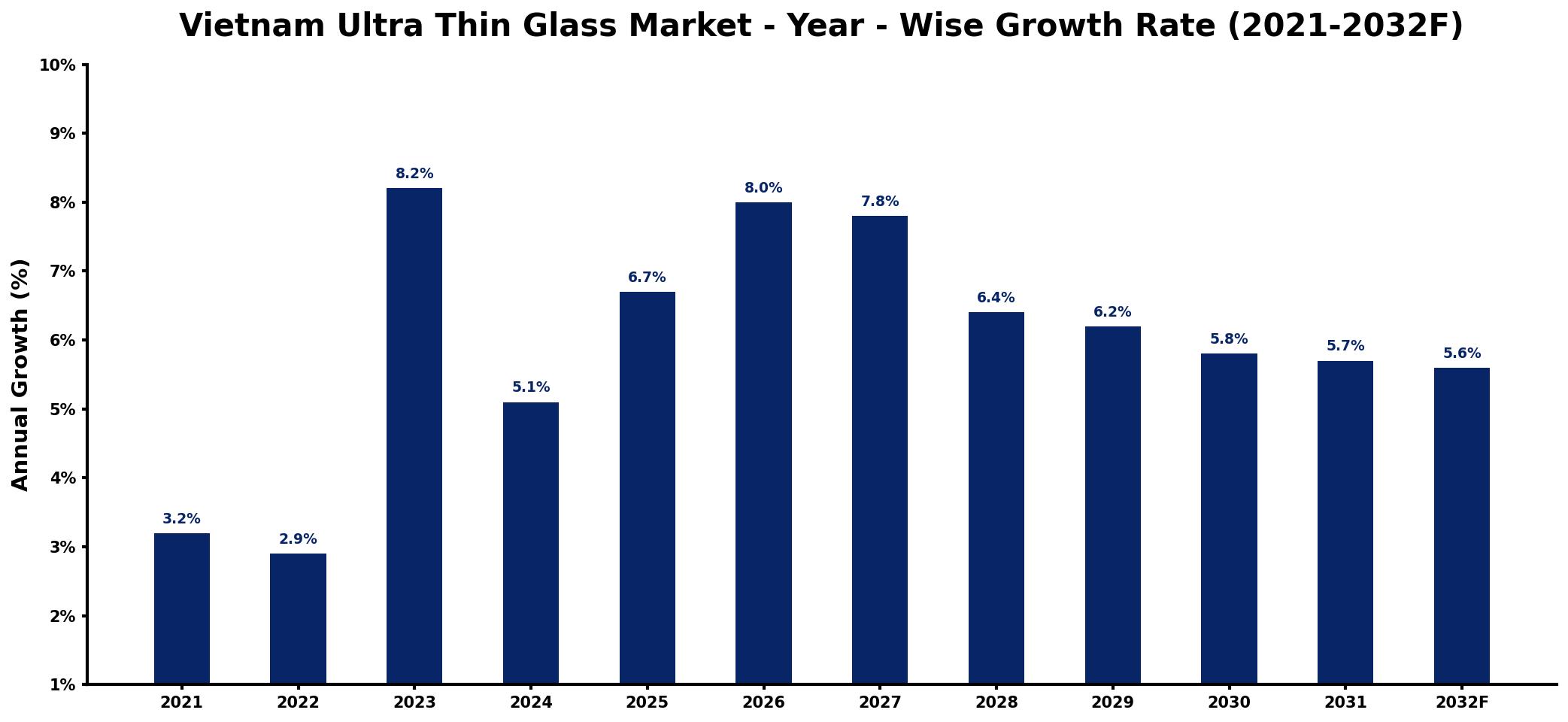
The table below presents the year‑wise growth rates along with the key drivers influencing the market
| Year | Growth Rate | Major Drivers |
| 2021 | 3.2% | Rising demand from electronics sector |
| 2022 | 2.9% | Growth in renewable energy investments |
| 2023 | 8.2% | Expansion of construction industry projects |
| 2024 | 5.1% | Increase in automotive manufacturing requirements |
| 2025 | 6.7% | Surge in consumer electronics production |
| 2026 | 8.0% | Boost in architectural design innovations |
| 2027 | 7.8% | Strengthening of export market opportunities |
| 2028 | 6.4% | Advancements in manufacturing technologies |
| 2029 | 6.2% | Growing interest in sustainable materials |
| 2030 | 5.8% | rising export shipment volumes |
| 2031 | 5.7% | strengthening international trade flows |
| 2032 | 5.6% | improved processing technologies adoption |
Note: Market size estimations and growth projections presented in this report are based on 6Wresearch's proprietary forecasting methodology, utilizing the latest available industry data, government publications, and primary research inputs.
Vietnam Ultra Thin Glass Market Synopsis
The Vietnam ultra-thin glass market has become a crucial segment within the rapidly evolving electronics landscape. As manufacturers aim for devices that are both functional and aesthetically appealing, ultra-thin glass has emerged as a preferred material, particularly for applications in smartphones and tablets.
In addition to electronic displays, ultra-thin glass is finding new avenues in architectural and optical applications, showcasing its versatility. This expanding scope not only meets the demands of contemporary design but also aligns with sustainability goals, as manufacturers strive for eco-friendly materials.
Vietnam Ultra Thin Glass Market Key Takeaways
- The market is set to grow significantly, driven by technological advancements and consumer preferences for lightweight designs.
- Ultra-thin glass is indispensable in modern electronic devices, enhancing durability while maintaining visual clarity.
- Emerging applications in flexible displays and solar energy solutions are creating new growth avenues.
- Competition from alternative materials is a critical factor that players in the market must navigate effectively.
- Post-pandemic recovery has seen a renewed focus on supply chain resilience and innovation in manufacturing processes.
Evaluation of Restraints in Vietnam Ultra Thin Glass Market
Despite the promising growth prospects, the Vietnam ultra-thin glass market faces several restraints that could hinder its potential. Notably, the competition from alternative technologies, such as polymer films and emerging display materials, poses a significant challenge. Additionally, ensuring consistent quality and optical transparency while maintaining cost-effectiveness is an ongoing concern for manufacturers. The rapid pace of technological advancements further necessitates agility in production processes and design to keep up with evolving market demands. As a result, companies must invest strategically to overcome these barriers while maximizing their competitive edge.
Vietnam Ultra Thin Glass Market Trends
One of the most significant trends in the Vietnam ultra-thin glass market is the rising adoption of flexible and curved display technologies. As consumer preferences shift towards innovative device designs, manufacturers are increasingly incorporating ultra-thin glass into their products. Additionally, there is a growing emphasis on sustainable manufacturing practices, driving demand for eco-friendly glass solutions. The market is also seeing the integration of advanced coatings that enhance scratch resistance and improve performance, further solidifying ultra-thin glass's role in next-generation electronic devices.
Vietnam Ultra Thin Glass Market Opportunities
Significant growth opportunities lie in the expansion of applications beyond consumer electronics. The architectural sector, for example, is beginning to embrace ultra-thin glass for its aesthetic and functional benefits in building facades and interior design. Moreover, as solar energy solutions gain traction, the potential for ultra-thin glass in photovoltaic applications is becoming increasingly apparent. Companies that can leverage these emerging segments stand to benefit from new revenue streams and market diversification.
Government Initiatives in the Vietnam Ultra Thin Glass Market
The Vietnamese government has recognized the importance of the high-tech manufacturing sector, including the ultra-thin glass market. Initiatives aimed at fostering innovation through research and development, as well as providing incentives for eco-friendly manufacturing practices, are being prioritized. Policies supporting foreign investment in technology-driven industries are also playing a role in enhancing the domestic capabilities of ultra-thin glass manufacturers, helping them to compete on a global scale.
Future Insights of the Vietnam Ultra Thin Glass Market
Looking ahead to 2026-2032, the Vietnam ultra-thin glass market is expected to continue its upward trend, spurred by ongoing technological innovations and expanding applications. As consumer electronics increasingly favor lightweight and high-performance materials, ultra-thin glass will play a pivotal role in meeting these needs. The alignment of market strategies with sustainability trends and advancements in manufacturing technology will be crucial in capitalizing on new opportunities, ensuring resilience against competitive pressures.
Vietnam Ultra Thin Glass Market Latest Developments (2025 - 2026)
Recent developments in the Vietnam ultra-thin glass market indicate a strong shift towards innovative manufacturing processes and the integration of advanced technologies. Companies are exploring partnerships and collaborations to enhance product offerings and expand into emerging sectors. Additionally, efforts are being made to improve supply chain efficiencies post-pandemic, ensuring timely delivery and maintaining quality standards. The market is poised for transformation as new entrants bring fresh perspectives and cutting-edge solutions.
Vietnam Ultra Thin Glass Market - Key Attractiveness of the Report
- 10 Years of Market Numbers
- Historical Data Starting from 2022 to 2025
- Base Year: 2025
- Forecast Data until 2032
- Key Performance Indicators Impacting the Market
- Major Upcoming Developments and Projects
Key Highlights of the Report:
- Vietnam Ultra Thin Glass Market Outlook
- Market Size of Vietnam Ultra Thin Glass Market, 2025
- Forecast of Vietnam Ultra Thin Glass Market, 2032
- Historical Data and Forecast of Vietnam Ultra Thin Glass Revenues & Volume for the Period 2022-2032F
- Vietnam Ultra Thin Glass Market Trend Evolution
- Vietnam Ultra Thin Glass Market Drivers and Challenges
- Vietnam Ultra Thin Glass Price Trends
- Vietnam Ultra Thin Glass Porter's Five Forces
- Vietnam Ultra Thin Glass Industry Life Cycle
- Historical Data and Forecast of Vietnam Ultra Thin Glass Market Revenues & Volume By Thickness for the Period 2022-2032F
- Historical Data and Forecast of Vietnam Ultra Thin Glass Market Revenues & Volume By <0.1mm for the Period 2022-2032F
- Historical Data and Forecast of Vietnam Ultra Thin Glass Market Revenues & Volume By 0.1mm-0.5mm for the Period 2022-2032F
- Historical Data and Forecast of Vietnam Ultra Thin Glass Market Revenues & Volume By 0.5mm-1.0mm for the Period 2022-2032F
- Historical Data and Forecast of Vietnam Ultra Thin Glass Market Revenues & Volume By Manufacturing Process for the Period 2022-2032F
- Historical Data and Forecast of Vietnam Ultra Thin Glass Market Revenues & Volume By Float for the Period 2022-2032F
- Historical Data and Forecast of Vietnam Ultra Thin Glass Market Revenues & Volume By Fusion for the Period 2022-2032F
- Historical Data and Forecast of Vietnam Ultra Thin Glass Market Revenues & Volume By Down-Draw for the Period 2022-2032F
- Historical Data and Forecast of Vietnam Ultra Thin Glass Market Revenues & Volume By Application for the Period 2022-2032F
- Historical Data and Forecast of Vietnam Ultra Thin Glass Market Revenues & Volume By Semiconductor Substrate for the Period 2022-2032F
- Historical Data and Forecast of Vietnam Ultra Thin Glass Market Revenues & Volume By Touch Panel Display for the Period 2022-2032F
- Historical Data and Forecast of Vietnam Ultra Thin Glass Market Revenues & Volume By Fingerprint Sensor for the Period 2022-2032F
- Historical Data and Forecast of Vietnam Ultra Thin Glass Market Revenues & Volume By Others for the Period 2022-2032F
- Historical Data and Forecast of Vietnam Ultra Thin Glass Market Revenues & Volume By End-use Industry for the Period 2022-2032F
- Historical Data and Forecast of Vietnam Ultra Thin Glass Market Revenues & Volume By Consumer Electronics for the Period 2022-2032F
- Historical Data and Forecast of Vietnam Ultra Thin Glass Market Revenues & Volume By Automotive & Transportation for the Period 2022-2032F
- Historical Data and Forecast of Vietnam Ultra Thin Glass Market Revenues & Volume By Medical & Healthcare for the Period 2022-2032F
- Historical Data and Forecast of Vietnam Ultra Thin Glass Market Revenues & Volume By Others for the Period 2022-2032F
- Vietnam Ultra Thin Glass Import Export Trade Statistics
- Market Opportunity Assessment By Thickness
- Market Opportunity Assessment By Manufacturing Process
- Market Opportunity Assessment By Application
- Market Opportunity Assessment By End-use Industry
- Vietnam Ultra Thin Glass Top Companies Market Share
- Vietnam Ultra Thin Glass Competitive Benchmarking By Technical and Operational Parameters
- Vietnam Ultra Thin Glass Company Profiles
- Vietnam Ultra Thin Glass Key Strategic Recommendations






































