Vietnam Video Game Market Summary
The vietnam video game market was estimated at USD 698 Million in 2025 and is projected to reach USD 991 Million by 2032, growing at a CAGR of 8.3% from 2026 to 2032.
Vietnam Video Game Market Year-wise Growth Rate and Key Drivers
This graph highlights how the Vietnam Video Game Market has steadily grown over the past five years, supported by major growth factors.
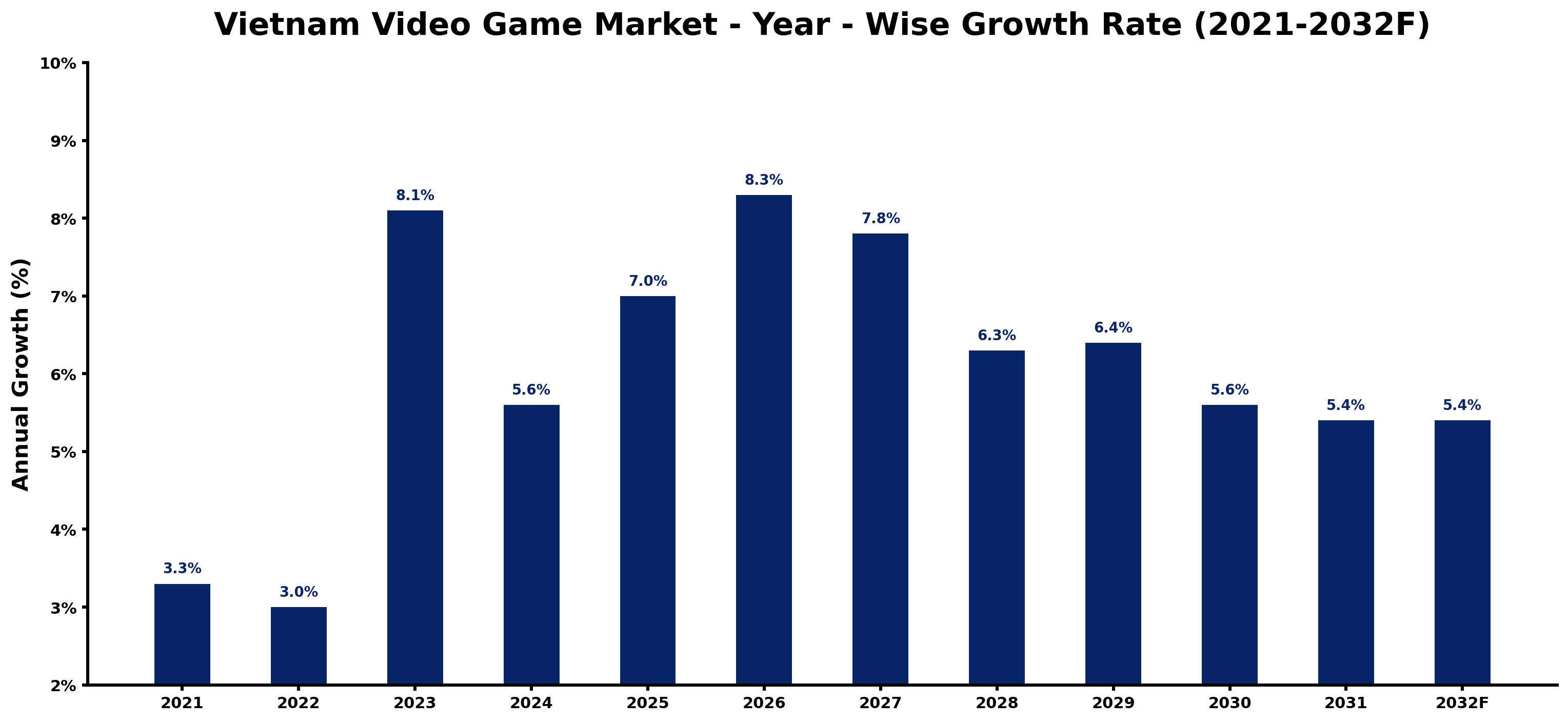
The table below presents the year wise growth rates along with the key drivers influencing the market
| Year | Growth Rate | Major Drivers |
| 2021 | 3.3% | Vietnam's gaming community flourished during lockdowns, boosting online gaming participation significantly. |
| 2022 | 3.0% | Investment in local game development studios attracted international partnerships and increased innovation. |
| 2023 | 8.1% | Mobile gaming platforms expanded, catering to Vietnam's young, tech-savvy population's preferences. |
| 2024 | 5.6% | Increased internet penetration, especially in rural areas, enhanced access to gaming content. |
| 2025 | 7.0% | E-sports tournaments gained traction, promoting competitive gaming culture and audience engagement. |
| 2026 | 8.3% | Consumer spending on gaming hardware surged as disposable incomes rose across demographics. |
| 2027 | 7.8% | Local regulations began favoring foreign investments, enhancing market competition and opportunities. |
| 2028 | 6.3% | Collaboration between tech firms and educational institutions fostered talent development in gaming. |
| 2029 | 6.4% | Emergence of virtual reality gaming experiences drew interest from a broader audience base. |
| 2030 | 5.6% | Increased mobile payment solutions streamlined transactions for gamers, enhancing user experience significantly. |
| 2031 | 5.4% | Localized content resonated with diverse cultural segments, fostering deeper audience connections in gaming. |
| 2032 | 5.4% | Augmented reality applications began integrating into daily life, boosting gaming in everyday settings. |
Note - Market size estimations and growth projections presented in this report are based on 6Wresearch's advanced forecasting approach, validated with industry datasets as of June 2026.
Vietnam Video Game Market Synopsis
The Vietnam Video Game Market is projected to reach 8.3% and witness significant growth during the forecast period (2026-2032). This burgeoning market is underpinned by a constellation of favorable factors including a youthful demographic, increasing disposable incomes, and heightened internet connectivity, all contributing to a vibrant gaming culture in the country.
Vietnam Video Game Market Growth Drivers
A myriad of factors is propelling growth within the Vietnam Video Game Market:
- The proliferation of affordable smartphones has democratized gaming access, making mobile gaming a prevalent choice among a wide audience.
- With a large, young, and tech-savvy population, Vietnam provides an ideal consumer base for video game developers and publishers looking to penetrate the market.
- The expansion of e-sports in Vietnam has generated significant interest, fostering communities that engage with video games as a competitive and social medium.
- Cross-platform gaming capabilities enhance accessibility, allowing players to engage with games across multiple devices, thus broadening the appeal of various gaming titles.
- Increased local content, particularly games with Vietnamese language support, has become crucial in effectively attracting and retaining local players.
Vietnam Video Game Market Challenges and Restraints
Despite the promising growth, the Vietnam Video Game Market faces several challenges that could temper its expansion:
- Software piracy significantly undermines the potential revenue for legitimate game developers, posing a considerable threat to intellectual property rights.
- Localized gaming content remains underdeveloped, impacting player engagement and satisfaction, particularly for those preferring Vietnamese language options.
- While internet infrastructure improvements are ongoing, issues like network stability and high latency continue to challenge the online gaming experience.
- The market may encounter regulatory hurdles that could complicate game publishing and distribution, particularly for foreign entities.
- Competition with alternative entertainment options—such as social media and streaming services—may divert attention from gaming, impacting growth metrics.
Vietnam Video Game Market Government Investment and Initiatives
The Vietnamese government recognizes the potential of the video game market as a significant contributor to the country's economic and cultural development. Various initiatives have been launched to bolster this sector:
- The government has implemented policies aimed at fostering innovation and technology development, which benefit the gaming industry directly.
- Public investment in digital infrastructure continues to improve internet access, critical for enhancing the gaming experience across urban and rural areas.
- Incentives for educational programs and training in digital skills help nurture local talent, essential for the development of homegrown video games.
- Efforts to reduce software piracy through stricter enforcement of intellectual property laws are underway, which may help safeguard developers' revenues.
- Collaborations with international partners are encouraged to enhance knowledge transfer and elevate the quality of Vietnamese games on global platforms.
Vietnam Video Game Market Latest Developments (May 2025 - June 2026)
Recent months have seen notable shifts in the Vietnam Video Game Market, particularly influenced by trends and consumer behaviors:
- There has been a marked increase in the adoption of cloud gaming services, enabling players to enjoy high-quality gaming experiences without the need for expensive hardware.
- The rise of mobile gaming has continued its momentum, with many developers prioritizing mobile-first strategies to engage the vast user base.
- Collaborative gaming experiences, facilitated by social media integrations, have become more commonplace, further driving community engagement.
- Industry events and e-sports tournaments have gained traction, solidifying Vietnam's status as a competitive hub in the Southeast Asian gaming landscape.
- New partnerships between local developers and global gaming franchises have emerged, signaling a maturing market and increasing interest from international players.
Vietnam Video Game Market - Key Attractiveness of the Report
- 10 Years of Market Numbers
- Historical Data Starting from 2022 to 2025
- Base Year: 2025
- Forecast Data until 2032
- Key Performance Indicators Impacting the Market
- Major Upcoming Developments and Projects
Key Highlights of the Report:
- Vietnam Video Game Market Outlook
- Market Size of Vietnam Video Game Market, 2025
- Forecast of Vietnam Video Game Market, 2032
- Historical Data and Forecast of Vietnam Video Game Revenues & Volume for the Period 2022-2032F
- Vietnam Video Game Market Trend Evolution
- Vietnam Video Game Market Drivers and Challenges
- Vietnam Video Game Price Trends
- Vietnam Video Game Porter's Five Forces
- Vietnam Video Game Industry Life Cycle
- Historical Data and Forecast of Vietnam Video Game Market Revenues & Volume By Device for the Period 2022-2032F
- Historical Data and Forecast of Vietnam Video Game Market Revenues & Volume By Console for the Period 2022-2032F
- Historical Data and Forecast of Vietnam Video Game Market Revenues & Volume By Mobile for the Period 2022-2032F
- Historical Data and Forecast of Vietnam Video Game Market Revenues & Volume By Computer for the Period 2022-2032F
- Historical Data and Forecast of Vietnam Video Game Market Revenues & Volume By Type for the Period 2022-2032F
- Historical Data and Forecast of Vietnam Video Game Market Revenues & Volume By Online for the Period 2022-2032F
- Historical Data and Forecast of Vietnam Video Game Market Revenues & Volume By Offline for the Period 2022-2032F
- Vietnam Video Game Import Export Trade Statistics
- Market Opportunity Assessment By Device
- Market Opportunity Assessment By Type
- Vietnam Video Game Top Companies Market Share
- Vietnam Video Game Competitive Benchmarking By Technical and Operational Parameters
- Vietnam Video Game Company Profiles
- Vietnam Video Game Key Strategic Recommendations






































