Vietnam Warm Air Heating and Air Conditioning Market Summary
The vietnam warm air heating and air conditioning market was estimated at USD 431 Million in 2025 and is projected to reach USD 701 Million by 2032, growing at a CAGR of 10.4% from 2026 to 2032.
Vietnam Warm Air Heating and Air Conditioning Market Year-wise Growth Rate and Key Drivers
This graph highlights how the Vietnam Warm Air Heating and Air Conditioning Market has steadily grown over the past five years, supported by major growth factors.
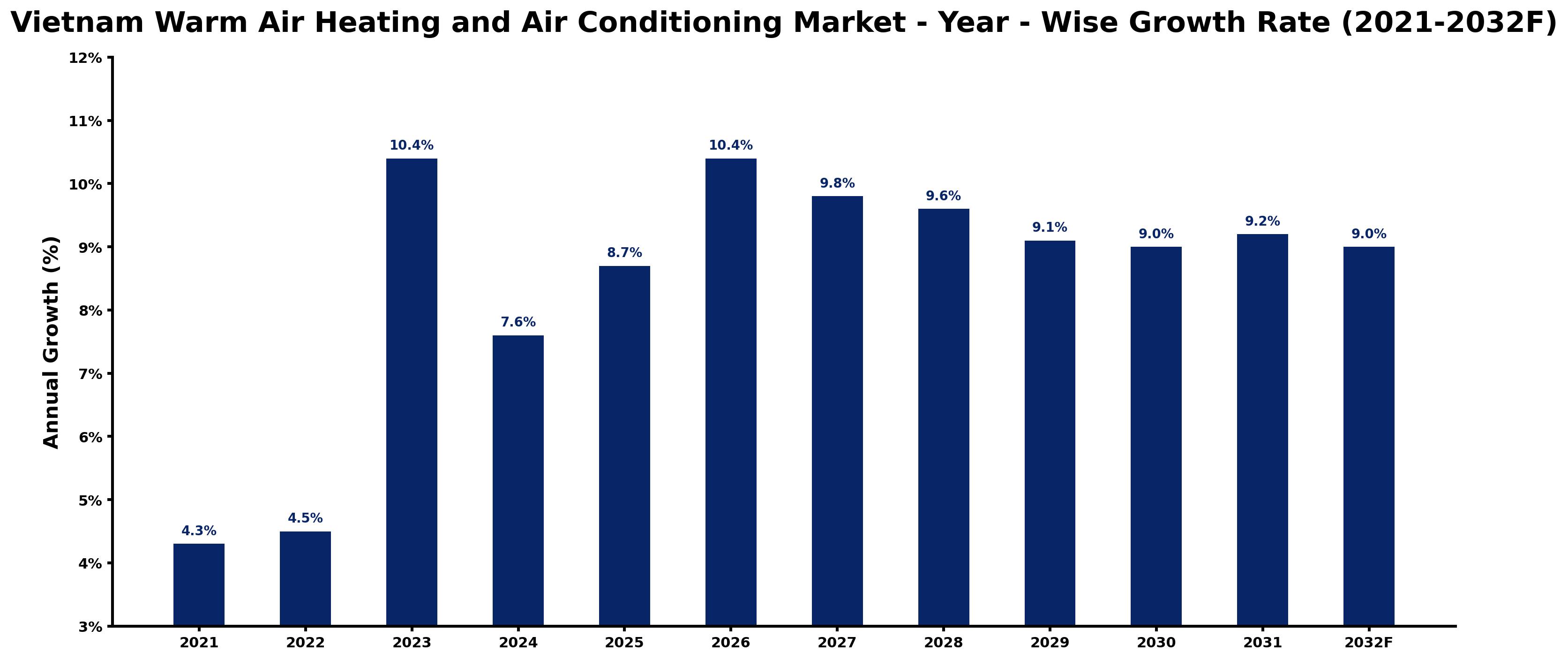
The table below presents the year wise growth rates along with the key drivers influencing the market
| Year | Growth Rate | Major Drivers |
| 2021 | 4.3% | Post-lockdown retail projects stimulated demand for HVAC systems in urban areas. |
| 2022 | 4.5% | Rural electrification initiatives expanded access to modern heating and cooling solutions. |
| 2023 | 10.4% | Manufacturing relocations to Vietnam increased the need for efficient air conditioning units. |
| 2024 | 7.6% | Local climate challenges prompted innovative solutions in thermal management technologies. |
| 2025 | 8.7% | Investment in smart buildings created new opportunities for integrated HVAC systems. |
| 2026 | 10.4% | Consumer preferences began shifting toward energy-efficient and eco-friendly air conditioning. |
| 2027 | 9.8% | Robust construction activities across cities fueled demand for commercial HVAC installations. |
| 2028 | 9.6% | Innovative financing options made air conditioning systems more accessible for households. |
| 2029 | 9.1% | Public awareness campaigns highlighted the importance of indoor air quality improvements. |
| 2030 | 9.0% | Collaboration with international brands enhanced product offerings in the local market. |
| 2031 | 9.2% | Economic recovery post-pandemic bolstered residential renovations and HVAC upgrades. |
| 2032 | 9.0% | Technological advancements in HVAC efficiency attracted investments from local startups. |
Note - Market size estimations and growth projections presented in this report are based on 6Wresearch's advanced forecasting approach, validated with industry datasets as of June 2026.
Vietnam Warm Air Heating and Air Conditioning Market Synopsis
The Vietnam Warm Air Heating and Air Conditioning Market is projected to reach 10.4% and witness significant growth during the forecast period (2026-2032). This market encompasses the installation, sales, and servicing of heating and cooling systems designed for residential, commercial, and industrial applications. The importance of this market is underscored by the need for comfort and effective indoor temperature regulation in Vietnam's tropical climate.
Vietnam Warm Air Heating and Air Conditioning Market Growth Drivers
Several factors are driving the expansion of the Vietnam Warm Air Heating and Air Conditioning Market. The ongoing increase in living standards and disposable income levels among Vietnamese populations is leading to a heightened demand for air conditioning systems. These systems are essential for alleviating discomfort caused by the hot and humid climate prevalent in many regions.
- Urbanization is a notable trend, with rapid development transforming cities and boosting demand for heating and air conditioning systems in newly built commercial properties, offices, and service establishments.
- Technological advancements in energy-efficient and eco-friendly heating and cooling solutions are prompting both residential and commercial consumers to upgrade existing systems, aligning usage with modern standards.
- Government initiatives aimed at promoting energy efficiency and reducing greenhouse gas emissions are driving the adoption of greener HVAC systems, further emphasizing sustainability in the market.
- Additionally, the growing awareness of the importance of indoor air quality has led to increased interest in advanced HVAC systems that include air purification features.
- The integration of smart technologies in heating and cooling systems offers enhanced user control and energy management, appealing to tech-savvy consumers and businesses alike.
Vietnam Warm Air Heating and Air Conditioning Market Challenges and Restraints
Despite the positive growth outlook, the Vietnam Warm Air Heating and Air Conditioning Market faces several challenges. The initial investment associated with the purchase and installation of heating and air conditioning systems can be a significant barrier for many consumers and businesses, particularly in lower-income segments.
- High electricity tariffs in Vietnam pose a challenge, making ongoing operational costs more substantial and impacting the affordability of air conditioning systems for some households.
- The competitive landscape of this market includes a diverse array of local and international entities, creating a challenging environment for new entrants who may struggle to gain market share.
- Economic fluctuations may also influence consumer purchasing power and overall market stability, potentially delaying investments in HVAC technologies.
- Furthermore, the COVID-19 pandemic's effect on economic activity led to periods of reduced demand, impacting installers and service providers in the sector.
- Lastly, varying levels of consumer education regarding maintenance and energy-efficient technologies can hinder widespread adoption of more sustainable options.
Vietnam Warm Air Heating and Air Conditioning Market Government Investment and Initiatives
The Vietnamese government has recognized the significance of the warm air heating and air conditioning sector in enhancing energy efficiency and advancing environmental goals. Public spending on infrastructure projects is explicitly aimed at modernizing urban areas, thus contributing to increased demand for advanced HVAC systems.
- Various policies have been adopted to encourage the adoption of energy-efficient technologies, including financial incentives that support consumers in upgrading older systems.
- The government is actively promoting research and development efforts in energy-efficient HVAC solutions, collaborating with private sectors to foster innovation.
- Energy efficiency standards have been established, requiring manufacturers to comply with regulations that promote the use of greener technologies.
- State-led initiatives are focused on public awareness campaigns that educate consumers regarding the benefits of energy-saving systems, resulting in more informed purchasing decisions.
- Funding for training programs enhances the skill sets of technicians and service providers, ensuring that the market is equipped to handle the growing complexity of modern heating and air conditioning systems.
Vietnam Warm Air Heating and Air Conditioning Market Latest Developments (May 2025 - June 2026)
Recent developments in the Vietnam Warm Air Heating and Air Conditioning Market reflect a growing focus on sustainability and technological innovation. There has been a noticeable trend towards the integration of smart and energy-efficient technologies, with many companies investing in research to enhance product offerings.
- Consumer demand for advanced indoor air quality solutions has surged, leading to an increase in the availability of air purification technologies alongside traditional HVAC systems.
- Marketing campaigns focused on energy efficiency and sustainability have gained traction, aiming to educate consumers about the long-term benefits of investing in modern HVAC technologies.
- In response to economic recovery post-pandemic, several local manufacturers have announced plans to expand their production capacities to meet the rising demand.
- The ongoing urbanization movement has spurred collaborations among construction companies and HVAC providers to offer integrated solutions within newly developed commercial projects.
- Research and advisory organizations are increasingly focusing on market trends, which has led to a plethora of reports highlighting investment opportunities in energy-efficient and eco-friendly systems across Vietnam.
Vietnam Warm Air Heating and Air Conditioning Market - Key Attractiveness of the Report
- 10 Years of Market Numbers
- Historical Data Starting from 2022 to 2025
- Base Year: 2025
- Forecast Data until 2032
- Key Performance Indicators Impacting the Market
- Major Upcoming Developments and Projects
Key Highlights of the Report:
- Vietnam Warm Air Heating and Air Conditioning Market Outlook
- Market Size of Vietnam Warm Air Heating and Air Conditioning Market, 2025
- Forecast of Vietnam Warm Air Heating and Air Conditioning Market, 2032
- Historical Data and Forecast of Vietnam Warm Air Heating and Air Conditioning Revenues & Volume for the Period 2022-2032F
- Vietnam Warm Air Heating and Air Conditioning Market Trend Evolution
- Vietnam Warm Air Heating and Air Conditioning Market Drivers and Challenges
- Vietnam Warm Air Heating and Air Conditioning Price Trends
- Vietnam Warm Air Heating and Air Conditioning Porter's Five Forces
- Vietnam Warm Air Heating and Air Conditioning Industry Life Cycle
- Historical Data and Forecast of Vietnam Warm Air Heating and Air Conditioning Market Revenues & Volume By Components for the Period 2022-2032F
- Historical Data and Forecast of Vietnam Warm Air Heating and Air Conditioning Market Revenues & Volume By Sensors for the Period 2022-2032F
- Historical Data and Forecast of Vietnam Warm Air Heating and Air Conditioning Market Revenues & Volume By Controllers & Constrolled Devices for the Period 2022-2032F
- Historical Data and Forecast of Vietnam Warm Air Heating and Air Conditioning Market Revenues & Volume By Applications for the Period 2022-2032F
- Historical Data and Forecast of Vietnam Warm Air Heating and Air Conditioning Market Revenues & Volume By Residential for the Period 2022-2032F
- Historical Data and Forecast of Vietnam Warm Air Heating and Air Conditioning Market Revenues & Volume By Commercial for the Period 2022-2032F
- Historical Data and Forecast of Vietnam Warm Air Heating and Air Conditioning Market Revenues & Volume By Industrial for the Period 2022-2032F
- Vietnam Warm Air Heating and Air Conditioning Import Export Trade Statistics
- Market Opportunity Assessment By Components
- Market Opportunity Assessment By Applications
- Vietnam Warm Air Heating and Air Conditioning Top Companies Market Share
- Vietnam Warm Air Heating and Air Conditioning Competitive Benchmarking By Technical and Operational Parameters
- Vietnam Warm Air Heating and Air Conditioning Company Profiles
- Vietnam Warm Air Heating and Air Conditioning Key Strategic Recommendations






































