Vietnam Wi-Fi Market Size, Share & Growth Rate
The Vietnam Wi-Fi Market was estimated at USD 611 Million in 2025 and is projected to reach USD 867 Million by 2032, growing at a CAGR of 5.1% from 2026 to 2032. This growth trajectory is significantly driven by the escalating adoption of smart devices and an increasing demand for seamless connectivity in diverse environments, from educational institutions to bustling urban centers. As remote work and online learning gain traction, the necessity for reliable and expansive Wi-Fi networks has never been more critical.
Vietnam Wi-Fi Market Year-wise Growth Rate and Key Drivers
This graph highlights how the Vietnam Wi-Fi Market has steadily grown over the years, supported by major growth factors.
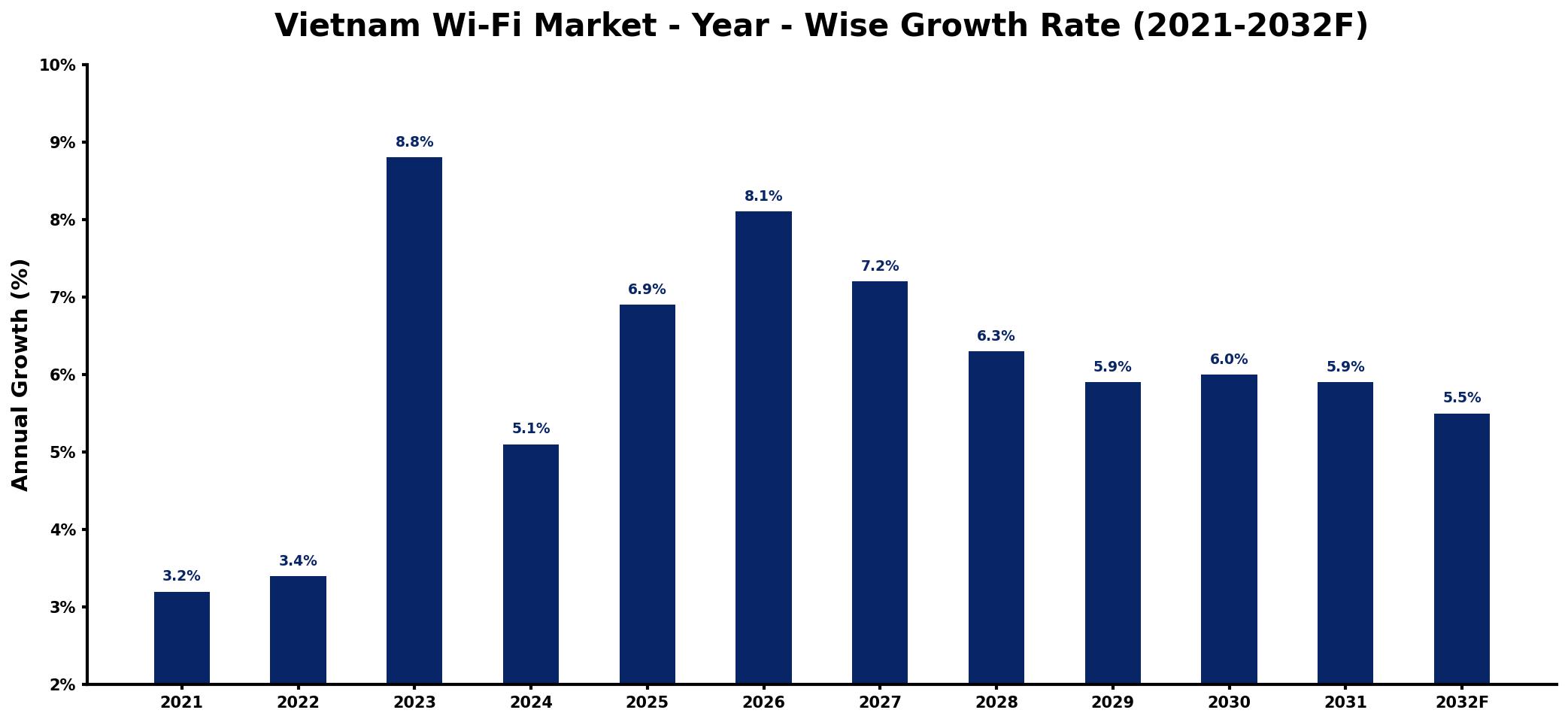
The table below presents the year‑wise growth rates along with the key drivers influencing the market
| Year | Growth Rate | Major Drivers |
| 2021 | 3.2% | Rising consumer internet adoption |
| 2022 | 3.4% | Growth in smart device usage |
| 2023 | 8.8% | Expansion of e-commerce platforms |
| 2024 | 5.1% | Increased remote work opportunities |
| 2025 | 6.9% | Development of smart cities initiatives |
| 2026 | 8.1% | Surge in digital entertainment consumption |
| 2027 | 7.2% | Investment in telecommunications infrastructure |
| 2028 | 6.3% | Growth of online education platforms |
| 2029 | 5.9% | Advancement in IoT applications |
| 2030 | 6.0% | Emergence of 5G networks |
| 2031 | 5.9% | Rising demand for cloud services |
| 2032 | 5.5% | Increased focus on cybersecurity solutions |
Note: Market size estimations and growth projections presented in this report are based on 6Wresearch's proprietary forecasting methodology, utilizing the latest available industry data, government publications, and primary research inputs.
Vietnam Wi-Fi Market Synopsis
Recently, the Vietnam Wi-Fi market has witnessed unprecedented momentum, primarily fueled by the increased penetration of connected devices and the surge in demand for high-speed internet access. This momentum is set against a backdrop of ongoing advancements in Wi-Fi technology, promising even greater reliability and performance. Looking forward, the market is poised for substantial growth as key sectors embrace Wi-Fi as an essential utility for both consumers and businesses.
With the hospitality and retail sectors increasingly prioritizing Wi-Fi infrastructure, the demand for enhanced user experiences and data analytics capabilities is becoming a focal point. Government initiatives aimed at expanding public Wi-Fi access further signify a strong commitment to improving connectivity across urban and rural areas, setting a favorable stage for future market expansion.
Vietnam Wi-Fi Market Key Takeaways
- The Vietnam Wi-Fi market is on a growth trajectory, driven by the increasing demand for high-speed connectivity.
- Significant investment in Wi-Fi infrastructure is evident in the hospitality and retail sectors, enhancing customer experiences.
- Government initiatives support the expansion of public Wi-Fi, particularly in urban and tourist locations.
- The focus on robust security measures for public Wi-Fi networks is critical amid rising cyber threats.
- Technological advancements are shaping the capabilities of Wi-Fi networks, paving the way for innovative applications.
Evaluation of Restraints in Vietnam Wi-Fi Market
Despite the promising growth, the Vietnam Wi-Fi market faces specific restraints that may impede its potential. Scalability is a primary concern as networks must evolve to accommodate a rising number of users and connected devices. Additionally, achieving comprehensive coverage in rural regions poses logistical challenges, often requiring significant investments in infrastructure. The urgency for secure public Wi-Fi networks further complicates these dynamics, necessitating ongoing attention to cybersecurity measures as the market continues to expand.
Vietnam Wi-Fi Market Trends
Current trends in the Vietnam Wi-Fi market underscore a shift towards enhanced network capabilities, driven by the adoption of advanced Wi-Fi technologies. The rise of IoT devices is prompting a re-evaluation of traditional Wi-Fi infrastructure to support increased connectivity demands. Additionally, the focus on integrating artificial intelligence and analytics into Wi-Fi solutions is reshaping how businesses approach customer engagement and operational efficiency. Furthermore, the growing emphasis on environmental sustainability is steering investment towards energy-efficient Wi-Fi technologies.
Vietnam Wi-Fi Market Opportunities
There exist numerous growth opportunities within the Vietnam Wi-Fi market, particularly in underserved rural areas where connectivity remains limited. Expanding Wi-Fi services to these regions not only aligns with national development goals but also opens up new markets for service providers. Furthermore, the hospitality sector's drive to enhance guest experiences through reliable Wi-Fi offers potential for innovative solutions, ranging from personalized services to advanced data analytics. Investments in next-generation Wi-Fi standards will also create avenues for enhanced user experiences across various sectors.
Government Initiatives in the Vietnam Wi-Fi Market
The Vietnamese government has actively pursued initiatives aimed at expanding public Wi-Fi access, particularly in urban centers and tourist destinations. These efforts include public-private partnerships designed to improve infrastructure and increase internet penetration. By promoting digital inclusion through broader Wi-Fi access, the government is not only enhancing connectivity but also fostering economic development and supporting the transition to a more digital economy.
Future Insights of the Vietnam Wi-Fi Market
Looking ahead to 2026-2032, the Vietnam Wi-Fi market is anticipated to experience robust expansion fueled by a confluence of technological advancements and increasing consumer expectations. The ongoing digital transformation across various sectors will necessitate more sophisticated and reliable Wi-Fi solutions, paving the way for innovation. As remote work continues to shape professional landscapes, the demand for resilient and high-capacity networks will solidify the importance of Wi-Fi as a foundational infrastructure component in Vietnam's evolving economy.
Vietnam Wi-Fi Market Latest Developments (2025 - 2026)
Recent developments in the Vietnam Wi-Fi market indicate a steady shift towards adopting next-gen Wi-Fi technologies, aimed at improving speed and connectivity. Several companies are exploring partnerships to enhance their service offerings, particularly within the education and retail sectors. Additionally, pilot projects aimed at extending public Wi-Fi coverage have shown promising results, indicating the potential for widespread rollouts in the coming years. Innovations in security protocols are also gaining traction, aimed at safeguarding user data amid growing concerns over cybersecurity.
Vietnam Wi-Fi Market - Key Attractiveness of the Report
- 10 Years of Market Numbers
- Historical Data Starting from 2022 to 2025
- Base Year: 2025
- Forecast Data until 2032
- Key Performance Indicators Impacting the Market
- Major Upcoming Developments and Projects
Key Highlights of the Report:
- Vietnam Wi-Fi Market Outlook
- Market Size of Vietnam Wi-Fi Market, 2025
- Forecast of Vietnam Wi-Fi Market, 2032
- Historical Data and Forecast of Vietnam Wi-Fi Revenues & Volume for the Period 2022-2032F
- Vietnam Wi-Fi Market Trend Evolution
- Vietnam Wi-Fi Market Drivers and Challenges
- Vietnam Wi-Fi Price Trends
- Vietnam Wi-Fi Porter's Five Forces
- Vietnam Wi-Fi Industry Life Cycle
- Historical Data and Forecast of Vietnam Wi-Fi Market Revenues & Volume By Component for the Period 2022-2032F
- Historical Data and Forecast of Vietnam Wi-Fi Market Revenues & Volume By Hardware for the Period 2022-2032F
- Historical Data and Forecast of Vietnam Wi-Fi Market Revenues & Volume By Solutions for the Period 2022-2032F
- Historical Data and Forecast of Vietnam Wi-Fi Market Revenues & Volume By Services for the Period 2022-2032F
- Historical Data and Forecast of Vietnam Wi-Fi Market Revenues & Volume By Density for the Period 2022-2032F
- Historical Data and Forecast of Vietnam Wi-Fi Market Revenues & Volume By High-density Wi-Fi for the Period 2022-2032F
- Historical Data and Forecast of Vietnam Wi-Fi Market Revenues & Volume By Enterprise-class Wi-Fi for the Period 2022-2032F
- Historical Data and Forecast of Vietnam Wi-Fi Market Revenues & Volume By Location Type for the Period 2022-2032F
- Historical Data and Forecast of Vietnam Wi-Fi Market Revenues & Volume By Indoor for the Period 2022-2032F
- Historical Data and Forecast of Vietnam Wi-Fi Market Revenues & Volume By Outdoor for the Period 2022-2032F
- Historical Data and Forecast of Vietnam Wi-Fi Market Revenues & Volume By Organization Size for the Period 2022-2032F
- Historical Data and Forecast of Vietnam Wi-Fi Market Revenues & Volume By Large Enterprises for the Period 2022-2032F
- Historical Data and Forecast of Vietnam Wi-Fi Market Revenues & Volume By SMEs for the Period 2022-2032F
- Historical Data and Forecast of Vietnam Wi-Fi Market Revenues & Volume By Vertical for the Period 2022-2032F
- Historical Data and Forecast of Vietnam Wi-Fi Market Revenues & Volume By Education for the Period 2022-2032F
- Historical Data and Forecast of Vietnam Wi-Fi Market Revenues & Volume By Healthcare and Life Sciences for the Period 2022-2032F
- Historical Data and Forecast of Vietnam Wi-Fi Market Revenues & Volume By Transportation and Logistics for the Period 2022-2032F
- Historical Data and Forecast of Vietnam Wi-Fi Market Revenues & Volume By Retail and Ecommerce for the Period 2022-2032F
- Historical Data and Forecast of Vietnam Wi-Fi Market Revenues & Volume By Government for the Period 2022-2032F
- Historical Data and Forecast of Vietnam Wi-Fi Market Revenues & Volume By Manufacturing for the Period 2022-2032F
- Historical Data and Forecast of Vietnam Wi-Fi Market Revenues & Volume By Hospitality for the Period 2022-2032F
- Historical Data and Forecast of Vietnam Wi-Fi Market Revenues & Volume By Other Verticals (BFSI, oil and gas, utilities, IT and telecom, and sports and leisure) for the Period 2022-2032F
- Vietnam Wi-Fi Import Export Trade Statistics
- Market Opportunity Assessment By Component
- Market Opportunity Assessment By Density
- Market Opportunity Assessment By Location Type
- Market Opportunity Assessment By Organization Size
- Market Opportunity Assessment By Vertical
- Vietnam Wi-Fi Top Companies Market Share
- Vietnam Wi-Fi Competitive Benchmarking By Technical and Operational Parameters
- Vietnam Wi-Fi Company Profiles
- Vietnam Wi-Fi Key Strategic Recommendations






































