India Beer Market Size & Growth Rate
According to 6Wresearch internal database and industry insights, the India Beer Market was valued at USD 4.25 Billion in 2025 and is projected to reach USD 7.67 Billion by 2032, growing at a CAGR of approximately 8.8% during 2026–2032.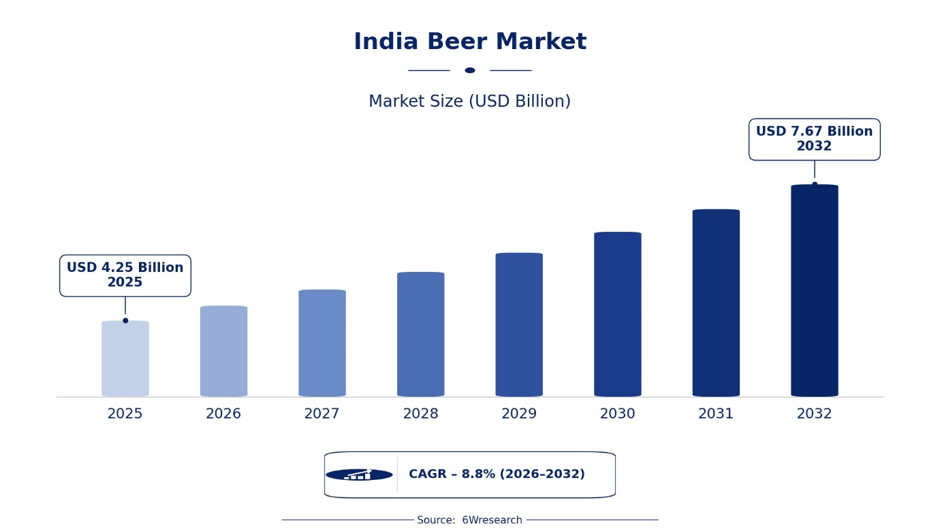 India Beer Market Highlights
| Report Metric | Details |
| Report Name | India Beer Market (2026-2032) |
| Market Size 2025 | USD 4.25 Billion |
| Market Size 2032 | USD 7.67 Billion |
| Absolute Growth 2025–2032 | USD 3.42 Billion |
| CAGR 2026–2032 | 8.8% |
| Peak Annual Growth | 9.9% in 2028 |
| Forecast Period | 2026–2032 |
| Historical Data | 2022–2025 |
| Base Year | 2025 |
| Leading Type, 2025 | Lager (58% share) |
| Leading Category, 2025 | Popular Price (52% share) |
| Leading Packaging, 2025 | Glass (71% share) |
| Leading Production, 2025 | Macro-brewery (86% share) |
| Fastest-Growing Type | Ale (11.2% CAGR) |
| Fastest-Growing Category | Super Premium (13.1% CAGR) |
| Fastest-Growing Packaging | Metal Can (12.5% CAGR) |
| Fastest-Growing Production | Craft Brewery (14.2% CAGR) |
| Growing Sector | Hospitality and on-trade venues |
| Key End Users | Bars, pubs and brewpubs; restaurants and hotels; retail consumers through liquor stores and state beverage corporations; event and festival organisers |
India Beer Market Year-wise Growth Rate and Key Drivers (2022–2032)
This graph illustrates the annual growth rates of the market from 2022 to 2032, highlighting gradual market development in the historical period and stronger expansion during the forecast period.
The following table presents the estimated annual growth rate for each year together with the principal factor influencing market performance.
| Year | Estimated Annual Growth (%) | Market Rationale |
| 2022 | 13.8% | Reopening of bars, restaurants and events after pandemic restrictions eased lifted on-trade volumes sharply during 2022. |
| 2023 | 9.4% | Input cost inflation and state price revisions following the Russia-Ukraine war moderated growth as consumers became more price sensitive. |
| 2024 | 7.6% | Dry days during the April to June 2024 general elections interrupted peak-season sales and tempered growth in several states. |
| 2025 | 8.5% | Recovery in on-trade footfall after the 2024 election period and steady summer demand lifted volumes during 2025. |
| 2026 | 9.6% | Higher disposable incomes following the Union Budget 2025 income tax relief are expected to lift discretionary beer spending. |
| 2027 | 8.1% | Growth is expected to normalise after the strong 2026 expansion as a higher base and softer discretionary spending take effect. |
| 2028 | 9.9% | Newly commissioned brewery capacity in under-served states is expected to widen availability and drive the forecast period’s peak growth. |
| 2029 | 8.4% | Intensifying competition and promotional discounting among brewers is expected to compress margins and restrain price-led growth. |
| 2030 | 9.2% | Rising tourism flows and wider distribution in Tier 2 cities are expected to broaden consumption occasions and revive growth. |
| 2031 | 7.9% | Market maturity in metropolitan centres and tighter state controls on retail outlet density are expected to slow expansion. |
| 2032 | 8.5% | A larger cohort of legal-age drinkers entering the market and stable policy conditions are expected to support a modest recovery. |
India Beer Market Synopsis
The India Beer Market comprises the production, packaging and sale of lager, ale, stout, malt and other brewed beers through retail outlets, bars, restaurants and brewpubs across the country. Growth is supported by a young consumer base, rising incomes, expanding hospitality venues in cities such as Bengaluru and Pune, and the presence of global brewers through Heineken’s stake in United Breweries. However, state-level excise and pricing controls and high input costs for glass and barley continue to restrict margins and uniform national expansion.
Market Dynamics Impact Analysis (2026–2032)
| Factor | Type | Impact | Primary Segment Affected |
| Expanding urban consumer base | Driver | High | Premium |
| Growth of brewpubs and on-trade venues | Driver | High | Micro-brewery |
| Adoption of canned and lightweight packaging | Opportunity | High | Metal Can |
| Distribution expansion into Tier 2 and Tier 3 cities | Opportunity | Medium | Popular Price |
| State-level excise and pricing controls | Restraint | High | Popular Price |
| Restrictions on alcohol advertising | Restraint | Medium | Super Premium |
| Water stress and brewing resource costs | Challenge | Medium | Macro-brewery |
| Summer heat and cold-chain gaps | Challenge | Medium | Lager |
Evaluation of Drivers in India Beer Market (2026–2032)
Below mentioned are some major drivers and their influence on market dynamics.
| Drivers | Primary Segment Affected | Why It Matters (Evidence) |
| Rapid growth of the urban consumer base | Premium | Cities host higher-income households with more frequent social occasions, which raises per capita beer spending. India’s urban population share is about 36% and rising each year. |
| Expansion of on-trade hospitality | Micro-brewery | Brewpubs, bars and restaurants create repeat consumption occasions and introduce new beer styles. Bengaluru alone hosts more than 50 microbreweries, making it a national hub for on-premise beer. |
| Seasonal heat demand | Lager | Beer is consumed as a cooling drink, so long summers lift volumes. Sales concentrate between March and June, when northern and western regions record peak temperatures. |
| Foreign brewer capital and technology | Macro-brewery | Global brewers bring capital, brands and process know-how that raise capacity and quality. Heineken holds roughly 46% of United Breweries, the largest brewer in the country. |
| Low per capita consumption | Popular Price | Low penetration leaves a large unserved base that converts as incomes rise. Annual per capita beer consumption is roughly 2 litres, a small fraction of levels in Europe or China. |
Market growth is supported by a young and expanding consumer base, with more than 1.4 billion people and a median age of about 28 years, which adds new legal-age drinkers every year. Rising household incomes increase discretionary spending on leisure and social occasions, allowing consumers to buy more frequently. Growth in organised retail and modern warehousing improves product freshness and extends availability beyond metropolitan areas. Expanding domestic and international tourism raises consumption at resorts and city destinations, while social media and digital brand engagement are widening awareness of beer brands and drinking occasions among younger adults.
Evaluation of Restraints in India Beer Market
Below mentioned are some major restraints and their influence on market dynamics.
| Market Restraint | Primary Segment Affected | Why It Matters (Evidence) |
| State-level excise and pricing controls | Popular Price | Each state sets duties, maximum retail prices and licences, so brewers face uneven margins and delayed price revisions. Gujarat has prohibited sales since 1960 and Bihar since 2016. |
| High tax burden on beer | Lager | Excise, VAT and related levies raise shelf prices and suppress volumes among price-sensitive buyers. In several states, taxes account for more than half of the retail price. |
| Advertising restrictions | Super Premium | Direct alcohol advertising is barred on television and in print under the Cable Television Networks Rules, which slows brand building and forces reliance on events and music. |
| Preference for spirits | Lager | Whisky is the default social drink, which limits beer’s share of alcohol spending. India is the world’s largest whisky market by volume. |
| Input cost inflation | Glass | Swings in glass, barley, malt and energy costs squeeze margins as price increases need state approval. Global grain and energy prices rose sharply in 2022 after the Russia-Ukraine war. |
India Beer Market Challenges
In terms of challenges, brewing requires roughly 4 to 6 litres of water for every litre of beer, thus plants in water-stressed states such as Rajasthan and Telangana face community scrutiny and rising extraction costs that slow capacity additions. Distribution is equally demanding, as northern summer temperatures above 45°C degrade unrefrigerated stock and push brewers toward costly temperature-controlled trucking. Almost all hops and many specialty malts are imported, which exposes producers to currency swings and freight delays that disrupt input planning. Shelf lives of around six months make slow-moving inventory expensive for distributors serving remote districts, so stock-outs and write-offs occur together.
Trends in the India Beer Market
Below mentioned are some of the trends shaping the India Beer Market growth.
- Shift from Mass Strong Beer to Premium and Craft Experimentation: Consumers in metropolitan cities are moving from high-alcohol mass lagers toward wheat beers, pale ales and flavoured variants. Brewpubs in Bengaluru, Pune and Mumbai, along with brands such as Bira 91, have normalised styles beyond lager. The trend favours suppliers of specialty malt and hops and brewers able to sustain small, frequent batch releases.
- Transition from Returnable Glass to Cans in Modern Retail and Events: Metal cans are gaining ground as they are lighter, chill faster and avoid bottle-return logistics, which suits supermarkets, airports and festivals such as Lollapalooza India. Brewers are adding can-filling lines and sourcing from domestic can makers. The trend benefits aluminium packaging suppliers and brands targeting younger buyers who consume outside the home.
- Tier 2 and Tier 3 Cities Emerging as Growth Centres: Rising incomes and new retail and hospitality formats in cities such as Lucknow, Indore, Coimbatore and Jaipur are widening beer awareness beyond the metros. Brewers are extending distribution networks and local sales teams to these cities, often through state corporation outlets. The trend rewards suppliers with strong depot coverage and affordable, locally priced offerings.
Investment Opportunities in the India Beer Market
Some of the investment opportunities in the India Beer Market are mentioned below.
- Brewery Capacity in Under-Served States: Several large states such as Uttar Pradesh, Madhya Pradesh and Odisha have lower beer availability relative to population, and brewers must produce close to demand to cut freight. Investors can build greenfield or brownfield breweries and bottling lines, entering through state excise licences or contract brewing partnerships with established players.
- Aluminium Can-Filling and Packaging Lines: Rising use of cans in retail and events creates demand for lightweight, recyclable packaging. Investors can set up can-filling and seaming lines, label printing and can-end supply, entering through supply agreements with leading brewers or joint ventures with global can manufacturers that already operate plants in western and southern India.
- Microbreweries and Brewpubs in Metropolitan Cities: Consumer interest in locally brewed styles and experiential venues is growing in Bengaluru, Pune, Mumbai, Gurugram and Hyderabad. Investors can open brewpubs, taprooms and contract-brewing facilities, entering through hospitality joint ventures, licensed premises in high-footfall districts and partnerships with experienced head brewers. Operating costs are lower when brewing and serving on the same premises.
Leading Players in India Beer Market
Stated below are some of the leading companies contributing significantly to the India Beer Market share.
1. United Breweries Limited
| Company Name | United Breweries Limited |
|---|---|
| Established Year | 1915 |
| Headquarters | Bengaluru, India |
| Official Website | Click Here |
United Breweries Limited is a leading Indian brewer and owner of the Kingfisher portfolio. It operates breweries across several states and supplies major retail and on-trade markets.
2. Carlsberg India
| Company Name | Carlsberg India |
|---|---|
| Established Year | 2006 |
| Headquarters | Gurugram, India |
| Official Website | Click Here |
Carlsberg India manufactures and distributes international and local beer brands through breweries serving multiple Indian states. It is a prominent player in the mainstream and strong beer categories.
3. AB InBev India
| Company Name | AB InBev India |
|---|---|
| Established Year | 2000 |
| Headquarters | Gurugram, India |
| Official Website | Click Here |
AB InBev India produces and markets international beer brands such as Budweiser and Corona. It supplies various Indian markets through its brewing operations and distribution partners.
4. B9 Beverages (Bira 91)
| Company Name | B9 Beverages Private Limited |
|---|---|
| Established Year | 2015 |
| Headquarters | New Delhi, India |
| Official Website | - |
B9 Beverages is the Indian company behind the Bira 91 brand. It is recognised for wheat beers, flavoured varieties, and introducing newer beer styles to urban consumers.
5. Mohan Meakin Limited
| Company Name | Mohan Meakin Limited |
|---|---|
| Established Year | 1855 |
| Headquarters | Ghaziabad, India |
| Official Website | Click Here |
Mohan Meakin Limited is a long-established Indian brewer and distiller known for beer brands such as Golden Eagle. It serves regional markets, particularly in northern India.
Government Initiatives in the India Beer Market
Alcohol regulation in India sits within Entry 8 of the State List under the Seventh Schedule of the Constitution, which gives each of the 28 states and 8 Union Territories authority over production, pricing and retail licensing. At the national level, the Food Safety and Standards (Alcoholic Beverages) Regulations, 2018 prescribe quality, labelling and additive standards for beer, and legal drinking ages vary from 18 to 25 years depending on the state.
Implementation rests with state excise departments, which collectively raised roughly INR 2.5 trillion in alcohol revenue in fiscal 2023-24 and grant brewery, brewpub and retail licences. In December 2023, Gujarat permitted liquor service within GIFT City, setting a precedent for regulated consumption zones, while Karnataka and Maharashtra continue to license microbreweries that serve beer produced on the premises.
Future Insight of the India Beer Market
The future outlook of the market seems optimistic owing to large-scale infrastructure build-out across airports, expressways and logistics corridors, which will widen distribution reach and shorten delivery times for brewers. Growing private equity and venture funding into beverage brands will support new product development and faster market entry. Hosting of major sporting and entertainment events will create sustained group-consumption occasions in host cities, while digital excise tracking and licensing reforms in several states will improve supply visibility and encourage investment. India’s national vision of developed-economy status by 2047 and the award of the 2030 Commonwealth Games to Ahmedabad underpin this outlook.
Market Segmentation Analysis
The report offers a comprehensive study of the market across its key segments. The chart below highlights the leading segment by market share in 2025 and the fastest-growing segment by CAGR over 2026–2032, followed by a detailed analysis of each segment.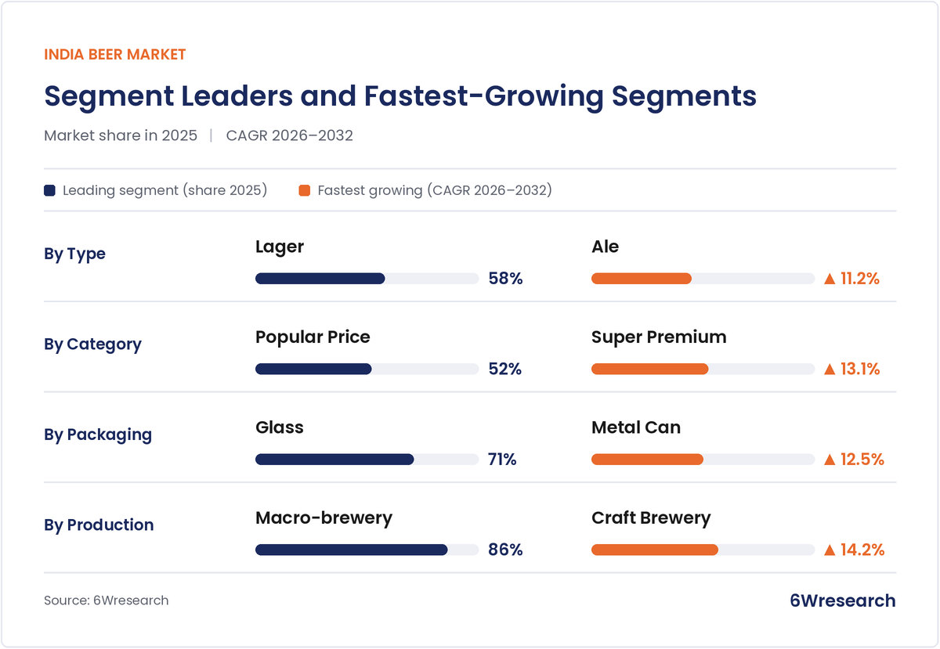
By Type – Lager Leads, Ale Expected to Grow Fastest
According to Ravi Bhandari, Research Head at 6Wresearch, Lager leads the India Beer Market by Type with a 58% share in 2025, supported by affordability, familiar taste and the dominance of mass-market brands across state-run and private retail outlets. Ale is expected to record the fastest growth at a CAGR of 11.2% during 2026–2032, on account of specialty bars and beer festivals that introduce pale and wheat styles to younger urban drinkers.
By Category – Popular Price Leads, Super Premium Expected to Grow Fastest
Popular Price accounts for 52% of 2025 revenue, as most consumers in Tier 2 cities and state-controlled retail outlets buy strong beer at accessible price points. Super Premium is projected to expand at a 13.1% CAGR through 2032, as affluent urban consumers in Mumbai, Delhi NCR and Bengaluru seek imported and high-end domestic labels.
By Packaging – Glass Leads, Metal Can Expected to Grow Fastest
Glass holds a 71% share in 2025 as returnable bottles are embedded in the supply chain, accepted by state retail and cost-efficient for price-led purchases. Metal Can is forecast to rise at a 12.5% CAGR during 2026–2032, supported by modern retail, airport sales and music festivals that favour lightweight, quick-chilling formats.
By Production – Macro-brewery Leads, Craft Brewery Expected to Grow Fastest
Macro-brewery capacity dominates with an 86% share in 2025, since the plants of United Breweries, Carlsberg and AB InBev supply national brands at scale to most states. Craft Brewery output is expected to grow at a 14.2% CAGR through 2032, as independent and contract brewers introduce small-batch styles in Bengaluru, Pune, Mumbai and Delhi NCR.
Key Attractiveness of the Report
- 10 Years of Market Numbers
- Historical Data Starting from 2022 to 2025
- Base Year 2025
- Forecast Data until 2032
- Key Performance Indicators Impacting the Market
- Major Upcoming Developments and Projects
Key Highlights of the Report:
- India Beer Market Outlook
- Market Size of India Beer Market, 2025
- Forecast of India Beer Market, 2032
- Historical Data and Forecast of Beer Revenues & Volume for the Period 2022-2032
- India Beer Market Trend Evolution
- India Beer Market Drivers and Challenges
- Beer Price Trends
- Beer Porter’s Five Forces
- Beer Industry Life Cycle
- Historical Data and Forecast of India Beer Market Revenues & Volume By Type for the Period 2022-2032
- Historical Data and Forecast of India Beer Market Revenues & Volume By Lager for the Period 2022-2032
- Historical Data and Forecast of India Beer Market Revenues & Volume By Ale for the Period 2022-2032
- Historical Data and Forecast of India Beer Market Revenues & Volume By Stout & Porter for the Period 2022-2032
- Historical Data and Forecast of India Beer Market Revenues & Volume By Malt for the Period 2022-2032
- Historical Data and Forecast of India Beer Market Revenues & Volume By Others for the Period 2022-2032
- Historical Data and Forecast of India Beer Market Revenues & Volume By Category for the Period 2022-2032
- Historical Data and Forecast of India Beer Market Revenues & Volume By Popular Price for the Period 2022-2032
- Historical Data and Forecast of India Beer Market Revenues & Volume By Premium for the Period 2022-2032
- Historical Data and Forecast of India Beer Market Revenues & Volume By Super Premium for the Period 2022-2032
- Historical Data and Forecast of India Beer Market Revenues & Volume By Packaging for the Period 2022-2032
- Historical Data and Forecast of India Beer Market Revenues & Volume By Glass for the Period 2022-2032
- Historical Data and Forecast of India Beer Market Revenues & Volume By PET Bottle for the Period 2022-2032
- Historical Data and Forecast of India Beer Market Revenues & Volume By Metal Can for the Period 2022-2032
- Historical Data and Forecast of India Beer Market Revenues & Volume By Others for the Period 2022-2032
- Historical Data and Forecast of India Beer Market Revenues & Volume By Production for the Period 2022-2032
- Historical Data and Forecast of India Beer Market Revenues & Volume By Macro-brewery for the Period 2022-2032
- Historical Data and Forecast of India Beer Market Revenues & Volume By Micro-brewery for the Period 2022-2032
- Historical Data and Forecast of India Beer Market Revenues & Volume By Craft Brewery for the Period 2022-2032
- Historical Data and Forecast of India Beer Market Revenues & Volume By Others for the Period 2022-2032
- Beer Import Export Trade Statistics
- Market Opportunity Assessment By Type
- Market Opportunity Assessment By Category
- Market Opportunity Assessment By Packaging
- Market Opportunity Assessment By Production
- Beer Top Companies Market Share
- Beer Competitive Benchmarking By Technical and Operational Parameters
- Beer Company Profiles
- Beer Key Strategic Recommendations
Market Covered
The report offers an extensive study of the following market segments.
By Type
- Lager
- Ale
- Stout & Porter
- Malt
- Others
By Category
- Popular Price
- Premium
- Super Premium
By Packaging
- Glass
- PET Bottle
- Metal Can
- Others
By Production
- Macro-brewery
- Micro-brewery
- Craft Brewery
- Others































