Japan’s Export Potential Is Set to Reach USD 826.04 Billion by 2031, with USD 22.48 Billion Emerging from New Product Lines Beyond Established Trade Corridors
In 2031, while China constitutes 25.93% (the largest share) of Japan Export Potential across existing trade relationships, Turkey (10.62%) and the United States (5.07%) emerge as the most promising markets for entirely new product lines, signaling that Japan's next wave of growth will come less from deepening old relationships and more from opening new ones.
 Source: 6WExportGTM
New Export Frontiers: Turkey, the U.S. & Mexico
Looking Japan's export strategy for 2031 reflects a two-pronged approach, balancing strength in established markets with targeted expansion into new territories. In existing trade relationships, Japan's export potential reaches USD 803.56 billion, led by China at 25.93% (USD 208.33 billion) and the United States at 20.71% (USD 166.45 billion). Hong Kong, South Korea, and Singapore complete the top five, together confirming Japan's enduring position within core Asia-Pacific and North American supply chains. This concentration highlights the resilience of Japan's long-standing trade infrastructure heading into the next decade.
| Top 5 Current Leading Importers | Export Potential (USD Billion) | Top 5 New Potential Importers for New Product Lines | Export Potential (USD Billion) |
| China | 208.33 | Turkey | 2.39 |
| United States | 166.45 | United States | 1.14 |
| Hong Kong | 51.08 | Mexico | 1.12 |
| South Korea | 49.12 | China | 1.07 |
| Singapore | 29.53 | Brazil | 0.98 |
Source: 6WExportGTM
At the same time, Japan is looking beyond its traditional footprint. Japan's export potential stands at USD 22.48 Billion, with Turkey leading at 10.62% (USD 2.39 billion). The United States, Mexico, China, and Brazil follow, each holding a 4-5% share. While smaller in scale, this diversification reflects Japan's forward-looking approach to identifying growth corridors and reducing reliance on any single regional strategy poised to strengthen its global trade footprint by 2031.
Where the Next Trade Corridors Emerge
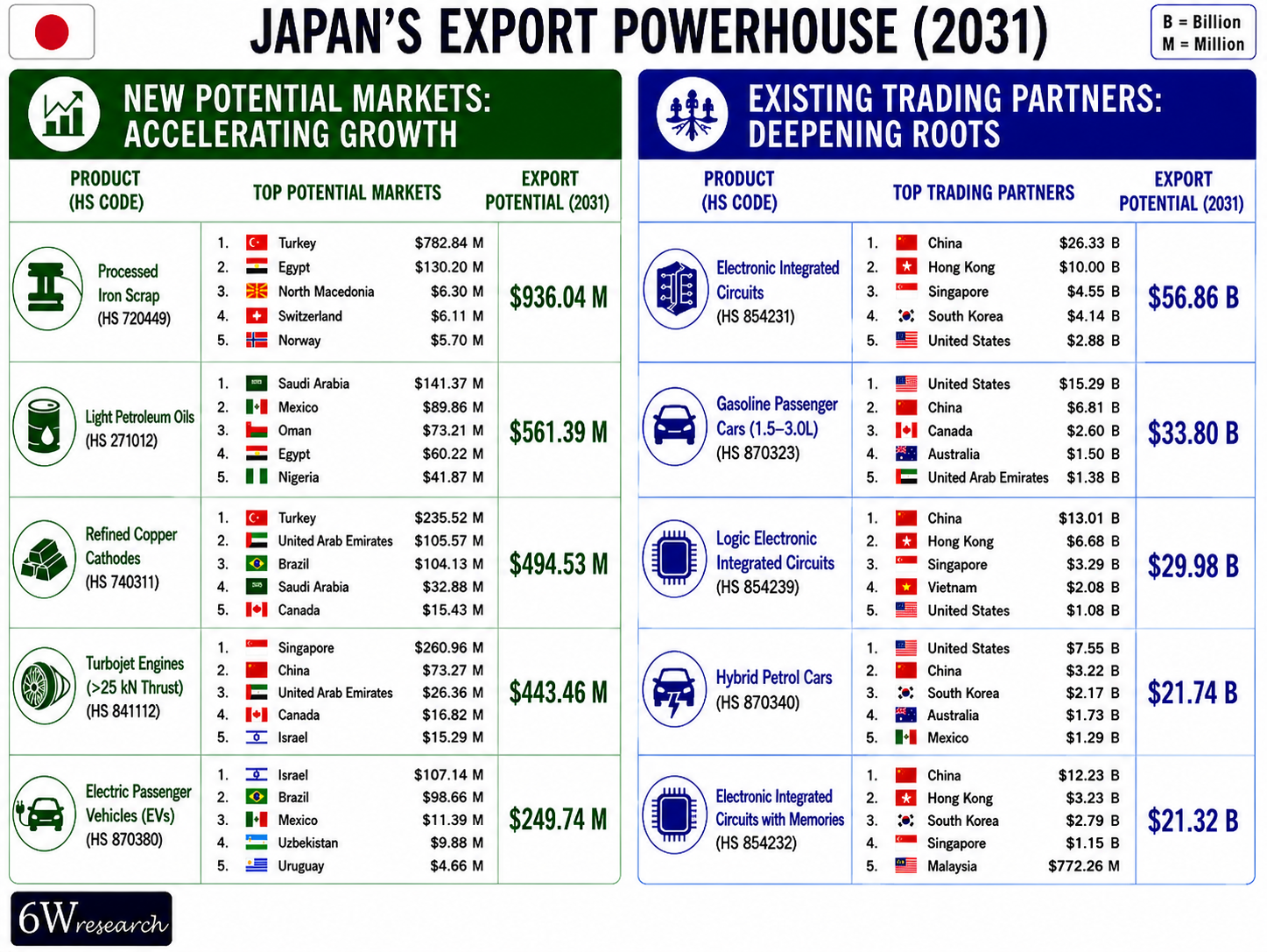
Processed iron scrap, light petroleum oils and turbojet engines lead the way. While Japan currently has minimal trade with these destinations, analysis by 6WExportGTM shows substantial untapped export opportunities emerging by 2031. Products such as processed iron scrap, light petroleum oils, refined copper cathodes, turbojet engines and electric passenger cars highlight sectors where international demand is rising but Japanese exports remain relatively underpenetrated offering a path to diversify Japan's export portfolio and strengthen resilience against concentration risk.
Processed iron scrap represents the largest opportunity, reaching USD 936.0 million by 2031, with the top five markets accounting for USD 931.2 million. Turkey dominates at USD 782.8 million on growing electric-arc-furnace steel production, followed by Egypt (USD 130.2 million), North Macedonia, Switzerland and Norway. Light petroleum oils follow at USD 561.4 million, led by Saudi Arabia (USD 141.4 million), Mexico (USD 89.9 million) and Oman (USD 73.2 million), supported by Japan's advanced refining infrastructure. Refined copper cathodes add USD 494.5 million, led by Turkey (USD 235.5 million), the UAE (USD 105.6 million) and Brazil (USD 104.1 million).
In aerospace, turbojet engines offer USD 443.5 million in potential, led by Singapore (USD 261.0 million) as a leading MRO hub, with further demand from China, the UAE, Canada and Israel. Electric passenger cars round out the top five at USD 249.7 million, led by Israel (USD 107.1 million) and Brazil (USD 98.7 million), as rising EV adoption and supportive policy create early-mover positioning for Japanese manufacturers.
The Core Engine: Semiconductors and Automotive Exports Drive Growth Across Existing Trading Partners
Electronic integrated circuits, gasoline passenger cars and logic integrated circuits represent Japan's highest-value future export potential by 2031, driven by expanding demand across its established global trading partners.
Electronic integrated circuits are Japan's largest existing export opportunity, projected at USD 56.86 billion by 2031, led by China (USD 26.33 billion), Hong Kong (USD 10 billion) as a re-export hub, Singapore (USD 4.55 billion) and South Korea (USD 4.14 billion). Gasoline passenger cars follow at USD 33.80 billion, led by the United States (USD 15.29 billion), China (USD 6.81 billion) and Canada (USD 2.60 billion). Logic integrated circuits add USD 29.98 billion, again led by China (USD 13.01 billion) and Hong Kong (USD 6.68 billion), with Singapore and Vietnam reflecting growing regional assembly activity.
Hybrid petrol cars contribute a further USD 21.74 billion, led by the United States (USD 7.55 billion) on rising demand for fuel-efficient vehicles, while memory integrated circuits close the top five at USD 21.32 billion, led by China (USD 12.23 billion), Hong Kong and South Korea together underscoring how deeply Japan's core export base remains woven into Asia-Pacific and North American electronics and automotive supply chains.
|
Japan's strongest export priorities remain semiconductors and automobiles into China and the United States, supported by growing hybrid-vehicle and integrated-circuit demand across South Korea, Hong Kong and Singapore. 6WExportGTM Analysis |
The Next Priorities for Japan's Export Growth
Japan's export strategy for 2031 cannot rest on historical strength alone it has to be built around three real pressures the country is navigating right now: a semiconductor race it is racing to re-enter, an automotive industry losing ground to Chinese EV makers even as US tariffs squeeze margins, and a structural lack of domestic natural resources that makes energy and raw-material diversification a matter of national necessity, not just export ambition. China and the US together accounting for 46.6% of Japan's existing export potential, and Turkey leading a smaller but strategically important set of new markets these real-world dynamics should shape where Japan focuses next.
Semiconductors: A Comeback Built on Equipment, Not Just Chips
Japan's semiconductor opportunity is real but narrower than it looks. Electronic and logic integrated circuits together represent close to USD 87 billion in existing export potential, concentrated in China, Hong Kong and Singapore. But Japan's actual competitive edge today sits upstream in semiconductor manufacturing and cleaning equipment, where METI's 2023 export controls on 23 categories of advanced chipmaking tools, aligned with US restrictions on China, have made Japan a gatekeeper in the global chip supply chain rather than just a component supplier. The government's pledge of over 10 trillion yen toward semiconductors and AI over the next seven years, anchored by the Rapidus foundry project, signals Japan is betting on rebuilding leading-edge fabrication capacity domestically while protecting its equipment and materials strengths abroad.
|
Japan's ability to control critical points in the semiconductor equipment and materials supply chain gives it durable leverage even as chip manufacturing itself becomes more geographically contested, positioning the country as an indispensable partner rather than a peripheral supplier in the next phase of the global chip race. Manish Pant, Senior Data Scientist, Data Science & Market Intelligence, 6Wresearch |
For exporters, this means the next phase of growth is less about chasing volume in finished chips and more about deepening Japan's role as the supplier that both the US and China-aligned supply chains cannot easily route around.
Automotive: Defending Share While the Ground Shifts
Japan's automotive exports led by gasoline passenger cars and hybrid petrol cars into the United States remain a core pillar, but the industry is under genuine strain. Chinese EV makers have overtaken Japan in global auto sales, capturing dominant EV share in markets like Thailand where Japanese brands once led. Toyota posted its first-ever operating loss in North America amid tariff pressure, even after the US-Japan deal cut Section 232 duties from 27.5% to 15%. A weak yen has offered exporters some cushion, but it isn't a substitute for competitiveness in electrification, where Japanese automakers have leaned on hybrid strength while lagging in battery-electric models.
|
Japan's hybrid technology base gives its automakers a credible bridge strategy while battery-electric capabilities catch up, but sustaining export share will depend on how quickly that transition is matched with investment in software, batteries and cost competitiveness against Chinese rivals. Manisha Gupta, Data Analyst, Data Science & Market Intelligence, 6Wresearch |
The priority here is less about chasing new markets and more about defending existing ones, while watching closely how long the current 15% US tariff rate holds given recurring signals from Washington that it could rise again.
Energy and Resource Security: Turning Geography into Strategy
Japan's lack of domestic natural resources makes energy and critical-mineral diversification a genuine strategic imperative, not just a trade opportunity. This is where the6Wresearch’s analysis highlights light petroleum oils into Saudi Arabia, refined copper cathodes and iron scrap into Turkey connects directly to Japan's broader foreign policy, including its Asia Zero Emission Community and POWERR Asia initiatives aimed at linking the Middle East and Asia around stable, coercion-resistant energy markets. With China having weaponized rare-earth and graphite export controls in recent years, Japan has strong incentive to build redundant supply relationships in metals and energy well beyond its traditional partners, even where individual trade volumes remain modest for now.
Top Global Export Opportunities (2031), By Product
| Product | Export Opportunity (USD Billion) |
| Electronic Integrated Circuits | 685.7 |
| Refined Petroleum Oils | 668.4 |
| Light Petroleum Oils | 588.9 |
| Logic Electronic Integrated Circuits | 507.9 |
| Medicines | 381.2 |
| Gasoline Passenger Cars (1.5–3.0l) | 360.9 |
| Smartphones | 343.6 |
| Electronic Integrated Circuits with Memory | 333.2 |
| Data Transmission Equipment | 216.9 |
| Human Vaccines | 209.6 |
Excludes naturally occurring products (e.g., crude oil, raw gold). Source: 6WExportGTM
Globally, the largest export opportunities beyond naturally occurring products are concentrated in electronics, energy and pharmaceuticals highlighting the growing dominance of semiconductors, advanced manufacturing and high-value technology products in global trade. Japan already sits inside several of these categories, but its real priority through 2031 is defending semiconductor-equipment leadership, stabilizing its auto industry through a difficult transition, and using energy and metals diversification to reduce the geopolitical exposure that comes with a resource-poor, trade-dependent economy.
Japan's Current Trade Anchors
Japan's highest-trading sector is passenger vehicles at USD 106.7 billion, led by gasoline passenger cars in the 1.5–3.0L range (31.8% share) and hybrid petrol cars (26.8% share) reflecting decades of manufacturing excellence and global brand trust in fuel-efficient, reliable vehicles. The second-ranked sector, semiconductors, reaches USD 74.1 billion and is anchored by semiconductor manufacturing machines (25.6% share) and logic electronic integrated circuits (19.16% share), underscoring Japan's technological leadership in the precision equipment critical to global chip fabrication supply chains. Automotive parts round out the top three at USD 43.3 billion, driven by vehicle gearboxes (28.6% share) and petrol engine parts (8.95% share), reinforcing Japan's position as a deeply integrated upstream supplier to the same automotive value chain its finished vehicles dominate downstream.
| Sector | Exports (USD Billion) | Leading Products / Share |
| Passenger Vehicles | 106.7 | Gasoline Passenger Cars, 1.5–3.0L (31.8%); Hybrid Petrol Cars (26.8%) |
| Semiconductors | 74.1 | Semiconductor Manufacturing Machines (25.6%); Logic Electronic Integrated Circuits (19.16%) |
| Automotive Parts | 43.3 | Vehicle Gearboxes (28.6%): Petrol Engine Parts (8.95%) |
Source: UN Comtrade
By trading value, three markets stand out. The United States leads at USD 132.39 billion, led by gasoline passenger cars in the 1.5–3.0L range (10.09% share) and high-capacity petrol cars (6.08% share), reflecting sustained American consumer demand and Japan's established automotive distribution networks. China follows at USD 116.75 billion, led by semiconductor manufacturing machines (8.16% share) and electronic integrated circuits with memory (3.25% share), consistent with China's expanding domestic chip manufacturing base. South Korea ranks third at USD 41.81 billion, led by logic electronic integrated circuits (7.43% share) and semiconductor manufacturing machines (5.97% share), reflecting its own semiconductor industry's reliance on specialized Japanese components.
| Country | Exports (USD Billion) | Leading Products / Share |
| United States | 132.39 | Gasoline Passenger Cars, 1.5–3.0L (10.09%); High-Capacity Petrol Cars (6.08%) |
| China | 116.75 | Semiconductor Manufacturing Machines (8.16%); Electronic Integrated Circuits with Memory (3.25%) |
| South Korea | 41.81 | Logic Electronic Integrated Circuits (7.43%); Semiconductor Manufacturing Machines (5.97%) |
Source: UN Comtrade
Trade Agreements: Japan's Next Export Frontier
Japan's prospective new markets where Japanese exporters currently have little or no established trade present a notably cleaner tariff picture, though regulatory exposure varies sharply by destination. Turkey is the most tariff-friendly, with both processed iron scrap and refined copper cathodes entering duty-free and facing minimal to no trade remedy action, positioning it as a low-friction entry point for metals diversification. Singapore offers the cleanest opportunity in the set: turbojet engines above 25 kN thrust enter at 0% tariff with zero regulatory measures and zero trade remedies, aided by the existing Japan-Singapore Economic Partnership Agreement. Saudi Arabia's light petroleum oils similarly enter duty-free, though the absence of a bilateral FTA means this treatment currently rests on Saudi Arabia's general tariff schedule rather than a locked-in guarantee.
Egypt stands apart as the one market carrying meaningful non-tariff exposure: processed iron scrap enters duty-free but faces 41 regulatory measures, reflecting tighter scrap-metal import controls tied to domestic steel-industry protection. Across all five new-market opportunities, the near-universal 0% tariff environment gives Japanese exporters a genuine head start on diversification but the wide variance in regulatory measures makes market-by-market compliance readiness, not tariff negotiation, the decisive factor in how quickly these corridors convert into real trade through 2031.
| Country | Product | Applied Import Tariff |
| Turkey | Iron Scrap Processed | 0 |
| Singapore | Turbojet Engines (>25 kN Thrust) | 0 |
| Turkey | Refined Copper Cathodes | 0 |
| Saudi Arabia | Light Petroleum Oils | 0 |
| Egypt | Iron Scrap Processed | 0 |
Source: MacMap (ITC)
Beyond Tariffs: The Regulatory Frontier
Japan's core export relationships remain largely duty-free, reinforcing its position as a preferred semiconductor and automotive supplier to China, the United States and Hong Kong. Electronic and memory integrated circuits enter China at 0% tariff treatment rooted in the WTO's Information Technology Agreement rather than a bilateral concession. The real friction lies elsewhere: both product lines face 46 active regulatory measures in China, spanning standards, licensing and customs-compliance requirements that add cost and lead time even where tariffs are zero. Hong Kong offers a cleaner corridor for electronic integrated circuits, also duty-free but with just 2 regulatory measures, underscoring its role as a low-barrier re-export hub.
The United States tells a different story one that has moved fast since late 2025 and just moved again. Gasoline passenger cars and hybrid petrol cars currently carry a 3% applied tariff, sharply improved from the 25% Section 232 duty imposed in March 2025 and later eased to 15% under the US-Japan trade agreement finalized that September. Gasoline passenger cars also carry 41 active trade remedy actions, while hybrid petrol cars carry none a comparatively cleaner compliance path. The U.S. trade environment remains a key consideration for Japanese exporters. On 24 July 2026, Washington replaced its temporary global tariff with a new Section 301 framework, placing Japan in the 12.5% tariff tier alongside 45 other economies. The additional duty generally applies where existing MFN tariffs are below 12.5%, while products already subject to higher duties—such as certain automotive exports under Section 232—are largely unaffected. Japan has expressed disappointment over the decision and continues discussions with the U.S., arguing that its significant investments in American manufacturing and infrastructure should be reflected in more stable market access. As trade negotiations continue, Japanese exporters will need to navigate evolving tariff rules and regulatory requirements to maintain their competitiveness in the U.S. market.
| Country | Product | Applied Import Tariff |
| China | Electronic Integrated Circuits | 0% |
| China | Memory Integrated Circuits | 0% |
| United States | Gasoline Passenger Cars (1.5–3.0L) | 3% |
| United States | Hybrid Petrol Cars | 3% |
| Hong Kong | Electronic Integrated Circuits | 0% |
Source: MacMap (ITC)
The Bottom Line
Japan's next export wave will not be won on tariff advantage alone most of the frictionless doors (Turkey, Singapore, Saudi Arabia) are already open, and most of the mature markets (China, the US, Hong Kong) are now regulatory and geopolitical contests rather than tariff contests. The playbook is threefold: defend semiconductor-equipment leadership while chip manufacturing itself becomes more geographically contested, stabilize automotive share through the EV and tariff transition, and use energy and metals diversification to convert resource dependence into strategic resilience because that is where the next USD 22.48 billion in untapped potential will actually be won.

Leadership Perspectives from Industry Events
Search
Thought Leadership and Analyst Meet





Our Clients








6WResearch In News
- Crude Petroleum (USD 57.7 Billion) and Semiconductor ICs (USD 82.7 Billion) Dominate Malaysia's 2031 Export Potential, While USD 19.8 Billion in New Product Lines Opens New Opportunities
- Japan’s Export Potential Is Set to Reach USD 826.04 Billion by 2031, with USD 22.48 Billion Emerging from New Product Lines Beyond Established Trade Corridors
- Integrated Circuits Anchor South Korea's USD 320.8B Export Potential, While New Product Lines Unlock USD 22.4B Opportunity by 2031
- Thailand's USD 25.5 Billion Logic IC Opportunity Is Just the Beginning: New Product Lines Could Unlock Another USD 17.9 Billion in 2031
- Smartphones Lead India's Exports potential at $94 Billion by 2031 — But $30.1 Billion in Untapped Markets Is the Real Story
- India Air Conditioner Market Set for Strong Rebound in 2026 After Weather-Led Correction and GST-Driven Recovery: 6Wresearch
Latest Reports
- Gabon Citrullinemia Type-1 Market (2026-2032)
- Finland Citrullinemia Type-1 Market (2026-2032)
- Fiji Citrullinemia Type-1 Market (2026-2032)
- Ethiopia Citrullinemia Type-1 Market (2026-2032)
- Estonia Citrullinemia Type-1 Market (2026-2032)
- Eritrea Citrullinemia Type-1 Market (2026-2032)
- Equatorial Guinea Citrullinemia Type-1 Market (2026-2032)
- El Salvador Citrullinemia Type-1 Market (2026-2032)
- Ecuador Citrullinemia Type-1 Market (2026-2032)
- Dominica Citrullinemia Type-1 Market (2026-2032)
Industry Events and Analyst Meet

EV India Expo 2026

HIMTEX 2026

India Refining Summit 2026

India EV Show 2026

EV tech India Expo 2026
Whitepaper
- Middle East & Africa Commercial Security Market Click here to view more.
- Middle East & Africa Fire Safety Systems & Equipment Market Click here to view more.
- GCC Drone Market Click here to view more.
- Middle East Lighting Fixture Market Click here to view more.
- GCC Physical & Perimeter Security Market Click here to view more.


