Crude Petroleum (USD 57.7 Billion) and Semiconductor ICs (USD 82.7 Billion) Dominate Malaysia's 2031 Export Potential, While USD 19.8 Billion in New Product Lines Opens New Opportunities
In 2031, while China (30.56%) and the United States (15.45%) anchor the bulk of Malaysia's existing export potential, the United States (13.10%) and Mexico (10.98%) emerge as the most promising markets for entirely new product lines, signaling that Malaysia Export Potential 2031 will be shaped by diversifying its petroleum, automotive and display exports into new corridors, even as its semiconductor and energy base continues to deepen.
 Source: 6WExportGTM
Emerging Export Opportunities: The United States, Mexico and China
Looking at current product lines through 2031, Malaysia's export potential remains firmly anchored by its existing energy and semiconductor partners, led by China at USD 124.99 billion 30.56% of the total main-category opportunity. The United States follows at USD 63.16 billion (15.45%), with Hong Kong (USD 31.10 billion, 7.60%), Singapore (USD 29.43 billion, 7.20%) and Japan (USD 27.98 billion, 6.84%) rounding out a top five that underscores how much of Malaysia's crude oil and semiconductor trade still rests on a handful of large, established markets. Together these five account for roughly 68% of total main-category potential, and three of them Hong Kong, Singapore and Japan are regional re-export, testing or refining hubs rather than pure end-consumption markets, underscoring just how concentrated Malaysia's current trade remains.
| Top 5 Current Leading Importers | Export Potential (USD Billion) | Top 5 New Potential Importers | Export Potential (USD Billion) |
| China | 124.99 | United States | 2.60 |
| United States | 63.16 | Mexico | 2.18 |
| Hong Kong | 31.10 | China | 1.70 |
| Singapore | 29.43 | India | 1.41 |
| Japan | 27.98 | Israel | 1.24 |
Source: 6WExportGTM
However, Malaysia's growth story is set to diversify through new product lines where Malaysia currently has minimal trade, rather than through its trade relationships as a whole. The United States emerges as the top new-potential market for such products at USD 2.60 billion (13.10%), followed by Mexico (USD 2.18 billion, 10.98%) and China itself (USD 1.70 billion, 8.59%) showing that even existing partners hold room to grow through categories Malaysia has yet to tap. India (USD 1.41 billion, 7.12%) and Israel (USD 1.24 billion, 6.26%) round out the top five, pointing to Malaysia's potential to expand into South Asian and Middle Eastern markets. This top five is notably less concentrated than the current-trade picture accounting for around 46% of total new-potential opportunity versus roughly 68% for existing markets and spans a broader geographic mix, from North America and Latin America to South Asia and the Middle East, signaling genuine market diversification rather than simply deepening existing relationships.
The Next Frontier for Export Growth
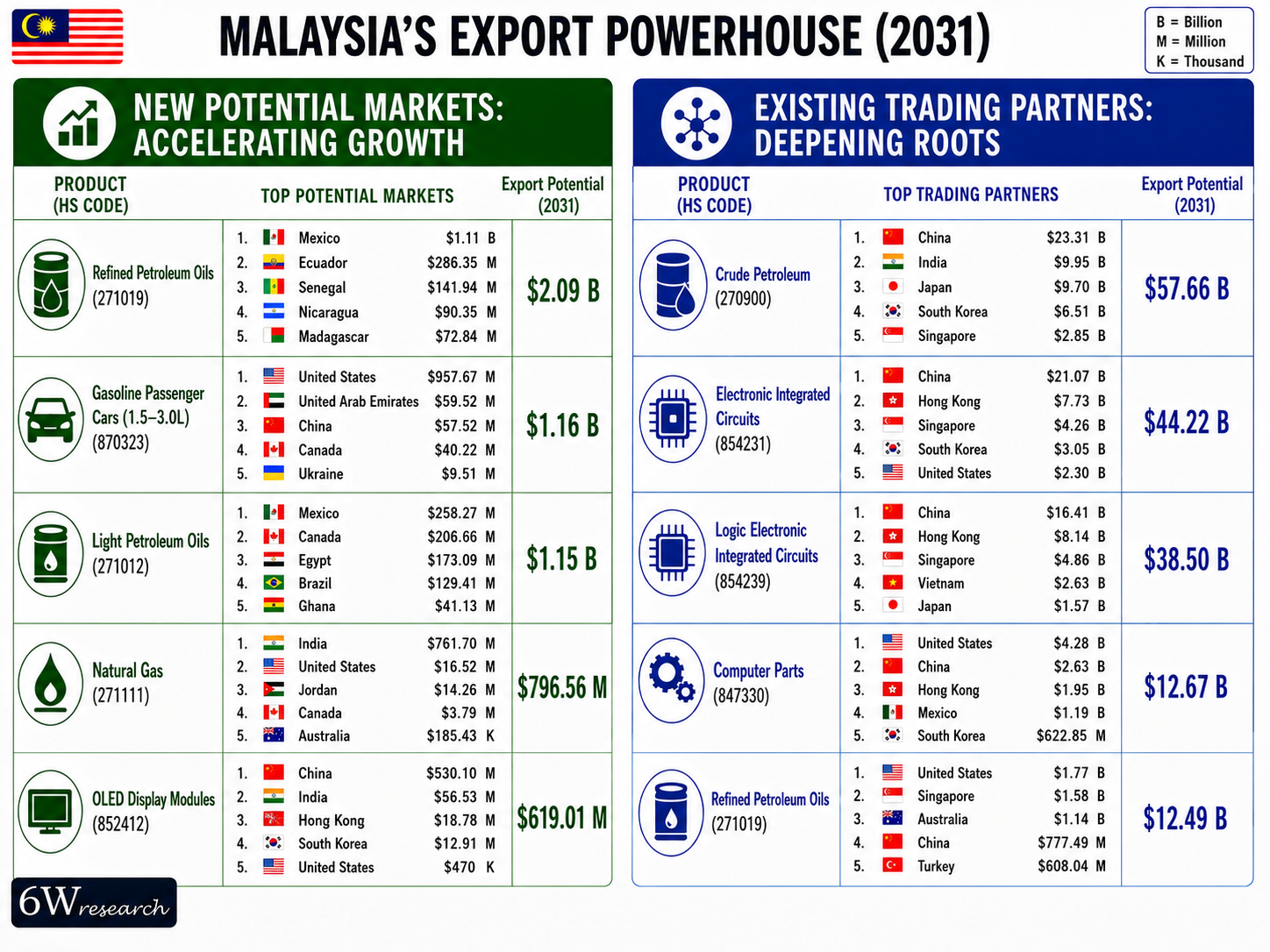
Refined petroleum, gasoline passenger cars and light petroleum oils lead the way. While Malaysia currently has minimal trade with these countries for example, Refined Petroleum Oils with Mexico, or Gasoline Passenger Cars with the United States analysis by 6WExportGTM by 6Wresearch, shows substantial untapped export opportunities projected to emerge by 2031, creating significant scope for market diversification.
Refined Petroleum Oils top the list of emerging opportunities, offering a combined potential of USD 2.09 billion by 2031. Mexico is the standout at USD 1.11 billion, followed by Ecuador (USD 286.35 million), Senegal (USD 141.94 million), Nicaragua (USD 90.35 million) and Madagascar (USD 72.84 million) a spread of Latin American and African markets that signals genuinely new refining-export corridors for Malaysia rather than deeper penetration of existing ones.
Gasoline Passenger Cars (1.5–3.0L) follow, adding USD 1.16 billion in potential the United States alone accounts for USD 957.67 million of it, with the UAE, China, Canada and Ukraine contributing smaller volumes. Light Petroleum Oils add a further USD 1.15 billion, led by Mexico (USD 258.27 million) and Canada (USD 206.66 million); Natural Gas contributes USD 796.56 million, overwhelmingly led by India at USD 761.70 million; and OLED Display Modules add USD 619.01 million, led by China at USD 530.10 million an early signal of Malaysia's growing role in the display and electronic-components supply chain.
Malaysia's Export Powerhouses: Crude Petroleum, Semiconductors and Computer Parts
Crude petroleum, electronic and logic integrated circuits, computer parts and refined petroleum oils represent Malaysia's highest-value future export potential by 2031, reflecting a genuinely dual-engine economy built on both energy exports and its established semiconductor manufacturing base. Projections indicate massive long-term potential, led by China across crude petroleum (USD 23.31B), electronic integrated circuits (USD 21.07B) and logic electronic integrated circuits (USD 16.41B), alongside the United States across computer parts (USD 4.28B), and substantial growth opportunities across Hong Kong, Singapore and India.
Crude Petroleum remains Malaysia's single largest opportunity. Total potential is estimated at USD 57.66 billion by 2031, led by China at USD 23.31 billion, followed by India (USD 9.95 billion), Japan (USD 9.70 billion), South Korea (USD 6.51 billion) and Singapore (USD 2.85 billion) a top five that spans nearly all of Asia's major energy importers. Electronic Integrated Circuits add a further USD 44.22 billion, led again by China (USD 21.07 billion), with Hong Kong (USD 7.73 billion) and Singapore (USD 4.26 billion) reinforcing their role as regional semiconductor re-export and testing hubs.
Logic Electronic Integrated Circuits contribute USD 38.50 billion, led by China (USD 16.41 billion), Hong Kong (USD 8.14 billion) and Singapore (USD 4.86 billion), with Vietnam (USD 2.63 billion) emerging as a notable fourth market. Computer Parts close out the core list at USD 12.67 billion, led by the United States (USD 4.28 billion) and China (USD 2.63 billion), just ahead of Refined Petroleum Oils at USD 12.49 billion, led by the United States (USD 1.77 billion) and Singapore (USD 1.58 billion).
|
Malaysia's strongest export priorities remain crude petroleum and semiconductors into China, supported by growing chip-testing positioning into Hong Kong and Singapore, and a widening computer-parts and refined-fuels footprint across the United States. |
Energy and Semiconductors Drive Malaysia's Export Momentum
Malaysia's export future is being written on two fronts at once. On one side, its position as a top-tier global energy exporter crude petroleum alone accounts for USD 57.66 billion of 2031 potential continues to anchor its trade relationship with China, India, Japan and South Korea. On the other, Penang's decades-old semiconductor back-end manufacturing base is moving up the value chain, evolving from pure assembly and testing toward chip design and advanced packaging, just as global supply chains diversify away from concentration risk in China and Taiwan.
This is not a hypothetical shift it is already underway. In February 2026, Taiwan's Chipbond Technology opened a near-USD 200 million advanced packaging and testing facility in Penang's Batu Kawan industrial park, reinforcing Malaysia's role in the global outsourced semiconductor assembly and test (OSAT) chain. Malaysia already holds roughly 13% of global semiconductor testing and packaging capacity and about 7% of the overall global semiconductor market, with the government's New Industrial Master Plan explicitly targeting a doubling of that share to 14% by 2029. Industry events through 2026 have repeatedly framed the opportunity in the same terms: strong investment momentum, six of the world's twelve largest semiconductor companies already operating locally, and a deliberate push to move beyond assembly into chip design and IC development tempered by a real and openly-acknowledged shortage of skilled engineers needed to execute on it.
|
Malaysia is moving beyond its traditional role in semiconductor assembly and testing. Advanced packaging investments in Penang, combined with the national push into chip design and IC development, are positioning the country as a higher-value semiconductor hub, although closing the skilled-engineer gap will be critical to sustaining this transition. Manish Pant, Senior Data Scientist, Data Science & Market Intelligence, 6Wresearch |
|
With crude petroleum alone worth USD 57.7 billion in 2031 potential, Malaysia doesn't have to choose between energy and electronics the real strategic question is whether it can staff its semiconductor ambitions fast enough to capture the value-chain shift it has already won on investment. Manisha Gupta, Data Analyst, Data Science & Market Intelligence, 6Wresearch |
Malaysia's next wave of export growth will come from treating energy exports and semiconductor value-chain upgrading as parallel, mutually-reinforcing priorities defending its crude petroleum and refined-fuels relationships with China, India and Japan, while investing in the engineering talent pipeline needed to convert Penang's packaging and testing momentum into design-stage, higher-margin semiconductor exports.
Top Global Export Opportunities (2031), By Product
| Product | Export Opportunity (USD Billion) |
| Electronic Integrated Circuits | 685.7 |
| Refined Petroleum Oils | 668.4 |
| Light Petroleum Oils | 588.9 |
| Logic Electronic Integrated Circuits | 507.9 |
| Medicines | 381.2 |
| Gasoline Passenger Cars (1.5–3.0l) | 360.9 |
| Smartphones | 343.6 |
| Electronic Integrated Circuits with Memories | 333.2 |
| Data Transmission Equipment | 216.9 |
| Human Vaccines | 209.6 |
Excludes naturally occurring products (e.g., crude oil, raw gold). Source: 6WExportGTM
Globally, the largest export opportunities beyond naturally occurring products are concentrated in electronics, energy and pharmaceuticals highlighting the growing dominance of semiconductors, advanced manufacturing and high-value technology products in global trade. Japan already sits inside several of these categories, but its real priority through 2031 is defending semiconductor-equipment leadership, stabilizing its auto industry through a difficult transition, and using energy and metals diversification to reduce the geopolitical exposure that comes with a resource-poor, trade-dependent economy.
Malaysia's Current Leading Export Sectors
A handful of established sectors, supported by scaled semiconductor-assembly and energy-production capacity, underpin Malaysia's current trade base. Semiconductors lead at USD 98.05 billion, split out by electronic integrated circuits (40.40% share) and logic electronic integrated circuits (19.95% share). Oil & gas follows at USD 47.81 billion, led by refined petroleum oils (34.96% share) and natural gas (27.81% share), while computers & IT hardware contributes USD 17.05 billion, led by automatic data processing units (32.81% share) and computer peripheral units (19.27% share).
| Sector | Exports (USD Billion) | Leading Products / Share |
| Semiconductors | 98.05 | Electronic Integrated Circuits (40.40%), Logic Electronic Integrated Circuits (19.95%) |
| Oil & Gas | 47.81 | Refined Petroleum Oils (34.96%), Natural Gas (27.81%) |
| Computers & IT Hardware | 17.05 | Automatic Data Processing Units (32.81%), Computer Peripheral Units (19.27%) |
Source: UN Comtrade
By trading value, three markets stand out. Singapore leads at USD 50.44 billion, led by logic electronic integrated circuits (18.92% share) and refined petroleum oils (8.87% share). The United States follows at USD 43.43 billion, led by electronic integrated circuits (11.93% share) and integrated circuit parts (7.30% share). China rounds out the top three at USD 41.01 billion, led by electronic integrated circuits (18.30% share) and natural gas (8.16% share) confirming that Malaysia's three largest trading relationships are all fundamentally semiconductor-and-energy led.
| Country | Exports (USD Billion) | Leading Products / Share |
| Singapore | 50.44 | Logic Electronic Integrated Circuits (18.92%), Refined Petroleum Oils (8.87%) |
| United States | 43.43 | Electronic Integrated Circuits (11.93%), Integrated Circuit Parts (7.30%) |
| China | 41.01 | Electronic Integrated Circuits (18.30%), Natural Gas (8.16%) |
Source: UN Comtrade
Trade Agreements: Malaysia's Next Export Frontier
Tariff and regulatory data across Malaysia's leading new-potential markets show that duty rates are generally modest, but regulatory measure density varies sharply even within the same trading partner. Mexico applies a modest 3.00% tariff on refined petroleum oils (USD 1.11 billion) with a moderate 19 regulatory measures, while its light petroleum oils line (USD 258.27 million) enters entirely duty-free at 0.00% with a lighter load of 16 measures showing that tariff and compliance treatment can differ meaningfully even within the same country and product family.
India applies a 2.50% tariff on liquefied natural gas (USD 761.70 million), already benefiting from a 0.00% preferential rate and carrying the lightest regulatory load of the group at just 4 measures Malaysia's cleanest new-market access by far. China's OLED display modules (USD 530.10 million) face a steeper 8.00% tariff (also with a 0.00% preferential rate available) alongside the heaviest regulatory load in the group at 47 measures, while Egypt applies a 5.00% duty on light petroleum oils (USD 173.09 million) with 29 regulatory measures. None of these five new corridors currently carry an active trade remedy against Malaysia. None of these five new corridors currently carry an active trade remedy against Malaysia. This new-market picture now sits alongside a broader shift in Malaysia's own US tariff exposure: after the IEEPA reciprocal tariff was struck down by the US Supreme Court in February 2026, Washington's Section 301 forced-labour tariff took effect on 24 July 2026 at 10% on nearly all Malaysian exports still Malaysia's lowest tier among the 60 economies affected though a pending Section 232 investigation into semiconductor imports could layer a further, more targeted duty on top
| Country | Product (HS Code) | Applied Tariff | Reg. Measures | Trade Remedy |
| Mexico | Refined Petroleum Oils | 3.00% | 19 | No |
| India | Liquefied Natural Gas | 2.50% | 4 | No |
| China | OLED Display Modules | 8.00% | 47 | No |
| Mexico | Light Petroleum Oils | 0.00% | 16 | No |
| Egypt | Light Petroleum Oils | 5.00% | 29 | No |
Source: MacMap (ITC) / 6WExportGTM
Beyond Tariffs: The Regulatory Frontier
Across Malaysia's five largest established export lines, applied tariffs are uniformly at 0.00% electronic integrated circuits, logic electronic integrated circuits and computer parts all enter China, Hong Kong, the United States and Vietnam duty-free, confirming that tariff cost plays no meaningful role in Malaysia's core chip and computer-hardware trade. What separates these markets instead is regulatory measure density: China applies 46 regulatory measures to both electronic integrated circuits (USD 21.07 billion) and logic electronic integrated circuits (USD 16.41 billion) the heaviest compliance load of any established partner while Vietnam applies 27 measures to its logic electronic integrated circuits trade (USD 2.63 billion).
Hong Kong stands in sharp contrast, applying just 2 regulatory measures to logic electronic integrated circuits (USD 8.14 billion) Malaysia's lowest-friction established corridor by a wide margin. The United States presents the most consequential flag in the data: computer parts and accessories (USD 4.28 billion) enter duty-free with a moderate 18 regulatory measures, but this line currently carries an active trade remedy. As with any anti-dumping, countervailing, or safeguard action, this can restrict market access regardless of the zero tariff, and given the USD 4.28 billion at stake, it warrants direct monitoring. it warrants direct monitoring. That remedy is not an isolated case: the US Department of Commerce issued a preliminary affirmative countervailing-duty determination against Malaysian fatty acids exports on 23 July 2026, and Australia's Anti-Dumping Commission kept duties on Malaysian aluminum extrusions in force through a sunset review effective 3 June 2026 a reminder that trade-remedy exposure against Malaysia is active across multiple partners, not confined to the US chip corridor
| Country | Product (HS Code) | Applied Tariff | Reg. Measures | Trade Remedy |
| China | Electronic Integrated Circuits | 0.00% | 46 | No |
| China | Logic Electronic Integrated Circuits | 0.00% | 46 | No |
| Hong Kong | Logic Electronic Integrated Circuits | 0.00% | 2 | No |
| United States | Computer Parts | 0.00% | 18 | Yes |
| Vietnam | Logic Electronic Integrated Circuits | 0.00% | 27 | No |
Source: MacMap (ITC) / 6WExportGTM
The Bottom Line
Malaysia's next export wave will not be won on tariff advantage alone every one of its five largest established semiconductor and computer-hardware lines already enters China, Hong Kong, the United States and Vietnam duty-free, and even its best new-potential corridor (India, on liquefied natural gas) carries just a 2.50% tariff with a 0.00% preferential rate. The real variables now are regulatory measure density and trade remedies: China applies the heaviest compliance load of any established partner (46 measures on both electronic and logic electronic integrated circuits), Hong Kong remains Malaysia's lowest-friction gateway at just 2 measures, and an active US trade remedy on computer parts and accessories a USD 4.28 billion line deserves direct monitoring regardless of its duty-free status. The playbook is twofold: scale fast where compliance is light and access is open Hong Kong's chip corridor and India's LNG market while building the certification and compliance capacity needed to defend share in heavier-regulated markets like China and Egypt, because that is where the next USD 19.8 billion in untapped potential will actually be won.

Leadership Perspectives from Industry Events
Search
Thought Leadership and Analyst Meet





Our Clients








6WResearch In News
- Crude Petroleum (USD 57.7 Billion) and Semiconductor ICs (USD 82.7 Billion) Dominate Malaysia's 2031 Export Potential, While USD 19.8 Billion in New Product Lines Opens New Opportunities
- Japan’s Export Potential Is Set to Reach USD 826.04 Billion by 2031, with USD 22.48 Billion Emerging from New Product Lines Beyond Established Trade Corridors
- Integrated Circuits Anchor South Korea's USD 320.8B Export Potential, While New Product Lines Unlock USD 22.4B Opportunity by 2031
- Thailand's USD 25.5 Billion Logic IC Opportunity Is Just the Beginning: New Product Lines Could Unlock Another USD 17.9 Billion in 2031
- Smartphones Lead India's Exports potential at $94 Billion by 2031 — But $30.1 Billion in Untapped Markets Is the Real Story
- India Air Conditioner Market Set for Strong Rebound in 2026 After Weather-Led Correction and GST-Driven Recovery: 6Wresearch
Latest Reports
- Gabon Citrullinemia Type-1 Market (2026-2032)
- Finland Citrullinemia Type-1 Market (2026-2032)
- Fiji Citrullinemia Type-1 Market (2026-2032)
- Ethiopia Citrullinemia Type-1 Market (2026-2032)
- Estonia Citrullinemia Type-1 Market (2026-2032)
- Eritrea Citrullinemia Type-1 Market (2026-2032)
- Equatorial Guinea Citrullinemia Type-1 Market (2026-2032)
- El Salvador Citrullinemia Type-1 Market (2026-2032)
- Ecuador Citrullinemia Type-1 Market (2026-2032)
- Dominica Citrullinemia Type-1 Market (2026-2032)
Industry Events and Analyst Meet

EV India Expo 2026

HIMTEX 2026

India Refining Summit 2026

India EV Show 2026

EV tech India Expo 2026
Whitepaper
- Middle East & Africa Commercial Security Market Click here to view more.
- Middle East & Africa Fire Safety Systems & Equipment Market Click here to view more.
- GCC Drone Market Click here to view more.
- Middle East Lighting Fixture Market Click here to view more.
- GCC Physical & Perimeter Security Market Click here to view more.


