Mauritius's Prepared Tuna Exports to Existing Partners Could Reach USD 114.83 Million, While Electronic Integrated Circuits Open USD 514.66 Million Across New Markets by 2031
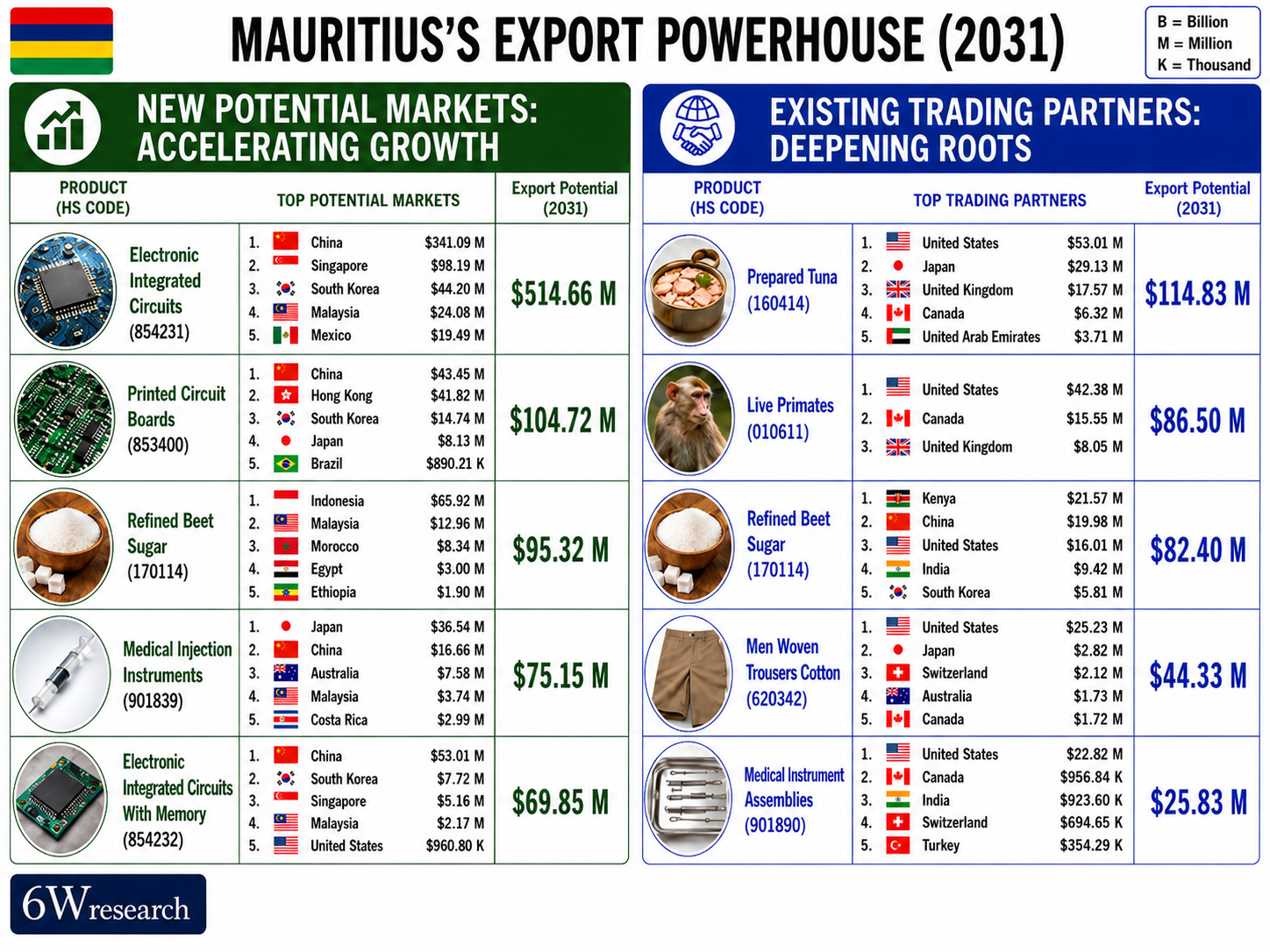
Mauritius export potential underscores a shift toward new-corridor opportunities, with emerging markets worth USD 1.85 billion, more than twice the established export base of USD 792 million. Electronics particularly integrated circuits, printed circuit boards, and memory chips account for nearly USD 690 million, led by China, Singapore, and Hong Kong. The United States leads established trade at 41.04%, while China leads new-corridor potential at 32.03%. Given Mauritius’s limited semiconductor manufacturing base, much of this electronics value likely reflects its role as a global business and financial hub, while its core productive exports remain centered on tuna processing, apparel, and sugar refining.
Source: 6WExportGTM
China Leads a New-Corridor Category Nearly Triple the Size of Mauritius's Established Export Base
China leads Mauritius's new potential importers at USD 593.43 million, well ahead of the United States at USD 195.75 million. Japan ranks third at USD 127.67 million, followed by South Korea at USD 118.67 million and Singapore at USD 115.69 million. As with the product-level breakdown, the scale of this list relative to established trade is worth treating cautiously: several of these buyer relationships are anchored by electronics categories where Mauritius has no manufacturing footprint, suggesting the underlying activity is trade and financial intermediation rather than a genuinely new export capability taking shape.
| Top 5 Existing Leading Importers | Export Potential (USD Million) | Top 5 New Potential Importers | Export Potential (USD Million) |
| United States | 324.96 | China | 593.43 |
| Japan | 70.95 | United States | 195.75 |
| China | 52.57 | Japan | 127.67 |
| Canada | 39.92 | South Korea | 118.67 |
| Zimbabwe | 39.35 | Singapore | 115.69 |
Source: 6WExportGTM
The United States accounts for USD 324.96 million of Mauritius's established export potential, more than four times Japan's USD 70.95 million in second place. China, Canada and Zimbabwe round out the top five at USD 52.57 million, USD 39.92 million and USD 39.35 million. This spread reflects genuine American demand for Mauritian tuna, apparel and primates, with Japan drawing primarily on seafood, and Zimbabwe's presence reflecting Mauritius's role as a regional trade and re-export point into Southern Africa.
Electronics Dominate the New-Corridor List, Most Likely Reflecting Trade Intermediation Rather Than Manufacturing
Electronic integrated circuits stand out as Mauritius’s largest new-corridor opportunity at USD 514.66 million, led by China at USD 341.09 million and Singapore at USD 69.19 million, with additional contributions from South Korea, Malaysia, and Mexico. Given Mauritius’s limited semiconductor manufacturing base, this opportunity is more closely linked to the country’s established role as a global business, financial-services, and trade-facilitation hub, supporting cross-border transactions and value flows through Mauritian-registered entities.
Printed circuit boards and electronic integrated circuits with memory add a further USD 104.72 million and USD 69.85 million, both again led by China, Hong Kong and South Korea, consistent with the same trade-intermediation pattern. Refined beet sugar into new markets contributes USD 95.32 million, led by Indonesia at USD 65.92 million and Malaysia at USD 12.96 million this category, unlike the electronics figures, extends a genuine established Mauritian industry into new Southeast Asian buyers.
Medical injection instruments round out the new-corridor top five at USD 75.15 million, led by Japan at USD 35.94 million and China at USD 16.66 million, followed by Australia, Malaysia and Costa Rica a plausible extension of Mauritius's established medical-device assembly capability. Overall, roughly USD 690 million of Mauritius's USD 1.85 billion new-corridor total sits in electronics categories that likely reflect financial and trade-services activity, while sugar and medical devices represent smaller but more genuinely production-linked opportunities.
Tuna, Primates and Sugar Define Mauritius's Established Export Base
Prepared tuna represents Mauritius's largest established export opportunity at USD 114.83 million, led by the United States at USD 53.01 million and Japan at USD 29.13 million, followed by the United Kingdom, Canada and the UAE. This reflects Mauritius's status as one of the world's largest tuna-processing hubs, anchored by Princes Tuna Mauritius and Thon des Mascareignes, with the island accounting for a meaningful share of the European Union's canned-tuna imports from the Indian Ocean.
Live primates add a further USD 86.50 million, led overwhelmingly by the United States at USD 62.88 million, with Canada and the United Kingdom providing smaller volumes. Mauritius has become the world's leading supplier of long-tailed macaques for biomedical research, a position it inherited after China redirected its own supply toward domestic use during the pandemic and a 2022 smuggling scandal collapsed Cambodian exports to the United States making this a genuine, if commercially and ethically distinctive, export category rather than an anomaly in the data.
Refined beet sugar, men's woven cotton trousers and medical instrument assemblies complete the established top five. Refined beet sugar contributes USD 82.40 million, led by Kenya at USD 21.67 million and China at USD 19.98 million, followed by the United States, India and South Korea. Men's woven cotton trousers add USD 44.33 million, led by the United States at USD 25.33 million, reflecting Mauritius's established garment-manufacturing base. Medical instrument assemblies contribute USD 25.83 million, led almost entirely by the United States at USD 22.82 million. Collectively, these five categories confirm that Mauritius's established export advantage rests on genuine, if individually modest, strengths in seafood processing, primate breeding, sugar refining and apparel manufacturing.
|
Mauritius’s export profile combines a strong base of established industries with emerging opportunities in higher-value sectors. Tuna processing, sugar refining and apparel manufacturing remain core pillars of the country’s productive export base, while the growing prominence of electronics in new-corridor trade highlights potential for Mauritius to expand its role in technology-linked value chains. Its established business-services ecosystem, Freeport infrastructure and connectivity between Asian and African markets could support future growth in electronic trading, distribution, assembly and other value-added activities. 6WExportGTM Analysis |
Top Global Export Opportunities (2031), By Product
| Product | Export Opportunity (USD Billion) |
| Electronic Integrated Circuits | 685.7 |
| Refined Petroleum Oils | 668.4 |
| Light Petroleum Oils | 588.9 |
| Logic Electronic Integrated Circuits | 507.9 |
| Medicines | 381.2 |
| Gasoline Passenger Cars (1.5–3.0L) | 360.9 |
| Smartphones | 343.6 |
| Electronic Integrated Circuits with Memory | 333.2 |
| Data Transmission Equipment | 216.9 |
| Immunological Products | 209.6 |
Excludes naturally occurring products (e.g., crude oil, raw gold). Source: 6WExportGTM
The global export opportunity landscape is increasingly concentrated in electronics, refined energy products, pharmaceuticals, automotive products, and advanced communication equipment. For Mauritania, these high-potential categories point to longer-term opportunities to diversify beyond traditional commodity exports by developing downstream processing capabilities, strengthening industrial value chains, and improving integration with higher-value international markets.
What Mauritius Already Sells and Where
Seafood and fisheries form Mauritius's largest established trade sector at USD 365.83 million, led by prepared tuna at 67.53% share, followed by fresh aquatic species at14.85% share. Apparel ranks second at USD 294.46 million, with men's woven cotton trousers contributing 26.05% share, while cotton knit t-shirts add 16.69%. Sugar follows at USD 220.68 million, led by refined sugars with no added flavors at 54.63% share, with other raw cane sugar adding 23.14% together confirming that Mauritius's genuine manufacturing base rests on three long-established pillars: tuna processing, garment assembly and sugar refining.
| Sector | Exports (USD Million) | Leading Products / Share |
| Seafood & Fisheries | 365.83 | Prepared Tuna (67.53%), Fresh Aquatic Species (14.85%) |
| Apparel | 294.46 | Men Woven Trousers Cotton (26.05%), Cotton Knit T-Shirts (16.69%) |
| Sugar | 220.68 | Refined Sugars, No Added Flavors (54.63%), Other Raw Cane Sugar (23.14%) |
Source: 6WExportGTM
France is Mauritius's largest destination market at USD 235.85 million, led by other medical, surgical and dental instruments at 10.11% of exports to the country and gold waste at 8.60% the latter most likely reflecting jewelry-refining or precious-metals recycling trade rather than domestic gold production. South Africa ranks second at USD 198.84 million, with men's woven cotton trousers contributing 27.50% and cotton knit t-shirts 12.96%, a genuinely apparel-driven regional relationship. Madagascar follows at USD 176.29 million, supported by knitted fabric dyed polyamide at 22.97% and refined sugars at 17.10%, reflecting Mauritius's role as a textile-input and sugar-trading partner for its Indian Ocean neighbor.
| Country | Exports (USD Million) | Leading Products / Share |
| France | 235.85 | Other Medical, Surgical & Dental Instruments (10.11%), Gold Waste (8.60%) |
| South Africa | 198.84 | Men Woven Trousers Cotton (27.50%), Cotton Knit T-Shirts (12.96%) |
| Madagascar | 176.29 | Knitted Fabric Dyed Polyamide (22.97%), Refined Sugars (17.10%) |
Source: 6WExportGTM
A Tuna Hub's Enduring Scale and a Primate-Trade Supply Shift: Two Developments Shaping Mauritius's Export Base
Two structural strengths underpin Mauritius’s established export profile: its long-standing role as a major global tuna-processing hub, and its growing importance in supplying research primates to the United States, reflecting the country’s specialized position within selected international supply chains.
Mauritius's Tuna-Processing Hub Continues to Anchor Its Established Export Base
Mauritius’s prepared-tuna export strength is supported by a mature and internationally integrated processing industry. Princes Tuna Mauritius, created through the merger of Mauritius Tuna Fishing and Canning Enterprises with Thon des Mascareignes, operates advanced facilities producing canned tuna, pouched products and tuna loins for major European and American canners. The country’s broader Seafood Hub spans fishing, transshipment, cold storage, canning and fishmeal production, supported by more than a dozen companies and substantial cumulative investment. With the seafood sector currently generating USD 365.83 million in exports and prepared tuna offering USD 114.83 million in export potential by 2031, Mauritius is well positioned to deepen its role as a key Indian Ocean seafood-processing and export hub serving markets such as the United States, Japan and the United Kingdom.
|
Mauritius's tuna sector is the clearest example in this report of a genuine, decades-deep industrial capability a processing hub built on real infrastructure and international buyer relationships, not a category likely to be explained away by trade intermediation. Manish Pant, Senior Data Scientist, Data Science & Market Intelligence, 6Wresearch |
A Global Supply-Chain Shift Has Made Mauritius the Dominant Source of US Research Primates
Mauritius's live-primate export position has been reshaped by a significant realignment in the global supply of long-tailed macaques for biomedical research. China, once the world's leading supplier, stopped exporting the animals during the pandemic in order to redirect them toward its own growing biomedical industry, while Cambodia which had stepped in to fill much of the gap saw its exports to the United States collapse to nearly zero after 2022 smuggling and mislabeling charges against several individuals in the trade. That combination of events has left Mauritius, alongside smaller suppliers such as Vietnam and Indonesia, as the dominant source of research-grade macaques for American and European laboratories, with breeding companies including Bioculture and Noveprim supplying an animal that researchers value for its consistent health status. For an established live-primates category’s export potential worth USD 86.50 million and led almost entirely by the United States, this supply realignment is a structural, multi-year shift in global sourcing patterns rather than a temporary spike, though it remains subject to ongoing scrutiny from animal-welfare organizations that could affect future demand or regulatory treatment.
|
Mauritius's position as the leading US supplier of research primates is a genuine consequence of supply disruptions in China and Cambodia rather than a deliberate Mauritian strategy, which means the category's durability depends partly on decisions made well outside the island's control. Manisha Gupta, Data Analyst, Data Science & Market Intelligence, 6Wresearch |
The Takeaway
Mauritius should focus strategic attention on its three genuine established industries tuna processing, apparel manufacturing and sugar refining while treating the large electronics figures dominating new-corridor trade as a signal to investigate rather than a manufacturing opportunity to pursue. The path forward depends on deepening the seafood hub's value-added processing capacity and monitoring the primate-export category's exposure to shifting international sourcing and regulatory dynamics.
Key strategic priorities for Mauritius include:
- Continue to invest in value added tuna processing rather than raw loins export: The prepared tuna has an export potential of USD 114.83 million by 2031, accelerated by Mauritius current seafood exports of USD 365.83 million. Expansion of pouch and ready-to-eat processing capacity could help the country to capture greater value from its established tuna-processing base and strengthen margins relative to lower-value loin exports to third-country canners. Expanding pouch and ready-to-eat processing capacity could help the country capture greater value from its established tuna-processing base and strengthen margins compared with lower-value loin exports to third-country canners.
- Examine the durability of the primate-export relationship given its external drivers: Live primates can generate USD 86.50 million in established potential by 2031, almost entirely tied to US demand that shifted to Mauritius after supply disruptions in China and Cambodia. Mauritius should track both international regulatory developments and any signs of supply recovery elsewhere that could affect this category's stability.
- Build on genuine new-corridor wins in sugar and medical devices: Refined beet sugar and medical injection instruments together add more than USD 170 million in new-corridor potential across Indonesia, Malaysia, Japan and China both plausible extensions of Mauritius's real production base. These, not the electronics figures, represent the most credible near-term diversification opportunities.
Overall, Mauritius's genuine export growth through 2031 will most likely come from deepening its established tuna-processing, apparel and sugar industries, and cautiously monitoring its primate-export position, rather than from the electronics-trading figures that dominate this report's raw new-corridor numbers but do not reflect activity taking place within Mauritius's own economy.

Leadership Perspectives from Industry Events
Search
6Wresearch in the News
 Forbes
Citing 6Wresearch analytics to map global infrastructure and pharmaceutical industry trajectories.
 Bloomberg Law
Direct syndication of 6Wresearch's macro data points, capturing complex supply chain shifts.
 Reuters
Tracking industrial manufacturing adjustments and electronic security ecosystem scaling.
 Mint
Mint
Utilizing deep-tech sector market sizing to analyze global automation and robotics.
 The Economic Times
Anchoring features on industrial IoT growth metrics and connected smart-grid devices.
 Business Standard
Featuring strategic evaluations of Advanced Driver Assistance Systems (ADAS) and AI road safety.
 The Hindu
Spotlighting core commercial metrics ranging from unmanned aerial vehicles (UAVs) to consumer durables.
 Financial Express
Anchoring quarterly reviews on cross-border real estate tech and structural hardware manufacturing.
 Yahoo Finance
Syndicating the tracker's $30.1 billion untapped-market findings, spotlighting Japan, the US and China as India's top new-potential importers.
 India Today
Carrying the release on smartphones leading India's export potential to $94 billion by 2031, per 6WExportGTM data.
 Dailyhunt
Distributing the tracker findings to its regional readership, framing India's export diversification into Japan and Mexico.
 PR Newswire Original release
Publishing the full India Export Attractiveness Tracker 2026, detailing new trade corridors across iron ore, LCVs and pharmaceuticals.
 The Industrial
Highlighting the tracker's read on India's semiconductor ambitions and long-term chip-assembly export potential.
 PTI News
Reporting on the $66.81 billion pharmaceuticals export opportunity flagged in the tracker, amid looming US generic-drug tariffs.
 Tribune India
Covering the tracker's tariff-versus-regulation analysis across India's mature export markets in the US, China and UAE.
 ANI News
Amplifying the report's findings on polished diamonds, refined petroleum and medicines as India's core export engines.
 International Business Magazine
Covering the report's insight into how AEB, blind spot detection, and driver monitoring are reshaping India's ADAS market.
 Focus Gaming News
Highlighting the research forecast for Egypt's gambling market, projecting steady growth through 2032.
Thought Leadership and Analyst Meet





Our Clients








Latest Reports
- Namibia Financial Asset Management Market (2026-2032)
- Mozambique Financial Asset Management Market (2026-2032)
- Montenegro Financial Asset Management Market (2026-2032)
- Mongolia Financial Asset Management Market (2026-2032)
- Monaco Financial Asset Management Market (2026-2032)
- Micronesia Financial Asset Management Market (2026-2032)
- Mauritius Financial Asset Management Market (2026-2032)
- Mauritania Financial Asset Management Market (2026-2032)
- Marshall Islands Financial Asset Management Market (2026-2032)
- Malta Financial Asset Management Market (2026-2032)
Industry Events and Analyst Meet

EV India Expo 2026

HIMTEX 2026

India Refining Summit 2026

India EV Show 2026

EV tech India Expo 2026
Whitepaper
- Middle East & Africa Commercial Security Market Click here to view more.
- Middle East & Africa Fire Safety Systems & Equipment Market Click here to view more.
- GCC Drone Market Click here to view more.
- Middle East Lighting Fixture Market Click here to view more.
- GCC Physical & Perimeter Security Market Click here to view more.


