Albania's Chromium Ore Exports to Existing Partners Could Reach USD 543.26 Million, While Small Electric Motors Open USD 158.47 Million Across New Markets by 2031
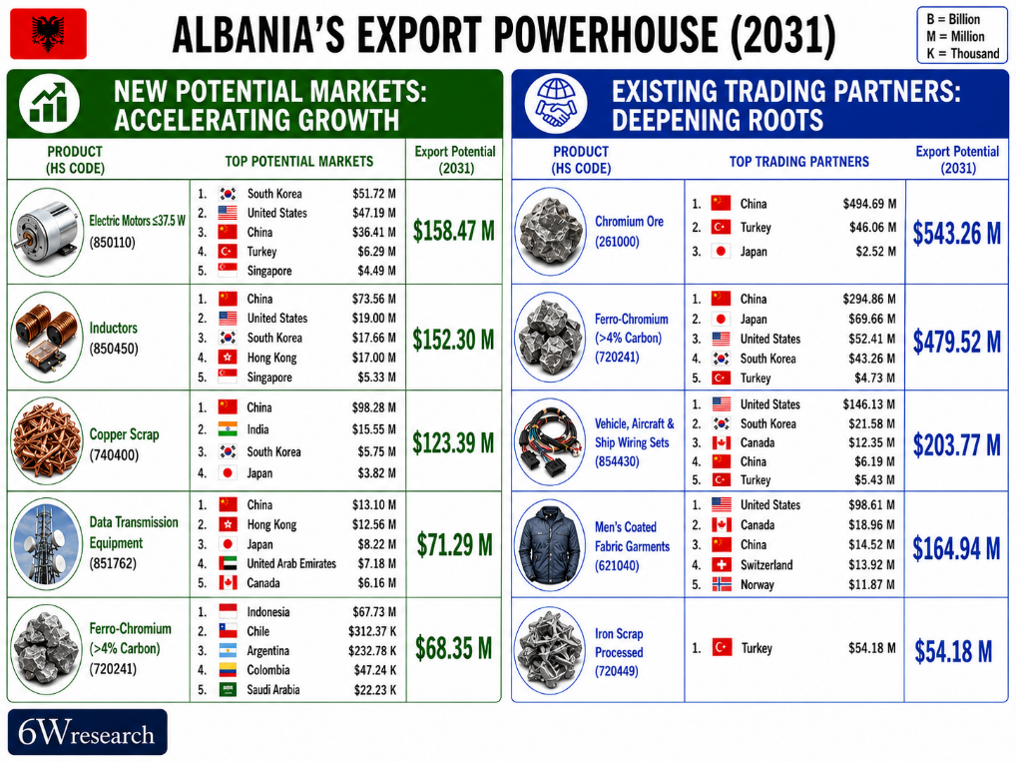
China and the United States remain closely matched as Albania’s leading trade partners across both categories. In established trade, China represents 34.83% of projected export potential in 2031, marginally higher than the United States at 33.20%. Both countries also dominate untapped export potential, accounting for 24.65% and 20.98%, respectively. Chromium ore and ferrochrome dominate Albania's established export portfolio, reflecting its position as home to one of Europe's largest chromium reserves, while iron scrap, apparel and wiring sets round out a base still closely tied to Italian and American contract-manufacturing relationships. Small electric motors, inductors and copper scrap headline a more fragmented new potential market opportunity, with China and the United States again setting the pace.
 Source: 6WExportGTM
China and the United States Emerge as Key Drivers of Albania’s Established and New Export Opportunities in 2031
China opens new opportunities for Albania export potential, with estimated potential of USD 533.81 million, followed closely by the United States at USD 454.25 million. Together these two markets represent the highest share of opportunity among the top five potential importers and emphasize their importance to the future export diversification of Albania. South Korea has the next potential opportunity of USD 133.14 million, followed by Indonesia and India with USD 116.21 million and USD 99.65 million opportunities, respectively. The presence of three major Asian markets indicates considerable scope for Albania to expand its export footprint beyond its traditional European trading relationships.
| Top 5 Existing Leading Importers | Export Potential (USD Million) | Top 5 New Potential Importers | Export Potential (USD Million) |
| China | 971.85 | China | 533.81 |
| United States | 926.38 | United States | 454.25 |
| Japan | 151.14 | South Korea | 133.14 |
| Turkey | 143.84 | Indonesia | 116.21 |
| South Korea | 109.79 | India | 99.65 |
Source: 6WExportGTM
China holds USD 971.85 million of Albania's established export potential, with the United States close behind at USD 926.38 million together the two account for more than two-thirds of the entire established total. Japan and Turkey follow at USD 151.14 million and USD 143.84 million, with South Korea rounding out the top five at USD 109.79 million. This spread reflects Chinese demand for chromium ore and ferrochrome running alongside American demand for wiring sets and garments, with Japan, Turkey and South Korea absorbing smaller, more specialized volumes across the same metals and manufacturing categories.
Small Electronics and Metal Scrap Drive Albania’s Diversified New Export Opportunities Across Emerging Markets
Small electric motors rated at 37.5 watts or below represent Albania's largest new-corridor opportunity at USD 158.47 million, led by South Korea at USD 51.72 million and the United States at USD 47.19 million, followed by China, Turkey and Singapore. Inductors add a further USD 152.30 million, led by China at USD 73.56 million, with the United States, South Korea and Hong Kong providing smaller volumes both categories consistent with Albania's growing role in electronics-component assembly and sub-supply for larger regional manufacturing chains rather than a wholly new industrial capability.
Copper scrap and data transmission equipment contribute USD 123.39 million and USD 71.29 million. Copper scrap is led overwhelmingly by China at USD 98.28 million, with India, South Korea and Japan, reflecting metal-recycling and scrap-aggregation activity rather than primary copper production. Data transmission equipment is more evenly split among China at USD 13.10 million, Hong Kong at USD 12.56 million followed by Japan, UAE and Canada, pointing to a modest but genuine electronics re-export and assembly trade.
Ferro-chromium directed at new destinations rounds out the new-corridor top five at USD 68.35 million, led almost entirely by Indonesia at USD 67.73 million, with Chile, Argentina, Colombia and Saudi Arabia contributing only marginal volumes. This is essentially the same ferrochrome production that anchors Albania's established trade finding a large, concentrated new outlet in Indonesia's stainless-steel industry. Overall, Albania's 2031 new market potential blends genuine electronics sub-assembly growth with an extension of its existing chromium-processing base into new Asian buyers.
Chromium, Ferrochrome and Wiring Sets Anchor Albania's Established Export Base
Chromium ore represents Albania's largest established export opportunity at USD 543.26 million, sold almost entirely to China at USD 494.69 million, followed by Turkey and Japan. This extreme buyer concentration reflects Albania's position as home to one of Europe's largest chromium deposits, feeding China's dominant global stainless-steel and specialty-alloy production base.
Ferro-chromium and vehicle, aircraft and ship wiring sets add a further USD 479.52 million and USD 203.77 million. Ferro-chromium is led again by China at USD 294.86 million, followed by Japan, the United States and South Korea, reflecting Albania's value-added processing of its own chromium ore into higher-value alloy inputs. Vehicle, aircraft and ship wiring sets are led by the United States at USD 146.13 million, followed by South Korea, Canada and China, consistent with Albania's role supplying wiring-harness components into automotive and aerospace assembly chains headquartered elsewhere.
Men’s coated fabric garments and processed iron scrap complete Albania’s established top five export opportunities. Men’s coated fabric garments contribute USD 164.94 million, led by the United States at USD 98.61 million, followed by Canada, China, Switzerland and Norway. Processed iron scrap adds USD 54.18 million, with Turkey accounting for the entire identified potential. Collectively, the top five products show that Albania’s established export advantage is anchored in chromium mining and ferrochrome processing, contract-based manufacturing in wiring sets and garments, and metal recycling, with demand concentrated across China, the United States, Japan and Turkey.
|
6WExportGTM indicates that Albania’s 2031 export potential will continue to be driven by chromium, ferrochrome, wiring sets, apparel and iron scrap, while new opportunities emerge in small electrical components, copper scrap and data transmission equipment. China and the United States are expected to remain the dominant destination markets across both established and emerging trade, with South Korea, Indonesia and India gaining importance. This points to a gradual shift toward broader, higher-value and more diversified export opportunities. 6WExportGTM Analysis |
Top Global Export Opportunities (2031), By Product
| Product | Export Opportunity (USD Billion) |
| Electronic Integrated Circuits | 685.7 |
| Refined Petroleum Oils | 668.4 |
| Light Petroleum Oils | 588.9 |
| Logic Electronic Integrated Circuits | 507.9 |
| Medicines | 381.2 |
| Gasoline Passenger Cars (1.5–3.0L) | 360.9 |
| Smartphones | 343.6 |
| Electronic Integrated Circuits with Memory | 333.2 |
| Data Transmission Equipment | 216.9 |
| Immunological Products | 209.6 |
Excludes naturally occurring products (e.g., crude oil, raw gold). Source: 6WExportGTM
Algeria’s global opportunity landscape shows strong potential in downstream petroleum products, supported by the country’s existing hydrocarbon and refining base. Refined petroleum oils and light petroleum oils, with global export opportunities of USD 668.4 billion and USD 588.9 billion, respectively, are the most relevant near-term opportunities. While electronics, pharmaceuticals and automotive products offer substantial global potential, Algeria’s most realistic pathway lies in expanding value addition within hydrocarbons while gradually building capabilities in higher-value manufacturing sectors.
What Albania Already Sells and Where
Apparel forms Albania's largest established trade sector at USD 485.23 million, led by men's woven cotton trousers at USD 57.85 million and an 11.92% share, followed by men's woven synthetic trousers at USD 49.71 million and a 10.24% share. Footwear ranks second at USD 423.26 million, with footwear uppers contributing USD 188.20 million and a 44.46% share, while footwear parts add USD 66.92 million and 15.81%. Iron and steel follow at USD 175.15 million, led by twisted steel bars at USD 89.65 million and a 51.18% share, with ferro-chromium adding USD 66.32 million and 37.87% together confirming Albania's manufacturing base spans contract apparel and footwear production alongside genuine metals processing.
| Sector | Exports (USD Million) | Leading Products / Share |
| Apparel | 485.23 | Men Woven Trousers Cotton (11.92%), Men Woven Trousers Synthetic (10.24%) |
| Footwear | 423.26 | Footwear Uppers (44.46%), Footwear Parts (15.81%) |
| Iron & Steel | 175.15 | Twisted Steel Bars (51.18%), Ferro-Chromium >4% Carbon (37.87%) |
Source: UN Comtrade
Italy is Albania's largest destination market by a wide margin at USD 1.74 billion, led by a broad category of miscellaneous trade goods at 30.07% of exports to the country and footwear uppers at 10.70%. Serbia ranks second at USD 485.24 million, with miscellaneous trade goods contributing 18.91% and twisted steel bars 18.47%. Greece follows at USD 251.79 million, supported by miscellaneous trade goods at 32.80% and men's coated fabric garments at 13.26%. This partner mix confirms Italy's outsized role as Albania's dominant trading partner across contract manufacturing, with Serbia and Greece providing smaller, more specialized regional demand in steel and apparel respectively.
| Country | Exports (USD Million) | Leading Products / Share |
| Italy | 1,748.22 | Miscellaneous Trade Goods (30.07%), Footwear Uppers (10.70%) |
| Serbia | 485.24 | Miscellaneous Trade Goods (18.91%), Twisted Steel Bars (18.47%) |
| Greece | 251.79 | Miscellaneous Trade Goods (32.80%), Men's Coated Fabric Garments (13.26%) |
Source: UN Comtrade
A Chromium Reserve's Strategic Rise and a Garment Sector Under Pressure: Two Developments Shaping Albania's Export Base
Two developments are shaping Albania’s export outlook: growing European strategic interest in the country’s chromium reserves, supported by the broader Western Balkans critical-minerals agenda, is strengthening Albania’s established chromium and ferrochrome base. At the same time, a multi-year contraction in Albania’s textile, footwear and leather sector is creating headwinds for apparel and footwear exports, limiting the momentum of these traditionally important manufacturing categories.
Albania's Chromium Reserves Gain Strategic Weight as Europe Looks to the Western Balkans
Albania's chromium export position is being reinforced by growing recognition of the Bulqizë district's strategic importance to European industry. AlbChrome, majority-owned by Turkey's Yildirim Group since 2022, operates the Bulqizë mine one of Europe's largest chromium reserves at roughly 2.82 million tons grading over 45% chromium alongside ferrochrome smelting plants in Burrel and Elbasan with combined capacity of 72,000 tons a year. Regional analysts have increasingly framed Albania's chromium processing as a candidate pillar for a Western Balkans critical raw materials hub that could reduce Europe's reliance on chromium imports for stainless steel, specialty alloys and defense manufacturing. In a further, unrelated but notable development, researchers confirmed in 2024 that a substantial natural hydrogen reservoir sits beneath the Bulqizë mine, with an estimated 200 or more tons of hydrogen escaping annually one of the largest such flows recorded anywhere, and a potential future clean-energy asset layered on top of the mine's existing chromium value. For an established chromium and ferrochrome export opportunity worth more than USD 1.02 billion combined, this growing strategic profile supports the case that Albania's metals sector has room to attract further European investment beyond its current China-dominated buyer base.
|
Albania's chromium sector benefits from a genuinely strategic asset one of Europe's largest reserves of a metal the continent needs for its own steel and defense industries and the Western Balkans critical-minerals conversation could open a more diversified buyer base than the China-heavy one Albania relies on today. Manish Pant, Senior Data Scientist, Data Science & Market Intelligence, 6Wresearch |
Albania's Textile, Footwear and Leather Sector Faces a Genuine Multi-Year Contraction
Albania's apparel and footwear export position is working through real and sustained pressure rather than steady growth. The country's textile, clothing, leather and footwear sector generated approximately USD 4.29 billion in exports in 2024, down from USD 4.68 billion in 2023 and USD 4.74 billion in 2022, with textile and footwear exports falling 17% and leather-goods exports falling 23% year over year. Industry associations have described contract-manufacturing companies as facing deepening financial strain amid currency fluctuations and softer European demand, prompting the government to include a substantial budget allocation to support the garment sector in its revised 2026 budget. PROEKSPORT ALBANIA, representing more than 700 export-oriented factories employing over 65,000 workers and accounting for roughly 32% of Albania's manufactured exports, has continued pushing for digital-transformation and Industry 4.0 support to help members remain competitive as contract volumes soften. For an established footwear-and-apparel base, exports worth more than USD 900 million combined, this contraction is a real headwind that government support measures are only beginning to address.
The Takeaway
Albania should treat its two established pillars very differently: chromium and ferrochrome represent a genuinely strategic, appreciating asset worth deeper European engagement, while apparel, footwear and leather manufacturing need active stabilization support to work through a real multi-year contraction before any new growth strategy can be built on top of them. The path forward depends on using chromium's rising strategic profile to diversify beyond China while giving contract manufacturers the support needed to remain competitive.
Key strategic priorities for Albania include:
- Leverage chromium's strategic profile to diversify beyond a China-dominated buyer base: With chromium ore and ferrochrome together worth more than USD 1.02 billion in established export potential and chromium ore alone 91% dependent on China, Albania should use growing European interest in Western Balkans critical minerals to attract EU-linked stainless-steel and defense-sector buyers as a genuine second market.
- Stabilize the textile, footwear and leather sector before pursuing new growth targets: With sector exports down from USD 4.74 billion in 2022 to USD 4.29 billion in 2024, and leather-goods exports falling 23% in a single year, Albania's revised 2026 budget support for the garment sector should focus on currency-risk management and working-capital access for the more than 700 factories PROEKSPORT ALBANIA represents.
- Build on the Indonesia ferrochrome relationship as a genuine new-corridor win: New-market ferro-chromium exports to Indonesia already total USD 67.73 million, almost the entire new-corridor category. Albania should pursue formal, longer-term supply arrangements with Indonesian stainless-steel producers rather than treating this as an incidental trade flow.
- Support electronics sub-assembly as a modest but genuine diversification path: Small electric motors and inductors together generate more than USD 310 million in new-corridor potential, spread across South Korea, the United States, China and Hong Kong. Albania should continue supporting this electronics-component niche as a complement to, not a replacement for, its metals and contract-manufacturing base.
Overall, Albania's export growth through 2031 will depend on managing two very different stories at once: converting chromium's rising strategic value into a more diversified buyer base, while giving its apparel, footwear and leather manufacturers the stabilization support needed to recover from a genuine multi-year contraction.

Leadership Perspectives from Industry Events
Search
6Wresearch in the News
 Forbes
Citing 6Wresearch analytics to map global infrastructure and pharmaceutical industry trajectories.
 Bloomberg Law
Direct syndication of 6Wresearch's macro data points, capturing complex supply chain shifts.
 Reuters
Tracking industrial manufacturing adjustments and electronic security ecosystem scaling.
 Mint
Mint
Utilizing deep-tech sector market sizing to analyze global automation and robotics.
 The Economic Times
Anchoring features on industrial IoT growth metrics and connected smart-grid devices.
 Business Standard
Featuring strategic evaluations of Advanced Driver Assistance Systems (ADAS) and AI road safety.
 The Hindu
Spotlighting core commercial metrics ranging from unmanned aerial vehicles (UAVs) to consumer durables.
 Financial Express
Anchoring quarterly reviews on cross-border real estate tech and structural hardware manufacturing.
 Yahoo Finance
Syndicating the tracker's $30.1 billion untapped-market findings, spotlighting Japan, the US and China as India's top new-potential importers.
 India Today
Carrying the release on smartphones leading India's export potential to $94 billion by 2031, per 6WExportGTM data.
 Dailyhunt
Distributing the tracker findings to its regional readership, framing India's export diversification into Japan and Mexico.
 PR Newswire Original release
Publishing the full India Export Attractiveness Tracker 2026, detailing new trade corridors across iron ore, LCVs and pharmaceuticals.
 The Industrial
Highlighting the tracker's read on India's semiconductor ambitions and long-term chip-assembly export potential.
 PTI News
Reporting on the $66.81 billion pharmaceuticals export opportunity flagged in the tracker, amid looming US generic-drug tariffs.
 Tribune India
Covering the tracker's tariff-versus-regulation analysis across India's mature export markets in the US, China and UAE.
 ANI News
Amplifying the report's findings on polished diamonds, refined petroleum and medicines as India's core export engines.
 International Business Magazine
Covering the report's insight into how AEB, blind spot detection, and driver monitoring are reshaping India's ADAS market.
 Focus Gaming News
Highlighting the research forecast for Egypt's gambling market, projecting steady growth through 2032.
Thought Leadership and Analyst Meet





Our Clients








Latest Reports
- Namibia Financial Asset Management Market (2026-2032)
- Mozambique Financial Asset Management Market (2026-2032)
- Montenegro Financial Asset Management Market (2026-2032)
- Mongolia Financial Asset Management Market (2026-2032)
- Monaco Financial Asset Management Market (2026-2032)
- Micronesia Financial Asset Management Market (2026-2032)
- Mauritius Financial Asset Management Market (2026-2032)
- Mauritania Financial Asset Management Market (2026-2032)
- Marshall Islands Financial Asset Management Market (2026-2032)
- Malta Financial Asset Management Market (2026-2032)
Industry Events and Analyst Meet

EV India Expo 2026

HIMTEX 2026

India Refining Summit 2026

India EV Show 2026

EV tech India Expo 2026
Whitepaper
- Middle East & Africa Commercial Security Market Click here to view more.
- Middle East & Africa Fire Safety Systems & Equipment Market Click here to view more.
- GCC Drone Market Click here to view more.
- Middle East Lighting Fixture Market Click here to view more.
- GCC Physical & Perimeter Security Market Click here to view more.


