Gambia's Zirconium Ore Exports to Existing Partners Could Reach USD 43.12 Million, While Fish Meal Opens USD 24.02 Million Across New Markets by 2031
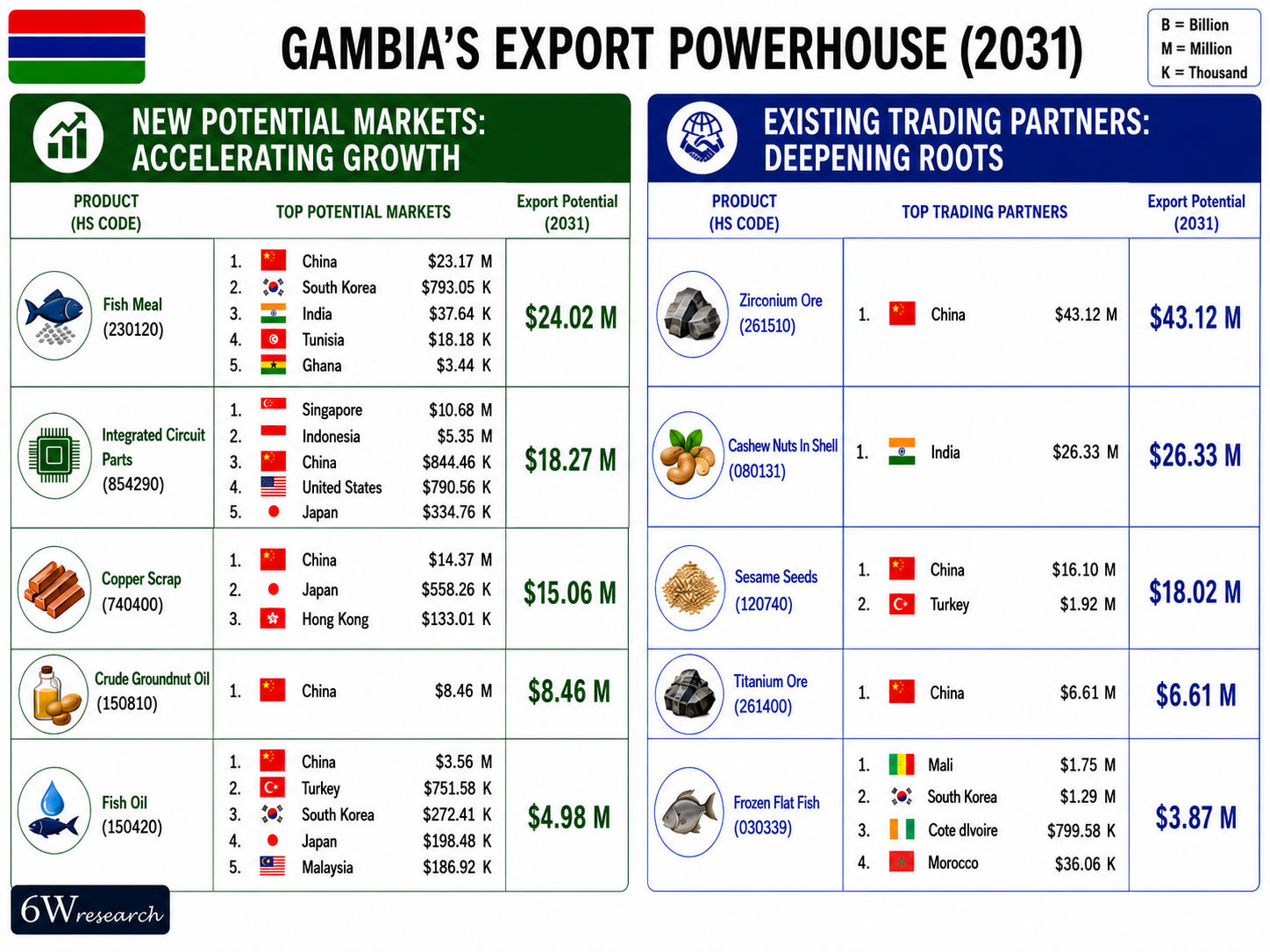
China is considered to be the largest export opportunity for Gambia until 2031. It accounts for 60.96% of established market potential and 57.91% of new potential markets. India continues to be the second largest established destination, while the US and Singapore emerging as the prominent new trade corridors. Zirconium ore, cashew nuts, and sesame seeds are the mainstays of the Gambia’s export potential, whereas fish meal, integrated circuit parts, and copper scrap providing opportunities for diversification and longer-term trade growth.
 Source: 6WExportGTM
China Consolidates Export Leadership for Gambia, as United States and Singapore Gain Momentum in New Potential Markets
Gambia’s new export corridors are led by China with USD 60.66 million in potential, followed by the United States (USD 13.37 million) and Singapore (USD 13.24 million). Indonesia and Canada add opportunities at USD 5.39 million and USD 2.61 million, respectively. The mix spans fish meal, integrated circuit parts, copper scrap and agricultural processing products, indicating that Gambia’s next phase of export diversification could combine established commodity flows with re-export and trading opportunities linked to Asian and North American demand through 2031.
| Top 5 Existing Importers | Export Potential (USD Million) | Top 5 New Potential Importers | Export Potential (USD Million) |
| China | 67.95 | China | 60.66 |
| India | 30.64 | United States | 13.37 |
| Turkey | 4.92 | Singapore | 13.24 |
| South Korea | 3.21 | Indonesia | 5.39 |
| Mali | 1.75 | Canada | 2.61 |
Source: 6WExportGTM
China accounts for USD 67.95 million of Gambia’s established export potential, well ahead of India at USD 30.64 million. Turkey ranks third at USD 4.92 million, with South Korea and Mali contributing USD 3.21 million and USD 1.75 million, respectively. This concentration reflects a trade structure anchored in mineral ores, cashew nuts and sesame seeds, with China dominating zirconium, titanium and sesame opportunities, India providing the principal destination for cashew nuts in shell, and Mali anchoring part of frozen flat fish demand. The resulting partner mix gives Gambia clear anchor markets but also leaves room for broader destination diversification.
Gambia Strengthens Export Diversification Through New Potential Markets
Fish meal represents Gambia's largest new-corridor opportunity at USD 24.02 million, led overwhelmingly by China at USD 23.17 million. South Korea contributes USD 0.79 million, while India, Tunisia and Ghana account for smaller opportunities. The concentration around China underscores the importance of Asian demand for marine feed ingredients and positions fisheries processing as a central component of Gambia’s new-market opportunity set, alongside the country’s established exports of frozen fish and other marine products.
Integrated circuit parts and copper scrap represent additional high-potential trade opportunities, contributing USD 18.27 million and USD 15.06 million, respectively. Integrated circuit parts are led by Singapore at USD 10.68 million and Indonesia at USD 5.35 million, followed by China, the United States and Japan. Given Gambia’s economic structure, this corridor is better viewed as a trading and re-export opportunity than as evidence of domestic semiconductor manufacturing. Copper scrap is concentrated in China at USD 14.37 million, with Japan and Hong Kong providing smaller secondary destinations. Together, these categories expand the opportunity set beyond Gambia’s traditional agricultural and fisheries base.
Crude groundnut oil and fish oil complete the new-corridor top five. Crude groundnut oil represents an export opportunity of USD 8.46 million, entirely concentrated in China, highlighting the potential to move Gambia’s established groundnut industry further up the value chain through processed exports. Fish oil adds USD 4.98 million, led by China at USD 3.56 million, followed by Turkey, South Korea, Japan and Malaysia. Overall, Gambia’s new-market opportunity set combines processed fisheries, agro-processing, recyclable metals and trade-oriented electronics, with China remaining the dominant buyer but Southeast Asian and North American destinations widening the potential market mix and creating additional channels for diversification.
Mineral Ores, Cashew and Sesame Continue to Anchor Gambia’s Export Strength
Zirconium ore represents Gambia’s largest established export opportunity at USD 43.12 million, with China accounting for the full identified potential. The scale of this single product-market pairing makes mineral sands a central pillar of Gambia’s established export profile. Titanium ore reinforces the same corridor at USD 6.61 million, also concentrated in China, highlighting both the commercial depth and buyer concentration of Gambia’s mineral-ore trade and the importance of maintaining reliable access to Chinese demand.
Cashew nuts in shell and sesame seeds add a further USD 26.33 million and USD 18.02 million. Cashew nuts are concentrated in India, which accounts for the full identified opportunity, consistent with India’s major role in raw-cashew processing. Sesame seeds are led by China at USD 16.10 million, while Turkey adds USD 1.92 million. Together, these agricultural categories diversify Gambia’s established base beyond mineral ores and provide a foundation for value addition in cleaning, grading, oil extraction and other downstream processing where domestic capabilities can deepen over time and capture a larger share of export value.
Frozen flat fish completes the established top five at USD 3.87 million. Mali leads the identified opportunity at USD 1.75 million, followed by South Korea at USD 1.29 million and Côte d’Ivoire at USD 0.80 million, with Morocco contributing a smaller amount. Collectively, Gambia’s top established categories show a three-part export structure: mineral ores sold primarily into China, agricultural commodities tied to India, China and Turkey, and fisheries products reaching both regional African and Asian buyers. This mix gives Gambia several distinct export channels, although the high concentration of zirconium, titanium and sesame opportunities in China makes market diversification an important strategic consideration through 2031.
|
Gambia’s export competitiveness is underpinned by a compact but diverse base spanning mineral ores, agricultural commodities and fisheries products rather than a single export segment. Its established zirconium and titanium corridor to China, cashew relationship with India, and emerging fish meal, groundnut oil and fish oil opportunities provide a platform to deepen value addition while expanding trade links across Asia, North America and regional African markets. 6WExportGTM Analysis |
What Gambia Already Sells and Where
Oilseeds represent the largest of the three highlighted sectors, with an export value of approximately USD 17.00 million. Groundnuts lead the segment at USD 10.81 million, accounting for 63.61% of the total, followed by groundnut seed at USD 4.62 million, or 27.18%. Oil & Gas represents approximately USD 13.66 million, led by refined petroleum oils at USD 11.45 million (83.82%) and light petroleum oils at USD 2.21 million (16.16%). Sugar adds approximately USD 8.26 million, with refined sugars with no added flavors at USD 6.91 million (83.56%) and refined sugars with added flavors at USD 0.97 million (11.69%). The mix highlights Gambia’s current trade base across oilseeds, petroleum products and refined sugar categories.
| Sector | Exports (USD Million) | Leading Products / Share |
| Oilseeds | 17.00 | Groundnuts (63.61%), Groundnut Seed (27.18%) |
| Oil & Gas | 13.66 | Refined Petroleum Oils (83.82%), Light Petroleum Oils (16.16%) |
| Sugar | 8.26 | Refined Sugars with no added flavors (83.56%), Refined Sugars with added flavors (11.69%) |
Source: UN Comtrade
China is the largest destination in the second current-trade table at approximately USD 18.03 million, led by groundnuts at 59.96% share, followed by groundnut seed at 25.48%. Mali follows at approximately USD 12.51 million, where refined petroleum oils account for 90.78%, while light petroleum oils contribute 7.88%. Guinea-Bissau adds approximately USD 7.37 million, led by refined sugars with no added flavors at 68.31%, with light petroleum oils contributing 16.57%. Together, the three markets show a current mix spanning oilseeds, refined fuels and processed sugar products.
| Country | Exports (USD Million) | Leading Products / Share |
| China | 18.03 | Groundnuts (59.96%), Groundnut Seed (25.48%) |
| Mali | 12.51 | Refined Petroleum Oils (90.78%), Light Petroleum Oils (7.88%) |
| Guinea-Bissau | 7.37 | Refined Sugars with no added flavors (68.31%), Light Petroleum Oils (16.57%) |
Source: UN Comtrade
Groundnut Value Addition and Port Modernization: Two Developments Shaping Gambia's Export Base
Gambia’s export capacity is being reinforced by two developments: supplementary financing is expanding groundnut processing infrastructure and value addition, while modernization of the Port of Banjul and progress on the Sanyang deep-sea port are improving the logistics platform required to move agricultural, fisheries and mineral products into international markets.
New Groundnut Financing Strengthens Gambia’s Agricultural Processing Export Base
Gambia’s groundnut value chain is receiving fresh processing support through supplementary financing agreed with the Islamic Development Bank in 2025. The financing provides USD 3 million for Phase 2 of the Enhancing Value Addition in the Groundnut Sector initiative. Government sources state that the funding will improve National Food Security Processing & Marketing Corporation (NFSPMC) processing infrastructure and support project management, supervision and financial-audit activities; the broader implementation window runs from 2025 to 2031 and is intended to move NFSPMC further up the value chain. The initiative sits alongside the African Development Bank managed Agriculture and Food Security Project, which remains ongoing through 2027 and includes groundnut production, climate-resilient farming, processing, storage and market access targets. This investment pipeline is closely aligned with Gambia’s opportunity mix, where crude groundnut oil appears among the five largest new market products at USD 8.46 million. The emphasis is therefore shifting from raw-crop trade toward processing capacity, product upgrading and more structured commercialization.
|
Gambia’s groundnut opportunity is increasingly about value addition rather than raw commodity trade. New financing for processing infrastructure, combined with broader production and market-access support, creates a clearer route for groundnut oil and other higher-value outputs to move into export channels. Manish Pant, Senior Data Scientist, Data Science & Market Intelligence, 6Wresearch |
Banjul Port Modernization Expands the Logistics Base for Gambia’s Export Corridors
Gambia is also strengthening the physical trade platform behind its export sectors through the Banjul Port Concession and the planned Sanyang deep-sea port. The government’s project portal states that the Banjul program includes yard expansion, port digitalization and terminal rehabilitation, with vessel waiting time reduced from 343 hours to 82 hours and demurrage eliminated. The same modernization drive has deployed a Port Management Information System for cargo and vessel information. In parallel, pre-construction engineering for the Sanyang deep-sea port is designed around larger, deeper-draft vessels, while the World Bank’s June 2026 economic update identifies both the Banjul expansion and the new deepwater port under a PPP framework as ongoing trade infrastructure priorities. For Gambia’s diverse export portfolio, including zirconium and titanium ores, cashew nuts, sesame, fish meal, fish oil and frozen fish, expanded port capacity and smoother cargo handling enhance access to distant Asian markets while strengthening trade connectivity across Africa.
|
Gambia’s export diversification depends not only on finding buyers but on moving products competitively. Faster Banjul port operations and deeper-draft capacity at Sanyang can reduce logistics friction across mineral, agricultural and fisheries corridors as the country broadens its destination base through 2031. Manisha Gupta, Data Analyst, Data Science & Market Intelligence, 6Wresearch |
The Takeaway
Gambia should focus on developing its existing export channels in mineral ores, agricultural commodities, and fisheries, alongside selectively develop new trade opportunities in fish meal, copper scrap, and parts of integrated circuits. The first priority is to combine stronger processing and logistics capacity with a more diversified buyer base, helping to reduce market concentration while at the same time strengthening the product categories where Gambia already has strong export potential.
Key strategic priorities for Gambia include:
- Deepen mineral trade with China while reducing concentration risk: Zirconium ore represents USD 43.12 million and titanium ore USD 6.61 million in established potential, while China accounts for 60.96% of the established market opportunity. Gambia should protect this anchor relationship while developing secondary buyers and improving contractual stability around mineral exports.
- Turn groundnut value-add financing into processed export growth: Crude groundnut oil contributes USD 8.46 million in new market potential. The new financing for NFSPMC processing infrastructure should be used to improve product quality, oil extraction and commercialization, while related capabilities can support broader upgrading across cashew and sesame value chains.
- Build fisheries corridors beyond a single buyer: Fish meal represents USD 24.02 million in new market potential and fish oil adds USD 4.98 million, with China dominant across both. Gambia should improve processing, cold chain reliability and export consistency, while deepening access to South Korea, Turkey, Japan, and regional African buyers.
- Use port modernization to widen the destination mix: The Banjul Port upgrades and Sanyang deep-sea port development can reduce logistics friction across mineral, agricultural and fisheries exports. Better port performance should support the emerging United States, Singapore and Indonesia corridors while strengthening existing routes into China, India and regional African markets.
Overall, Gambia’s export growth through 2031 should be supported by transforming its concentrated commodity base into a more processed and logistically efficient trade portfolio. This would involve maintaining China and India as key anchor markets, expanding value added groundnut and fisheries exports, and leveraging improved port infrastructure to reach additional buyers across Asia, North America and Africa, while remaining focused on sectors where domestic production capacity is sufficiently established.

Leadership Perspectives from Industry Events
Search
6Wresearch in the News
 Forbes
Citing 6Wresearch analytics to map global infrastructure and pharmaceutical industry trajectories.
 Bloomberg Law
Direct syndication of 6Wresearch's macro data points, capturing complex supply chain shifts.
 Reuters
Tracking industrial manufacturing adjustments and electronic security ecosystem scaling.
 Mint
Mint
Utilizing deep-tech sector market sizing to analyze global automation and robotics.
 The Economic Times
Anchoring features on industrial IoT growth metrics and connected smart-grid devices.
 Business Standard
Featuring strategic evaluations of Advanced Driver Assistance Systems (ADAS) and AI road safety.
 The Hindu
Spotlighting core commercial metrics ranging from unmanned aerial vehicles (UAVs) to consumer durables.
 Financial Express
Anchoring quarterly reviews on cross-border real estate tech and structural hardware manufacturing.
 Yahoo Finance
Syndicating the tracker's $30.1 billion untapped-market findings, spotlighting Japan, the US and China as India's top new-potential importers.
 India Today
Carrying the release on smartphones leading India's export potential to $94 billion by 2031, per 6WExportGTM data.
 Dailyhunt
Distributing the tracker findings to its regional readership, framing India's export diversification into Japan and Mexico.
 PR Newswire Original release
Publishing the full India Export Attractiveness Tracker 2026, detailing new trade corridors across iron ore, LCVs and pharmaceuticals.
 The Industrial
Highlighting the tracker's read on India's semiconductor ambitions and long-term chip-assembly export potential.
 PTI News
Reporting on the $66.81 billion pharmaceuticals export opportunity flagged in the tracker, amid looming US generic-drug tariffs.
 Tribune India
Covering the tracker's tariff-versus-regulation analysis across India's mature export markets in the US, China and UAE.
 ANI News
Amplifying the report's findings on polished diamonds, refined petroleum and medicines as India's core export engines.
 International Business Magazine
Covering the report's insight into how AEB, blind spot detection, and driver monitoring are reshaping India's ADAS market.
 Focus Gaming News
Highlighting the research forecast for Egypt's gambling market, projecting steady growth through 2032.
Thought Leadership and Analyst Meet





Our Clients








Latest Reports
- Poland Engine Ignition Components Market (2026-2032)
- Peru Engine Ignition Components Market (2026-2032)
- Pakistan Engine Ignition Components Market (2026-2032)
- Oman Engine Ignition Components Market (2026-2032)
- Nigeria Engine Ignition Components Market (2026-2032)
- Nepal Engine Ignition Components Market (2026-2032)
- Myanmar Engine Ignition Components Market (2026-2032)
- Morocco Engine Ignition Components Market (2026-2032)
- Mexico Engine Ignition Components Market (2026-2032)
- Malaysia Engine Ignition Components Market (2026-2032)
Industry Events and Analyst Meet

EV India Expo 2026

HIMTEX 2026

India Refining Summit 2026

India EV Show 2026

EV tech India Expo 2026
Whitepaper
- Middle East & Africa Commercial Security Market Click here to view more.
- Middle East & Africa Fire Safety Systems & Equipment Market Click here to view more.
- GCC Drone Market Click here to view more.
- Middle East Lighting Fixture Market Click here to view more.
- GCC Physical & Perimeter Security Market Click here to view more.


