Singapore Eyes USD 609.65 Billion in Export Potential by 2031, with USD 38.50 Billion Beyond Existing Trade Corridors
Singapore’s next export growth wave is likely to emerge from markets it already knows best. China accounts for 27.78% of existing export potential in 2031 and, together with the United States, represents major areas of Singapore Export Potential, creating opportunities for new product lines at 16.06% and 13.71%, respectively. This reinforces the importance of deepening anchor trade relationships while selectively building smaller, more diversified export corridors.
Source: 6WExportGTM
Singapore's Trade Compass: Doubling Down, Then Branching Out
Singapore's export strategy for 2031 reflects a two-pronged approach, balancing strength in established markets with targeted expansion into new territories. In existing trade relationships, Singapore's export potential reaches USD 571.15 billion, led by China at 27.78% (USD 158.65 billion) and the United States at 18.92% (USD 108.05 billion). Hong Kong, South Korea, and Malaysia complete the top five, together confirming Singapore's enduring position as the financial, chip-assembly, and re-export hub of the Asia-Pacific region. This concentration highlights the resilience of Singapore's long-standing trade infrastructure heading into the next decade.
| Top 5 Current Leading Importers | Export Potential (USD Billion) | Top 5 New Potential Importers for New Product Lines | Export Potential (USD Billion) |
| China | 158.65 | China | 6.18 |
| United States | 108.05 | United States | 5.28 |
| Hong Kong | 50.45 | Mexico | 3.12 |
| South Korea | 33.48 | Canada | 1.98 |
| Malaysia | 31.48 | Japan | 1.53 |
Source: 6WExportGTM
At the same time, Singapore is looking beyond its traditional footprint. Singapore's export potential in entirely new product-country pairs stands at USD 38.50 billion, with China leading at 16.06% (USD 6.18 billion) even within this "new corridors" bracket underscoring how difficult it is for any Singapore export line to fully de-link from Chinese demand. The United States, Mexico, Canada, and Japan follow, each holding a 4-14% share. While smaller in scale, this diversification reflects Singapore's forward-looking approach to identifying growth corridors and reducing reliance on any single regional strategy, poised to strengthen its global trade footprint by 2031.
New Markets for Singapore's Light Petroleum Oils and Turbojet Engines
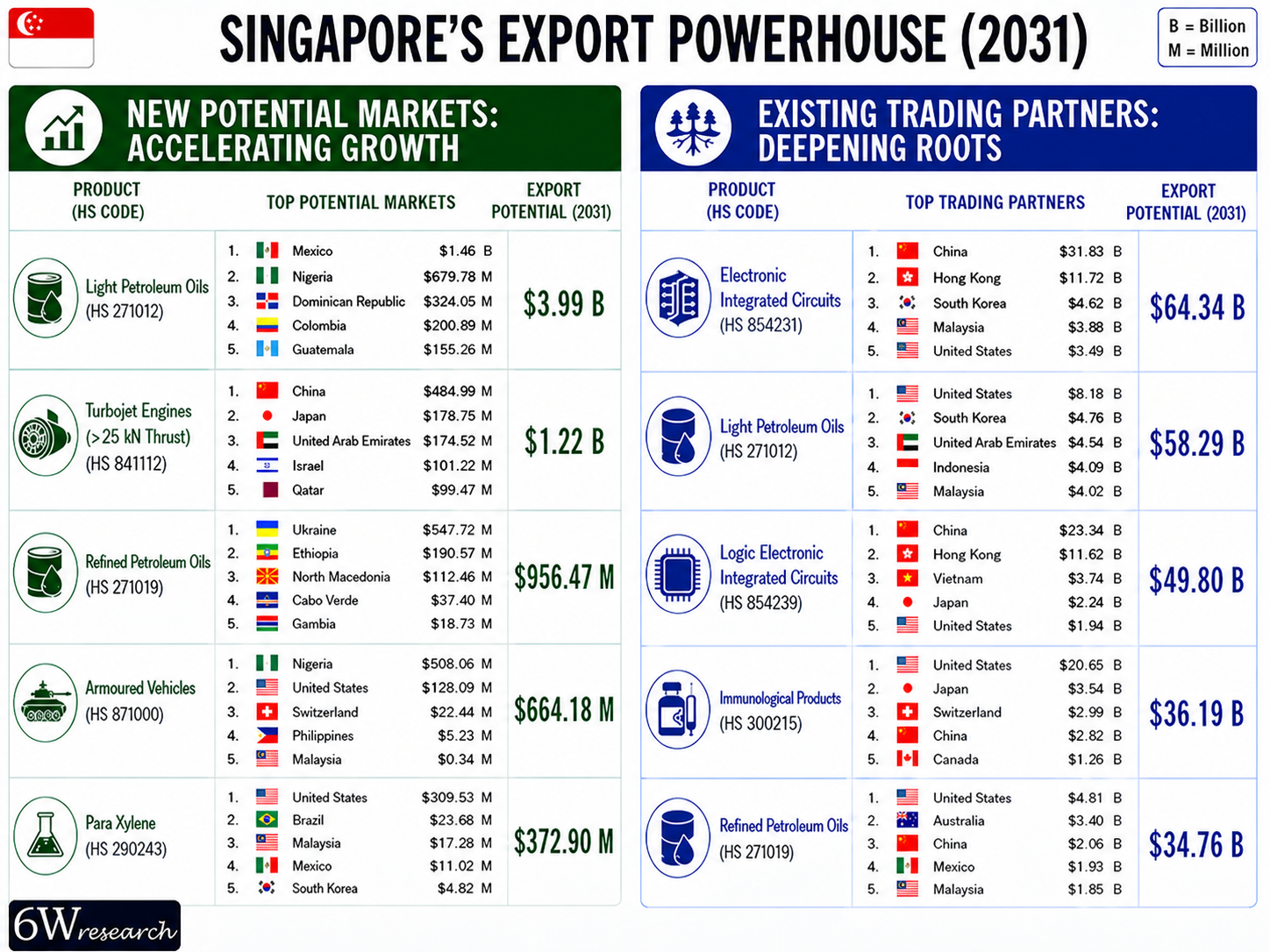
Light petroleum oils, turbojet engines and refined petroleum oils lead the way. While Singapore currently has minimal trade with several of these destinations, analysis by 6WExportGTM, 6Wresearch shows substantial untapped export opportunities emerging by 2031. Products such as light petroleum oils, turbojet engines, refined petroleum oils, armored vehicles and para xylene highlight sectors where international demand is rising but Singaporean exports remain relatively underpenetrated offering a path to diversify Singapore's export portfolio and strengthen resilience against concentration risk.
Light petroleum oils represent the largest new-corridor opportunity, reaching USD 3.99 billion by 2031, with the top five markets accounting for the bulk of that total. Mexico dominates at USD 1.46 billion, followed by Nigeria (USD 0.68 billion), the Dominican Republic, Colombia and Guatemala a spread of import-dependent economies where Singapore's refined-fuels trading expertise can serve demand without competing against its established Northeast Asian buyer base. In aerospace, turbojet engines above 25 kN thrust follow at USD 1.22 billion, led by China (USD 0.48 billion), with further demand from Japan, the UAE, Israel and Qatar a spread of buyers that lines up closely with Singapore's ongoing MRO capacity expansion.
Refined petroleum oils add a further USD 0.96 billion, led by Ukraine (USD 0.55 billion) and Ethiopia (USD 0.19 billion) a smaller, geopolitically sensitive corridor likely tied to post-conflict and import-substitution energy needs rather than routine commercial demand. Armored vehicles round out a notable new entrant at USD 0.66 billion, led by Nigeria (USD 0.51 billion) and the United States (USD 0.13 billion) a line that tracks with ST Engineering's push to convert its Terrex s5 platform, freshly contracted by Singapore's own military in January 2026, into an export product for overseas defense buyers. Para xylene closes out the top five at USD 0.37 billion, led by the United States (USD 0.31 billion), reflecting demand for the petrochemical feedstock used in polyester and PET production downstream of Singapore's Jurong Island refining complex.
Singapore’s Core Export Engines: Integrated Circuits and Refined Petroleum Products Across Established Markets
Electronic integrated circuits, light petroleum oils and logic electronic integrated circuits represent Singapore's highest-value future export potential by 2031, driven by expanding demand across its established global trading partners.
Electronic integrated circuits are Singapore's largest existing export opportunity, projected at USD 64.34 billion by 2031, led by China (USD 31.83 billion), Hong Kong (USD 11.72 billion) as a re-export hub, South Korea (USD 4.62 billion) and Malaysia (USD 3.88 billion). Light petroleum oils follow at USD 58.29 billion, led by the United States (USD 8.18 billion), South Korea (USD 4.76 billion) and the UAE (USD 4.54 billion) a materially more geographically diverse buyer base than the chip lines. Logic integrated circuits add USD 49.80 billion, again led by China (USD 23.34 billion) and Hong Kong (USD 11.62 billion), with Vietnam and Japan reflecting growing regional assembly activity.
Immunological Products contribute a striking USD 36.19 billion, led overwhelmingly by the United States (USD 20.65 billion) reflecting Singapore's growing role as a biomanufacturing base for US-bound pharmaceutical exports rather than a chip or energy product. Refined petroleum oils close out the top five at USD 34.76 billion, led by the United States (USD 4.81 billion) and Australia (USD 3.40 billion), together underscoring how deeply Singapore's core export base remains woven into Asia-Pacific and North American electronics, energy and life-sciences supply chains.
|
Singapore's strongest export priorities remain semiconductors and energy products into China and the United States, supported by growing vaccine demand from the US and integrated-circuit demand across Hong Kong, South Korea and Malaysia. 6WExportGTM Analysis |
Three Strategic Export Bets Shaping Singapore's Future
Singapore's export strategy for 2031 cannot rest on historical strength alone it has to be built around three real pressures the country is navigating right now: a semiconductor investment boom it must convert into durable export share, an aerospace MRO sector scaling fast enough to match regional demand, and a chip-transshipment reputation it must actively defend as US-China export-control enforcement intensifies. With China and the US together accounting for 46.7% of Singapore's existing export potential, and China leading a smaller but strategically important set of new markets too, these real-world dynamics should shape where Singapore focuses next.
Silicon Surge: Riding the Biggest Capital Wave in Its History
Singapore's semiconductor opportunity is real and accelerating. Electronic and logic electronic integrated circuits together represent close to USD 114 billion in existing export potential, concentrated in China, Hong Kong, South Korea and Malaysia. That potential is now backed by unprecedented capital: Micron has committed USD 24 billion to a new wafer fabrication plant, its largest single investment in Singapore's history, while UMC has opened a USD 5 billion advanced 22nm/28nm fab and continues to hold room for a second-phase expansion. Singapore has attracted over SDG 30 billion in semiconductor investment since 2022 alone and today accounts for roughly one in 10 chips and one in five semiconductor equipment units produced worldwide.
|
Singapore's ability to attract the world's largest memory and foundry investments in a single cycle gives it durable leverage even as chip manufacturing itself becomes more geographically contested, positioning the country as an indispensable node rather than a peripheral assembly point in the next phase of the global chip race. Manish Pant, Senior Data Scientist, Data Science & Market Intelligence, 6Wresearch |
For exporters, this means the next phase of growth is less about defending existing chip volumes and more about capturing the export potential that this new fabrication and packaging capacity is about to unlock, particularly into China, Hong Kong and South Korea.
Wings Over Changi: Turning Repair Work into an Export Line
Singapore's aerospace ecosystem anchored by turbojet engines and supported by its world-class MRO industry is creating significant export opportunities. Turbojet engines above 25 kN thrust are projected to generate USD 1.22 billion in export potential by 2031, led by China, Japan, the UAE, Israel and Qatar. This opportunity is being reinforced by fresh OEM investment. RTX committed more than USD 139 million in February 2026 to expand Collins Aerospace and Pratt & Whitney capabilities in Singapore, building on Rolls-Royce’s USD 180 million SAESL expansion, which nearly doubled its Trent-engine MRO footprint. With around 190 MRO companies, strong Changi Airport logistics connectivity and roughly one-third of Southeast Asia’s aircraft MRO revenue, Singapore has the industrial base to convert rising aerospace demand into higher-value engine exports and aftermarket services.
|
Singapore's aerospace strength lies less in finished-aircraft exports and more in owning the maintenance, repair and overhaul relationships that keep the region's fleets flying a services-and-parts model that is stickier and harder to displace than a manufacturing-only export base. Manisha Gupta, Data Analyst, Data Science & Market Intelligence, 6Wresearch |
The priority here is less about chasing new turbojet-buying markets and more about converting recent MRO investment into higher-value parts and components trade with the same aerospace hubs China, Japan, the UAE, Israel and Qatar already showing early demand.
Jurong Island's Next Act: From Barrels to Lower-Carbon Fuels
Singapore’s energy opportunity is substantial and evolving. Light and refined petroleum oils together represent more than USD 93 billion in existing export potential by 2031, with a further USD 4.95 billion emerging across new markets. That potential is being reinforced by fresh investment at Jurong Island, where Keppel, Aster and Aether Fuels are advancing sustainable aviation fuel projects, while ExxonMobil’s Singapore Resid Upgrade Project is expanding higher-value, lower-carbon refining capabilities. Singapore’s position as a major global refining and trading hub therefore remains central even as its energy sector shifts toward cleaner fuels and more advanced downstream products.
Top Global Export Opportunities (2031), By Product
| Product | Export Opportunity (USD Billion) |
| Electronic Integrated Circuits | 685.7 |
| Refined Petroleum Oils | 668.4 |
| Light Petroleum Oils | 588.9 |
| Logic electronic integrated circuits | 507.9 |
| Medicines | 381.2 |
| Gasoline Passenger Cars (1.5–3.0L) | 360.9 |
| Smartphones | 343.6 |
| Electronic integrated circuits with memory | 333.2 |
| Data Transmission Equipment | 216.9 |
| Immunological Products | 209.6 |
Excludes naturally occurring products (e.g., crude oil, raw gold). Source: 6WExportGTM
Globally, the largest export opportunities beyond naturally occurring products are concentrated in electronics, energy and pharmaceuticals highlighting the growing dominance of semiconductors, advanced manufacturing and high-value technology products in global trade. Japan already sits inside several of these categories, but its real priority through 2031 is defending semiconductor-equipment leadership, stabilizing its auto industry through a difficult transition, and using energy and metals diversification to reduce the geopolitical exposure that comes with a resource-poor, trade-dependent economy.
Where the World Is Buying: The Global Opportunity Map
The Trade Base Singapore Has Already Built
Semiconductors anchor Singapore's trade base by a wide margin. The core semiconductor line reaches USD 95.78 billion, led by electronic integrated circuits (48.85% share) and logic electronic integrated circuits (29.03% share) reflecting decades of investment in chip fabrication, assembly and re-export infrastructure. Oil & gas follows at USD 47.58 billion, split closely between refined petroleum oils (52.71% share) and light petroleum oils (47.29% share), reinforcing Singapore's role as a global energy trading and refining hub. Semiconductor manufacturing equipment rounds out the top three at USD 20.41 billion, driven by semiconductor manufacturing machines (73.28% share) and semiconductor fabrication machines (18.02% share) the capital equipment underpinning fabs across the region rather than the chips themselves.
| Sector | Exports (USD Billion) | Leading Products / Share |
| Semiconductors | 95.78 | Electronic Integrated Circuits (48.85%); Logic Electronic Integrated Circuits (29.03%) |
| Oil & Gas | 47.58 | Refined Petroleum Oils (52.71%); Light Petroleum Oils (47.29%) |
| Semiconductor Equipment | 20.41 | Semiconductor Manufacturing Machines (73.28%); Semiconductor Fabrication Machines (18.02%) |
Source: UN Comtrade
By trading value, three markets stand out. China leads at USD 68.82 billion, driven primarily by electronic integrated circuits (18.13% share), reflecting China's expanding domestic chip manufacturing base and Singapore's role as its assembly and equipment gateway. Malaysia follows at USD 51.69 billion, led by light petroleum oils (11.09% share), consistent with the tightly integrated Singapore-Malaysia refining and petrochemical corridor. Hong Kong ranks third at USD 50.91 billion, led by electronic integrated circuits (34.52% share), reinforcing its role as a re-export gateway deeper into mainland China.
| Country | Exports (USD Billion) | Leading Products / Share |
| China | 68.82 | Electronic Integrated Circuits (18.13%); Semiconductor Manufacturing Machines (12.60%) |
| Malaysia | 51.69 | Light Petroleum Oils (11.09%); Refined Petroleum Oils (9.72%) |
| Hong Kong | 50.91 | Electronic Integrated Circuits (34.52%); Logic Electronic Integrated Circuits (15.29%) |
Source: UN Comtrade

Leadership Perspectives from Industry Events
Search
Thought Leadership and Analyst Meet





Our Clients








6WResearch In News
- Hybrid Petrol Cars Lead New-Market Export Opportunities with USD 2.72 Billion in Export Potential by 2031
- The Philippines' Export Potential is Set to Reach USD 102.08 Billion by 2031, with USD 9.81 Billion Emerging from Untapped Markets Beyond Established Trade Corridors
- Coal, Copper and Ferro Nickel Anchor Over USD 69 Billion of Indonesia’s 2031 Potential and USD 22.1 Billion in Untapped Growth Is Opening Through Gold, Fuel and Automotive Products
- Singapore Eyes USD 609.65 Billion in Export Potential by 2031, with USD 38.50 Billion Beyond Existing Trade Corridors
- Crude Petroleum (USD 57.7 Billion) and Semiconductor ICs (USD 82.7 Billion) Dominate Malaysia's 2031 Export Potential, While USD 19.8 Billion in New Product Lines Opens New Opportunities
- Japan’s Export Potential Is Set to Reach USD 826.04 Billion by 2031, with USD 22.48 Billion Emerging from New Product Lines Beyond Established Trade Corridors
Latest Reports
- Gabon Citrullinemia Type-1 Market (2026-2032)
- Finland Citrullinemia Type-1 Market (2026-2032)
- Fiji Citrullinemia Type-1 Market (2026-2032)
- Ethiopia Citrullinemia Type-1 Market (2026-2032)
- Estonia Citrullinemia Type-1 Market (2026-2032)
- Eritrea Citrullinemia Type-1 Market (2026-2032)
- Equatorial Guinea Citrullinemia Type-1 Market (2026-2032)
- El Salvador Citrullinemia Type-1 Market (2026-2032)
- Ecuador Citrullinemia Type-1 Market (2026-2032)
- Dominica Citrullinemia Type-1 Market (2026-2032)
Industry Events and Analyst Meet

EV India Expo 2026

HIMTEX 2026

India Refining Summit 2026

India EV Show 2026

EV tech India Expo 2026
Whitepaper
- Middle East & Africa Commercial Security Market Click here to view more.
- Middle East & Africa Fire Safety Systems & Equipment Market Click here to view more.
- GCC Drone Market Click here to view more.
- Middle East Lighting Fixture Market Click here to view more.
- GCC Physical & Perimeter Security Market Click here to view more.


