The Philippines' Export Potential is Set to Reach USD 102.08 Billion by 2031, with USD 9.81 Billion Emerging from Untapped Markets Beyond Established Trade Corridors
In 2031, while China constitutes 31.88% (largest) of the Philippines' existing export potential, it is China again (44.03%) that dominates the smaller but faster-diversifying set of entirely new product lines a reminder that even as Manila pushes to widen its trade base beyond electronics, its single biggest customer keeps showing up as the biggest opportunity too, whether the product is a logic chip or a bar of gold, underscoring the long-term strength of the Philippines Export Potential.
 Source: 6WExportGTM
Anchors and Frontiers: Mapping the Philippines' Trade Future
The Philippines' export strategy for 2031 rests on a base that is already heavily electronics-led, while a smaller, faster-diversifying set of new corridors starts to take shape alongside it. In established trade relationships, export potential reaches USD 92.28 billion, led by China at 31.88% (USD 29.42 billion) and the United States at 16.11% (USD 14.87 billion). Hong Kong, Japan and Singapore round out the top five, confirming the Philippines' position as a back-end semiconductor assembly and testing hub feeding both Greater China's electronics supply chain and the US market directly.
| Top 5 Current Leading Importers | Export Potential (USD Billion) | Top 5 New Potential Importers for New Product Lines | Export Potential (USD Billion) |
| China | 29.42 | China | 4.32 |
| United States | 14.87 | Japan | 1.04 |
| Hong Kong | 11.37 | Turkey | 0.59 |
| Japan | 6.30 | United States | 0.56 |
| Singapore | 4.90 | India | 0.35 |
Source: 6WExportGTM
Beyond that established footprint, the Philippines' export potential in entirely new product-country pairs stands at USD 9.81 billion, with China again leading at 44.03% (USD 4.32 billion) more than four times the share of second-placed Japan (10.59%, USD 1.04 billion). Turkey, the United States and India follow with single-digit shares each. The concentration here is notably tighter than in the Philippines' established trade, signaling that the country's newest growth corridors are, for now, an extension of Chinese demand for raw and semi-processed materials rather than a genuinely separate growth story.
New Markets for the Philippines' Gold, Coal and Crude Petroleum
Unwrought gold, bituminous coal and crude petroleum lead the way. While the Philippines currently has minimal trade with several of these destinations, analysis by 6WExportGTM, a part of 6Wresearch, shows real untapped export opportunity emerging by 2031 in raw materials and mid-stream inputs a different profile from the finished-electronics base that defines the country's established trade.
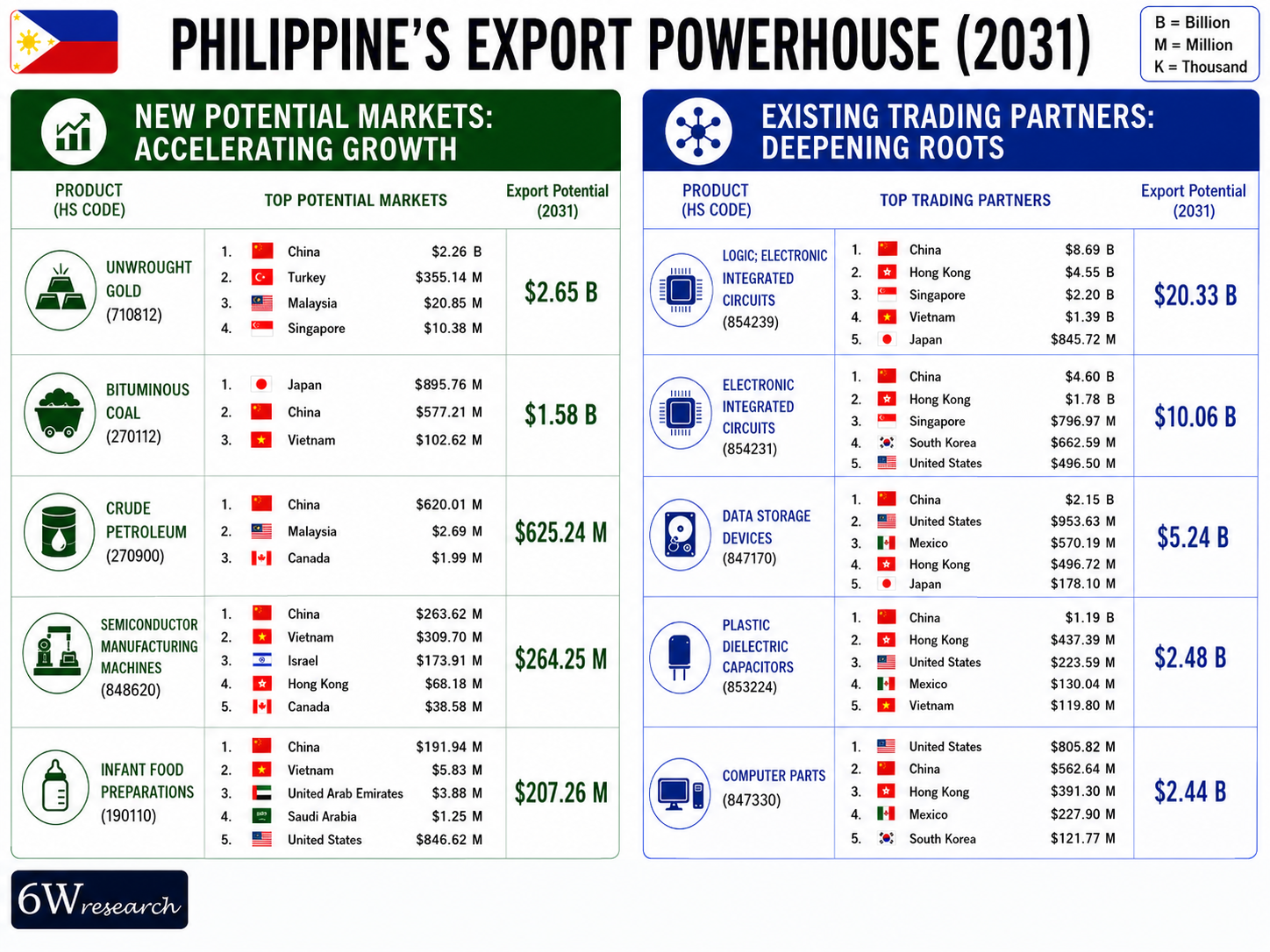
Unwrought gold represents the largest new-corridor opportunity at USD 2.65 billion, led overwhelmingly by China (USD 2.26 billion) and Turkey (USD 0.36 billion) a pairing that lines up with the Philippines' own gold-mining boom, where 2024 output already reached roughly 28,870 kilograms in production value terms and prices are forecast to keep climbing into 2026. Bituminous coal follows at USD 1.58 billion, led by Japan (USD 0.90 billion) and China (USD 0.58 billion), while crude petroleum adds a further USD 0.63 billion, almost entirely to China (USD 0.62 billion).
Semiconductor manufacturing machines appear as a smaller but symbolically significant new line at USD 0.26 billion, led by China (USD 0.26 billion) a reminder that even the Philippines' chip-equipment trade, not just its chip output, is starting to find new buyers. Infant food preparations round out the top five at USD 0.21 billion, led by China (USD 0.19 billion), a modest but telling sign of rising Chinese demand for Philippine-made consumer staples alongside its appetite for raw materials.
The Philippines' Core Export Engines: ICs & Data Storage Devices Across Established Markets
Logic electronic integrated circuits, electronic integrated circuits, data storage devices, capacitors and computer parts make up the five highest-value product lines carrying the Philippines' 2031 export potential every one of them tied to the country's decades-old role in global electronics assembly and testing. Forecasts point to enormous scale here, led by China across logic chips (USD 8.69B) and electronic ICs (USD 4.60B), with Hong Kong, Singapore and the United States providing meaningful secondary demand across nearly every line.
Logic Electronic Integrated Circuits alone represent the country's single biggest opportunity, totaling USD 20.33 billion by 2031 more than double the next entry on the list. China accounts for USD 8.69 billion of that, Hong Kong for USD 4.55 billion, and Singapore for USD 2.20 billion, with Vietnam (USD 1.39 billion) and Japan (USD 845.72 million) providing a smaller but still meaningful tail. Electronic Integrated Circuits contribute a further USD 10.06 billion, again led by China (USD 4.60 billion) and Hong Kong (USD 1.78 billion).
Data Storage Devices round out USD 5.24 billion, split between China (USD 2.15 billion) and the United States (USD 953.63 million), with Mexico emerging as a notable third buyer at USD 570.19 million. Plastic Dielectric Capacitors and Computer Parts close out the top five at USD 2.48 billion and USD 2.44 billion respectively the former led again by China, the latter the only product on this list where the United States, not China, holds first place.
|
The Philippines' strongest export priorities remain semiconductor back-end products into China, Hong Kong and the United States, with an emerging secondary opportunity in raw materials gold, coal and crude petroleum flowing almost entirely toward Chinese demand. 6WExportGTM Analysis |
The Philippines' Top Export Growth Opportunities By 2031
The Philippines' path to 2031 will be shaped less by discovering new markets than by converting three live domestic developments into durable export share: a government-backed push to more than double semiconductor and electronics exports by 2030, a mining sector riding record gold prices into a genuine production boom, and an automotive-parts corridor with Japan that remains under-leveraged relative to its scale. With China and the US together accounting for close to half of the country's existing export potential, and China alone driving the bulk of new-corridor growth, execution on these three fronts matters more than chasing entirely untested geographies.
Chips Ascending: A USD 110-Billion Roadmap
The Philippines' semiconductor and electronics sector remains its largest export earner by a wide margin, and the ambition attached to it has grown sharply. The Department of Trade and Industry's Semiconductor and Electronics Industry Roadmap, now moving into implementation as of April 2026, targets USD 110 billion in combined semiconductor (USD 70 billion) and electronics (USD 40 billion) exports by 2030 more than double the USD 49.64 billion the industry recorded in 2025. Industry body SEIPI expects exports to breach USD 50 billion in 2026 alone, a 5% increase, even as rising energy and freight costs tied to Middle East supply-chain disruption pose a real near-term risk. On the investment side, EMS Group has secured USD 1.6 billion in fresh capital from three multinational partners to produce power ICs for electric-vehicle platforms, with output beginning in 2026 a concrete signal that the roadmap's ambitions are starting to attract real capital, not just policy language.
|
A USD 110-billion target only becomes credible if the Philippines can close its persistent gaps in upstream wafer fabrication and power infrastructure the roadmap's real test will be whether policy follow-through keeps pace with the capital already arriving for EV-grade power semiconductors. Manish Pant, Senior Data Scientist, Data Science & Market Intelligence, 6Wresearch |
Digging Deeper: Gold, Nickel and the Minerals Wildcard
The Philippines' minerals sector is quietly becoming a second export engine. Gold is now the country's largest mining contributor by production value, and S&P Global forecasts gold prices to hit record highs heading into 2026 before easing a tailwind that shows up directly in the USD 2.65 billion new-corridor opportunity led by China and Turkey. Nickel adds a second, more contested dynamic: the Philippines is the world's second-largest nickel producer, shipping roughly 35 million wet metric tonnes to China alone in 2024 for battery-grade processing, and a Senate bill to ban unprocessed nickel ore exports by 2030 since shelved under industry pressure signals that Manila is actively weighing whether to follow Indonesia's playbook of forcing local processing rather than exporting raw ore.
|
Gold's price cycle is currently doing more for the Philippines' minerals export story than nickel policy is but if a future nickel-export restriction does materialize, it would mark a structural shift from raw-material exporter to processed-battery-materials supplier, reshaping this entire corridor. Manisha Gupta, Data Analyst, Data Science & Market Intelligence, 6Wresearch |
Wired for Growth: Auto Parts and the Japan Corridor
Vehicle wiring harnesses are the single largest product the Philippines sells to Japan, accounting for 12.06% of that USD 10.09 billion relationship, and the country's broader wiring-and-cables sector totals USD 2.84 billion in trade, 84.14% of it wiring harnesses alone. This is a durable, labor-intensive niche the Philippines has held for decades as a downstream supplier into Japanese and regional auto-assembly lines, and it sits apart from the volatility of the chip cycle a quieter complement to the semiconductor story that deserves its own attention rather than being read purely as a sub-line of the electronics sector.
Top Global Export Opportunities (2031), By Product
| Product | Export Opportunity (USD Billion) |
| Electronic Integrated Circuits | 685.7 |
| Refined Petroleum Oils | 668.4 |
| Light Petroleum Oils | 588.9 |
| Logic electronic integrated circuits | 507.9 |
| Medicines | 381.2 |
| Gasoline Passenger Cars (1.5–3.0L) | 360.9 |
| Smartphones | 343.6 |
| Electronic integrated circuits with memory | 333.2 |
| Data Transmission Equipment | 216.9 |
| Immunological Products | 209.6 |
Excludes naturally occurring products (e.g., crude oil, raw gold). Source: 6WExportGTM
Globally, the largest export opportunities beyond naturally occurring products are concentrated in electronics, energy and pharmaceuticals highlighting the growing dominance of semiconductors, advanced manufacturing and high-value technology products in global trade. Japan already sits inside several of these categories, but its real priority through 2031 is defending semiconductor-equipment leadership, stabilizing its auto industry through a difficult transition, and using energy and metals diversification to reduce the geopolitical exposure that comes with a resource-poor, trade-dependent economy.
The Trade Base Already in Place
Semiconductors dominate the Philippines' established trade base by a wide margin. The sector totals USD 25.89 billion, led by logic electronic integrated circuits (40.25% share) and electronic integrated circuits (35.05% share) together accounting for close to eight in every ten dollars of semiconductor trade. Computer & IT Hardware follow at USD 5.05 billion, led by Data Storage Devices (35.23%), reflecting the country's long-standing automotive-parts niche. Wiring & cables round out the top three at USD 1.53 billion, led by Vehicle Wiring Harnesses (83.25%) and Insulated Electric Cables (9.48%)
| Sector | Exports | Leading Products / Share |
| Semiconductors | USD 25.89B | Logic Electronic Integrated Circuits (40.25%); Electronic Integrated Circuits (35.05%) |
| Computer & IT hardware | USD 5.05B | Data Storage Devices (35.23%); Computer Parts (20.02%) |
| Wiring & Cables | USD 2.95B | Vehicle Wiring Harnesses (83.25%); Insulated Electric Cables (9.48%) |
Source: UN Comtrade
By trading value, three markets stand out. The United States leads at USD 12.12 billion, led by logic electronic integrated circuits (9.46% share) and electronic integrated circuits with memory (7.67% share). Japan follows at USD 10.25 billion, led by vehicle wiring harnesses (11.87% share) the clearest sign of how central the automotive-parts corridor is to that specific relationship and logic electronic integrated circuits (7.46% share). Hong Kong ranks third at USD 9.60 billion, led by logic electronic integrated circuits (28.99% share) and electronic integrated circuits (20.89% share), reinforcing its role as a re-export gateway deeper into mainland China.
| Country | Exports (USD Billion) | Leading Products / Share |
| United States | 12.12 | Logic Electronic Integrated Circuits (9.46%); Electronic ICs with Memory (7.67%) |
| Japan | 10.25 | Vehicle Wiring Harnesses (11.87%); Logic Electronic Integrated Circuits (7.46%) |
| Hong Kong | 9.60 | Logic Electronic Integrated Circuits (28.99%); Electronic Integrated Circuits (20.89%) |
Source: UN Comtrade
The Takeaway
The Philippines' next export wave will be won less by discovering new geography and more by deepening what already works: China and the United States together already account for close to half of established export potential, and China alone drives 44% of the smaller new-corridor opportunity too. The playbook is threefold convert the government's USD 110-billion semiconductor roadmap and the fresh USD 1.6 billion in EV-chip investment into durable export share; ride the current gold-price cycle while watching whether nickel-export policy shifts toward Indonesia-style local processing; and give the quieter, decades-old Japan auto-wiring corridor the strategic attention its USD 10 billion relationship deserves, rather than treating it as a footnote to the chip story. Together, these three moves are where the next USD 9.81 billion in untapped potential and a meaningful share of the existing USD 92.28 billion will actually be won.

Leadership Perspectives from Industry Events
Search
Thought Leadership and Analyst Meet





Our Clients








6WResearch In News
- The Philippines' Export Potential is Set to Reach USD 102.08 Billion by 2031, with USD 9.81 Billion Emerging from Untapped Markets Beyond Established Trade Corridors
- Coal, Copper and Ferro Nickel Anchor Over USD 69 Billion of Indonesia’s 2031 Potential and USD 22.1 Billion in Untapped Growth Is Opening Through Gold, Fuel and Automotive Products
- Singapore Eyes USD 609.65 Billion in Export Potential by 2031, with USD 38.50 Billion Beyond Existing Trade Corridors
- Crude Petroleum (USD 57.7 Billion) and Semiconductor ICs (USD 82.7 Billion) Dominate Malaysia's 2031 Export Potential, While USD 19.8 Billion in New Product Lines Opens New Opportunities
- Japan’s Export Potential Is Set to Reach USD 826.04 Billion by 2031, with USD 22.48 Billion Emerging from New Product Lines Beyond Established Trade Corridors
- Integrated Circuits Anchor South Korea's USD 320.8B Export Potential, While New Product Lines Unlock USD 22.4B Opportunity by 2031
Latest Reports
- Gabon Citrullinemia Type-1 Market (2026-2032)
- Finland Citrullinemia Type-1 Market (2026-2032)
- Fiji Citrullinemia Type-1 Market (2026-2032)
- Ethiopia Citrullinemia Type-1 Market (2026-2032)
- Estonia Citrullinemia Type-1 Market (2026-2032)
- Eritrea Citrullinemia Type-1 Market (2026-2032)
- Equatorial Guinea Citrullinemia Type-1 Market (2026-2032)
- El Salvador Citrullinemia Type-1 Market (2026-2032)
- Ecuador Citrullinemia Type-1 Market (2026-2032)
- Dominica Citrullinemia Type-1 Market (2026-2032)
Industry Events and Analyst Meet

EV India Expo 2026

HIMTEX 2026

India Refining Summit 2026

India EV Show 2026

EV tech India Expo 2026
Whitepaper
- Middle East & Africa Commercial Security Market Click here to view more.
- Middle East & Africa Fire Safety Systems & Equipment Market Click here to view more.
- GCC Drone Market Click here to view more.
- Middle East Lighting Fixture Market Click here to view more.
- GCC Physical & Perimeter Security Market Click here to view more.


