Romania Abaca Fibre Market (2026-2032) Outlook | Forecast, Share, Trends, Revenue, Industry, Growth, Companies, Analysis, Value & Size
Market Forecast By Application (Cordage, Ropes and Yarns, Paper and Pulp, Handicrafts, Fibre Craft, Others) And Competitive Landscape
| Product Code: ETC421694 | Publication Date: Oct 2022 | Updated Date: Jul 2026 | Product Type: Market Research Report | |
| Publisher: 6Wresearch | Author: Ravi Bhandari | No. of Pages: 70 | No. of Figures: 35 | No. of Tables: 5 |
Romania Abaca Fibre Market Growth Rate
According to 6Wresearch internal database and industry insights, the Romania Abaca Fibre Market is projected to grow at a compound annual growth rate (CAGR) of 5.8% during the forecast period (2026-2032).
Romania Abaca Fibre Market Year-wise Growth Rate and Key Drivers
This graph illustrates the annual growth rates of the Romania Abaca Fibre Market from 2022 to 2032, highlighting steady expansion driven by rail infrastructure modernization, freight corridor development, and logistics network upgrades across the country.
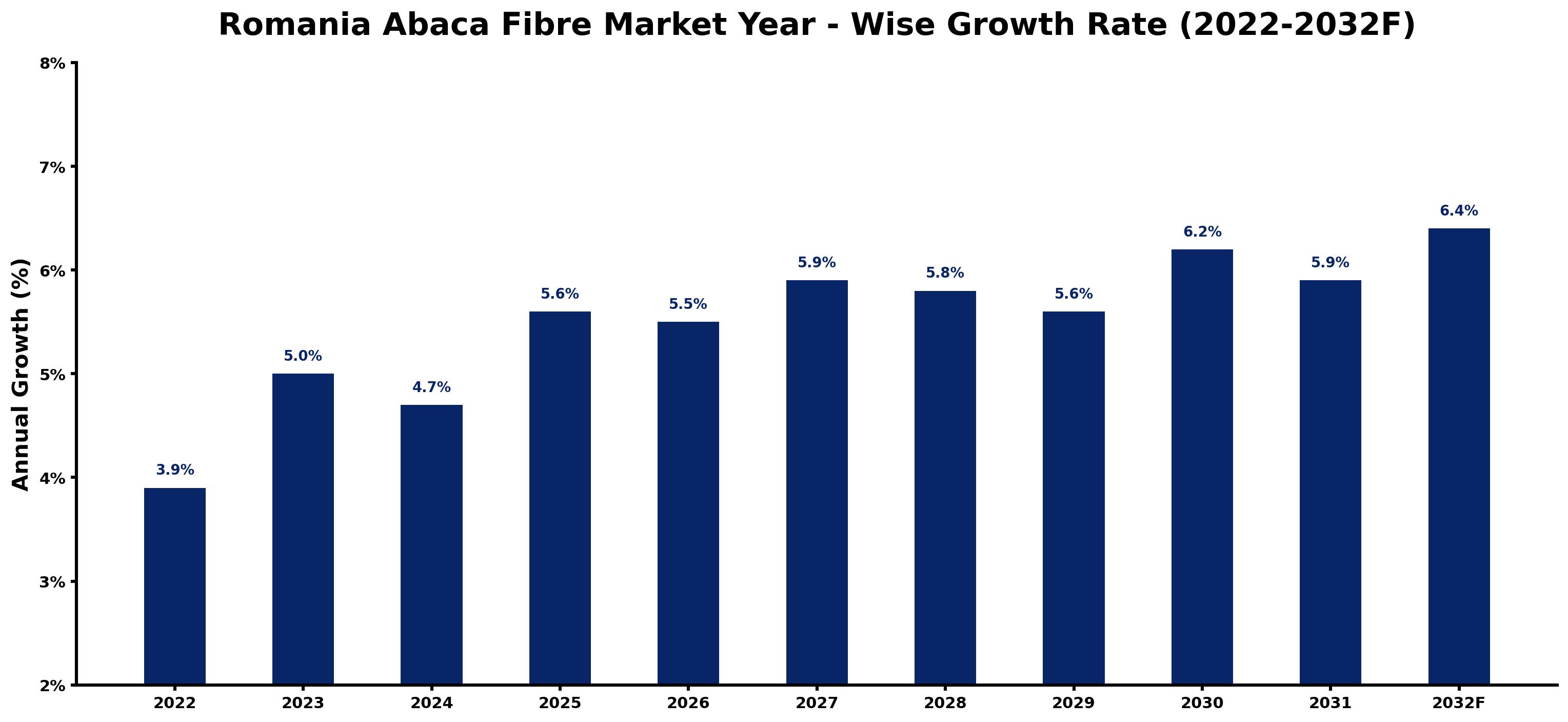
The table below represents the historical growth rates for the Romania Abaca Fibre Market and the rationale behind each year’s performance.
| Year | Estimated Growth | Market Rationale |
| 2022 | 3.9% | Limited demand for natural fibers amid supply chain disruptions and modest industrial activity. |
| 2023 | 5% | Rising awareness of sustainable materials increased imports and usage of abaca fibre in specialty applications. |
| 2024 | 4.7% | Fluctuating raw material availability and cautious industrial procurement moderated market expansion. |
| 2025 | 5.6% | Growing demand from paper, cordage, and eco-friendly packaging industries supported stronger growth. |
| 2026 | 5.5% | Sustainability initiatives and increasing adoption of biodegradable fibres drove market development. |
| 2027 | 5.9% | Higher utilization in specialty pulp, composites, and industrial applications boosted demand. |
| 2028 | 5.8% | Stable imports and expanding use in environmentally friendly products maintained market momentum. |
| 2029 | 5.6% | Temporary fluctuations in international fibre prices slightly moderated annual growth. |
| 2030 | 6.2% | Increased investments in sustainable manufacturing and green packaging accelerated adoption. |
| 2031 | 5.9% | Strong demand from industrial and consumer goods sectors supported continued expansion. |
| 2032 | 6.4% | Broader commercialization of natural fibre applications and sustainability regulations strengthened market growth. |
Topics Covered in the Romania Abaca Fibre Market Report
The Romania Abaca Fibre Market report thoroughly covers the market by application. The market report provides an unbiased and detailed analysis of ongoing market trends, opportunities/high growth areas, and market drivers, which help stakeholders devise and align their market strategies according to the current and future market dynamics.
Romania Abaca Fibre Market Highlights
| Report Name |
Romania Abaca Fibre Market |
| Forecast period | 2026-2032 |
| CAGR | 5.8% |
| Growing Sector |
Paper and Pulp |
Romania Abaca Fibre Market Synopsis
Romania Abaca Fibre Market is anticipated to record notable growth due to the high demand for sustainable raw materials, increased usage in the manufacture of specialty paper, and heightened environmental consciousness in businesses. Abaca fiber is a robust natural fiber that is obtained from the abaca plant leaf sheath and is well-known for its strength, elasticity, and biodegradability properties. It is commonly utilized in ropes, pulps, craftwork, and industry. In addition, the rise in investment in sustainable packaging and preference for renewable raw materials has been greatly influencing Romania Abaca Fibre Market Growth during the forecasted period.
Evaluation of Growth Drivers in the Romania Abaca Fibre Market (2026-2032)
Below mentioned are some prominent drivers and their influence on the market dynamics:
| Drivers | Primary Segments Affected | Why it Matters (Evidence) |
| Rising Demand for Sustainable Materials | Paper and Pulp; Others | Industries increasingly prefer renewable and biodegradable fibres over synthetic alternatives. |
| Growth in Eco-Friendly Packaging | Paper and Pulp | Sustainable packaging trends increase demand for abaca-based pulp products. |
| Expansion of Handicraft Industry | Handicrafts; Fibre Craft | Growing consumer interest in natural and handmade products supports fibre consumption. |
| Industrial Rope Manufacturing Demand | Cordage; Ropes and Yarns | High tensile strength of abaca fibre makes it suitable for industrial rope applications. |
| Environmental Regulations | All Applications | Policies promoting sustainable materials encourage wider adoption of natural fibres. |
Romania Abaca Fibre Market is expected to grow at the CAGR of 5.8% during the forecast period of 2026-2032. Expansion is facilitated by greater consciousness of sustainable materials and increased use of eco-friendly items in industries as well as consumers. There is a robust demand for pulp production from paper companies, especially as they try to reduce their ecological footprint and enhance their sustainable image. Moreover, increased usage of abaca fiber in various applications such as ropes, handicrafts, and specialty packaging has boosted market opportunities. Favorable environmental regulations, consumer trends, and investments in sustainable manufacturing processes are anticipated to drive the market during the forecast period.
Evaluation of Restraints in the Romania Abaca Fibre Market
Below mentioned are some major restraints and their influence on the market dynamics:
| Restraints | Primary Segments Affected | What This Means (Evidence) |
| Dependence on Imports | All Applications | Romania relies heavily on imported abaca fibre, increasing supply risks. |
| Price Volatility | Cordage; Paper and Pulp | Fluctuations in international fibre prices affect profitability and procurement planning. |
| Limited Domestic Processing Capacity | Paper and Pulp; Others | Restricted local processing infrastructure limits value-added production opportunities. |
| Competition from Synthetic Fibres | Ropes and Yarns; Cordage | Lower-cost synthetic alternatives challenge natural fibre adoption. |
| Supply Chain Disruptions | All Applications | Transportation and logistics issues may affect timely fibre availability. |
Romania Abaca Fibre Industry Challenges
Irrespective of massive growth and development, the Romania Abaca Fibre Industry faces several challenges that could affect long-term expansion. Amongst these problems, one of the main concerns is that the country has relied heavily on foreign abaca fibre, leaving the industry open to price volatility due to the volatility of international markets and logistics challenges. In addition to this, the problem of competition from artificial fibres poses a constant challenge in terms of pricing, especially where industrial usage takes place, since cost is a primary consideration. Lack of infrastructure makes it difficult to produce high-value products locally.
Romania Abaca Fibre Market Trends
Key trends in the Romania Abaca Fibre Market include:
- Increased Use of Sustainable Packaging Materials: The trend among manufacturers is to use abaca fibre in their sustainable packaging products in order to achieve sustainability goals.
- Increased Demand for Specialty Paper Products: There is an increased demand for premium grade abaca pulp in specialty paper production.
- Growth in Natural Fibre Crafts: Consumers’ inclination towards craft goods made from natural materials is boosting the use of abaca fibre in crafts.
- Increased Industrial Utilization of Degradable Fibres: Companies are substituting artificial materials with natural materials in their industrial production to stay environment-friendly.
- Development in Green Technologies: Green manufacturing technologies have brought new ways to use abaca fibre.
Investment Opportunities in the Romania Abaca Fibre Market
Major investment opportunities emerging within the Romania Abaca Fibre Market include:
- Abaca Fiber Paper Manufacturing Plants: Construction of modern plants for producing paper could exploit increasing global demand for sustainable and strong paper.
- Eco-friendly Packaging Materials: Companies can manufacture eco-friendly packaging materials that utilize abaca fiber due to increasing demand and regulation of environmental protection.
- Abaca Fiber Processing Plant: Development of a processing plant can reduce dependency on importing fibers as well as add value to the product.
- Handicraft and Fiber Crafts: Rising trend among consumers toward sustainable products will provide opportunity for producing handicrafts.
- Industrial Ropes Manufacturing: Development of premium ropes manufacturing plants could exploit tensile strength of abaca fiber.
Top 5 Leading Players in the Romania Abaca Fibre Market
Some leading players operating in the Romania Abaca Fibre Market include:
1. Specialty Pulp Manufacturing, Inc. (SPMI)
| Company Name | Specialty Pulp Manufacturing, Inc. (SPMI) |
|---|---|
| Established Year | 1991 |
| Headquarters | Metro Manila, Philippines |
| Official Website | Click Here |
Specialty Pulp Manufacturing produces premium abaca pulp for specialty papers and tea bags, serving global manufacturers through advanced processing and sustainable fibre sourcing.
2. Ching Bee Trading Corporation
| Company Name | Ching Bee Trading Corporation |
|---|---|
| Established Year | 1980 |
| Headquarters | Manila, Philippines |
| Official Website | Click Here |
Ching Bee Trading Corporation exports high-quality abaca fibre to paper, rope, textile, and industrial manufacturers through extensive international sourcing and distribution networks.
3. Terranova Papers
| Company Name | Terranova Papers |
|---|---|
| Established Year | 1983 |
| Headquarters | Madrid, Spain |
| Official Website | Click Here |
Terranova Papers supplies abaca pulp and fibres for specialty paper and filtration applications, supporting European converters with sustainable and customized fibre solutions.
4. Sellinrail International Trading Company
| Company Name | Sellinrail International Trading Company |
|---|---|
| Established Year | 1995 |
| Headquarters | Manila, Philippines |
| Official Website | - |
Sellinrail International Trading distributes industrial-grade abaca and Manila hemp to paper, textile, and cordage industries through global sourcing and trading expertise.
5. Glatfelter Corporation
| Company Name | Glatfelter Corporation |
|---|---|
| Established Year | 1864 |
| Headquarters | Charlotte, North Carolina, United States |
| Official Website | Click Here |
Glatfelter Corporation utilizes premium abaca fibre to manufacture specialty papers, tea bags, and food packaging materials for customers across international markets.
Government Regulations Introduced in the Romania Abaca Fibre Market
According to Romania’s environmental and industrial development initiatives, the adoption of sustainable and biodegradable material is being encouraged by the Romanian government through several policy mechanisms that reflect the environmental targets of the European Union. The Romanian National Sustainable Development Strategy advocates for companies to opt for renewable sources of raw materials and minimize the reliance on non-biodegradable material. Moreover, association with the European Green Deal and the Circular Economy Action Plan ensures an increased adoption of natural fibers in manufacturing companies. Funding schemes related to sustainable investments, resource efficiency, and sustainable packaging have further aided the process of promoting the adoption of such innovations.
Future Insights of the Romania Abaca Fibre Market
Romania Abaca Fibre Market is expected to witness sustained growth during the forecast period as industries increasingly prioritize environmentally responsible raw materials and sustainable production practices. Positive prospects for the industry are driven by increasing consumer preferences for biodegradable packaging material, specialty papers, and environment-friendly industrial material. Increasing consciousness about environmental issues among consumers and corporations will further boost the trend of using natural fibers as a substitute. In addition, improvements in fiber processing methods, greater green manufacturing capabilities, and widening applications in crafts, packaging, and industrial applications can open up new opportunities for growth in the future.
Market Segmentation Analysis
The report offers a comprehensive study of the following market segments and their leading categories:
Paper and Pulp accounted for a dominant 34.80% of the Romania Abaca Fibre Market revenue in 2025, driven by increasing demand for sustainable paper products, specialty packaging materials, filtration papers, tea bags, and other eco-friendly paper applications. The segment continues to benefit from the superior strength, flexibility, and biodegradability characteristics of abaca fibre. Meanwhile, Fibre Craft is projected to witness the fastest growth, registering a CAGR of 7.20% during 2026–2032, supported by rising consumer preference for handmade products, decorative items, and environmentally sustainable lifestyle accessories.
By Application – Cordage Maintains Strong Position, Ropes and Yarns Experience Rising Demand
According to Bhawna Singh, Assistant Manager, 6Wresearch, Cordage held a significant 26.40% segment of the Romania Abaca Fibre Market Share in 2025, supported by the exceptional tensile strength, durability, and saltwater resistance of abaca fibre, making it highly suitable for marine, industrial, and agricultural applications. The segment continues to maintain steady demand from industries requiring reliable natural fibre solutions. Meanwhile, Ropes and Yarns are anticipated to expand at the fastest CAGR of 6.80% through 2032, owing to increasing adoption across construction, logistics, transportation, and farming sectors seeking biodegradable and high-performance fibre products.
Note: Market size estimations and growth projections presented in this report are based on 6Wresearch’s advanced forecasting approach, validated with industry datasets as of June 2026.
Key Attractiveness of the Report
- 10 Years of Market Numbers.
- Historical Data Starting from 2022 to 2025.
- Base Year: 2025.
- Forecast Data until 2032.
- Key Performance Indicators Impacting the Market.
- Major Upcoming Developments and Projects.
Key Highlights of the Report:
- Romania Abaca Fibre Market Outlook
- Market Size of Romania Abaca Fibre Market, 2025
- Forecast of Romania Abaca Fibre Market, 2032
- Historical Data and Forecast of Romania Abaca Fibre Revenues & Volume for the Period 2022-2032F
- Romania Abaca Fibre Market Trend Evolution
- Romania Abaca Fibre Market Drivers and Challenges
- Romania Abaca Fibre Price Trends
- Romania Abaca Fibre Porter's Five Forces
- Romania Abaca Fibre Industry Life Cycle
- Historical Data and Forecast of Romania Abaca Fibre Market Revenues & Volume By Application for the Period 2022-2032F
- Historical Data and Forecast of Romania Abaca Fibre Market Revenues & Volume By Cordage for the Period 2022-2032F
- Historical Data and Forecast of Romania Abaca Fibre Market Revenues & Volume By Ropes and Yarns for the Period 2022-2032F
- Historical Data and Forecast of Romania Abaca Fibre Market Revenues & Volume By Paper and Pulp for the Period 2022-2032F
- Historical Data and Forecast of Romania Abaca Fibre Market Revenues & Volume By Handicrafts for the Period 2022-2032F
- Historical Data and Forecast of Romania Abaca Fibre Market Revenues & Volume By Fibre Craft for the Period 2022-2032F
- Historical Data and Forecast of Romania Abaca Fibre Market Revenues & Volume By Others for the Period 2022-2032F
- Romania Abaca Fibre Import Export Trade Statistics
- Market Opportunity Assessment By Application
- Romania Abaca Fibre Top Companies Market Share
- Romania Abaca Fibre Competitive Benchmarking By Technical and Operational Parameters
- Romania Abaca Fibre Company Profiles
- Romania Abaca Fibre Key Strategic Recommendations
Market Covered
The report offers a comprehensive study of the subsequent market segments:
By Application
- Cordage
- Ropes and Yarns
- Paper and Pulp
- Handicrafts
- Fibre Craft
- Others
Romania Abaca Fibre Market (2026-2032): FAQs
The Romania Abaca Fibre Market is projected to grow at a CAGR of 5.8% during the forecast period 2026-2032.
Paper and Pulp dominate the market due to increasing demand for sustainable packaging materials, specialty paper products, filtration papers, and biodegradable industrial applications.
Key challenges include dependence on imported raw materials, supply chain disruptions, competition from synthetic fibres and fluctuations in international fibre prices.
The market is expected to experience stable growth supported by increasing sustainability initiatives, rising environmental awareness and growing demand for biodegradable industrial and consumer products.
6Wresearch actively monitors the Romania Abaca Fibre Market and publishes its comprehensive annual report, highlighting emerging trends, growth drivers, revenue analysis, and forecast outlook. Our insights help businesses to make data-backed strategic decisions with ongoing market dynamics. Our analysts track relevent industries related to the Romania Abaca Fibre Market, allowing our clients with actionable intelligence and reliable forecasts tailored to emerging regional needs.
Yes, we provide customisation as per your requirements. To learn more, feel free to contact us on sales@6wresearch.com
| 1 Executive Summary |
| 2 Introduction |
| 2.1 Key Highlights of the Report |
| 2.2 Report Description |
| 2.3 Market Scope & Segmentation |
| 2.4 Research Methodology |
| 2.5 Assumptions |
| 3 Romania Abaca Fibre Market Overview |
| 3.1 Romania Country Macro Economic Indicators |
| 3.2 Romania Abaca Fibre Market Revenues & Volume, 2022 & 2032F |
| 3.3 Romania Abaca Fibre Market - Industry Life Cycle |
| 3.4 Romania Abaca Fibre Market - Porter's Five Forces |
| 3.5 Romania Abaca Fibre Market Revenues & Volume Share, By Application, 2022 & 2032F |
| 4 Romania Abaca Fibre Market Dynamics |
| 4.1 Impact Analysis |
| 4.2 Market Drivers |
| 4.2.1 Increasing demand for sustainable and eco-friendly materials in various industries |
| 4.2.2 Growing awareness about the benefits of using abaca fiber over synthetic materials |
| 4.2.3 Government initiatives promoting the use of natural fibers in manufacturing processes |
| 4.3 Market Restraints |
| 4.3.1 Fluctuations in raw material prices affecting production costs |
| 4.3.2 Limited availability of skilled labor for abaca fiber cultivation and processing |
| 4.3.3 Competition from other natural fibers such as cotton and jute |
| 5 Romania Abaca Fibre Market Trends |
| 6 Romania Abaca Fibre Market, By Types |
| 6.1 Romania Abaca Fibre Market, By Application |
| 6.1.1 Overview and Analysis |
| 6.1.2 Romania Abaca Fibre Market Revenues & Volume, By Application, 2022-2032F |
| 6.1.3 Romania Abaca Fibre Market Revenues & Volume, By Cordage, 2022-2032F |
| 6.1.4 Romania Abaca Fibre Market Revenues & Volume, By Ropes and Yarns, 2022-2032F |
| 6.1.5 Romania Abaca Fibre Market Revenues & Volume, By Paper and Pulp, 2022-2032F |
| 6.1.6 Romania Abaca Fibre Market Revenues & Volume, By Handicrafts, 2022-2032F |
| 6.1.7 Romania Abaca Fibre Market Revenues & Volume, By Fibre Craft, 2022-2032F |
| 6.1.8 Romania Abaca Fibre Market Revenues & Volume, By Others, 2022-2032F |
| 7 Romania Abaca Fibre Market Import-Export Trade Statistics |
| 7.1 Romania Abaca Fibre Market Export to Major Countries |
| 7.2 Romania Abaca Fibre Market Imports from Major Countries |
| 8 Romania Abaca Fibre Market Key Performance Indicators |
| 8.1 Percentage increase in the number of companies adopting abaca fiber in their products |
| 8.2 Growth in research and development investments focused on enhancing abaca fiber properties |
| 8.3 Expansion of abaca fiber production capacity in Romania |
| 9 Romania Abaca Fibre Market - Opportunity Assessment |
| 9.1 Romania Abaca Fibre Market Opportunity Assessment, By Application, 2022 & 2032F |
| 10 Romania Abaca Fibre Market - Competitive Landscape |
| 10.1 Romania Abaca Fibre Market Revenue Share, By Companies, 2025 |
| 10.2 Romania Abaca Fibre Market Competitive Benchmarking, By Operating and Technical Parameters |
| 11 Company Profiles |
| 12 Recommendations |
| 13 Disclaimer |
Global Go To Market Strategy - 2030
Export potential enables firms to identify high-growth global markets with greater confidence by combining advanced trade intelligence with a structured quantitative methodology. The framework analyzes emerging demand trends and country-level import patterns while integrating macroeconomic and trade datasets such as GDP and population forecasts, bilateral import–export flows, tariff structures, elasticity differentials between developed and developing economies, geographic distance, and import demand projections. Using weighted trade values from 2020–2024 as the base period to project country-to-country export potential for 2030, these inputs are operationalized through calculated drivers such as gravity model parameters, tariff impact factors, and projected GDP per-capita growth. Through an analysis of hidden potentials, demand hotspots, and market conditions that are most favorable to success, this method enables firms to focus on target countries, maximize returns, and global expansion with data, backed by accuracy.
By factoring in the projected importer demand gap that is currently unmet and could be potential opportunity, it identifies the potential for the Exporter (Country) among 190 countries, against the general trade analysis, which identifies the biggest importer or exporter.
To discover high-growth global markets and optimize your business strategy:
Click Here
Pricing
- Single User License$ 1,995
- Department License$ 2,400
- Site License$ 3,120
- Global License$ 3,795

Leadership Perspectives from Industry Events
Search
Thought Leadership and Analyst Meet





Our Clients








6WResearch In News
- India Export Attractiveness Tracker 2026
- India Air Conditioner Market Set for Strong Rebound in 2026 After Weather-Led Correction and GST-Driven Recovery: 6Wresearch
- ADAS in India: How Automatic Emergency Braking, Blind Spot Detection & Driver Monitoring are Transforming Road Safety
- Doha a strategic location for EV manufacturing hub: IPA Qatar
- Demand for luxury TVs surging in the GCC, says Samsung
- Empowering Growth: The Thriving Journey of Bangladesh’s Cable Industry
Latest Reports
- Greece Insulated Sandwich Panels Market (2026-2032)
- Qatar Access and Home Network Market (2026-2032)
- Nicaragua RPG Gaming Market (2026-2032)
- New Zealand RPG Gaming Market (2026-2032)
- Netherlands RPG Gaming Market (2026-2032)
- Nauru RPG Gaming Market (2026-2032)
- Namibia RPG Gaming Market (2026-2032)
- Mozambique RPG Gaming Market (2026-2032)
- Montenegro RPG Gaming Market (2026-2032)
- Mongolia RPG Gaming Market (2026-2032)
Industry Events and Analyst Meet

EV India Expo 2026

HIMTEX 2026

India Refining Summit 2026

India EV Show 2026

EV tech India Expo 2026
Whitepaper
- Middle East & Africa Commercial Security Market Click here to view more.
- Middle East & Africa Fire Safety Systems & Equipment Market Click here to view more.
- GCC Drone Market Click here to view more.
- Middle East Lighting Fixture Market Click here to view more.
- GCC Physical & Perimeter Security Market Click here to view more.


