South Korea Abrasive Blasting Media Market (2026-2032) | Forecast, Value, Outlook, Trends, Analysis, Industry, Share, Size, Companies, Growth & Revenue
Market Forecast By Type (Silica/Si Sand, Aluminum Oxide Grit, Coal Sag, Corn Cob Grit, Glass Beads, Acrylic, Crushed Glass Grit, Silicon Carbide), By Application (Paint Spraying & Coating, Communication, Aircraft Maintenance, Construction, Metalworking, Home Appliances, Others), By End-Use Industry (Automotive, Building & Construction, Industrial, Consumer, Aviation, Others) And Competitive Landscape
| Product Code: ETC046323 | Publication Date: Jan 2021 | Updated Date: Jul 2026 | Product Type: Report | |
| Publisher: 6Wresearch | Author: Ravi Bhandari | No. of Pages: 70 | No. of Figures: 35 | No. of Tables: 5 |
South Korea Abrasive Blasting Media Market Growth Rate
According to 6Wresearch internal database and industry insights, the South Korea Abrasive Blasting Media Market is projected to grow at a compound annual growth rate (CAGR) of 8.6% during the forecast period (2026-2032).
South Korea Abrasive Blasting Media Market Year-wise Growth Rate and Key Drivers (2022-2032)
This graph illustrates the annual growth rates of the South Korea Abrasive Blasting Media Market from 2022 to 2032, highlighting a steady upward trajectory and projected market expansion over the forecast period.
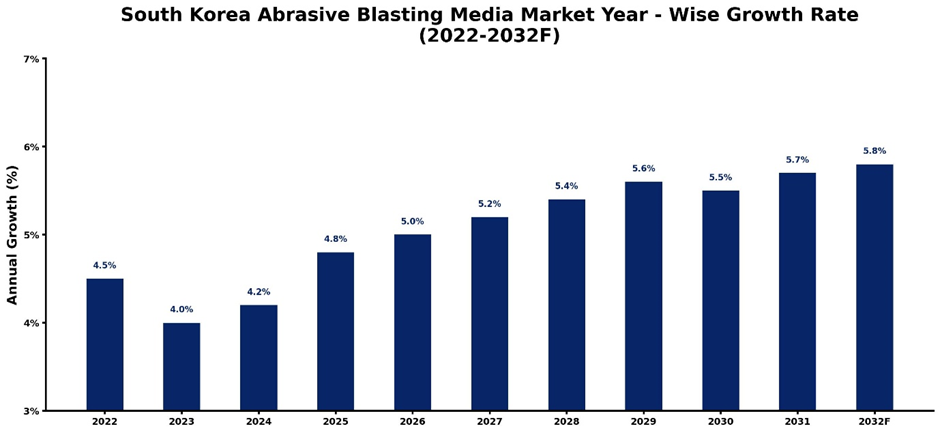
The following table summarizes the historical and forecasted growth rates of the South Korea Abrasive Blasting Media Market, along with the rationale behind each year’s performance.
| Year | Estimated Growth (%) | Market Rationale |
| 2022 | 4.5% | Stable demand from automotive refinishing and moderate slowdown in construction projects |
| 2023 | 4% | Energy price pressures and export moderation in heavy industries |
| 2024 | 4.2% | Recovery in industrial equipment refurbishment and gradual infrastructure revival |
| 2025 | 4.8% | Increased adoption of precision surface finishing in automotive and electronics sectors |
| 2026 | 5% | Strong demand from shipbuilding and defense coating applications supports steady growth |
| 2027 | 5.2% | Expansion of eco-friendly abrasive materials and stricter environmental blasting regulations |
| 2028 | 5.4% | Rising aerospace component manufacturing and high-performance surface treatment demand |
| 2029 | 5.6% | Growth in advanced manufacturing and corrosion protection applications in marine industry |
| 2030 | 5.5% | Slight normalization due to market maturity and efficiency improvements in blasting technologies |
| 2031 | 5.7% | Increased OEM outsourcing and higher demand for precision surface preparation |
| 2032 | 5.8% | Strong industrial modernization and sustained defense + shipbuilding investments |
Topics Covered in the South Korea Abrasive Blasting Media Market Report
The South Korea Abrasive Blasting Media Market report thoroughly covers the market by Type, Application and End-Use Industry. The market report provides an unbiased and detailed analysis of ongoing market trends, opportunities/high growth areas, and market drivers, which help stakeholders devise and align their market strategies according to the current and future market dynamics.
South Korea Abrasive Blasting Media Market Highlights
| Report Name | South Korea Abrasive Blasting Media Market |
| Forecast period | 2026-2032 |
| CAGR | 8.6% |
| Growing Sector | Automotive & Shipbuilding |
South Korea Abrasive Blasting Media Market Synopsis
South Korea Abrasive Blasting Media Market is likely to witness significant growth because of growing industry demand, higher levels of manufacturing automation, and the strong government mandate for environment-friendly surface treatment solutions. Abrasive blasting media generally include different types of materials such as steel grit, glass beads, aluminum oxide and other similar materials, which are sprayed at high speed to remove dirt and contaminants from the surface of the products or components. In addition to that, the country has strong automobile, aerospace and electronics industries which have been putting considerable efforts into precise finishing operations, along with local suppliers using environmentally friendly media.
Evaluation of Growth Drivers in the South Korea Abrasive Blasting Media Market (2026-2032)
Below mentioned are some prominent drivers and their influence on the market dynamics:
| Drivers | Primary Segments Affected | Why it Matters (Evidence) |
| Demand for High-Performance Abrasives | Metalworking, Automotive | Need for precision in electronics and automotive manufacturing. |
| Shift to Eco-Friendly Media | Industrial Cleaning, Construction | Regulatory compliance and sustainable manufacturing goals. |
| Adoption of Automated Blasting | Shipbuilding, Aerospace | Enhances efficiency and consistency in complex surface finishing. |
| Growth in Shipbuilding Industry | Marine, Heavy Manufacturing | Consistent need for large-scale rust removal and profile etching. |
| Expansion of Electronics Sector | Consumer Electronics, Semiconductor | Requires specialized, fine-grade media for delicate surface etching. |
South Korea Abrasive Blasting Media Market is expected to grow at the CAGR of 8.6% during the forecast period of 2026-2032. The growth has been fueled by the country’s speedy embrace of Industry 4.0 that includes automatic blasting systems for better finishes. The growth has also been enhanced by the increased investments in heavy industries such as shipbuilding and defense industries. Other factors responsible for growth include the sustainable manufacturing practices of private companies that promote reusable blasting media.
Evaluation of Restraints in the South Korea Abrasive Blasting Media Market
Below mentioned are some major restraints and their influence on the market dynamics:
| Restraints | Primary Segments Affected | What This Means (Evidence) |
| Fluctuating Raw Material Costs | All Types, Industrial | Volatile prices of minerals impact manufacturer profit margins. |
| Strict Environmental Regulations | All Types, Construction | Higher compliance costs for dust management and waste disposal. |
| Competition from Alternative Methods | Cleaning, Surface Finishing | Growth of chemical or ultrasonic cleaning displaces mechanical blasting. |
| High Initial Investment Costs | Automated Blasting, Aviation | Capital-intensive equipment limits adoption by smaller workshops. |
| Skilled Labor Shortages | Specialized Blasting, Heavy Industry | Lack of expertise in operating complex, automated blasting machinery. |
South Korea Abrasive Blasting Media Market Challenges
Irrespective of massive growth and development, the market faces several challenges such as stringent environmental compliance, high raw material price volatility, and technical barriers in specialized applications. In addition to this, the transition toward complex automated systems requires significant capital investment, while a scarcity of technical expertise to maintain high-precision equipment hampers the overall South Korea Abrasive Blasting Media Market growth. These socioeconomic and technical factors necessitate a strategic shift toward sustainable innovation to maintain a competitive advantage in the global market.
South Korea Abrasive Blasting Media Market Trends
Industry trends in the South Korea Abrasive Blasting Media Market have been discussed in detail below:
- Blasting Machines Based on IoT: An increase in usage of smart blast systems with IoT sensors to measure the real-time pressure at the nozzles and abrasive use to reduce downtime.
- High-Durability Ceramic Abrasives: A trend in the industry towards the use of highly durable ceramic abrasives to ensure a long-life cycle and low wastage in each cycle.
- Low-Dust Blasting Process: The use of wet blasting and special dust suppression chemicals to comply with strict local environmental requirements.
- Micro Blasting Media for Semiconductors: A growing need for micro-sized engineered blasting media to clean high-sensitive electronics equipment surfaces.
Investment Opportunities in the South Korea Abrasive Blasting Media Market
High Return Investment Opportunities in South Korea Abrasive Blasting Media Market can be seen below:
- Production of Eco-Friendly Media: Setting up production plants for organic media or recyclable mineral slag in order to take advantage of green manufacturing market share.
- Automation Solution Companies: Investing in software and hardware development firms which cater specifically to robotic blasting systems for ship building and auto industries.
- Training Centers for Technicians: Providing localized training services for the technicians working on surface finishing machines to overcome shortage of labor force in advanced surface finishing industry.
- Blasting Logistical Providers: Setting up logistics centers which provide special abrasives used in the semiconductor and electronics components industry.
Top 5 Leading Players in the South Korea Abrasive Blasting Media Market
A detailed compilation of major companies active in the South Korea Abrasive Blasting Media Market is presented below:
1. Winoa South Korea
| Company Name | Winoa South Korea |
|---|---|
| Established Year | 1961 |
| Headquarters | Gimhae-si, South Korea |
| Official Website | Click Here |
Winoa specializes in high-quality steel shot and grit solutions for industrial shot blasting and metal surface preparation worldwide.
2. KCC Corporation
| Company Name | KCC Corporation |
|---|---|
| Established Year | 1958 |
| Headquarters | Seoul, South Korea |
| Official Website | Click Here |
KCC provides industrial coatings and abrasive materials essential for the maintenance of large-scale maritime and automotive steel structures.
3. Saint-Gobain Abrasives
| Company Name | Saint-Gobain Abrasives |
|---|---|
| Established Year | 1665 |
| Headquarters | Courbevoie, France |
| Official Website | Click Here |
Saint-Gobain offers a comprehensive portfolio of high-performance abrasive grains and materials used in precision surface engineering processes.
4. 3M Korea
| Company Name | 3M Korea |
|---|---|
| Established Year | 1977 |
| Headquarters | Seoul, South Korea |
| Official Website | Click Here |
3M produces advanced abrasive systems and blasting media technology for various demanding industrial finishing and maintenance applications.
5. POSCO Holdings
| Company Name | POSCO Holdings |
|---|---|
| Established Year | 1968 |
| Headquarters | Pohang, South Korea |
| Official Website | Click Here |
POSCO supplies steel-based abrasive precursors used for heavy-duty metal cleaning in domestic manufacturing and global supply chains.
Government Initiatives Being Implemented in the South Korea Abrasive Blasting Media Market
According to South Korean Government Data, major initiatives that are being implemented are mentioned below:
2026 Industrial AI Transformation (AX) Fund: The government has allocated significant fiscal resources toward the AI-driven transformation of core manufacturing sectors, including shipbuilding and steel, which directly supports the adoption of automated, precision-blasting equipment.
Green Manufacturing Roadmap: Policies providing tax incentives for companies transitioning to eco-friendly production methods, encouraging the shift from traditional mineral slag to high-durability, low-dust recyclable abrasive media.
Specialized Human Capital Development: Establishment of government-funded technical academies designed to provide high-tech training for the specialized workforce needed to operate modern, IoT-integrated surface finishing technologies.
Future Insights of the South Korea Abrasive Blasting Media Market
The outlook for the market is promising due to the impact of improved manufacturing infrastructure, increasing domestic focus on high-tech surface treatment for semiconductors, the rise of AI-driven automated blasting systems, and dedicated government investments in training for industrial professionals, will ultimately boost opportunities for the South Korea Abrasive Blasting Media Market Growth.
Market Segmentation Analysis
This report presents a detailed analysis of the market segments along with their leading categories:
By Type- Silicon Carbide Leads Market, Aluminum Oxide Set for Rapid Expansion
According to Ravi Bhandari, Senior Research Analyst, 6Wresearch, silicon carbide secured a dominant 32.50% of the South Korea Abrasive Blasting Media market value in 2025, driven by its extreme hardness and superior performance in micro-precision semiconductor cleaning. Conversely, aluminum oxide grit is projected to advance at a stellar CAGR of 6.90% during 2026–2032, fueled by its versatility in steel and heavy-metal profile etching across the shipbuilding and automotive sectors.
By End-Use Industry- Automotive Leads Market, Industrial Shows Rapid Growth
The automobile segment accounted for 38.60% of the South Korea Abrasive Blasting Media market share in 2025, due to the necessity of having a good finish on the chassis and engine parts. The industrial applications segment is expected to witness a CAGR of 6.45% up till 2032 owing to the shift of manufacturers from manual to automated cleaning systems, which demands good performing blasting media.
Note: Market size estimations and growth projections presented in this report are based on 6Wresearch's proprietary forecasting methodology, utilizing the latest available industry data, government publications, and primary research inputs.
Key Attractiveness of the Report
- 10 Years of Market Numbers.
- Historical Data Starting from 2022 to 2025.
- Base Year: 2025.
- Forecast Data until 2032.
- Key Performance Indicators Impacting the Market.
- Major Upcoming Developments and Projects.
Key Highlights of the Report:
- South Korea Abrasive Blasting Media Market Outlook
- Market Size of South Korea Abrasive Blasting Media Market, 2025
- Forecast of South Korea Abrasive Blasting Media Market, 2032
- Historical Data and Forecast of South Korea Abrasive Blasting Media Revenues & Volume for the Period 2022-2032
- South Korea Abrasive Blasting Media Market Trend Evolution
- South Korea Abrasive Blasting Media Market Drivers and Challenges
- South Korea Abrasive Blasting Media Price Trends
- South Korea Abrasive Blasting Media Porter's Five Forces
- South Korea Abrasive Blasting Media Industry Life Cycle
- Historical Data and Forecast of South Korea Abrasive Blasting Media Market Revenues & Volume By Type for the Period 2022-2032
- Historical Data and Forecast of South Korea Abrasive Blasting Media Market Revenues & Volume By Silica/Si Sand for the Period 2022-2032
- Historical Data and Forecast of South Korea Abrasive Blasting Media Market Revenues & Volume By Aluminum Oxide Grit for the Period 2022-2032
- Historical Data and Forecast of South Korea Abrasive Blasting Media Market Revenues & Volume By Coal Sag for the Period 2022-2032
- Historical Data and Forecast of South Korea Abrasive Blasting Media Market Revenues & Volume By Corn Cob Grit for the Period 2022-2032
- Historical Data and Forecast of South Korea Abrasive Blasting Media Market Revenues & Volume By Glass Beads for the Period 2022-2032
- Historical Data and Forecast of South Korea Abrasive Blasting Media Market Revenues & Volume By Acrylic for the Period 2022-2032
- Historical Data and Forecast of South Korea Abrasive Blasting Media Market Revenues & Volume By Crushed Glass Grit for the Period 2022-2032
- Historical Data and Forecast of South Korea Silica/Si Sand Abrasive Blasting Media Market Revenues & Volume By Silicon Carbide for the Period 2022-2032
- Historical Data and Forecast of South Korea Abrasive Blasting Media Market Revenues & Volume By Application for the Period 2022-2032
- Historical Data and Forecast of South Korea Abrasive Blasting Media Market Revenues & Volume By Paint Spraying & Coating for the Period 2022-2032
- Historical Data and Forecast of South Korea Abrasive Blasting Media Market Revenues & Volume By Communication for the Period 2022-2032
- Historical Data and Forecast of South Korea Abrasive Blasting Media Market Revenues & Volume By Aircraft Maintenance for the Period 2022-2032
- Historical Data and Forecast of South Korea Abrasive Blasting Media Market Revenues & Volume By Construction for the Period 2022-2032
- Historical Data and Forecast of South Korea Abrasive Blasting Media Market Revenues & Volume By Metalworking for the Period 2022-2032
- Historical Data and Forecast of South Korea Abrasive Blasting Media Market Revenues & Volume By Home Appliances for the Period 2022-2032
- Historical Data and Forecast of South Korea Abrasive Blasting Media Market Revenues & Volume By Others for the Period 2022-2032
- Historical Data and Forecast of South Korea Abrasive Blasting Media Market Revenues & Volume By End-Use Industry for the Period 2022-2032
- Historical Data and Forecast of South Korea Abrasive Blasting Media Market Revenues & Volume By Automotive for the Period 2022-2032
- Historical Data and Forecast of South Korea Abrasive Blasting Media Market Revenues & Volume By Building & Construction for the Period 2022-2032
- Historical Data and Forecast of South Korea Abrasive Blasting Media Market Revenues & Volume By Industrial for the Period 2022-2032
- Historical Data and Forecast of South Korea Abrasive Blasting Media Market Revenues & Volume By Consumer for the Period 2022-2032
- Historical Data and Forecast of South Korea Abrasive Blasting Media Market Revenues & Volume By Aviation for the Period 2022-2032
- Historical Data and Forecast of South Korea Abrasive Blasting Media Market Revenues & Volume By Others for the Period 2022-2032
- South Korea Abrasive Blasting Media Import Export Trade Statistics
- Market Opportunity Assessment By Type
- Market Opportunity Assessment By Application
- Market Opportunity Assessment By End-Use Industry
- South Korea Abrasive Blasting Media Top Companies Market Share
- South Korea Abrasive Blasting Media Competitive Benchmarking By Technical and Operational Parameters
- South Korea Abrasive Blasting Media Company Profiles
- South Korea Abrasive Blasting Media Key Strategic Recommendations
Market Covered
The report offers a comprehensive study of the subsequent market segments:
By Type
- Silica / Si Sand
- Aluminum Oxide Grit
- Coal Slag
- Corn Cob Grit
- Glass Beads
- Acrylic
- Crushed Glass Grit
- Silicon Carbide
By Application
- Paint Spraying & Coating
- Communication
- Aircraft Maintenance
- Construction
- Metalworking
- Home Appliances
- Others
By End-Use Industry
- Automotive
- Building & Construction
- Industrial
- Consumer
- Aviation
- Others
South Korea Abrasive Blasting Media Market (2026-2032): FAQs
South Korea Abrasive Blasting Media Market is projected to grow at a CAGR of 8.6% between 2026-2032.
The growth of the market is due to fast automation in heavy industries and the growing need for precision surface finishing in semiconductors.
One of the biggest obstacles is changing prices on raw materials and the necessity to comply with strict environmental legislation.
The leading companies are Winoa South Korea, KCC Corporation, Saint-Gobain Abrasives, 3M Korea, and POSCO Holdings.
6Wresearch actively monitors the South Korea Abrasive Blasting Media Market and publishes its comprehensive annual report, highlighting emerging trends, growth drivers, revenue analysis, and forecast outlook. Our insights help businesses to make data-backed strategic decisions with ongoing market dynamics. Our analysts track relevent industries related to the South Korea Abrasive Blasting Media Market, allowing our clients with actionable intelligence and reliable forecasts tailored to emerging regional needs.
Yes, we provide customisation as per your requirements. To learn more, feel free to contact us on sales@6wresearch.com
| 1 Executive Summary |
| 2 Introduction |
| 2.1 Key Highlights of the Report |
| 2.2 Report Description |
| 2.3 Market Scope & Segmentation |
| 2.4 Research Methodology |
| 2.5 Assumptions |
| 3 South Korea Abrasive Blasting Media Market Overview |
| 3.1 South Korea Country Macro Economic Indicators |
| 3.2 South Korea Abrasive Blasting Media Market Revenues & Volume, 2022 & 2032F |
| 3.3 South Korea Abrasive Blasting Media Market - Industry Life Cycle |
| 3.4 South Korea Abrasive Blasting Media Market - Porter's Five Forces |
| 3.5 South Korea Abrasive Blasting Media Market Revenues & Volume Share, By Type, 2022 & 2032F |
| 3.6 South Korea Abrasive Blasting Media Market Revenues & Volume Share, By Application, 2022 & 2032F |
| 3.7 South Korea Abrasive Blasting Media Market Revenues & Volume Share, By End-Use Industry, 2022 & 2032F |
| 4 South Korea Abrasive Blasting Media Market Dynamics |
| 4.1 Impact Analysis |
| 4.2 Market Drivers |
| 4.2.1 Growth in construction and infrastructure projects leading to increased demand for surface preparation solutions. |
| 4.2.2 Increasing adoption of abrasive blasting media in automotive and aerospace industries for cleaning and finishing applications. |
| 4.2.3 Emphasis on industrial maintenance and repair activities driving the need for abrasive blasting media. |
| 4.3 Market Restraints |
| 4.3.1 Stringent regulations and environmental concerns regarding the use and disposal of abrasive blasting media. |
| 4.3.2 Fluctuating raw material prices impacting the overall production cost of abrasive blasting media. |
| 4.3.3 Competition from alternative surface preparation methods such as water blasting and chemical cleaning. |
| 5 South Korea Abrasive Blasting Media Market Trends |
| 6 South Korea Abrasive Blasting Media Market, By Types |
| 6.1 South Korea Abrasive Blasting Media Market, By Type |
| 6.1.1 Overview and Analysis |
| 6.1.2 South Korea Abrasive Blasting Media Market Revenues & Volume, By Type, 2022-2032F |
| 6.1.3 South Korea Abrasive Blasting Media Market Revenues & Volume, By Silica/Si Sand, 2022-2032F |
| 6.1.4 South Korea Abrasive Blasting Media Market Revenues & Volume, By Aluminum Oxide Grit, 2022-2032F |
| 6.1.5 South Korea Abrasive Blasting Media Market Revenues & Volume, By Coal Sag, 2022-2032F |
| 6.1.6 South Korea Abrasive Blasting Media Market Revenues & Volume, By Corn Cob Grit, 2022-2032F |
| 6.1.7 South Korea Abrasive Blasting Media Market Revenues & Volume, By Glass Beads, 2022-2032F |
| 6.1.8 South Korea Abrasive Blasting Media Market Revenues & Volume, By Acrylic, 2022-2032F |
| 6.1.9 South Korea Abrasive Blasting Media Market Revenues & Volume, By Silicon Carbide, 2022-2032F |
| 6.1.10 South Korea Abrasive Blasting Media Market Revenues & Volume, By Silicon Carbide, 2022-2032F |
| 6.2 South Korea Abrasive Blasting Media Market, By Application |
| 6.2.1 Overview and Analysis |
| 6.2.2 South Korea Abrasive Blasting Media Market Revenues & Volume, By Paint Spraying & Coating, 2022-2032F |
| 6.2.3 South Korea Abrasive Blasting Media Market Revenues & Volume, By Communication, 2022-2032F |
| 6.2.4 South Korea Abrasive Blasting Media Market Revenues & Volume, By Aircraft Maintenance, 2022-2032F |
| 6.2.5 South Korea Abrasive Blasting Media Market Revenues & Volume, By Construction, 2022-2032F |
| 6.2.6 South Korea Abrasive Blasting Media Market Revenues & Volume, By Metalworking, 2022-2032F |
| 6.2.7 South Korea Abrasive Blasting Media Market Revenues & Volume, By Home Appliances, 2022-2032F |
| 6.3 South Korea Abrasive Blasting Media Market, By End-Use Industry |
| 6.3.1 Overview and Analysis |
| 6.3.2 South Korea Abrasive Blasting Media Market Revenues & Volume, By Automotive, 2022-2032F |
| 6.3.3 South Korea Abrasive Blasting Media Market Revenues & Volume, By Building & Construction, 2022-2032F |
| 6.3.4 South Korea Abrasive Blasting Media Market Revenues & Volume, By Industrial, 2022-2032F |
| 6.3.5 South Korea Abrasive Blasting Media Market Revenues & Volume, By Consumer, 2022-2032F |
| 6.3.6 South Korea Abrasive Blasting Media Market Revenues & Volume, By Aviation, 2022-2032F |
| 6.3.7 South Korea Abrasive Blasting Media Market Revenues & Volume, By Others, 2022-2032F |
| 7 South Korea Abrasive Blasting Media Market Import-Export Trade Statistics |
| 7.1 South Korea Abrasive Blasting Media Market Export to Major Countries |
| 7.2 South Korea Abrasive Blasting Media Market Imports from Major Countries |
| 8 South Korea Abrasive Blasting Media Market Key Performance Indicators |
| 8.1 Average utilization rate of abrasive blasting media in key industries. |
| 8.2 Rate of adoption of advanced abrasive blasting technologies in South Korea. |
| 8.3 Percentage of companies compliant with environmental regulations related to abrasive blasting media disposal. |
| 8.4 Innovation rate in abrasive blasting media products and technologies. |
| 8.5 Customer satisfaction and repeat business rate for abrasive blasting media suppliers. |
| 9 South Korea Abrasive Blasting Media Market - Opportunity Assessment |
| 9.1 South Korea Abrasive Blasting Media Market Opportunity Assessment, By Type, 2022 & 2032F |
| 9.2 South Korea Abrasive Blasting Media Market Opportunity Assessment, By Application, 2022 & 2032F |
| 9.3 South Korea Abrasive Blasting Media Market Opportunity Assessment, By End-Use Industry, 2022 & 2032F |
| 10 South Korea Abrasive Blasting Media Market - Competitive Landscape |
| 10.1 South Korea Abrasive Blasting Media Market Revenue Share, By Companies, 2025 |
| 10.2 South Korea Abrasive Blasting Media Market Competitive Benchmarking, By Operating and Technical Parameters |
| 11 Company Profiles |
| 12 Recommendations |
| 13 Disclaimer |
Global Go To Market Strategy - 2030
Export potential enables firms to identify high-growth global markets with greater confidence by combining advanced trade intelligence with a structured quantitative methodology. The framework analyzes emerging demand trends and country-level import patterns while integrating macroeconomic and trade datasets such as GDP and population forecasts, bilateral import–export flows, tariff structures, elasticity differentials between developed and developing economies, geographic distance, and import demand projections. Using weighted trade values from 2020–2024 as the base period to project country-to-country export potential for 2030, these inputs are operationalized through calculated drivers such as gravity model parameters, tariff impact factors, and projected GDP per-capita growth. Through an analysis of hidden potentials, demand hotspots, and market conditions that are most favorable to success, this method enables firms to focus on target countries, maximize returns, and global expansion with data, backed by accuracy.
By factoring in the projected importer demand gap that is currently unmet and could be potential opportunity, it identifies the potential for the Exporter (Country) among 190 countries, against the general trade analysis, which identifies the biggest importer or exporter.
To discover high-growth global markets and optimize your business strategy:
Click Here
Pricing
- Single User License$ 1,995
- Department License$ 2,400
- Site License$ 3,120
- Global License$ 3,795

Leadership Perspectives from Industry Events
Search
Thought Leadership and Analyst Meet





Our Clients








6WResearch In News
- India Export Attractiveness Tracker 2026
- India Air Conditioner Market Set for Strong Rebound in 2026 After Weather-Led Correction and GST-Driven Recovery: 6Wresearch
- ADAS in India: How Automatic Emergency Braking, Blind Spot Detection & Driver Monitoring are Transforming Road Safety
- Doha a strategic location for EV manufacturing hub: IPA Qatar
- Demand for luxury TVs surging in the GCC, says Samsung
- Empowering Growth: The Thriving Journey of Bangladesh’s Cable Industry
Latest Reports
- Qatar Access and Home Network Market (2026-2032)
- Nicaragua RPG Gaming Market (2026-2032)
- New Zealand RPG Gaming Market (2026-2032)
- Netherlands RPG Gaming Market (2026-2032)
- Nauru RPG Gaming Market (2026-2032)
- Namibia RPG Gaming Market (2026-2032)
- Mozambique RPG Gaming Market (2026-2032)
- Montenegro RPG Gaming Market (2026-2032)
- Mongolia RPG Gaming Market (2026-2032)
- Monaco RPG Gaming Market (2026-2032)
Industry Events and Analyst Meet

EV India Expo 2026

HIMTEX 2026

India Refining Summit 2026

India EV Show 2026

EV tech India Expo 2026
Whitepaper
- Middle East & Africa Commercial Security Market Click here to view more.
- Middle East & Africa Fire Safety Systems & Equipment Market Click here to view more.
- GCC Drone Market Click here to view more.
- Middle East Lighting Fixture Market Click here to view more.
- GCC Physical & Perimeter Security Market Click here to view more.


