South Korea Abrasive Cloth Market (2026-2032) Outlook | Industry, Size, Forecast, Trends, Value, Growth, Companies, Analysis, Share & Revenue
Market Forecast By Cloth Type (Cotton Abrasive Cloth, Polyester Abrasive Cloth, Other Abrasive Cloth), By Application (Woodworking, Metalworking, Paint/surface Preparation), By End Use (Glass, Transportation, Furniture, Leather, General Manufacturing & Fabrication) And Competitive Landscape
| Product Code: ETC273323 | Publication Date: Aug 2022 | Updated Date: Jul 2026 | Product Type: Market Research Report | |
| Publisher: 6Wresearch | Author: Ravi Bhandari | No. of Pages: 70 | No. of Figures: 35 | No. of Tables: 5 |
South Korea Abrasive Cloth Market Growth Rate
According to 6Wresearch internal database and industry insights, the South Korea Abrasive Cloth Market is projected to grow at a compound annual growth rate (CAGR) of 5.8% during the forecast period (2026-2032).
South Korea Abrasive Cloth Market Year-wise Growth Rate and Key Drivers (2022-2032)
This graph illustrates the annual growth rates of the South Korea Abrasive Cloth Market from 2022 to 2032, highlighting a steady upward trajectory and projected market expansion over the forecast period.
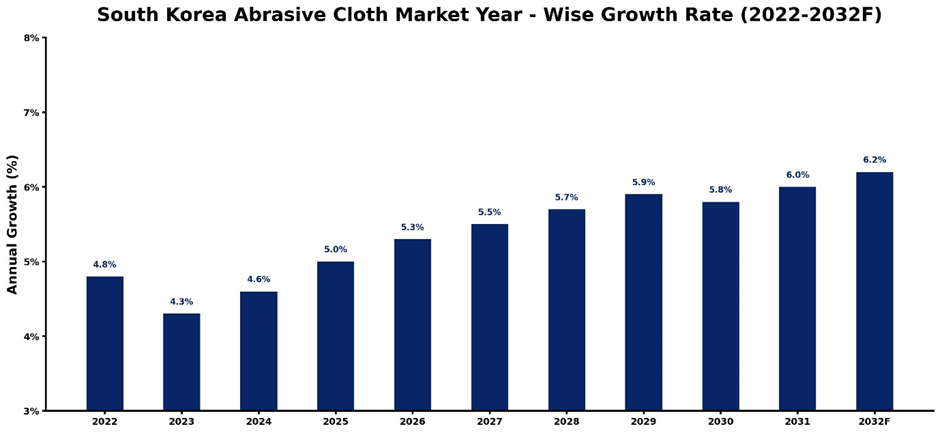
The following table summarizes the historical and forecasted growth rates of the South Korea Abrasive Cloth Market, along with the rationale behind each year’s performance.
| Year | Estimated Growth (%) | Market Rationale |
| 2022 | 4.8% | Stable industrial output but mild slowdown in construction-related sanding demand |
| 2023 | 4.3% | Export softness in electronics and industrial machinery reduces abrasive usage |
| 2024 | 4.6% | Recovery in furniture and woodworking sectors with rising domestic consumption |
| 2025 | 5% | Increased use in automotive refinishing and precision surface finishing applications |
| 2026 | 5.3% | Strong industrial recovery driven by OEM and metal fabrication demand |
| 2027 | 5.5% | Growth in eco-friendly abrasive cloth and high-durability synthetic variants |
| 2028 | 5.7% | Expansion in transportation manufacturing and maintenance activities |
| 2029 | 5.9% | Higher adoption in advanced manufacturing and automated finishing systems |
| 2030 | 5.8% | Slight stabilization due to market maturity and efficiency improvements |
| 2031 | 6% | Strong demand from aerospace, shipbuilding, and high-precision industries |
| 2032 | 6.2% | Continued industrial modernization and export-driven manufacturing growth |
Topics Covered in the South Korea Abrasive Cloth Market Report
The South Korea Abrasive Cloth Market report thoroughly covers the market by Cloth Type, Application and End Use. The market report provides an unbiased and detailed analysis of ongoing market trends, opportunities/high growth areas, and market drivers, which help stakeholders devise and align their market strategies according to the current and future market dynamics.
South Korea Abrasive Cloth Market Highlights
| Report Name | South Korea Abrasive Cloth Market |
| Forecast period | 2026-2032 |
| CAGR | 5.8% |
| Growing Sector | Metalworking & Automotive |
South Korea Abrasive Cloth Market Synopsis
There are immense potential and momentum developing in the South Korea Abrasive Cloth Market due to the high level of industrial manufacturing capability in the country, dependence on auto exports, and innovation in high precision finishing techniques. In particular, the use of abrasive cloth products such as those with abrasive materials attached to flexible material for finishing processes is gaining increasing importance in the context of automation in factories. There is an emphasis on hi-tech industries, including semiconductor manufacturing and robotics, where high temperature and durable abrasives are needed.
Evaluation of Growth Drivers in the South Korea Abrasive Cloth Market (2026-2032)
Below mentioned are some prominent drivers and their influence on the market dynamics:
| Drivers | Primary Segments Affected | Why it Matters (Evidence) |
| Expansion of Automotive Industry | Metalworking, Transportation | EV drivetrain and chassis finishing requires high-performance abrasive cloths. |
| Growth in Electronics Manufacturing | General Manufacturing, Electronics | Precision grinding of semiconductor housings demands stable, high-quality abrasives. |
| Finishing Lines Automation | Metal and Furniture | Mechanical arms need consistent and constant grit consistency in the abrasive belts. |
| Heavy Industry (Ship Building) | Metal and Fabrication | Large steel structures need abrasive cloths with a high removal rate in preparation for welding. |
| R&D Investment in Technology | All Types and Surface Preparation | Bond technology advances decrease costs. |
South Korea Abrasive Cloth Market is expected to grow at the CAGR of 5.8% during the forecast period of 2026-2032. Growth is driven by accelerating industrial automation, increasing demand for refined automotive components, and the integration of precision manufacturing processes. Other contributions arise from R&D funding by the government on high-tech industries as well as the modernization of shipyards and manufacturing facilities within the nation. In totality, all of these contribute towards justifying the need for quality abrasives.
Evaluation of Restraints in the South Korea Abrasive Cloth Market
Below mentioned are some major restraints and their influence on the market dynamics:
| Restraints | Primary Segments Affected | What This Means (Evidence) |
| Volatility in Raw Materials | All Types, Manufacturing | Fluctuating costs of backing materials and mineral grains impact final product pricing. |
| Import Dependence | Medication & Specialty Cloths | Reliance on imported high-end minerals limits supply chain flexibility for local producers. |
| Stringent Environmental Norms | Paint/Surface Preparation | Tightening VOC and waste regulations increase compliance costs for abrasive manufacturers. |
| High Competition | All Segments | Intense pressure from low-cost regional players squeezes profit margins for premium suppliers. |
| Substitution Threats | Metalworking, Furniture | Emergence of non-abrasive chemical polishing technologies threatens traditional cloth usage. |
South Korea Abrasive Cloth Market Challenges
Some of the obstacles faced by the South Korea Abrasive Cloth Industry include the tough competition presented by inexpensive foreign imports, increasing difficulties in compliance with the stringent requirements for environmental sustainability, and dependency on international sourcing for materials.
Furthermore, there is the problem of evolving techniques such as chemical etching and laser polishing, which may affect abrasive cloth usage in the future. The way to surmount all the above is innovation since the success of this industry depends on solving these structural problems.
South Korea Abrasive Cloth Market Trends
Principal trends driving growth in the South Korea Abrasive Cloth Market are outlined below:
- Integration of Smart Abrasives: Development of intelligent abrasive cloths that signal wear levels to sensors, preventing machine downtime in automated lines.
- Sustainability Focus: Manufacturers are shifting toward bio-derived backings and eco-friendly resins to satisfy strict corporate ESG mandates.
- Increasing Demand for Custom Grades: Rising demand for custom grades of grit size in order to cater to special material finish in the semiconductors and aerospace industries.
- Use of Digital Sales Channels: Shifting focus from physical sales channels to digital channels such as B2B online marketplaces.
Investment Opportunities in the South Korea Abrasive Cloth Market
Opportunities for growth investments in the South Korea Abrasive Cloth Market are as follows:
- Development of High-Tech Finishing Technology Research & Development (R&D): Creation of laboratories that will develop ultra-fine grain abrasive cloth for micro-electronics and precise components.
- Automation-Friendly Distribution Network: Creation of intelligent storage and logistics capabilities that will provide abrasives on-demand to local industrial zones.
- Sustainable Materials Manufacturing: Creation of local manufacturing facilities for backing materials to minimize material imports.
- Integration with Robotics Manufacturers: Collaboration with robotics companies to create abrasive products suited for particular robotic surface finishing cells.
Top 5 Leading Players in the South Korea Abrasive Cloth Market
The following includes major players operating in the South Korea Abrasive Cloth Market:
1. 3M
| Company Name | 3M |
|---|---|
| Established Year | 1902 |
| Headquarters | Minnesota, USA |
| Official Website | Click Here |
3M provides high-performance coated abrasives utilized for precision sanding and finishing in South Korea's automotive and electronics assembly sectors.
2. Saint-Gobain
| Company Name | Saint-Gobain |
|---|---|
| Established Year | 1665 |
| Headquarters | Courbevoie, France |
| Official Website | Click Here |
Saint-Gobain manufactures durable abrasive belts and discs, supporting complex metal fabrication and industrial manufacturing processes across regional Korean markets.
3. Klingspor
| Company Name | Klingspor |
|---|---|
| Established Year | 1893 |
| Headquarters | Haiger, Germany |
| Official Website | Click Here |
Klingspor supplies high-quality abrasive cloth belts favored in woodworking and metalworking for their consistency, longevity, and superior grinding efficiency.
4. Mirka
| Company Name | Mirka |
|---|---|
| Established Year | 1943 |
| Headquarters | Jeppo, Finland |
| Official Website | Click Here |
Mirka specializes in dust-free sanding solutions and advanced abrasive cloths, focusing on ergonomic efficiency for professional automotive repair and manufacturing.
5. Kelco
| Company Name | Kelco |
|---|---|
| Established Year | 2004 |
| Headquarters | Siheung-si, Republic of Korea |
| Official Website | Click Here |
Kelco is a prominent Korean manufacturer offering professional-grade abrasive belts and flap discs, customized for specific regional industrial finishing requirements.
Government Initiatives Being Implemented in the South Korea Abrasive Cloth Market
According to South Korean Government Data, the government has initiated the “2026 AI-Driven Industrial Transformation Strategy” that invests heavily in upgrading industrial manufacturing centers. The strategy offers tax exemptions and research & development grants to industries that make use of sophisticated materials and automation systems based on AI in their manufacturing processes. Moreover, through the “Green Manufacturing Roadmap 2030”, the government promotes the use of sustainable materials in industrial products by offering financial incentives to those companies that manage to go green without compromising export standards in the industry.
Future Insights of the South Korea Abrasive Cloth Market
The market is poised for consistent development as domestic manufacturers embrace high-precision automation and sustainable production technologies. The outlook is bolstered by heavy national investment in the semiconductor, shipbuilding, and automotive sectors, all of which require sophisticated surface finishing. In addition, the emergence of AI-enabled production units and the need for tailor-made abrasives will contribute to the continued growth of the South Korea Abrasive Cloth Market Growth, making sure that regional firms maintain their competitiveness in the international market by innovating and becoming more efficient in their industrial processes.
Market Segmentation Analysis
This report presents a detailed analysis of the market segments along with their leading categories:
By Cloth Type- Market Dominated by Polyester Abrasive Cloth, Cotton Set for Niche Utility
According to Ravi Bhandari, Senior Research Analyst, 6Wresearch, Polyester abrasive cloth took control of 52.30% of the South Korea abrasive cloth market share in 2025 owing to its strength and water-resistance properties that make it ideal for robotic grinding. Conversely, cotton abrasive cloth is expected to maintain a steady utility in specific woodworking and artisanal applications, though its growth is constrained by the rapid transition to synthetic backing materials in large-scale automated industries.
By Application- Metalworking Leads Market, Surface Preparation Shows Rapid Expansion
In terms of end-use applications, metalworking held the major 45.60% market share of abrasive cloths in South Korea by 2025, due to large-scale automobile and shipbuilding industries needing continuous removal of stock from the surfaces. On the other hand, Paint & Surface Preparation is anticipated to witness rapid growth with CAGR of 6.12% during 2023-2032 owing to increasing consumer electronics applications and coating processes.
By End Use- General Manufacturing Leads, Transportation Set for Rapid Expansion
In terms of end-use, the general manufacturing and fabrication sector accounted for 38.90% of the total market revenue in 2025, benefiting from diverse infrastructure projects. Additionally, the transportation industry is projected to grow with a strong 6.45% CAGR owing to the quick adoption of high-grade, light materials for manufacturing new-age EVs that need specific finishings.
Note: Market size estimations and growth projections presented in this report are based on 6Wresearch's proprietary forecasting methodology, utilizing the latest available industry data, government publications, and primary research inputs.
Key Attractiveness of the Report
- 10 Years of Market Numbers.
- Historical Data Starting from 2022 to 2025.
- Base Year: 2025.
- Forecast Data until 2032.
- Key Performance Indicators Impacting the Market.
- Major Upcoming Developments and Projects.
Key Highlights of the Report:
- South Korea Abrasive Cloth Market Outlook
- Market Size of South Korea Abrasive Cloth Market, 2025
- Forecast of South Korea Abrasive Cloth Market, 2032
- Historical Data and Forecast of South Korea Abrasive Cloth Revenues & Volume for the Period 2022 - 2032
- South Korea Abrasive Cloth Market Trend Evolution
- South Korea Abrasive Cloth Market Drivers and Challenges
- South Korea Abrasive Cloth Price Trends
- South Korea Abrasive Cloth Porter's Five Forces
- South Korea Abrasive Cloth Industry Life Cycle
- Historical Data and Forecast of South Korea Abrasive Cloth Market Revenues & Volume By Cloth Type for the Period 2022 - 2032
- Historical Data and Forecast of South Korea Abrasive Cloth Market Revenues & Volume By Cotton Abrasive Cloth for the Period 2022 - 2032
- Historical Data and Forecast of South Korea Abrasive Cloth Market Revenues & Volume By Polyester Abrasive Cloth for the Period 2022 - 2032
- Historical Data and Forecast of South Korea Abrasive Cloth Market Revenues & Volume By Other Abrasive Cloth for the Period 2022 - 2032
- Historical Data and Forecast of South Korea Abrasive Cloth Market Revenues & Volume By Application for the Period 2022 - 2032
- Historical Data and Forecast of South Korea Abrasive Cloth Market Revenues & Volume By Woodworking for the Period 2022 - 2032
- Historical Data and Forecast of South Korea Abrasive Cloth Market Revenues & Volume By Metalworking for the Period 2022 - 2032
- Historical Data and Forecast of South Korea Abrasive Cloth Market Revenues & Volume By Paint/surface Preparation for the Period 2022 - 2032
- Historical Data and Forecast of South Korea Abrasive Cloth Market Revenues & Volume By End Use for the Period 2022 - 2032
- Historical Data and Forecast of South Korea Abrasive Cloth Market Revenues & Volume By Glass for the Period 2022 - 2032
- Historical Data and Forecast of South Korea Abrasive Cloth Market Revenues & Volume By Transportation for the Period 2022 - 2032
- Historical Data and Forecast of South Korea Abrasive Cloth Market Revenues & Volume By Furniture for the Period 2022 - 2032
- Historical Data and Forecast of South Korea Abrasive Cloth Market Revenues & Volume By Leather for the Period 2022 - 2032
- Historical Data and Forecast of South Korea Abrasive Cloth Market Revenues & Volume By General Manufacturing & Fabrication for the Period 2022 - 2032
- South Korea Abrasive Cloth Import Export Trade Statistics
- Market Opportunity Assessment By Cloth Type
- Market Opportunity Assessment By Application
- Market Opportunity Assessment By End Use
- South Korea Abrasive Cloth Top Companies Market Share
- South Korea Abrasive Cloth Competitive Benchmarking By Technical and Operational Parameters
- South Korea Abrasive Cloth Company Profiles
- South Korea Abrasive Cloth Key Strategic Recommendations
Market Covered
The report offers a comprehensive study of the subsequent market segments:
By Cloth Type
- Cotton Abrasive Cloth
- Polyester Abrasive Cloth
- Other Abrasive Cloth
By Application
- Woodworking
- Metalworking
- Paint / Surface Preparation
By End Use
- Glass
- Transportation
- Furniture
- Leather
- General Manufacturing & Fabrication
South Korea Abrasive Cloth Market (2026-2032): FAQs
The South Korea Abrasive Cloth Market is projected to grow at a CAGR of 5.8% between 2026-2032.
Growth is driven by high-tech automotive manufacturing, heavy shipbuilding activity, and increasing automation in industrial surface finishing.
Key players include 3M, Saint-Gobain, Klingspor, Mirka, and Kelco.
Dependence on global raw material imports and tightening environmental regulations on waste and emissions pose significant challenges.
6Wresearch actively monitors the South Korea Abrasive Cloth Market and publishes its comprehensive annual report, highlighting emerging trends, growth drivers, revenue analysis, and forecast outlook. Our insights help businesses to make data-backed strategic decisions with ongoing market dynamics. Our analysts track relevent industries related to the South Korea Abrasive Cloth Market, allowing our clients with actionable intelligence and reliable forecasts tailored to emerging regional needs.
Yes, we provide customisation as per your requirements. To learn more, feel free to contact us on sales@6wresearch.com
| 1 Executive Summary |
| 2 Introduction |
| 2.1 Key Highlights of the Report |
| 2.2 Report Description |
| 2.3 Market Scope & Segmentation |
| 2.4 Research Methodology |
| 2.5 Assumptions |
| 3 South Korea Abrasive Cloth Market Overview |
| 3.1 South Korea Country Macro Economic Indicators |
| 3.2 South Korea Abrasive Cloth Market Revenues & Volume, 2022 & 2032F |
| 3.3 South Korea Abrasive Cloth Market - Industry Life Cycle |
| 3.4 South Korea Abrasive Cloth Market - Porter's Five Forces |
| 3.5 South Korea Abrasive Cloth Market Revenues & Volume Share, By Cloth Type, 2022 & 2032F |
| 3.6 South Korea Abrasive Cloth Market Revenues & Volume Share, By Application, 2022 & 2032F |
| 3.7 South Korea Abrasive Cloth Market Revenues & Volume Share, By End Use, 2022 & 2032F |
| 4 South Korea Abrasive Cloth Market Dynamics |
| 4.1 Impact Analysis |
| 4.2 Market Drivers |
| 4.2.1 Growth in the automotive industry in South Korea, leading to increased demand for abrasive cloth for manufacturing and finishing purposes. |
| 4.2.2 Expansion of the construction sector in South Korea, driving the need for abrasive cloth for surface preparation and finishing applications. |
| 4.2.3 Technological advancements in abrasive cloth materials, leading to improved product performance and durability. |
| 4.3 Market Restraints |
| 4.3.1 Fluctuations in raw material prices impacting the production costs of abrasive cloth manufacturers. |
| 4.3.2 Intense competition among abrasive cloth manufacturers in South Korea, leading to pricing pressures. |
| 4.3.3 Environmental regulations and sustainability concerns influencing the choice of abrasive cloth materials and manufacturing processes. |
| 5 South Korea Abrasive Cloth Market Trends |
| 6 South Korea Abrasive Cloth Market, By Types |
| 6.1 South Korea Abrasive Cloth Market, By Cloth Type |
| 6.1.1 Overview and Analysis |
| 6.1.2 South Korea Abrasive Cloth Market Revenues & Volume, By Cloth Type, 2022-2032F |
| 6.1.3 South Korea Abrasive Cloth Market Revenues & Volume, By Cotton Abrasive Cloth, 2022-2032F |
| 6.1.4 South Korea Abrasive Cloth Market Revenues & Volume, By Polyester Abrasive Cloth, 2022-2032F |
| 6.1.5 South Korea Abrasive Cloth Market Revenues & Volume, By Other Abrasive Cloth, 2022-2032F |
| 6.2 South Korea Abrasive Cloth Market, By Application |
| 6.2.1 Overview and Analysis |
| 6.2.2 South Korea Abrasive Cloth Market Revenues & Volume, By Woodworking, 2022-2032F |
| 6.2.3 South Korea Abrasive Cloth Market Revenues & Volume, By Metalworking, 2022-2032F |
| 6.2.4 South Korea Abrasive Cloth Market Revenues & Volume, By Paint/surface Preparation, 2022-2032F |
| 6.3 South Korea Abrasive Cloth Market, By End Use |
| 6.3.1 Overview and Analysis |
| 6.3.2 South Korea Abrasive Cloth Market Revenues & Volume, By Glass, 2022-2032F |
| 6.3.3 South Korea Abrasive Cloth Market Revenues & Volume, By Transportation, 2022-2032F |
| 6.3.4 South Korea Abrasive Cloth Market Revenues & Volume, By Furniture, 2022-2032F |
| 6.3.5 South Korea Abrasive Cloth Market Revenues & Volume, By Leather, 2022-2032F |
| 6.3.6 South Korea Abrasive Cloth Market Revenues & Volume, By General Manufacturing & Fabrication, 2022-2032F |
| 7 South Korea Abrasive Cloth Market Import-Export Trade Statistics |
| 7.1 South Korea Abrasive Cloth Market Export to Major Countries |
| 7.2 South Korea Abrasive Cloth Market Imports from Major Countries |
| 8 South Korea Abrasive Cloth Market Key Performance Indicators |
| 8.1 Adoption rate of new abrasive cloth technologies in the market. |
| 8.2 Rate of growth in demand for abrasive cloth in key industries such as automotive and construction. |
| 8.3 Customer satisfaction levels with the quality and performance of abrasive cloth products. |
| 8.4 Percentage of market share held by eco-friendly and sustainable abrasive cloth products. |
| 9 South Korea Abrasive Cloth Market - Opportunity Assessment |
| 9.1 South Korea Abrasive Cloth Market Opportunity Assessment, By Cloth Type, 2022 & 2032F |
| 9.2 South Korea Abrasive Cloth Market Opportunity Assessment, By Application, 2022 & 2032F |
| 9.3 South Korea Abrasive Cloth Market Opportunity Assessment, By End Use, 2022 & 2032F |
| 10 South Korea Abrasive Cloth Market - Competitive Landscape |
| 10.1 South Korea Abrasive Cloth Market Revenue Share, By Companies, 2025 |
| 10.2 South Korea Abrasive Cloth Market Competitive Benchmarking, By Operating and Technical Parameters |
| 11 Company Profiles |
| 12 Recommendations |
| 13 Disclaimer |
Global Go To Market Strategy - 2030
Export potential enables firms to identify high-growth global markets with greater confidence by combining advanced trade intelligence with a structured quantitative methodology. The framework analyzes emerging demand trends and country-level import patterns while integrating macroeconomic and trade datasets such as GDP and population forecasts, bilateral import–export flows, tariff structures, elasticity differentials between developed and developing economies, geographic distance, and import demand projections. Using weighted trade values from 2020–2024 as the base period to project country-to-country export potential for 2030, these inputs are operationalized through calculated drivers such as gravity model parameters, tariff impact factors, and projected GDP per-capita growth. Through an analysis of hidden potentials, demand hotspots, and market conditions that are most favorable to success, this method enables firms to focus on target countries, maximize returns, and global expansion with data, backed by accuracy.
By factoring in the projected importer demand gap that is currently unmet and could be potential opportunity, it identifies the potential for the Exporter (Country) among 190 countries, against the general trade analysis, which identifies the biggest importer or exporter.
To discover high-growth global markets and optimize your business strategy:
Click Here
Pricing
- Single User License$ 1,995
- Department License$ 2,400
- Site License$ 3,120
- Global License$ 3,795

Leadership Perspectives from Industry Events
Search
Thought Leadership and Analyst Meet





Our Clients








6WResearch In News
- India Export Attractiveness Tracker 2026
- India Air Conditioner Market Set for Strong Rebound in 2026 After Weather-Led Correction and GST-Driven Recovery: 6Wresearch
- ADAS in India: How Automatic Emergency Braking, Blind Spot Detection & Driver Monitoring are Transforming Road Safety
- Doha a strategic location for EV manufacturing hub: IPA Qatar
- Demand for luxury TVs surging in the GCC, says Samsung
- Empowering Growth: The Thriving Journey of Bangladesh’s Cable Industry
Latest Reports
- Greece Insulated Sandwich Panels Market (2026-2032)
- Qatar Access and Home Network Market (2026-2032)
- Nicaragua RPG Gaming Market (2026-2032)
- New Zealand RPG Gaming Market (2026-2032)
- Netherlands RPG Gaming Market (2026-2032)
- Nauru RPG Gaming Market (2026-2032)
- Namibia RPG Gaming Market (2026-2032)
- Mozambique RPG Gaming Market (2026-2032)
- Montenegro RPG Gaming Market (2026-2032)
- Mongolia RPG Gaming Market (2026-2032)
Industry Events and Analyst Meet

EV India Expo 2026

HIMTEX 2026

India Refining Summit 2026

India EV Show 2026

EV tech India Expo 2026
Whitepaper
- Middle East & Africa Commercial Security Market Click here to view more.
- Middle East & Africa Fire Safety Systems & Equipment Market Click here to view more.
- GCC Drone Market Click here to view more.
- Middle East Lighting Fixture Market Click here to view more.
- GCC Physical & Perimeter Security Market Click here to view more.


