Tunisia Botulism Illness Market (2026-2032) Outlook | Companies, Size, Share, Industry, Growth, Analysis, Trends, Forecast, Revenue & Value
Market Forecast By Toxin Type (Botulinum Type A, Botulinum Type B), By Treatment Type (Antitoxins, Meticulous Airway Management, Cathartics, Foley Catheter, Others), By Distribution Channel (Retail Pharmacy, Online Stores), By End-user (Hospitals, Clinics, Others) And Competitive Landscape
| Product Code: ETC315714 | Publication Date: Aug 2022 | Updated Date: Jul 2026 | Product Type: Market Research Report | |
| Publisher: 6Wresearch | Author: Summon Dutta | No. of Pages: 75 | No. of Figures: 35 | No. of Tables: 20 |
Tunisia Botulism Illness Market Size, Share & Growth Rate
The Tunisia Botulism Illness Market was estimated at USD 419 Million in 2025 and is projected to reach USD 558 Million by 2032, growing at a CAGR of 4.2% from 2026 to 2032. This growth trajectory is largely driven by increasing public awareness of food safety and hygiene practices, coupled with enhanced surveillance and diagnostic capabilities within the healthcare system. Moreover, the rising demand for preventive measures and effective treatments underscores a collective effort to mitigate the risk of botulism within the population.
Tunisia Botulism Illness Market Year-wise Growth Rate and Key Drivers
This graph highlights how the Tunisia Botulism Illness Market has steadily grown over the years, supported by major growth factors.
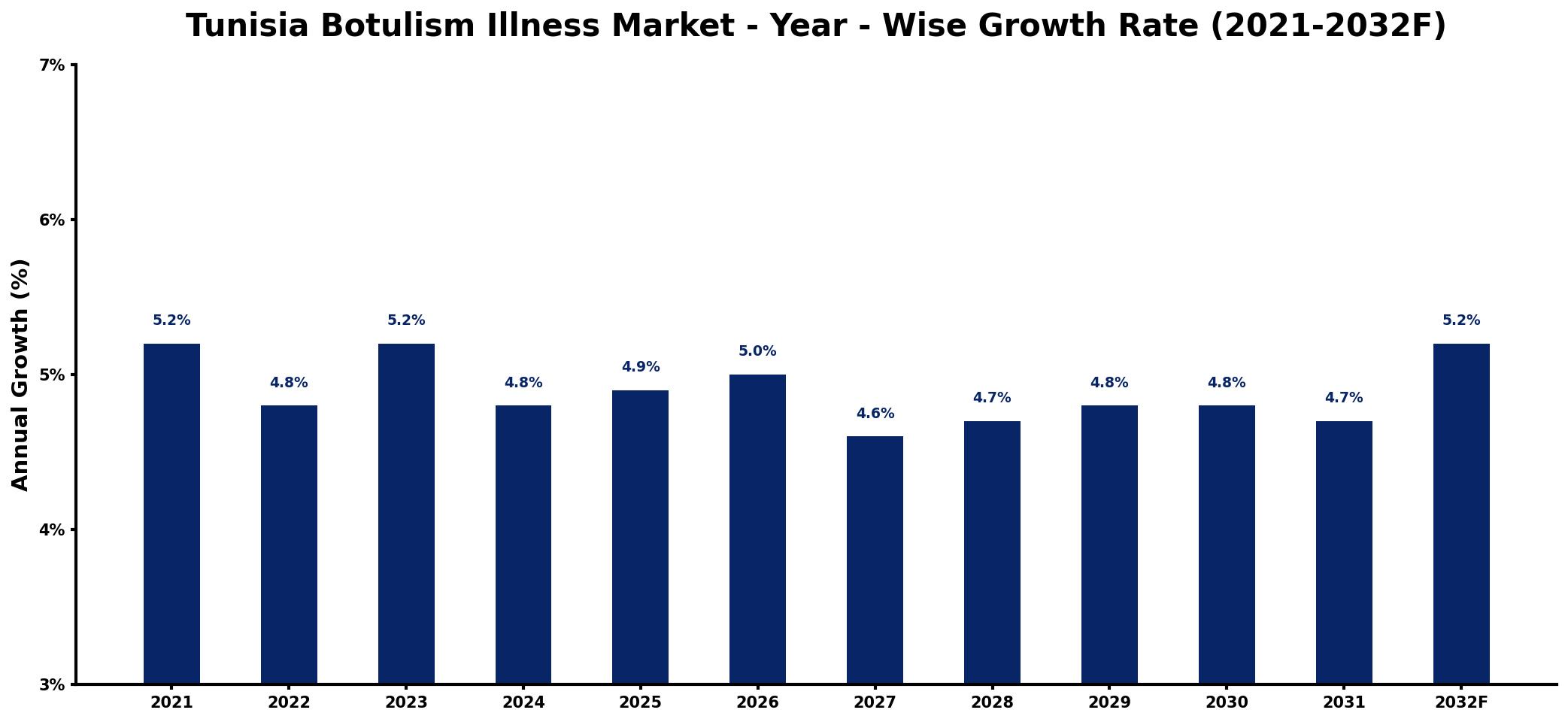
The table below presents the year‑wise growth rates along with the key drivers influencing the market
| Year | Growth Rate | Major Drivers |
| 2021 | 5.2% | Rising consumer health awareness |
| 2022 | 4.8% | Increased food safety regulations |
| 2023 | 5.2% | Growth in healthcare infrastructure |
| 2024 | 4.8% | Expansion of preventive healthcare |
| 2025 | 4.9% | Surge in nutritional supplements demand |
| 2026 | 5.0% | Investment in public health initiatives |
| 2027 | 4.6% | Focus on food quality assurance |
| 2028 | 4.7% | Emergence of new health technologies |
| 2029 | 4.8% | Strengthening of health education programs |
| 2030 | 4.8% | growing emerging market penetration |
| 2031 | 4.7% | Increase in public health campaigns |
| 2032 | 5.2% | Advancements in medical research funding |
Note: Market size estimations and growth projections presented in this report are based on 6Wresearch's proprietary forecasting methodology, utilizing the latest available industry data, government publications, and primary research inputs.
Tunisia Botulism Illness Market Synopsis
In Tunisia, the incidence of botulism remains low, yet the illness poses serious health risks that necessitate effective management strategies. With a focus on prevention and treatment, local healthcare providers are becoming increasingly proactive in addressing potential cases through education and resources.
Public health campaigns have taken center stage, emphasizing the importance of proper food safety practices to curtail the risk of contamination by Clostridium botulinum. Efforts to improve healthcare infrastructure and access to antitoxin treatments are critical components in the ongoing battle against this rare but serious illness.
Tunisia Botulism Illness Market Key Takeaways
- The market is characterized by a low incidence rate of botulism, yet remains a critical focus for healthcare providers.
- Public health initiatives are driving increased awareness and proactive food safety measures among consumers.
- Investment opportunities exist in the development of diagnostics, antitoxin treatments, and preventive resources.
- The government plays a key role in enforcing food safety regulations and education programs.
- Research and development efforts are vital for improving therapies and understanding botulism epidemiology.
Evaluation of Restraints in Tunisia Botulism Illness Market
Despite the promising landscape for the Tunisia Botulism Illness Market, several constraints hinder its full potential. One significant barrier is the limited awareness of botulism symptoms and risks within the general population, which can result in delayed diagnosis and treatment. Furthermore, healthcare facilities—especially in rural areas—may struggle with accessibility and resources, complicating timely intervention. The absence of standardized reporting systems for botulism cases further clouds the understanding of its true prevalence and impacts effective public health planning. Addressing these issues will require coordinated efforts from healthcare authorities, government entities, and community stakeholders.
Tunisia Botulism Illness Market Trends
Recent trends within the Tunisia Botulism Illness Market indicate a growing consumer shift toward food safety and hygiene. Increased scrutiny of food production practices has led to greater interest in products like home canning kits and food safety testing equipment. Additionally, the rising demand for natural and organic food products reflects a broader trend towards perceived safety, with consumers seeking options that minimize the risk of contamination. Public education campaigns are also gaining momentum, further raising awareness about safe food handling practices and the dangers posed by botulism.
Tunisia Botulism Illness Market Opportunities
The market presents various avenues for investment aimed at addressing healthcare needs related to botulism. Opportunities lie in the development of novel antitoxin treatments, advanced diagnostic tools, and research initiatives focused on preventive measures such as vaccines. Furthermore, strengthening healthcare infrastructure and enhancing educational outreach about food safety can foster community resilience against botulism. By aligning with local healthcare providers and government agencies, stakeholders can cultivate impactful investments that resonate well within the Tunisian context.
Government Initiatives in the Tunisia Botulism Illness Market
The Tunisian government is actively engaged in promoting food safety through the National Food Safety Agency (ANSV), which oversees the implementation of stringent food safety standards. By conducting regular inspections and collaborating with international organizations like the WHO and FAO, the government aims to fortify food safety protocols. Additionally, public awareness campaigns focused on educating consumers about botulism prevention strategies play a crucial role in minimizing risks associated with the illness.
Future Insights of the Tunisia Botulism Illness Market
Looking ahead to the period from 2026 to 2032, the Tunisia Botulism Illness Market is anticipated to continue its growth trajectory, propelled by heightened awareness regarding food safety. The demand for effective treatments and preventive measures will likely drive innovative research and development initiatives, bolstering healthcare systems' capacity to manage botulism cases. However, ongoing efforts to address disparities in healthcare access, particularly in rural regions, will be essential to ensure comprehensive coverage and optimal outcomes for all segments of the population.
Tunisia Botulism Illness Market Latest Developments (2025 - 2026)
In recent months, there has been a notable uptick in public health campaigns aimed at increasing awareness of botulism and its prevention methods across Tunisia. Healthcare facilities have also reported enhancing their diagnostic capabilities, leveraging new technologies to ensure quicker and more accurate identification of cases. Collaborative efforts between the government and local health organizations are focusing on establishing more robust food safety regulations, reflecting a broader commitment to safeguarding public health.
Tunisia Botulism Illness Market - Key Attractiveness of the Report
- 10 Years of Market Numbers
- Historical Data Starting from 2022 to 2025
- Base Year: 2025
- Forecast Data until 2032
- Key Performance Indicators Impacting the Market
- Major Upcoming Developments and Projects
Key Highlights of the Report:
- Tunisia Botulism Illness Market Outlook
- Market Size of Tunisia Botulism Illness Market, 2025
- Forecast of Tunisia Botulism Illness Market, 2032
- Historical Data and Forecast of Tunisia Botulism Illness Revenues & Volume for the Period 2022-2032F
- Tunisia Botulism Illness Market Trend Evolution
- Tunisia Botulism Illness Market Drivers and Challenges
- Tunisia Botulism Illness Price Trends
- Tunisia Botulism Illness Porter's Five Forces
- Tunisia Botulism Illness Industry Life Cycle
- Historical Data and Forecast of Tunisia Botulism Illness Market Revenues & Volume By Toxin Type for the Period 2022-2032F
- Historical Data and Forecast of Tunisia Botulism Illness Market Revenues & Volume By Botulinum Type A for the Period 2022-2032F
- Historical Data and Forecast of Tunisia Botulism Illness Market Revenues & Volume By Botulinum Type B for the Period 2022-2032F
- Historical Data and Forecast of Tunisia Botulism Illness Market Revenues & Volume By Treatment Type for the Period 2022-2032F
- Historical Data and Forecast of Tunisia Botulism Illness Market Revenues & Volume By Antitoxins for the Period 2022-2032F
- Historical Data and Forecast of Tunisia Botulism Illness Market Revenues & Volume By Meticulous Airway Management for the Period 2022-2032F
- Historical Data and Forecast of Tunisia Botulism Illness Market Revenues & Volume By Cathartics for the Period 2022-2032F
- Historical Data and Forecast of Tunisia Botulism Illness Market Revenues & Volume By Foley Catheter for the Period 2022-2032F
- Historical Data and Forecast of Tunisia Botulism Illness Market Revenues & Volume By Others for the Period 2022-2032F
- Historical Data and Forecast of Tunisia Botulism Illness Market Revenues & Volume By Distribution Channel for the Period 2022-2032F
- Historical Data and Forecast of Tunisia Botulism Illness Market Revenues & Volume By Retail Pharmacy for the Period 2022-2032F
- Historical Data and Forecast of Tunisia Botulism Illness Market Revenues & Volume By Online Stores for the Period 2022-2032F
- Historical Data and Forecast of Tunisia Botulism Illness Market Revenues & Volume By End-user for the Period 2022-2032F
- Historical Data and Forecast of Tunisia Botulism Illness Market Revenues & Volume By Hospitals for the Period 2022-2032F
- Historical Data and Forecast of Tunisia Botulism Illness Market Revenues & Volume By Clinics for the Period 2022-2032F
- Historical Data and Forecast of Tunisia Botulism Illness Market Revenues & Volume By Others for the Period 2022-2032F
- Tunisia Botulism Illness Import Export Trade Statistics
- Market Opportunity Assessment By Toxin Type
- Market Opportunity Assessment By Treatment Type
- Market Opportunity Assessment By Distribution Channel
- Market Opportunity Assessment By End-user
- Tunisia Botulism Illness Top Companies Market Share
- Tunisia Botulism Illness Competitive Benchmarking By Technical and Operational Parameters
- Tunisia Botulism Illness Company Profiles
- Tunisia Botulism Illness Key Strategic Recommendations
Frequently Asked Questions About the Market Study (FAQs):
The market's growth is significantly influenced by increasing public awareness of food safety, the development of better diagnostic tools, and the focus on preventive health strategies.
While the incidence remains relatively low, ongoing efforts to improve food safety and healthcare access are critical in monitoring and managing potential cases effectively.
The Tunisia Botulism Illness Market was estimated at USD 419 Million in 2025 and is projected to reach USD 558 Million by 2032, growing at a CAGR of 4.2% from 2026 to 2032.
Investors can explore opportunities in developing antitoxin treatments, enhancing diagnostic equipment, and investing in educational initiatives focused on food safety.
The Tunisian government actively promotes food safety through the National Food Safety Agency and collaborates with international bodies to enforce effective standards and regulations.
6Wresearch actively monitors the Tunisia Botulism Illness Market and publishes its comprehensive annual report, highlighting emerging trends, growth drivers, revenue analysis, and forecast outlook. Our insights help businesses to make data-backed strategic decisions with ongoing market dynamics. Our analysts track relevent industries related to the Tunisia Botulism Illness Market, allowing our clients with actionable intelligence and reliable forecasts tailored to emerging regional needs.
Yes, we provide customisation as per your requirements. To learn more, feel free to contact us on sales@6wresearch.com
1 Executive Summary |
2 Introduction |
2.1 Key Highlights of the Report |
2.2 Report Description |
2.3 Market Scope & Segmentation |
2.4 Research Methodology |
2.5 Assumptions |
3 Tunisia Botulism Illness Market Overview |
3.1 Tunisia Country Macro Economic Indicators |
3.2 Tunisia Botulism Illness Market Revenues & Volume, 2022 & 2032F |
3.3 Tunisia Botulism Illness Market - Industry Life Cycle |
3.4 Tunisia Botulism Illness Market - Porter's Five Forces |
3.5 Tunisia Botulism Illness Market Revenues & Volume Share, By Toxin Type, 2022 & 2032F |
3.6 Tunisia Botulism Illness Market Revenues & Volume Share, By Treatment Type, 2022 & 2032F |
3.7 Tunisia Botulism Illness Market Revenues & Volume Share, By Distribution Channel, 2022 & 2032F |
3.8 Tunisia Botulism Illness Market Revenues & Volume Share, By End-user, 2022 & 2032F |
4 Tunisia Botulism Illness Market Dynamics |
4.1 Impact Analysis |
4.2 Market Drivers |
4.2.1 Increasing awareness about food safety and hygiene practices |
4.2.2 Growing prevalence of botulism cases in Tunisia |
4.2.3 Implementation of stringent regulations and guidelines for food processing and storage |
4.3 Market Restraints |
4.3.1 Limited healthcare infrastructure and resources for botulism diagnosis and treatment |
4.3.2 Lack of specialized medical professionals with expertise in treating botulism |
4.3.3 Challenges in timely and accurate diagnosis of botulism cases |
5 Tunisia Botulism Illness Market Trends |
6 Tunisia Botulism Illness Market, By Types |
6.1 Tunisia Botulism Illness Market, By Toxin Type |
6.1.1 Overview and Analysis |
6.1.2 Tunisia Botulism Illness Market Revenues & Volume, By Toxin Type, 2022-2032F |
6.1.3 Tunisia Botulism Illness Market Revenues & Volume, By Botulinum Type A, 2022-2032F |
6.1.4 Tunisia Botulism Illness Market Revenues & Volume, By Botulinum Type B, 2022-2032F |
6.2 Tunisia Botulism Illness Market, By Treatment Type |
6.2.1 Overview and Analysis |
6.2.2 Tunisia Botulism Illness Market Revenues & Volume, By Antitoxins, 2022-2032F |
6.2.3 Tunisia Botulism Illness Market Revenues & Volume, By Meticulous Airway Management, 2022-2032F |
6.2.4 Tunisia Botulism Illness Market Revenues & Volume, By Cathartics, 2022-2032F |
6.2.5 Tunisia Botulism Illness Market Revenues & Volume, By Foley Catheter, 2022-2032F |
6.2.6 Tunisia Botulism Illness Market Revenues & Volume, By Others, 2022-2032F |
6.3 Tunisia Botulism Illness Market, By Distribution Channel |
6.3.1 Overview and Analysis |
6.3.2 Tunisia Botulism Illness Market Revenues & Volume, By Retail Pharmacy, 2022-2032F |
6.3.3 Tunisia Botulism Illness Market Revenues & Volume, By Online Stores, 2022-2032F |
6.4 Tunisia Botulism Illness Market, By End-user |
6.4.1 Overview and Analysis |
6.4.2 Tunisia Botulism Illness Market Revenues & Volume, By Hospitals, 2022-2032F |
6.4.3 Tunisia Botulism Illness Market Revenues & Volume, By Clinics, 2022-2032F |
6.4.4 Tunisia Botulism Illness Market Revenues & Volume, By Others, 2022-2032F |
7 Tunisia Botulism Illness Market Import-Export Trade Statistics |
7.1 Tunisia Botulism Illness Market Export to Major Countries |
7.2 Tunisia Botulism Illness Market Imports from Major Countries |
8 Tunisia Botulism Illness Market Key Performance Indicators |
8.1 Percentage increase in public awareness campaigns on food safety and botulism prevention |
8.2 Number of reported botulism cases in Tunisia |
8.3 Compliance rate of food processing and storage facilities with regulatory requirements |
8.4 Average time taken for diagnosis and treatment initiation for botulism cases |
9 Tunisia Botulism Illness Market - Opportunity Assessment |
9.1 Tunisia Botulism Illness Market Opportunity Assessment, By Toxin Type, 2022 & 2032F |
9.2 Tunisia Botulism Illness Market Opportunity Assessment, By Treatment Type, 2022 & 2032F |
9.3 Tunisia Botulism Illness Market Opportunity Assessment, By Distribution Channel, 2022 & 2032F |
9.4 Tunisia Botulism Illness Market Opportunity Assessment, By End-user, 2022 & 2032F |
10 Tunisia Botulism Illness Market - Competitive Landscape |
10.1 Tunisia Botulism Illness Market Revenue Share, By Companies, 2025 |
10.2 Tunisia Botulism Illness Market Competitive Benchmarking, By Operating and Technical Parameters |
11 Company Profiles |
12 Recommendations |
13 Disclaimer |
Global Go To Market Strategy - 2030
Export potential enables firms to identify high-growth global markets with greater confidence by combining advanced trade intelligence with a structured quantitative methodology. The framework analyzes emerging demand trends and country-level import patterns while integrating macroeconomic and trade datasets such as GDP and population forecasts, bilateral import–export flows, tariff structures, elasticity differentials between developed and developing economies, geographic distance, and import demand projections. Using weighted trade values from 2020–2024 as the base period to project country-to-country export potential for 2030, these inputs are operationalized through calculated drivers such as gravity model parameters, tariff impact factors, and projected GDP per-capita growth. Through an analysis of hidden potentials, demand hotspots, and market conditions that are most favorable to success, this method enables firms to focus on target countries, maximize returns, and global expansion with data, backed by accuracy.
By factoring in the projected importer demand gap that is currently unmet and could be potential opportunity, it identifies the potential for the Exporter (Country) among 190 countries, against the general trade analysis, which identifies the biggest importer or exporter.
To discover high-growth global markets and optimize your business strategy:
Click Here
Pricing
- Single User License$ 1,995
- Department License$ 2,400
- Site License$ 3,120
- Global License$ 3,795

Leadership Perspectives from Industry Events
Search
Thought Leadership and Analyst Meet





Our Clients








6WResearch In News
- India Export Attractiveness Tracker 2026
- India Air Conditioner Market Set for Strong Rebound in 2026 After Weather-Led Correction and GST-Driven Recovery: 6Wresearch
- ADAS in India: How Automatic Emergency Braking, Blind Spot Detection & Driver Monitoring are Transforming Road Safety
- Doha a strategic location for EV manufacturing hub: IPA Qatar
- Demand for luxury TVs surging in the GCC, says Samsung
- Empowering Growth: The Thriving Journey of Bangladesh’s Cable Industry
Latest Reports
- Qatar Access and Home Network Market (2026-2032)
- Nicaragua RPG Gaming Market (2026-2032)
- New Zealand RPG Gaming Market (2026-2032)
- Netherlands RPG Gaming Market (2026-2032)
- Nauru RPG Gaming Market (2026-2032)
- Namibia RPG Gaming Market (2026-2032)
- Mozambique RPG Gaming Market (2026-2032)
- Montenegro RPG Gaming Market (2026-2032)
- Mongolia RPG Gaming Market (2026-2032)
- Monaco RPG Gaming Market (2026-2032)
Industry Events and Analyst Meet

EV India Expo 2026

HIMTEX 2026

India Refining Summit 2026

India EV Show 2026

EV tech India Expo 2026
Whitepaper
- Middle East & Africa Commercial Security Market Click here to view more.
- Middle East & Africa Fire Safety Systems & Equipment Market Click here to view more.
- GCC Drone Market Click here to view more.
- Middle East Lighting Fixture Market Click here to view more.
- GCC Physical & Perimeter Security Market Click here to view more.


